2016 Citroen DS3 RHD topping up
[x] Cancel search: topping upPage 31 of 380

29
Warning/indicator lampis on Cause Action / Observations
Engine
autodiagnosis
system flashing.
The
engine management system has
a
fault.Risk
of destruction of the catalytic converter.
Have
it checked by a CITROËN dealer or a qualified
w
orkshop.
fixed. The
emission control system has a
f
ault.
The warning lamp should go off when the engine is started.
I f it does not go off, contact a CITROËN dealer or qualified w
orkshop without delay.
Low fuel level fixed. When it first comes on there remains a
pproximately 5 litres of fuel in the
tank. You
must refuel as soon as possible to avoid running o
ut of fuel.
This
warning lamp will come on every time the ignition is
s
witched on, until a sufficient addition of fuel is made.
Fuel
tank capacity: approximately 50 litres (petrol)
o
r 46 litres (Diesel); depending on version:
a
pproximately 30 litres (petrol or Diesel).
Never
continue to drive until you run out of fuel as
t
his could damage the emission control and injection
s
ystems.
Maximum coolant
temperature fixed.
The
t
emperature
o
f
t
he
c
ooling
s
ystem
i
s too high.Stop
as soon as it is safe to do so.
Wait
until the engine has cooled down before topping
u
p the level, if necessary.
If
the problem persists, contact a CITROËN dealer or
q
ualified
w
orkshop.
Monitoring
Page 35 of 380

33
Warning/indicator lampis on Cause Action / Observations
AdBlue
® additive
(BlueH
d i d iesel) fixed,
on switching o
n the ignition,
a
ccompanied by an
a
udible signal and a
m
essage indicating
t
he
r
emaining
d
riving
ra
nge. The
remaining driving range is b
etween 350 miles (600 km) and
1500
miles (2400 km).Have
the AdBlue® additive tank topped up as soon a
s
possible:
go
to
a CITROËN dealer or a qualified
w
orkshop,
or
carry out this operation yourself.
+ flashing
a
ssociated
w
ith
t
he
SERVICE
warning
l
amp,
accompanied
by
a
n
audible
signal
and
a
message
indicating
t
he
r
emaining
d
riving
ra
nge. The
remaining
driving
range
is
b
etween
0
and
350
miles
(600
km). You
must
top-up the
Ad
Blue
® additive tank to avoid
a
breakdown :
go
to
a
CITROËN dealer or a qualified
w
orkshop,
or
carry
out
this
operation yourself.
flashing,
associated
w
ith the SERVICE
warning
lam
p,
a
ccompanied
by
an
a
udible
signal
and
a
m
essage
indicating
t
hat
starting
is
p
revented. The
AdBlue
® tank is empty: the s
tarting
inhibition system required
b
y
legislation prevents starting of the
e
ngine. To
be able to start the engine, you must top-up the
AdBlue® additive tank: go to a CITROËN dealer or a q
ualified workshop, or carry out this operation yourself.
It is essential
to add at least 3.8 litres of AdBlue
® to
the
additive
tank.
For
topping-up
or
for
more
information
on
the
AdBlue
® additive, refer to the corresponding section.
Monitoring
Page 65 of 380

63
Do not throw the remote control batteries away, they contain metals
w
hich are harmful to the environment.
Take
them to an approved collection
po
int.Lost keys
Go to a CITROËN dealer with the vehicle's registration document, your personal identification documents and if possible the key code label.
The
CITROËN dealer will be able to look up the key code and the transponder code
r
equired to order a new key.
Remote control
The high frequency remote control is a sensitive system; do not operate it while it is in your pocket as there is a possibility that it may unlock the vehicle, without you being aware of it.
Do
not repeatedly press the buttons of your remote control out of range and out of sight of
y
our vehicle. You run the risk of stopping it from working and the remote control would have
t
o be reinitialised.
No
remote control can operate when the key is in the ignition switch, even when the ignition
i
s switched off, except for reinitialisation.
Locking the vehicle
Driving with the doors locked may make access to the passenger compartment by the emergency services more difficult in an emergency.
As
a safety precaution, never leave children alone in the vehicle, except for a very short
p
eriod.
In
all cases, it is essential to remove the key from the ignition switch when leaving the vehicle.
Anti-theft protection
Do not make any modifications to the electronic engine immobiliser system; this could cause m alfunctions.
When purchasing a second-hand vehicle
Have the pairing of all of the keys in your possession checked by a CITROËN dealer, to ensure that only your keys can be used to open and start the vehicle.
Access
Page 93 of 380
91
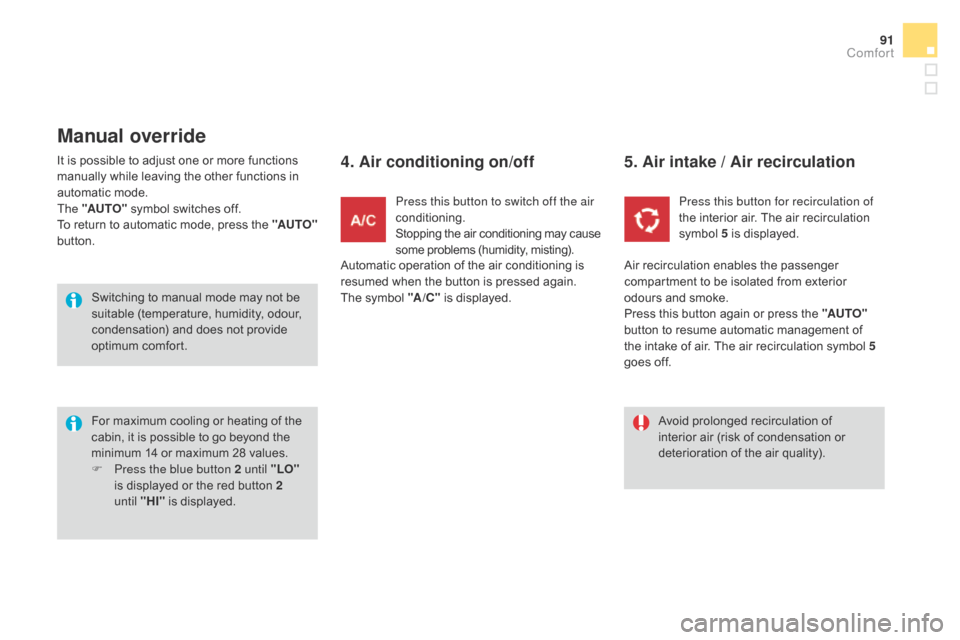
It is possible to adjust one or more functions manually while leaving the other functions in
a
utomatic mode.
The "AUTO"
symbol switches off.
To
return to automatic mode, press the "AUTO"
button.
Manual override
4. Air conditioning on/off
For maximum cooling or heating of the c abin, it is possible to go beyond the
m
inimum 14 or maximum 28 values.
F
P
ress the blue button 2 until "LO"
is
displayed or the red button 2
until
"HI"
is displayed. Press this button to switch off the air
conditioning.
Stopping
the air conditioning may cause
s
ome problems (humidity, misting).
5. Air intake / Air recirculation
Press this button for recirculation of
the
interior air. The air recirculation
s
ymbol
5
is displayed.
Avoid
prolonged recirculation of
i
nterior air (risk of condensation or
d
eterioration of the air quality).
Switching
to
manual
mode
may
not
be
s
uitable
(temperature,
humidity,
odour,
c
ondensation)
and
does
not
provide
o
ptimum
c
omfort. Automatic
operation
of
the
air
conditioning
is
r
esumed
when
the
button
is
pressed
again.
The
symbol
"A /C "
is
displayed. Air
recirculation enables the passenger
c
ompartment to be isolated from exterior
o
dours
and smoke.
Press
this
button again or press the "AUTO"
button
to
resume automatic management of
t
he
intake
of air. The air recirculation symbol 5
goes
off.
Comfort
Page 115 of 380

11 3
The gear change requests are only carried out if the engine speed permits.
It is not necessary to release the accelerator
pedal
during gear changes.
When
braking or slowing down, the gearbox
c
hanges down automatically so that the vehicle
p
icks up in the right gear.
Under
full acceleration, the change up will not
t
ake place unless the driver operates the gear
s
elector or steering mounted control paddle
(
unless the engine is close to its maximum
s
peed).
Reverse
To engage reverse, the vehicle must be immobilised with your foot on the brake.
F
Sel
ect position R .
Stopping the vehicle
Before switching off the engine:
- c hange to position n to be in neutral,
or
-
l
eave the vehicle in gear; in this case the
v
ehicle cannot be moved.
Manual mode
F Select position M.
The gears engaged appear in
s
uccession in the instrument panel.
You
can change mode at any time by
m
oving the gear selector from A to M or
the
other way round.
Never
select neutral (position n
)
when
m
oving. There
is an audible signal on
enga
gement
o
f
r
everse.For
all parking situations, you must
apply the parking brake
to immobilise
t
he vehicle.
When
immobilising the vehicle with the
e
ngine running, you must put the gear
s
elector into the neutral (position n
).
B
efore doing anything under the
b
onnet, ensure that the gear selector
i
s in neutral (position n
)
and that the
p
arking brake is applied.
At
low speed, if reverse gear is requested,
t
he n warning lamp flashes and the gearbox
g
oes into neutral automatically.
To
engage reverse, put the gear selector into
p
osition n
, t
hen to position R.
driving
Page 120 of 380

There is a risk of damage to the gearbox:
- i f you press the accelerator and
b
rake pedals at the same time,
-
i
f you force the movement of the
s
elector from the P position to
another position when the battery
is
flat.
To
reduce fuel consumption when at
a
prolonged standstill with the engine
r
unning (traffic jam...), put the selector
i
n the n position and apply the parking
b
rake.
If the selector is not in position P
,
when
the
driver's
door
is
opened
or
a
pproximately
45
seconds
after
the
i
gnition
is
switched
off,
a
warning
m
essage
appears
in
the
screen.
F
R
eturn the selector to position P ;
t
he
message
disappears.
When
driving
on
flooded
roads
or
when
c
rossing
a
ford,
proceed
at
walking
p
ace.
Operating fault
Manual operation
When the ignition is on, the lighting o
f this warning lamp, accompanied
b
y
an
audible signal and a message in the
m
ultifunction screen, indicates a gearbox fault.
In
this
case, the gearbox switches to back-up
m
ode
and
is locked in 3rd gear. You may feel
a
substantial knock when changing from P
to R
and
from n to R .
This will not cause any
d
amage
to
the gearbox.
Do
not
exceed 60 mph (100 km/h), local speed
r
estrictions
p
ermitting.
Contact
a
CITROËN dealer or a qualified
w
orkshop
as soon as possible.
F
Sel
ect position M for sequential c
hanging o
f
the
four
gears.
F
P
ush
the
selector
towards
the
+
sign
to
c
hange
up
a
gear.
F
P
ull
the
selector
towards
the
-
sign
to
c
hange
down
a
gear.
It
is
only
possible
to
change
from
one
gear
to
a
nother
if
the
vehicle
speed
and
engine
speed
p
ermit;
other wise,
the
gearbox
will
operate
t
emporarily
in
automatic
mode. This
symbol
is
displayed
if
a
gear
i
s
not
engaged
correctly
(selector
b
etween
two
positions).
d
disappears
and
the
gears
e
ngaged
appear
in
succession
in
the
in
strument
pan
el.
Stopping the vehicle
Before switching off the engine, you can engage p osition P or
n
to place the gearbox in neutral.
In
both cases, apply the parking brake to
i
mmobilise the vehicle.
Invalid value during manual
operation
If the engine speed is too low or too high, the gear selected flashes for a few seconds, then
t
he actual gear engaged is displayed.
It
is possible to change from position d
(automatic)
to position M (manual) at any time.
When
the vehicle is stationary or moving
v
ery slowly, the gearbox selects gear M1
automatically.
The
sport and snow programmes do not
o
perate in manual mode.
Page 124 of 380

To reduce fuel consumption when at a prolonged standstill with the engine
r
unning (traffic jam...), put the selector
i
n the n position and apply the parking
b
rake.
If the selector is not in position P
,
when
the
driver's
door
is
opened
or
a
pproximately
45
seconds
after
the
i
gnition
is
switched
off,
a
warning
m
essage
appears
in
the
screen.
F
R
eturn the selector to position P
;
t
he
message
disappears.
When
driving
on
flooded
roads
or
when
c
rossing
a
ford,
proceed
at
walking
p
ace. There
is a risk of damage to the gearbox:
-
i
f you press the accelerator and
b
rake pedals at the same time,
-
i
f you force the movement of the
s
elector from the P position to
another position when the battery
is flat.
F
Sel
ect position M for sequential
c
hanging
o
f
the
six
gears.
F
M
ove
the
selector
towards
the
+
sign
to
c
hange
up
a
gear.
F
M
ove
the
selector
towards
the
-
sign
to
c
hange
down
a
gear.
It
is
only
possible
to
change
from
one
gear
to
a
nother
if
the
vehicle
speed
and
engine
speed
p
ermit;
other wise,
the
gearbox
will
operate
t
emporarily
in
automatic
mode.
Manual operation
d disappears and the gears e
ngaged appear in succession in the
in
strument
pan
el.
If
the
engine speed is too low or too high, the
g
ear
selected flashes for a few seconds, then
t
he
actual
gear engaged is displayed.
It
is
possible to change from position d
(automatic)
to position M (manual) at any time.
When
the
vehicle is stationary or moving
v
ery
slowly, the gearbox engages first gear
au
tomatically.
Invalid value during manual
operation
This symbol is displayed if a gear i s not engaged correctly (selector
b
etween two positions).
Stopping the vehicle
Before switching off the engine, you can engage position P or n to place the gearbox in
neu
tral.
In
both cases, apply the parking brake to
i
mmobilise the vehicle. When
the ignition is on, the lighting
o
f this warning lamp, accompanied
Operating fault
by an audible signal and a message in the m
ultifunction screen, indicates a gearbox fault.
In
this case, the gearbox switches to back-up
m
ode and is locked in 3rd gear. You may feel
a
substantial knock when changing from P
to R
and from n to R.
This will not cause any
d
amage to the gearbox.
Do
not exceed 60 mph (100 km/h), local speed
r
estrictions
p
ermitting.
Contact
a CITROËN dealer or a qualified
w
orkshop as soon as possible.
Page 161 of 380
159
Emergency braking assistance
System which, in an emergency, enables you to obtain the optimum braking pressure more
q
uickly, thus reducing the stopping distance.
Activation
It is triggered by the speed at which the brake pedal is pressed.
The
effect of this is a reduction in the
r
esistance of the pedal and an increase in
b
raking
e
fficiency.
When
braking in an emergency, press
f
irmly without releasing the pressure.
Trajectory control systems
Anti-slip regulation (ASR)
and dynamic stability
control (
d
SC)
The anti-slip regulation (also known as traction control) optimises traction to prevent skidding
o
f the wheels, by acting on the brakes of the
d
riving wheels and on the engine.
The electronic stability control acts on the
brake
of one or more wheels and on the engine
t
o keep the vehicle on the trajectory required
b
y the driver, within the limits of the laws of
p
hysics.Activation
These systems are activated automatically each time the vehicle is started.
They
come into operation in the event of a grip
o
r
t
rajectory
pro
blem.
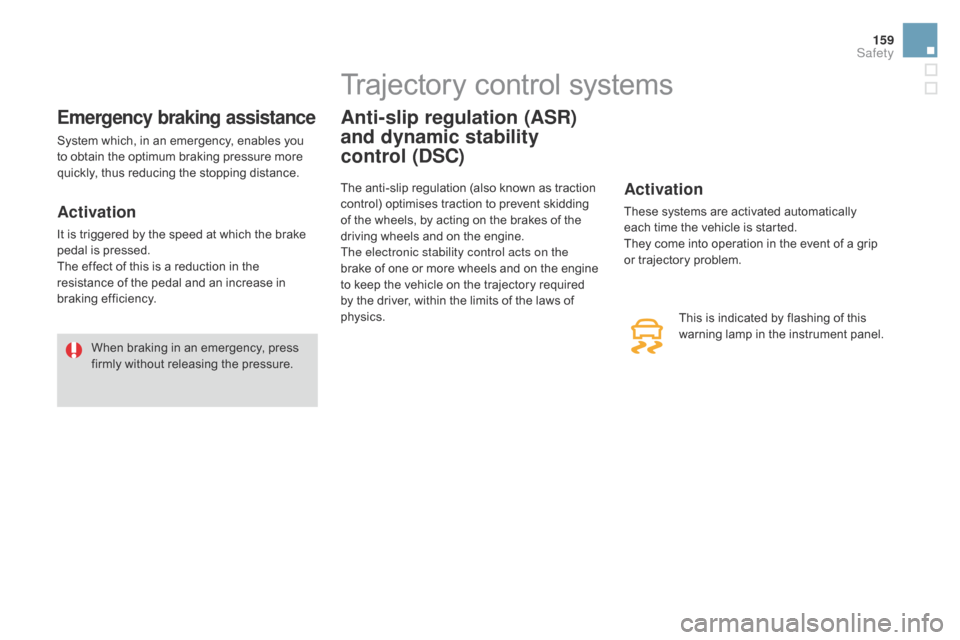
This
is indicated by flashing of this
w
arning lamp in the instrument panel.
Safety