2016 Citroen DS3 RHD service
[x] Cancel search: servicePage 201 of 380

199
In the event of a fault with the SCR emissions control system
If it is a temporary fault, the alert disappears during the next journey,
a
fter self-diagnosis of the SCR system.
A
system that prevents engine starting is activated automatically from 650 miles (1 100 km) after confirmation of a fault with the SCR emissions
c
ontrol system. Have the system checked by a CITROËN dealer or a qualified workshop as soon as possible.
In the event of the detection of a fault
du
ring an authorised driving phase (between
650 miles and 0 miles) (1 100 km and 0 km)
The
UREA, SERVICE and diagnostic warning
l
amps
comes on, accompanied by an audible
s
ignal
and the display of the message
"
Emissions
f
ault".
The
alert is triggered when driving when the
f
ault
is detected for the first time, then when
s
witching on the ignition for subsequent
j
ourneys, while the fault persists. If a fault with the SCR system is confirmed (after
3
0 miles (50 km) covered with the permanent
d
isplay of the message signalling a fault), the
S
ERVICE and engine diagnostic warning lamps
c
ome on and the UREA warning lamp flashes,
a
ccompanied by an audible signal and the
d
isplay of a message (e.g.: "Emissions fault:
S
tarting prevented in 150 miles") indicating the
r
emaining range express in miles or kilometres.
While driving, the message is displayed every
3
0 seconds while the fault with the SCR system
p
ersists.
The alert is repeated when switching on the ig
nition.
You
should go to a CITROËN dealer or a
q
ualified workshop as soon as possible.
Other wise, you will not be able to restart your
engine. You
have exceeded the authorised
d
riving limit: the starting prevention
s
ystem inhibits engine starting.
Every
time the ignition is switched on, the SERVICE a
nd engine diagnostic warning lamps come on and t
he UREA warning lamp flashes, accompanied by
a
n audible signal and the display of the message
"
Emissions fault: Starting prevented".
Starting prevented
To
be able to start the engine, you must call on
a
CITROËN dealer or a qualified workshop.
Practical information
Page 202 of 380
Freezing of the AdBlue® additiveKeep AdBlue
® out of the reach of
children,
in
its
original bottle.
Never
transfer AdBlue
® to another
container:
it
would
lose
its purity. Never
dilute the additive with water.
Never pour the additive into the Diesel
f
uel tank.
Never top-up from an AdBlue®
dispenser
reserved
for
heavy
goods
v
ehicles.
Filling
the
AdBlue
® tank is an operation i
ncluded
in
every
routine service on your
v
ehicle
by
a
CITROËN dealer or a qualified
w
orkshop.
Nevertheless,
given the capacity of the tank,
i
t
may
be
necessary to top-up the additive
b
etween
services,
more particularly if an alert
(
warning
lamps
and a message) signals the
r
equirement.
You
can
got
to
a
CITROËN dealer or a qualified
w
orkshop.
If
you
envisage
topping-up yourself, please
r
ead
the
following
warnings carefully.
Topping-up the AdBlue® additive
Precautions in use
Use only AdBlue® additive that meets the I
SO 22241
standard.
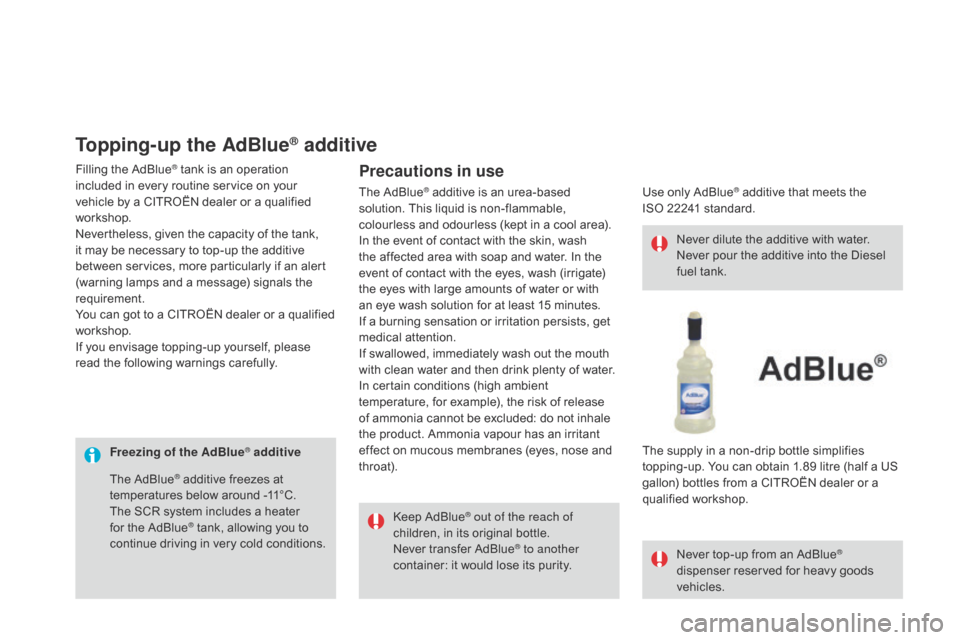
The
supply
in
a
non-drip bottle simplifies
t
opping-up.
You
can obtain 1.89 litre (half a US
g
allon)
bottles
from a CITROËN dealer or a
q
ualified
w
orkshop.
The
AdBlue® additive is an urea-based s
olution.
This liquid is non-flammable,
c
olourless
and odourless (kept in a cool area).
In
the
event
of contact with the skin, wash
t
he
affected
area with soap and water. In the
e
vent
of
contact with the eyes, wash (irrigate)
t
he
eyes
with large amounts of water or with
a
n
eye
wash
solution for at least 15 minutes.
I
f
a
burning
sensation or irritation persists, get
m
edical
attention.
If
swallowed, immediately wash out the mouth
w
ith
clean
water and then drink plenty of water.
In
certain
conditions (high ambient
t
emperature,
for example), the risk of release
o
f
ammonia
cannot be excluded: do not inhale
t
he
product.
Ammonia vapour has an irritant
e
ffect
on
mucous membranes (eyes, nose and
t
hroat).
The
AdBlue
® additive freezes at t
emperatures below around -11°C.
The
SCR
system includes a heater
f
or
the
AdBlue
® tank, allowing you to c
ontinue
driving in very cold conditions.
Page 235 of 380

233
If you envisage charging your vehicle's battery yourself, use only a charger
c
ompatible with lead-acid batteries of a
n
ominal voltage of 12 V.
If this label is present, it is essential
to
use only a 12 V charger, to avoid
c
ausing irreversible damage to the
e
lectrical components related to the
S
top & Start system. Follow
the instructions for use provided
b
y the manufacturer of the charger.
Never reverse polarities.
Charging the battery using
a battery charger
For optimum service life of the battery, it is e
ssential to maintain an adequate state of
c
harge.
In
some circumstances it may be necessary to
c
harge the battery:
-
i
f you use your vehicle essentially for short
j
ourneys,
-
i
f the vehicle is to be taken off the road for
s
everal weeks.
Contact
a CITROËN dealer or a qualified
w
orkshop. It
is not necessary to disconnect the
b
attery.
F
S
witch off the ignition.
F
S
witch off all electrical consumers (audio
s
ystem, lighting, wipers, ...).
F
S
witch off the charger B before connecting
t
he cables to the battery, so as to avoid any
d
angerous
spar
ks.
F
E
nsure that the charger cables are in good
c
ondition.
F
C
onnect the charger B cables as follows:
-
t
he positive (+) red cable to the (+)
t
erminal of the battery A,
-
t
he negative (-) black cable to the earth
p
oint C on the vehicle.
F
A
t the end of the charging operation, switch
o
ff the charger B before disconnecting the
c
ables from the battery A. Never
try to charge a frozen battery.
If the battery has been frozen, have
it
checked by a CITROËN dealer or
a
qualified workshop, who will check
t
hat the internal components have not
b
een damaged and the casing is not
c
racked, which could cause a leak of
t
oxic and corrosive acid.
Practical information
Page 236 of 380

disconnecting the battery
In order to maintain an adequate state of charge for starting the engine, it is
r
ecommended that the battery be disconnected
i
f the vehicle is taken out of service for a long
p
eriod.
Wait
2 minutes after switching off the ignition
b
efore disconnecting the battery:
F
c
lose all openings (doors, boot, windows,
r
oof (for Cabrio versions)),
F
s
witch off all electrical consumers (audio
s
ystem, wipers, lighting, ...),
F
s
witch off the ignition and wait for
f
our minutes.
Having
exposed the battery, it is only
n
ecessary to disconnect the (+) terminal.
Following reconnection of the
battery
After reconnecting the battery, switch on the ignition and wait 1 minute before starting to
a
llow initialisation of the electronic systems.
However,
if minor problems persist following
t
his operation, contact a CITROËN dealer or a
q
ualified
w
orkshop.
Referring
to the corresponding section, you
m
ust yourself reinitialise or reset certain
s
ystems, such as:
-
t
he remote control,
-
t
he electric windows,
-
t
he date and time,
-
t
he radio preset stations.
Quick release terminal
di
sconnecting the (+) terminal
F Raise the lever A fully to release the clamp B.
Reconnecting the (+) terminal
F Position the open clamp B of the cable on
the positive post (+) of the battery.
F
P
ress down on the clamp to position it
c
orrectly on the battery post.
F
L
ock the clamp by lowering the lever A. The
Stop & Start system may not be
o
perational during the trip following the
f
irst engine start.
In
this case, the system will only be
a
vailable again after a continuous
p
eriod of immobilisation of the vehicle,
a
period which depends on the ambient
t
emperature and the state of charge of
t
he battery (up to about 8 hours).
Do
not force the lever as locking
w
ill not be possible if the clamp is
n
ot positioned correctly; start the
p
rocedure again.
Page 239 of 380

237
Towing the vehicleProcedure for having your vehicle towed or for towing another vehicle using a removable towing eye.
T he towing eye is installed in the boot under
t
he floor.
To
gain access to it:
F
o
pen the boot,
F
r
aise the floor,
F
r
emove the polystyrene storage box,
F
r
emove the towing eye from the holder.
Access to the tools
ge
neral recommendations
Observe the legislation in force in your country.
E nsure that the weight of the towing vehicle is higher than that of the towed vehicle.
The
driver must remain at the wheel of the towed vehicle and must have a valid driving licence.
When
towing a vehicle with all four wheels on the ground, always use an approved towing
a
rm; rope and straps are prohibited.
The
towing vehicle must move off gently.
When
towing a vehicle with the engine off, there is no longer any power assistance for
b
raking or steering.
In
the following cases, you must always call on a professional recovery service:
-
v
ehicle broken down on a motor way or fast road,
-
f
our-wheel drive vehicle,
-
w
hen it is not possible to put the gearbox into neutral, unlock the steering, or release
t
he parking brake,
-
t
owing with only two wheels on the ground,
-
w
here there is no approved towing arm available...
Practical information
Page 254 of 380
Checking levels
Check all of these levels regularly, in line with the manufacturer's service schedule. Top them up if necessary, unless other wise indicated.
I f a level drops significantly, have the corresponding system checked by a CITROËN dealer or a qualified workshop.
Engine oil level
It is normal to top up the oil level between two services (or oil changes). CITROËN
r
ecommends that you check the level, and top
u
p if necessary, every 3 000 miles (5 000 kms).
The
check is carried out either when
t
he ignition is switched on using the
o
il level indicator in the instrument
p
anel for vehicles so equipped, or
u
sing the dipstick.
To ensure that the reading is correct,
y
our vehicle must be parked on a level
s
ur face with the engine having been off
f
or more than 30 minutes.
Take care when working under the
b
onnet, as certain areas of the engine
m
ay be extremely hot (risk of burns)
a
nd the cooling fan could start at any
t
ime (even with the ignition off).
Checking using the dipstick
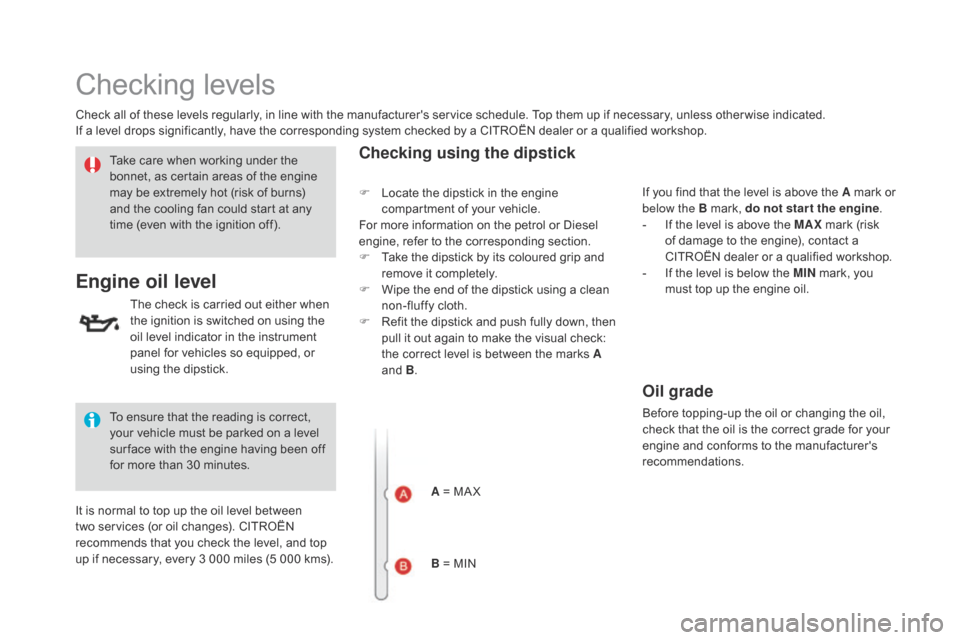
A = MA X
B = MIN If
you find that the level is above the A mark or
belo
w the B mark, do not star t the engine
.
-
I
f the level is above the MAX
mark (risk
o
f damage to the engine), contact a
C
ITROËN dealer or a qualified workshop.
-
I
f the level is below the MI n
mark, you
m
ust top up the engine oil.
F
L
ocate
the dipstick in the engine
c
ompartment of your vehicle.
For
more
information on the petrol or Diesel
e
ngine,
refer
to the corresponding section.
F
T
ake
the
dipstick by its coloured grip and
r
emove
it completely.
F
W
ipe
the
end of the dipstick using a clean
n
on-fluffy cloth.
F
R
efit
the
dipstick and push fully down, then
p
ull
it
out again to make the visual check:
t
he
correct level is between the marks A
and
B
.
Oil grade
Before topping-up the oil or changing the oil, c
heck that the oil is the correct grade for your
e
ngine and conforms to the manufacturer's
r
ecommendations.
Page 255 of 380

253
Brake fluid level
Changing the fluid
Refer to the manufacturer's service schedule for details of the interval for this operation.
Fluid specification
The brake fluid must conform to the manufacturer's r ecommendations.
The
brake fluid level should be close
t
o the "MA X" mark. If it is not, check
t
he brake pad wear.
After
topping-up
the
oil,
the
check
when
s
witching
on
the
ignition
with
the
oil
level
i
ndicator
in
the
instrument
panel
is
not
valid
d
uring
the
30
minutes
after
topping
up.
Topping-up the engine oil level
F Locate the oil filler cap in the engine c
ompartment of your vehicle.
For
more information on the petrol or Diesel
e
ngine, refer to the corresponding section.
F
U
nscrew the oil filler cap to reveal the filler
aperture.
F
A
dd oil in small quantities, avoiding any
s
pills on engine components (risk of fire).
F
W
ait a few minutes before checking the
l
evel again using the dipstick.
F
A
dd more oil if necessary.
F
A
fter checking the level, carefully refit the
o
il filler cap and the dipstick in its tube.
Engine oil change
Refer to the manufacturer's service schedule for details of the interval for this operation.
In
order to maintain the reliability of the engine
a
nd emission control system, never use
a
dditives in the engine oil.
Checks
Page 258 of 380

Checks
12 V batteryAir filter and passenger compartment filter
Oil filterParticle filter (
di
esel)
Unless other wise indicated, check these components in accordance with the manufacturer's service schedule and according to your engine.
O ther wise, have them checked by a CITROËN dealer or a qualified workshop.
The battery does not require any maintenance.However, check regularly that the terminals are correctly tightened and
t
hat the connections are clean. Refer
to the manufacturer's s
ervice schedule for details of the r
eplacement intervals for these
c
omponents.
Replace
the oil filter each time the
e
ngine oil is changed.
Refer
to the manufacturer's
s
ervice schedule for details of
t
he replacement interval for this
c
omponent.
Versions
equipped with Stop & Start
a
re fitted with a 12 V lead-acid
b
attery of specific technology and
s
pecification.
Its
replacement should be carried
o
ut only by a CITROËN dealer or a
q
ualified
w
orkshop. The start of saturation of the
particle
filter is indicated by the
O
n a new vehicle, the first particle
filter
regeneration operations may be
a
ccompanied by a "burning" smell,
w
hich is per fectly normal.
Following
prolonged operation of the
v
ehicle at very low speed or at idle,
y
ou may, in exceptional circumstances,
n
otice the emission of water vapour at
t
he exhaust on acceleration. This does
n
ot affect the behaviour of the vehicle
or
the environment.
When
carrying out any operation on the 12 V
b
attery,
refer to the corresponding section for
d
etails
of
the precautions to be taken before
s
tarting
work. Depending
on the environment (e.g. dusty
a
tmosphere) and the use of the vehicle (e.g.
c
ity driving), replace them twice as often if
necessary .
A
clogged passenger compartment filter may
h
ave an adverse effect on the per formance
o
f the air conditioning system and generate
u
ndesirable
o
dours.temporary
illumination of this warning lamp
a
ccompanied by a message in the multifunction
sc
reen.
As
soon as the traffic conditions permit,
r
egenerate the filter by driving at a speed of at
l
east 40 mph (60 km/h) until the warning lamp
g
oes off.
If
the warning lamp stays on, this indicates a
l
ow additive level.
For
more information on checking levels, refer
t
o the corresponding section.