2016 Citroen C4 CACTUS fuel
[x] Cancel search: fuelPage 38 of 308
36
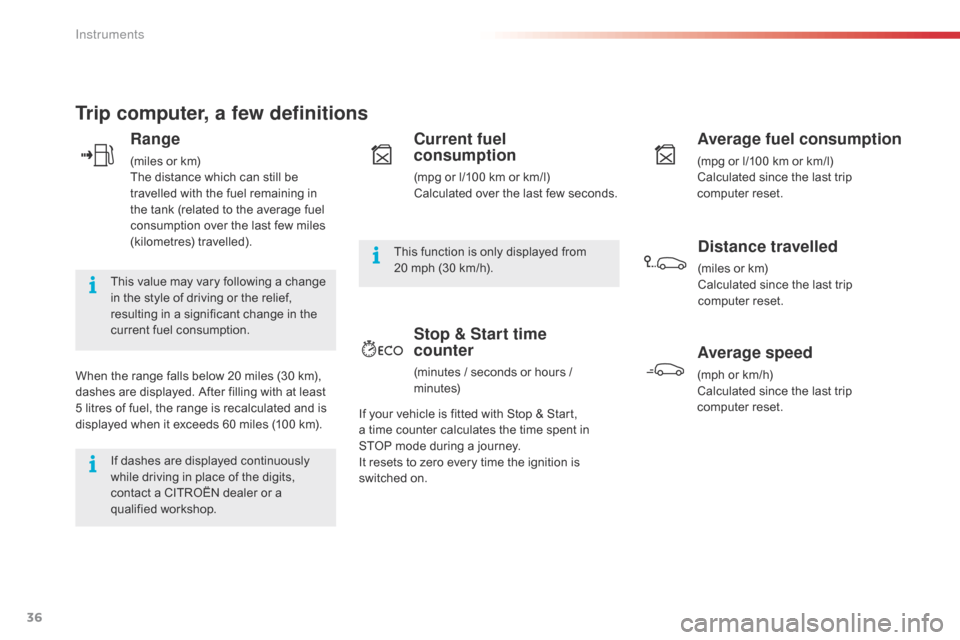
Trip computer, a few definitions
Range
(miles or km)
T he distance which can still be
t
ravelled with the fuel remaining in
t
he tank (related to the average fuel
c
onsumption over the last few miles
(
kilometres)
t
ravelled).
This
value may vary following a change
i
n
the style of driving or the relief,
r
esulting in a significant change in the
c
urrent fuel consumption.
When
the
range falls below 20 miles (30 km),
d
ashes
are displayed. After filling with at least
5
litres
of
fuel, the range is recalculated and is
d
isplayed
when it exceeds 60 miles (100 km).
If
dashes are displayed continuously
w
hile driving in place of the digits,
c
ontact a CITROËN dealer or a
q
ualified
w
orkshop. This
function is only displayed from
20
mph (30 km/h).
Current fuel
consumption
(mpg or l/100 km or km/l)
C alculated over the last few seconds.
Average fuel consumption
(mpg or l/100 km or km/l)
C alculated since the last trip
c
omputer
re
set.
Distance travelled
(miles or km)
C alculated since the last trip
c
omputer
re
set.
Average speed
(mph or km/h)
C alculated since the last trip
c
omputer
re
set.
Stop & Start time
counter
(minutes / seconds or hours / minutes)
If
your
vehicle is fitted with Stop & Start,
a t
ime
counter calculates the time spent in
S
TOP mode during a journey.
It
resets
to zero every time the ignition is
s
witched
on.
Instruments
Page 69 of 308

67
Rear screen demist - Defrost
Switching on Switching off
F Press
this button to demist /
defrost the rear screen and
(
depending on version) the door
m
irrors. The indicator lamp in the
b
utton comes on.
The demisting/defrosting switches off automatically to prevent an excessive consumption of current.
The rear screen demist - defrost can only operate when the engine is
r
unning.
Switch
off the heating of the rear screen
a
nd door mirrors as soon as you judge it
p
ossible, as reducing the consumption
o
f electrical current reduces fuel
c
onsumption. F
I
t is possible to stop the
demisting/defrosting
o
peration
b
efore it is switched off
a
utomatically by pressing this
b
utton again. The indicator lamp
i
n the button goes off.
3
Ease of use and comfort
Page 98 of 308

96
Driving advice
Your vehicle is designed principally to drive on tarmac roads but it allows you
t
o drive on other less passable terrain
o
ccasionally.
However,
it does not permit off-road
d
riving such as:
-
c
rossing and driving on terrain
w
hich could damage the underbody
o
r strip away components (fuel
p
ipe, fuel cooler...) due to obstacles
o
r stones in particular,
-
d
riving on terrain with steep
g
radients and poor grip,
-
c
rossing a stream.All terrain (mud, damp grass, ...)
This mode, when moving off, allows considerable spin on the wheel with the least
g
rip to optimise clearing of the mud and regain
g
rip. At the same time, the wheel with the most
g
rip is controlled in such a way as to pass as
m
uch torque as possible.
When
moving, the system optimises wheel spin
t
o respond to the driver's requirements as fully
a
s possible.
(mode
active up to 50 mph (80 km/h))
F
P
lace the dial in this position.
Sand
This mode allows little spin on the two driving wheels at the same time to allow the vehicle to
m
ove for ward and limit the risks of getting stuck
i
n the sand.
(mode
active up to 75 mph (120 km/h))
F
P
lace the dial in this position.
Do
not use the other modes on sand as the
v
ehicle may become stuck. You
can deactivate certain functions of the
ES
C (ASR and DSC) by turning the dial to the
"
O
FF
" position.
These functions are reactivated automatically
f
rom 30 mph (50 km/h) or every time the
i
gnition is switched back on.
Safety
Page 129 of 308

127
Operation
Gear efficiency indicator
System which reduces fuel consumption by advising the driver to change up, on vehicles fitted with a manual gearbox.
T he system adapts its gear change
r
ecommendation according to the
d
riving conditions (slope, load, ...) and
t
he demands of the driver (power,
a
cceleration, braking, ...).
The
system never suggests:
-
e
ngaging first gear,
-
enga
ging
r
everse
g
ear,
-
e
ngaging a lower gear.
Example:
-
Y
ou are in third gear.
Depending
on the driving situation and your
v
ehicle's equipment, the system may advise
y
ou to skip one (or more) gear(s). You can
f
ollow this instruction without engaging the
i
ntermediate
g
ears.
-
Y
ou press the accelerator pedal.
-
T
he system may suggest that you engage
a
higher gear.
The
information appears in the instrument
p
anel in the form of an arrow, accompanied by
t
he recommended gear.
On
certain Diesel versions with manual
g
earbox, the system may suggest
c
hanging into neutral (N
is displayed in
t
he instrument panel) so that the engine
c
an go into standby (STOP mode
w
ith Stop & Start), in certain driving
c
onditions.
The
gear engagement recommendations must
n
ot be considered compulsory. In fact, the
c
onfiguration of the road, the amount of traffic
a
nd safety remain determining factors when
c
hoosing the best gear. Therefore, the driver
r
emains responsible for deciding whether or not
t
o follow the advice given by the system.
This
system cannot be deactivated.
6
Driving
Page 132 of 308

130
Never select neutral (position N) when
moving.
Forward drive
F Press control D . T
he indicator lamp in the control comes on.
D
and the gear engaged appear in
t
he instrument panel.
The
gearbox then operates in auto-adaptive
m
ode, without any action on the part of the
d
river. It continuously selects the most suitable
g
ear taking account of:
-
o
ptimisation of fuel consumption,
-
d
riving style,
-
r
oad conditions,
-
v
ehicle load.
For
optimum acceleration, when
ov
ertaking another vehicle for example,
p
ress the accelerator pedal fully down,
b
eyond the point of resistance.
Temporary control of gear
changing
You can temporarily take over control of gear changes using the steering mounted "+" and "-"
control
paddles: if the engine speed allows, the
g
ear change is carried out.
This function allows you to anticipate certain
situations
s
uch
a
s
ov
ertaking
a
nother
v
ehicle
o
r
a
pproaching a bend.
After
a few moments without any action on the
p
addles, the gearbox resumes control of gear
c
hanging
a
utomatically. To
engage reverse, the vehicle must be
i
mmobilised with your foot on the brake.
F
P
ress control R
.
T
he indicator lamp in the control comes on.
Reverse
There is an audible signal on enga
gement o f r everse.
If
reverse gear is requested when moving,
t
he
N
warning lamp flashes and the gearbox
g
oes
into neutral automatically.
To
engage reverse, stop the vehicle then, with
y
our
foot on the brake pedal, press control N,
then R .
Do
not
press
the
brake
and
accelerator
p
edals
at
the
same
time:
this
could
c
ause
very
rapid
wear
of
the
clutch.
Driving
Page 135 of 308

133
Stop & Start
Operation
Going into engine STOP
mode
The "ECO" warning lamp comes on i
n the instrument panel and the engine g
oes into standby automatically:
-
w
ith a manual gearbox , when stationary,
in
neutral, and you release the clutch
ped
al.
-
w
ith an electronic gearbox , when
stationary
or at speeds below 5 mph
(
8 km/h) (depending on version), in neutral
(
control on N )
or when you press the brake
ped
al. Never
refuel with the engine in STOP
m
ode; you must switch off the ignition.
For
your comfort, during parking
m
anoeuvres, STOP mode is not
a
vailable for a few seconds after
c
oming out of reverse gear.
The
Stop & Start system does not affect
t
he the vehicle's other systems, such as
f
or example braking, power steering...
The
Stop
&
Start system
puts
the
engine
t
emporarily
into
standby
-
STOP
mode
-
during
s
tops
in
the
traffic
(red
lights,
traffic
jams,
or
o
ther...).
The
engine
restarts
automatically
-
S
TART
mode
-
as
soon
as
you
want
to
move
o
ff.
The
restart
takes
place
instantly,
quickly
a
nd
silently.
Per fect
for
urban
use,
the
Stop
&
Start
system
r
educes
fuel
consumption
and
exhaust
e
missions
as
well
as
the
noise
level
when
s
tationary.
Stop & Start time
counter
A cumulative time counter for periods i n STOP mode during a journey.
It
is
displayed in the trip computer (accessible
v
ia the " Driving assistance "
menu of the
t
ouch
screen tablet).
It
resets
to zero every time the ignition is
s
witched
on.
The
Stop
&
Start
system
requires
t
he
use
of
a
12
V
battery
of
special
t
echnology
and
specification.
All
w
ork
on
this
type
of
battery
must
o
nly
be
done
by
a
CITROËN
dealer
o
r
a
qualified
workshop.
For
more
i
nformation
on
the
12
V
battery,
refer
to
t
he
corresponding
section.
6
Driving
Page 153 of 308

151
Under-inflation detection
The system monitors the pressures in the four t
yres, once the vehicle is moving.
It
compares the information given by the four
w
heel speed sensors with reference values,
which must be reinitialised ever y time the
tyre pressures are adjusted or a wheel
changed .
The
system triggers an alert as soon as it
d
etects a drop in the inflation pressure of one
o
r more tyres. The
under-inflation detection system
d
oes not replace the need for vigilance
o
n the part of the driver.
This
system does not avoid the need to
c
heck the tyre pressures (including the
s
pare wheel) every month as well as
b
efore a long journey.
Driving
with under-inflated tyres impairs
r
oad holding, extends braking distances
a
nd causes premature tyre wear,
p
articularly under arduous condition
(
high loading, high speed, long journey).
System
which automatically checks the pressures of the tyres while driving.
The inflation pressures defined for
y
our vehicle can be found on the tyre
p
ressure label.
For
more information on the
i
dentification markings, refer to the
c
orresponding
s
ection.
Tyre
pressures should be checked
w
hen the tyres are "cold" (vehicle
s
topped for 1 hour or after a journey of
l
ess than 6 miles (10 km) at moderate
s
peeds).
Other wise
(when hot), add 0.3 bar to
t
he pressures shown on the label.
Driving
with under-inflated tyres
i
ncreases fuel consumption.
6
Driving
Page 156 of 308

154
Fuel tank
Capacity of the tank:
- Pe trol: approximately 50 litres.
-
D
iesel: approximately 45 or 50 litres (depending on version).
Low fuel levelRefuelling
When the low fuel level is reached, t
his warning lamp in the instrument
p
anel comes on, accompanied by
a
n audible warning, a message and
t
he last bar of the fuel gauge flashes
i
n red.
To
refuel in complete safety:
F
Y
ou must switch off the engine.
F
O
pen the filler flap.
A
label on the inside of the fuel filler flap r
eminds you of the type of fuel to use,
d
epending on your engine type.
Additions
of fuel must be of at least 5 litres to
b
e registered by the fuel gauge.
When
it
first comes on, about 5 litres of fuel
remain
in
the tank.
Until
sufficient fuel has been added, this
w
arning
lamp appears every time the ignition
i
s
switched on, accompanied by an audible
w
arning
and a message. This audible warning
a
nd
message are repeated with increasing
f
requency
as the fuel level drops towards "0 ".
Refuel
as
soon as possible to avoid running out.Opening
the filler cap may result in an inrush of
a
ir. This is entirely normal and results from the
s
ealing of the fuel system.
With Stop & Start, never refuel with the
system
in STOP mode; you must switch
o
ff the ignition with the key.
For
more information on running out of
f
uel (Diesel), refer to the corresponding
s
ection. F
T
ake care to select the pump that delivers
t
he correct type of fuel for your vehicle.
F
I
ntroduce the key into the cap and turn it to
t
he left.
Practical information