2016 CITROEN C-ELYSÉE Care
[x] Cancel search: CarePage 5 of 260

.
.
C-elysee_en_Chap00a_sommaire_ed01-2016
Direction indicators 100
Hazard warning lamps
1
00
Horn
10
0
Under-inflation
d
etection
1
01
Braking
assistance systems
1
05
Trajectory
control systems
1
06
Front
seat belts
1
07
Airbags
1
10
Safety
Child seats 1 14
Deactivating the passenger's front airbag
1
17
ISOFIX
mountings
1
23
Child
lock
1
28
Child safety
Fuel tank 129
Misfuel prevention (Diesel)
1
30
Running
out of fuel (Diesel)
1
32
AdBlue
® additive and SCR system
(
BlueHDi Diesel) 1 33
Temporary
puncture repair kit
1
40
Spare
wheel
1
45
Snow
chains
1
52
Changing
a bulb
1
53
Changing
a fuse
1
59
12
V
battery
1
64
Electrical
energy economy mode
1
68
Changing
a wiper blade
1
69
Towing
the vehicle
1
70
Towing
a trailer
1
72
Very
cold climate screen(s)
1
74
Advice
on care and maintenance
1
75
Accessories
1
75
M at s
17
7
Roof
bars
1
78
Practical information
Petrol engines 1 88
Petrol weights
1
89
Diesel
engines
1
90
Diesel
weights
1
91
Dimensions
1
92
Identification
ma
rkings
1
93
Technical data
Audio system / Bluetooth 1 95
Audio system
2
27
Audio and telematics
Visual search
Alphabetical
in
dex
Checks
Bonnet 18
0
Petrol engines
1
81
Diesel
engine
1
82
Checking
levels
1
83
Checks
18
6
Contents
Page 20 of 260

18
Warning / indicator lampStateCause Action / Observations
Dynamic
stability control
(ESP/ASR) flashing.
The
ESP/ASR regulation is active. The system optimises traction and improves the
d
irectional stability of the vehicle.
fixed. Unless
it has been deactivated
(
button pressed and its indicator lamp
o
n) the ESP/ASR system has a fault.Have
it checked by a CITROËN dealer or a qualified
w
orkshop.
Engine
autodiagnosis
system fixed.
The
emission control system has a
f
ault.
The warning lamp should go off when the engine is started.
I f it does not go off, contact a CITROËN dealer or qualified w
orkshop without delay.
flashing. The engine management system has a
fault. Risk
of destruction of the catalytic converter.
Have it checked by a CITROËN dealer or a qualified
w
orkshop.
Anti-lock
Braking System
(ABS)
fixed.
The anti-lock braking system has a
f
ault.
The vehicle retains conventional braking.
Drive carefully at reduced speed and contact a
C
ITROËN dealer or a qualified workshop without
d
e l ay.
Engine fault fixed,
o
range. The
engine has a minor fault. Contact a CITROËN dealer or a qualified workshop as
s
oon as possible.
fixed,
red. The
engine has a major fault causing
a
breakdown. You
must stop as soon as it is safe to do so.
Park,
switch off the ignition and contact a CITROËN
d
ealer or qualified workshop.
Monitoring
Page 22 of 260

20
Warning / indicator lampStateCause Action / Observations
Airbags on
temporarily. This lamp comes on for a few
s
econds when you turn on the
i
gnition, then goes off.This
lamp should go off when the engine is started.
If
it does not go off, contact a CITROËN dealer or a
q
ualified
w
orkshop.
fixed. One
of the airbag or seat belt
p
retensioner systems has a fault.Have
it checked by a CITROËN dealer or a qualified
w
orkshop.
Power steering fixed. The
power steering has a fault. Drive carefully at reduced speed.
Have
it checked by a CITROËN dealer or a qualified
w
orkshop.
Driver's seat
belt not fastened
or unfastened
/
Front
passenger's seat
belt unfastened fixed
or flashing
a
ccompanied by an
inc
reasing
a
udible
s
ignal.The
driver has not fastened or has
u
nfastened their seat belt.
The
front passenger has unfastened
t
heir seat belt.Pull
the strap then insert the tongue in the buckle.
Monitoring
Page 47 of 260
45
C-elysee_en_Chap03_confort_ed01-2016
Rear seats
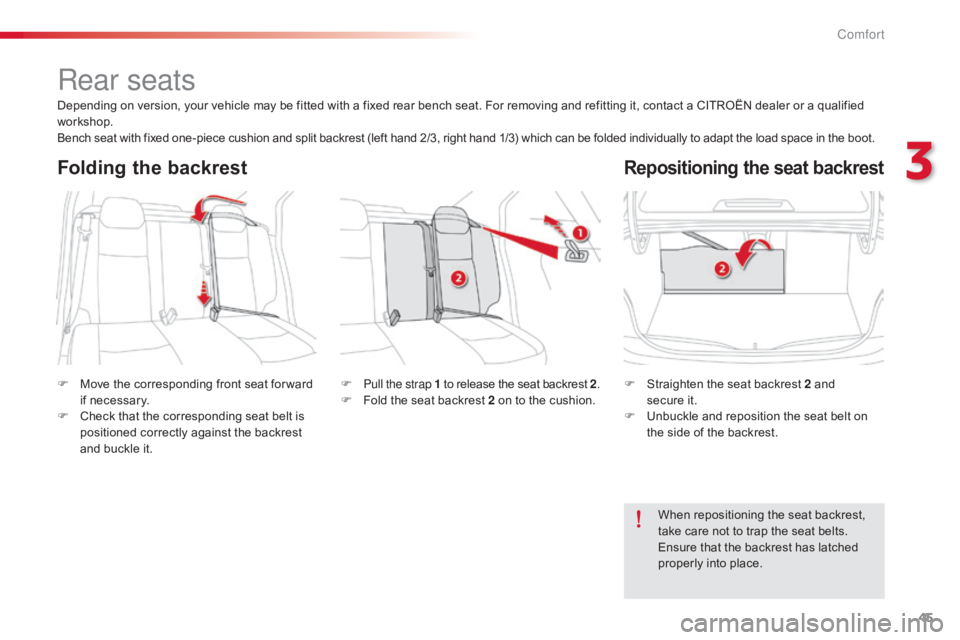
F Move the corresponding front seat for ward i
f necessary.
F
C
heck that the corresponding seat belt is
p
ositioned correctly against the backrest
a
nd buckle it. F
S traighten the seat backrest 2 and s
ecure it.
F
U
nbuckle and reposition the seat belt on
t
he side of the backrest.
When
repositioning the seat backrest,
t
ake care not to trap the seat belts.
Ensure
that the backrest has latched
p
roperly into place.
F
P ull the strap 1 to release the seat backrest 2.
F F old the seat backrest 2 on to the cushion.
Folding the backrest
Depending on version, your vehicle may be fitted with a fixed rear bench seat. For removing and refitting it, contact a CITROËN dealer or a qualified w
orkshop.
Bench
seat with fixed one-piece cushion and split backrest (left hand 2/3, right hand 1/3) which can be folded individually to adapt the load space in the boot.
Repositioning the seat backrest
3
Comfort
Page 52 of 260

50
C-elysee_en_Chap03_confort_ed01-2016
In order for these systems to be fully effective, follow the operation and maintenance guidelines belo w:
F
T
o obtain an even air distribution, take care not to obstruct the exterior air intake grilles
l
ocated at the base of the windscreen, the nozzles, the vents and the air outlets, as well
a
s the air extractor located in the boot.
F
O
perate the air conditioning system for at least 5 to 10 minutes, once or twice a month
t
o keep it in per fect working order.
F
E
nsure that the passenger compartment filter is in good condition and have the filter
e
lements replaced regularly.
F
T
o ensure correct operation of the air conditioning system, you are also advised to have
i
t checked regularly as recommended in the maintenance and warranty guide.
F
I
f the system does not produce cold air, switch it off and contact a CITROËN dealer or a
q
ualified
w
orkshop.
When
towing the maximum load on a steep gradient in high temperatures, switching off the
a
ir conditioning increases the available engine power and so improves the towing ability.
Recommendations for ventilation and air conditioning
If after an extended stop in sunshine, the i nterior t emperature i s v ery h igh, f irst
v
entilate the passenger compartment for
a
few moments.
Put
the air flow control at a setting high
e
nough to quickly change the air in the
p
assenger
c
ompartment.
The
air conditioning system does not
c
ontain chlorine and does not present
a
ny danger to the ozone layer.
The
condensation created by the air
c
onditioning results in a discharge
o
f water under the vehicle which is
p
er fectly normal.
C
Page 90 of 260

88
C-elysee_en_Chap05_conduite_ed01-2016
F Turn thumb wheel 1 to the
"CRUISE" position:
the cruise control
m
ode is selected but is not switched on
(
PAUS E).
Programming
You can then change the programmed speed using buttons 2 and 3:
- b y + or - 1 mph (km/h) = short press,
-
b
y + or - 5 mph (km/h) = long press,
-
i
n steps of + or - 5 mph (km/h) = maintained press. When
the cruise control is switched on,
b
e careful if you maintain the pressure
o
n one of the programmed speed
c
hanging buttons: this may result in a
v
ery rapid change in the speed of your
v
ehicle.
Do not use the cruise control on
slippery
roads or in heavy traffic.
On
a steep descent, the cruise control
w
ill not be able to prevent the vehicle
from
exceeding the programmed speed.
To
avoid any risk of jamming of the
ped
als:
-
e
nsure that the mat is secured
c
o r r e c t l y,
-
n
ever fit one mat on top of another.
In
the event of a cruise control malfunction,
t
he speed is cleared resulting in flashing of the d
ashes. Have it checked by a CITROËN dealer o
r a qualified workshop.
Operating fault
Leaving cruise control mode
F Turn thumb wheel 1 to the "0" position: the cruise control mode is d
eselected. The display returns to the distance recorder.
Exceeding the programmed speed
Intentional or unintentional exceeding of the programmed speed results in flashing of this speed in the screen.
Return
to the programmed speed, by means of intentional or
u
nintentional deceleration of the vehicle, automatically cancels the
f
lashing of the speed.F
S
et the programmed speed by
a
ccelerating to the required speed,
t
hen press button 2 or 3 (e.g.: 70 mph
(
110 km/h)).
F
S
witch off the cruise control by pressing button 4
: the screen
c
onfirms that it has been switched off (PAUSE).
F
S
witch the cruise control back on by pressing button 4
ag
ain.
Driving
Page 100 of 260
98
C-elysee_en_Chap06_visibilite_ed01-2016
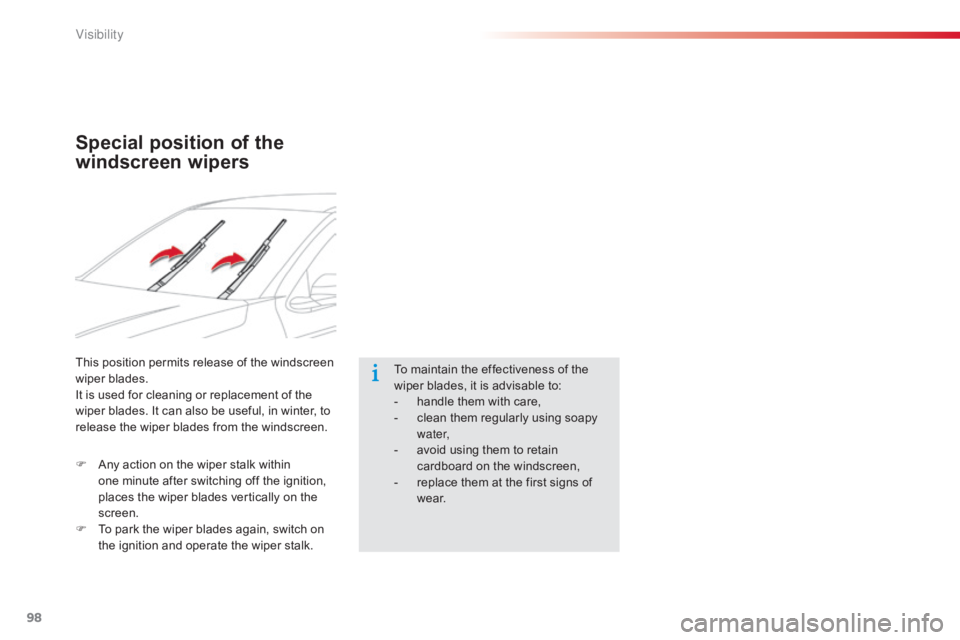
Special position of the
windscreen wipers
This position permits release of the windscreen wiper blades.
It
is used for cleaning or replacement of the
w
iper blades. It can also be useful, in winter, to
r
elease the wiper blades from the windscreen.To
maintain the effectiveness of the
w
iper blades, it is advisable to:
-
h
andle them with care,
-
c
lean them regularly using soapy
w
ater,
-
a
void using them to retain
c
ardboard on the windscreen,
-
r
eplace them at the first signs of
w
e a r.
F
A
ny action on the wiper stalk within
o
ne minute after switching off the ignition,
p
laces the wiper blades vertically on the
sc
reen.
F
T
o park the wiper blades again, switch on
t
he ignition and operate the wiper stalk.
Visibility
Page 104 of 260

102
C-elysee_en_Chap07_securite_ed01-2016
Before reinitialising the system, ensure that the pressures of the four tyres are
correct
for the use of the vehicle and in
l
ine with the recommendations on the
t
yre pressure label.
The
under-inflation alert can only be
r
elied on if the reinitialisation of the
s
ystem has done with the pressures in
t
he four tyres correctly adjusted.
The
under-inflation detection system
d
oes not give a warning if a pressure is
i
ncorrect at the time of reinitialisation.
The
loss
of
pressure
detected
does
not
a
lways
cause
visible
bulging
of
the
tyre.
D
o
not
satisfy
yourself
with
just
a
visual
c
heck. The
alert
is
maintained
until
the
system
i
s
r
einitialised.
Under-inflation alert
This is given by fixed illumination of t his warning lamp, accompanied by
a
n audible signal and the display of a
m
essage.
F
R
educe speed immediately, avoid
e
xcessive steering movements and sudden
b
raking
F
S
top the vehicle as soon as it is safe to
do so. F
I f you have a compressor (such as the one
i
n the temporary puncture repair kit), check
t
he pressures of the four tyres when cold.
I
f it is not possible to carry out this check
s
traight away, drive carefully at reduced
s
peed.
or
F
I
n the event of a puncture, use the
temporary
puncture repair kit or the spare
w
heel (depending on equipment),
Reinitialisation
It is necessary to reinitialise the system every time one or more tyre pressures are adjusted,
a
nd after changing one or more wheels.
Safety