2016 CITROEN C-ELYSÉE ignition
[x] Cancel search: ignitionPage 144 of 260
142
C-elysee_en_Chap09_info-pratiques_ed01-2016
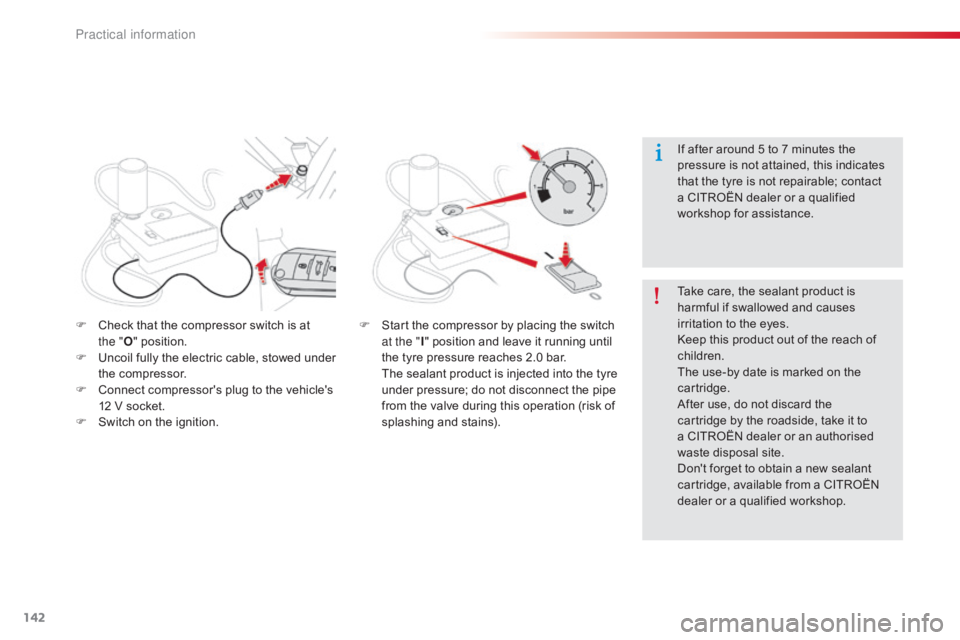
F Check that the compressor switch is at t
he "O "
position.
F
U
ncoil fully the electric cable, stowed under
t
he compressor.
F
C
onnect compressor's plug to the vehicle's
1
2 V socket.
F
S
witch on the ignition. If
after around 5 to 7 minutes the
p
ressure is not attained, this indicates
t
hat the tyre is not repairable; contact
a
CITROËN dealer or a qualified
w
orkshop for assistance.
Take care, the sealant product is
h
armful if swallowed and causes i
rritation to the eyes.
Keep this product out of the reach of
c
hildren.
The
use-by date is marked on the
c
artridge.
After
use, do not discard the
c
artridge by the roadside, take it to
a
CITROËN dealer or an authorised
w
aste disposal site.
Don't
forget to obtain a new sealant
c
artridge, available from a CITROËN
d
ealer or a qualified workshop.
F
S tart the compressor by placing the switch a
t the "I"
position and leave it running until
t
he tyre pressure reaches 2.0 bar.
T
he sealant product is injected into the tyre
u
nder pressure; do not disconnect the pipe
f
rom the valve during this operation (risk of
sp
lashing
an
d
s
tains).
Practical information
Page 145 of 260
143
C-elysee_en_Chap09_info-pratiques_ed01-2016
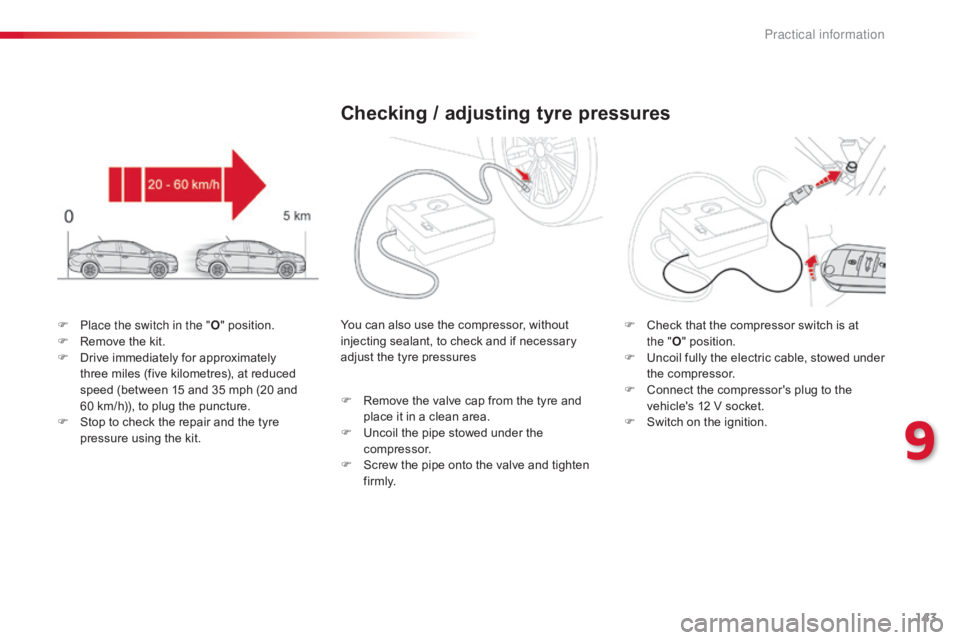
You can also use the compressor, without injecting sealant, to check and if necessary
a
djust the tyre pressures F
C heck that the compressor switch is at
t
he "O "
position.
F
U
ncoil fully the electric cable, stowed under
t
he compressor.
F
C
onnect the compressor's plug to the
v
ehicle's 12 V socket.
F
S
witch on the ignition.
F
P
lace the switch in the " O"
position.
F
R
emove
the
kit.
F
D
rive
immediately
for
approximately
t
hree
miles
(five
kilometres),
at
reduced
s
peed
(between
15
and
35
mph
(20
and
6
0 km/h)),
to
plug
the
puncture.
F
S
top
to
check
the
repair
and
the
tyre
p
ressure
using
the
kit.
Checking / adjusting tyre pressures
F Remove the valve cap from the tyre and p
lace it in a clean area.
F
U
ncoil the pipe stowed under the
c
ompressor.
F
S
crew the pipe onto the valve and tighten
f
i r m l y.
9
Practical information
Page 167 of 260

165
C-elysee_en_Chap09_info-pratiques_ed01-2016
Starting using another
battery
F Start the engine of the vehicle with the g
ood battery and leave it running for a
f
ew minutes.
F
O
perate the starter on the broken down
v
ehicle and let the engine run.
I
f the engine does not start straight away,
s
witch off the ignition and wait a few
m
oments before trying again.
Never
try
to
start
the
engine
by
c
onnecting
a
battery
charger.
Never
use
a
24
V
or
higher
battery
b
o o s t e r.
First
check
that
the
slave
battery
has
a
n
ominal
voltage
of
12
V
and
a
capacity
a
t
least
equal
to
that
of
the
discharged
b
attery.
The
two
vehicles
must
not
be
in
contact
w
ith
each
other.
Switch
off
the
electrical
consumers
on
b
oth
vehicles
(audio
system,
wipers,
l
ighting,
...
).
Ensure
that
the
jump
lead
cables
do
n
ot
pass
close
to
moving
parts
of
the
e
ngine
(cooling
fan,
belts,
...).
Do
not
disconnect
the
(+)
terminal
when
t
he
engine
is
running.
When
your
vehicle's
battery
is
discharged,
the
e
ngine
can
be
started
using
a
slave
battery
(
external
or
on
another
vehicle)
and
jump
lead
c
ables
or
a
battery
booster.
F
R
aise
the
plastic
cover
on
the
(+)
terminal,
i
f
your
vehicle
has
one.
F
C
onnect
the
red
cable
to
the
positive
t
erminal
(+)
of
the
flat
battery
A (at
the
metal
elbow)
then
to
the
positive
t
erminal (+)
of
the
slave
battery
B or the
b o o s t e r.
F
C
onnect
one
end
of
the
green
or
black
c
able
to
the
negative
terminal
(-)
of
the
s
lave battery B or the booster (or earth
point
on
the
other
vehicle).
F
C
onnect
t
he
o
ther
e
nd
o
f
t
he
g
reen
o
r
b
lack
c
able to the earth point C
on
the
broken
d
own
vehicle. F
W
ait until the engine returns to idle then
d
isconnect the jump lead cables in the
r
everse
o
rder.
F
R
efit the plastic cover to the (+) terminal, if
y
our vehicle has one.
F
A
llow the engine to run for at least
3
0 minutes, by driving or with the vehicle
s
tationary, so that the battery reaches an
adequate
state of charge.
Some
functions, including Stop & Start,
a
re not available if the battery is not
sufficiently
c
harged.
9
Practical information
Page 168 of 260
166
C-elysee_en_Chap09_info-pratiques_ed01-2016
Charging the battery using
a battery charger
For optimum service life of the battery, it is essential to maintain an adequate state of
c
harge.
In
some circumstances it may be necessary to
c
harge the battery:
-
i
f you use your vehicle essentially for short
j
ourneys,
-
i
f the vehicle is to be taken off the road for
s
everal weeks.
Contact
a CITROËN dealer or a qualified
w
orkshop. Never
try to charge a frozen battery.
If the battery has been frozen, have
it
checked by a CITROËN dealer or a
q
ualified workshop, who will check that
t
he internal components have not been
d
amaged and the casing is not cracked,
w
hich could cause a leak of toxic and
c
orrosive acid.
If
you envisage charging your vehicle's
b
attery yourself, use only a charger
c
ompatible with lead-acid batteries of a
n
ominal voltage of 12 V.
If this label is present, it is essential
to
use only a 12 V charger, to avoid
c
ausing irreversible damage to the
e
lectrical components related to the
S
top & Start system. Follow
the instructions for use provided
b
y the manufacturer of the charger.
Never
reverse polarities.
It
is not necessary to disconnect the
b
attery.
F
S
witch off the ignition.
F
S
witch off all electrical consumers (audio
s
ystem, lighting, wipers, ...).
F
S
witch off the charger B before connecting
t
he cables to the battery, so as to avoid any
d
angerous
spar
ks.
F
E
nsure that the charger cables are in good
c
ondition.
F
R
aise the plastic cover, if your vehicle has
one,
on the (+) terminal.
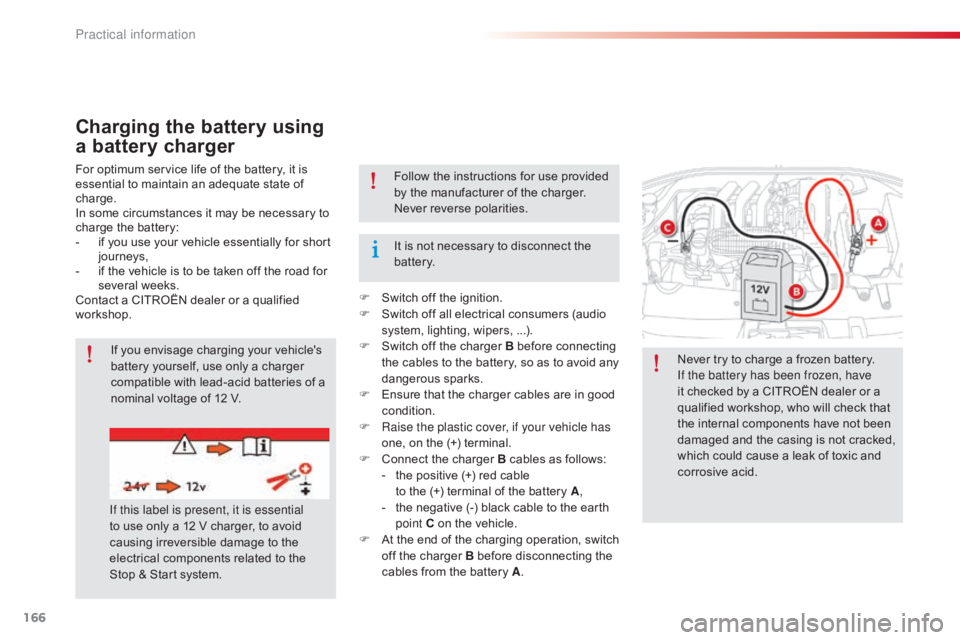
F
C
onnect the charger B cables as follows:
-
t
he positive (+) red cable
to
the (+) terminal of the battery A,
-
t
he negative (-) black cable to the earth
p
oint C on the vehicle.
F
A
t the end of the charging operation, switch
o
ff the charger B before disconnecting the
c
ables from the battery A.
Practical information
Page 169 of 260

167
C-elysee_en_Chap09_info-pratiques_ed01-2016
Disconnecting the (+) terminal
F Raise the lever A fully to release the clamp B.
Reconnecting the (+) terminal
F Position the open clamp B of the cable on
the positive post (+) of the battery.
F
P
ress down on the clamp to position it
c
orrectly on the battery post.
F
L
ock the clamp by lowering the lever A.
Do
not force the lever as locking will
n
ot be possible if the clamp is not
p
ositioned correctly; start the procedure
ag
ain.
Disconnecting the battery
In order to maintain an adequate state of charge for starting the engine, it is
r
ecommended that the battery be disconnected
i
f the vehicle is taken out of service for a long
p
eriod.
Wait
2 minutes after switching off the ignition
b
efore disconnecting the battery:
F
c
lose all openings (doors, boot, windows,
r
oof),
F
s
witch off all electrical consumers (audio
s
ystem, wipers, lighting, ...),
F
s
witch off the ignition and wait for
f
our minutes.
Having
exposed the battery, it is only
n
ecessary to disconnect the (+) terminal.
Following reconnection of the
battery
After reconnecting the battery, switch on the ignition and wait 1 minute before starting to
a
llow initialisation of the electronic systems.
However,
if minor problems persist following
t
his operation, contact a CITROËN dealer or a
q
ualified
w
orkshop.
Referring
to the corresponding section, you
m
ust yourself reinitialise or reset certain
s
ystems, such as:
-
t
he remote control,
-
t
he date and time,
-
t
he radio preset stations.
Quick release terminal
The Stop & Start system may not be operational during the trip following the
f
irst engine start.
In
this case, the system will only be
a
vailable again after a continuous
p
eriod of immobilisation of the vehicle,
a
period which depends on the ambient
t
emperature and the state of charge of
t
he battery (up to about 8 hours).
9
Practical information
Page 171 of 260
169
C-elysee_en_Chap09_info-pratiques_ed01-2016
Changing a wiper blade
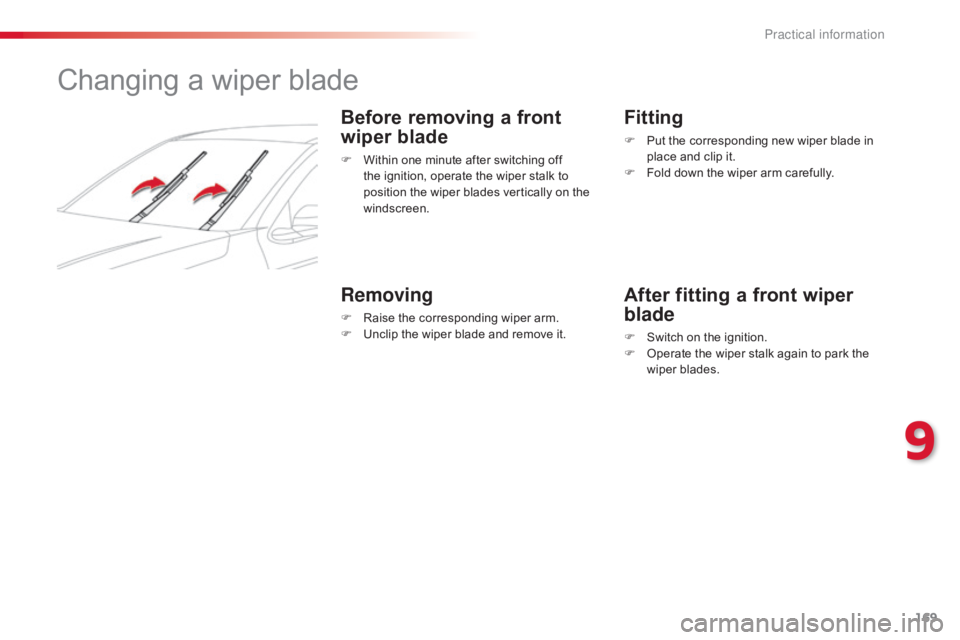
Before removing a front
wiper blade
F Within one minute after switching off t
he ignition, operate the wiper stalk to
p
osition the wiper blades vertically on the
w
indscreen.
Removing
F Raise the corresponding wiper arm.
F U nclip the wiper blade and remove it.
Fitting
F Put the corresponding new wiper blade in p
lace and clip it.
F
F
old down the wiper arm carefully.
After fitting a front wiper
blade
F Switch on the ignition.
F O perate the wiper stalk again to park the
w
iper blades.
9
Practical information
Page 173 of 260

171
C-elysee_en_Chap09_info-pratiques_ed01-2016
Towing your vehicleTowing another vehicle
F On the front bumper, unclip the cover by p
ressing on the left edge.
F
S
crew the towing eye in fully.
F
I
nstall the towing bar. Put
the gear lever into neutral
(
position
N for an electronic or
automatic gearbox).
Failure to follow this instruction may
c
ause damage to some components
(
braking, transmission...) and the
a
bsence of braking assistance when
t
he engine is restarted.
F U nlock the steering by turning the key i
n the ignition one notch and release the
par
king
b
rake.
F
S
witch on the hazard warning lamps on
b
oth vehicles.
F
M
ove off gently, drive slowly and for a short
di
stance.This
towing is strictly prohibited (risk of
d
amaging your vehicle).
9
Practical information
Page 185 of 260

183
C-elysee_en_Chap10_verifications_ed01-2016
Checking levels
Engine oil level
The check of the oil level is carried out with the dipstick, located under
t
he bonnet. For the position of the
d
ipstick, refer to the under-bonnet
v
iew on a previous page.Checking with dipstick
If you find that the oil level is above the A mark or below the B mark, do not star t the engine.
Take
care
when
working
under
the
bonnet,
as
certain
areas
of
the
engine
may
be
extremely
hot
(risk of burns) and the cooling fan could start at
a
ny
time
(even
with
the
ignition
off).
Check
all
of
these
levels
regularly,
in
line
with
the
manufacturer's
service
schedule.
Top
them
up
if
necessary, unless other wise indicated.
If
a
level
drops
significantly,
have
the
corresponding
system
checked
by
a
CITROËN
dealer
or
a
qualified workshop.
It
is
normal
to
top
up
the
oil
level
b
etween
two
services
(or
oil
changes).
C
ITROËN
recommends
that
you
check
t
he
level,
and
top
up
if
necessary,
every
3
000
miles
(5
000
km).
To
ensure
the
accuracy
of
the
reading,
your
v
ehicle
must
be
on
a
level
sur face,
with
the
e
ngine
off
for
at
least
30
minutes. -
I
f the level is above
t
he MAX
mark (risk of
e
ngine damage), contact
a
CITROËN dealer or a
q
ualified
w
orkshop.
-
I
f the level is below the
MIN
mark, you must
top-up
the engine oil.
Refer
to
the
under-bonnet
view
for
the
location
o
f
the
dipstick
on
your
vehicle.
F
T
ake
the
dipstick
by
its
coloured
grip
and
p
ull
it
out
completely.
F
W
ith
the
end
of
the
dipstick
with
a
clean
a
nd
non-fluffy
cloth.
F
R
efit
the
dipstick
and
push
it
fully
down,
t
hen
pull
it
out
again
for
a
visual
check
of
t
he
oil
level:
the
level
must
be
between
the
t
wo
marks
A
and
B .
10
Checks