Page 478 of 620
•To prevent excess heat generation, avoid continuous
driving at high RPM. Reduce vehicle speed as neces-
sary to avoid extended driving at high RPM. Return to
a higher gear or vehicle speed when grade and road
conditions allow.
Cooling System
To reduce potential for engine and transmission over-
heating, take the following actions:
City Driving
When stopped for short periods of time, shift the trans-
mission into NEUTRAL and increase engine idle speed.
Highway Driving
Reduce speed.
Air Conditioning
Turn off temporarily.
RECREATIONAL TOWING (BEHIND
MOTORHOME, ETC.)
Two-Wheel Drive And All-Wheel Drive
Recreational towing (with all four wheels on the ground,
or using a tow dolly) is NOT ALLOWED. The only
acceptable method for towing this vehicle (behind an-
other vehicle) is on a vehicle trailer with all four wheels
OFF the ground.
CAUTION!
Towing this vehicle in violation of the above require-
ments can cause severe transmission and/or transfer
case damage. Damage from improper towing is not
covered under the New Vehicle Limited Warranty.
476 STARTING AND OPERATING
Page 479 of 620
WHAT TO DO IN EMERGENCIES
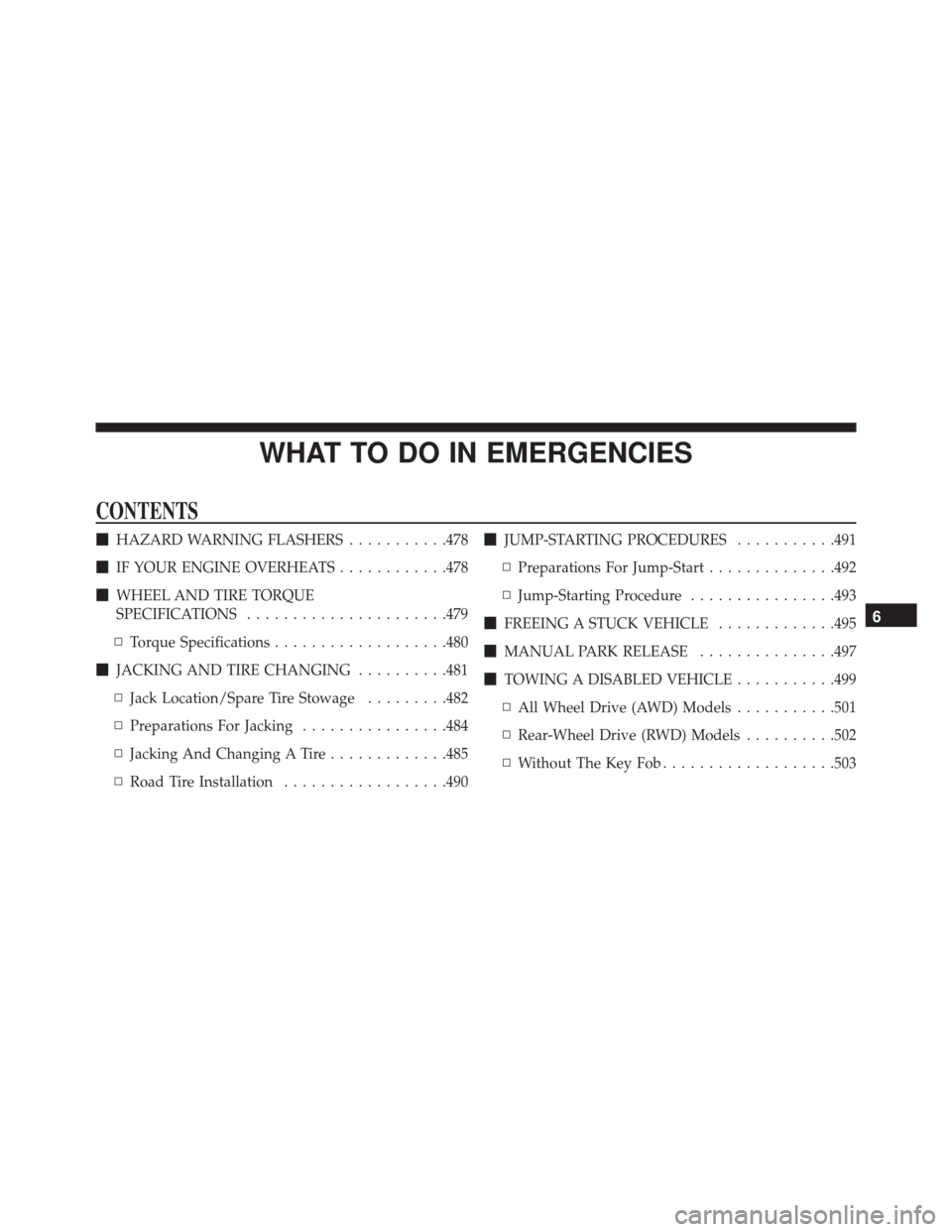
CONTENTS
�HAZARD WARNING FLASHERS ...........478
� IF YOUR ENGINE OVERHEATS ............478
� WHEEL AND TIRE TORQUE
SPECIFICATIONS ..................... .479
▫ Torque Specifications ...................480
� JACKING AND TIRE CHANGING ..........481
▫ Jack Location/Spare Tire Stowage .........482
▫ Preparations For Jacking ................484
▫ Jacking And Changing A Tire .............485
▫ Road Tire Installation ..................490 �
JUMP-STARTING PROCEDURES ...........491
▫ Preparations For Jump-Start ..............492
▫ Jump-Starting Procedure ................493
� FREEING A STUCK VEHICLE .............495
� MANUAL PARK RELEASE ...............497
� TOWING A DISABLED VEHICLE ...........499
▫ All Wheel Drive (AWD) Models ...........501
▫ Rear-Wheel Drive (RWD) Models ..........502
▫ Without The Key Fob ...................503
6
Page 501 of 620
5. While holding the locking tab in the disengagedposition, pull the tether strap to rotate the lever up and
rearward, until it locks in place in the vertical position.
The vehicle is now out of PARK and can be moved.
Release the parking brake only when the vehicle is
securely connected to a tow vehicle. To Reset The Manual Park Release:
1. Push the latch (at the base of the lever, on the rear side)
rearward (away from the lever) to unlatch the lever.
2. Rotate the Manual Park Release lever forward and down, to its original position, until the locking tab
snaps into place to secure the lever.
3. Pull up gently on the tether strap to confirm that the lever is locked in its stowed position.
4. Tuck the tether strap into the base of the console. Reinstall the console storage bin.
TOWING A DISABLED VEHICLE
This section describes procedures for towing a disabled
vehicle using a commercial towing service.
Tether Strap Location
6
WHAT TO DO IN EMERGENCIES 499
Page 502 of 620
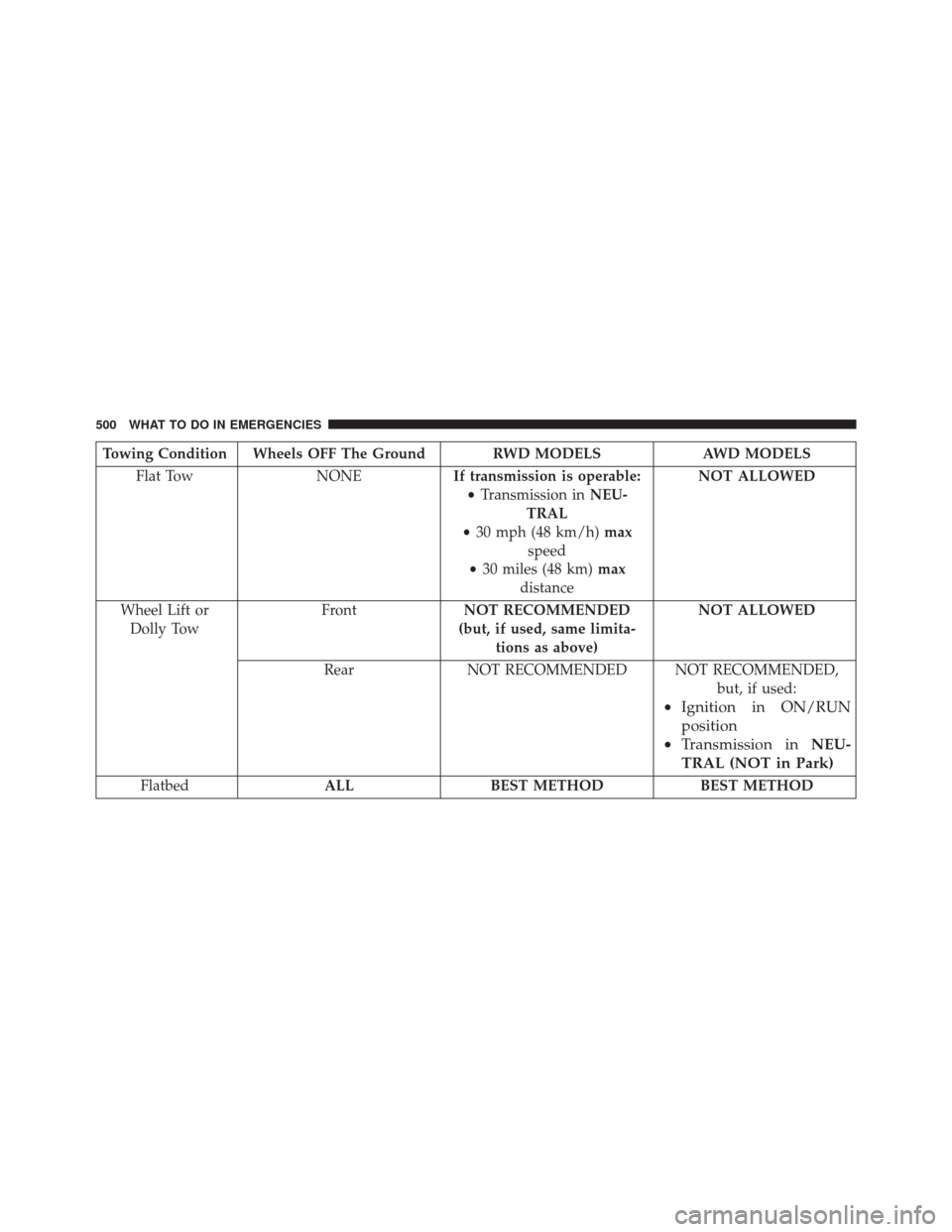
Towing Condition Wheels OFF The Ground RWD MODELSAWD MODELS
Flat Tow NONEIf transmission is operable:
• Transmission in NEU-
TRAL
• 30 mph (48 km/h) max
speed
• 30 miles (48 km) max
distance NOT ALLOWED
Wheel Lift or Dolly Tow Front
NOT RECOMMENDED
(but, if used, same limita- tions as above) NOT ALLOWED
Rear NOT RECOMMENDED NOT RECOMMENDED,
but, if used:
•Ignition in ON/RUN
position
• Transmission in NEU-
TRAL (NOT in Park)
Flatbed ALL BEST METHOD BEST METHOD
500 WHAT TO DO IN EMERGENCIES
Page 503 of 620
Proper towing or lifting equipment is required to prevent
damage to your vehicle. Use only tow bars and other
equipment designed for this purpose, following equip-
ment manufacturer ’s instructions. Use of safety chains is
mandatory. Attach a tow bar or other towing device to
main structural members of the vehicle, not to bumpers
or associated brackets. State and local laws regarding
vehicles under tow must be observed.
If you must use the accessories (wipers, defrosters, etc.)
while being towed, the ignition must be in the ON/RUN
position, not the ACC position.
If the key fob is unavailable, or the vehicle’s battery is
discharged, refer to�Manual Park Release� in this section
for instructions on shifting the transmission out of PARK
for towing.CAUTION!
• DO NOT use sling-type equipment when towing.
Vehicle damage may occur.
• When securing the vehicle to a flatbed truck, do not
attach to front or rear suspension components.
Damage to your vehicle may result from improper
towing.
• The manufacturer does not recommend towing this
vehicle using a tow dolly. Vehicle damage may
occur.
All Wheel Drive (AWD) Models
The manufacturer recommends towing your vehicle with
all four wheels OFF the ground using a flatbed.
If the transmission and drivetrain are operable, AWD
models can also be towed with the ignition in the
ON/RUN position, the transmission in NEUTRAL (not
in PARK!), and the rear wheels OFF the ground with no
6
WHAT TO DO IN EMERGENCIES 501
Page 504 of 620
limitation on speed or distance. Since the ignition MUST
be in the ON/RUN position to tow in this manner, AWD
vehicles must be towed with ALL FOUR wheels OFF the
ground (e.g. on a flatbed truck) if the Key Fob is
unavailable.
CAUTION!
•Towing this vehicle using any other method can
cause severe transmission and/or transfer case dam-
age.
• Damage from improper towing is not covered un-
der the New Vehicle Limited Warranty.
Rear-Wheel Drive (RWD) Models
The manufacturer recommends towing your vehicle with
all four wheels OFF the ground using a flatbed. If flatbed equipment is not available, and the transmis-
sion is operable, this vehicle may be flat towed (with all
four wheels on the ground) under the following condi-
tions:
•
The transmission must be in NEUTRAL. Refer to
�Manual Park Release� in this section for instructions
on shifting the transmission to NEUTRAL when the
engine is off.
• The towing speed must not exceed 30 mph (48 km/h).
• The towing distance must not exceed 30 miles (48 km).
If the transmission is not operable, or the vehicle must be
towed faster than 30 mph (48 km/h) or farther than 30
miles (48 km), then the only acceptable method of towing
is with a flatbed truck.
502 WHAT TO DO IN EMERGENCIES
Page 505 of 620
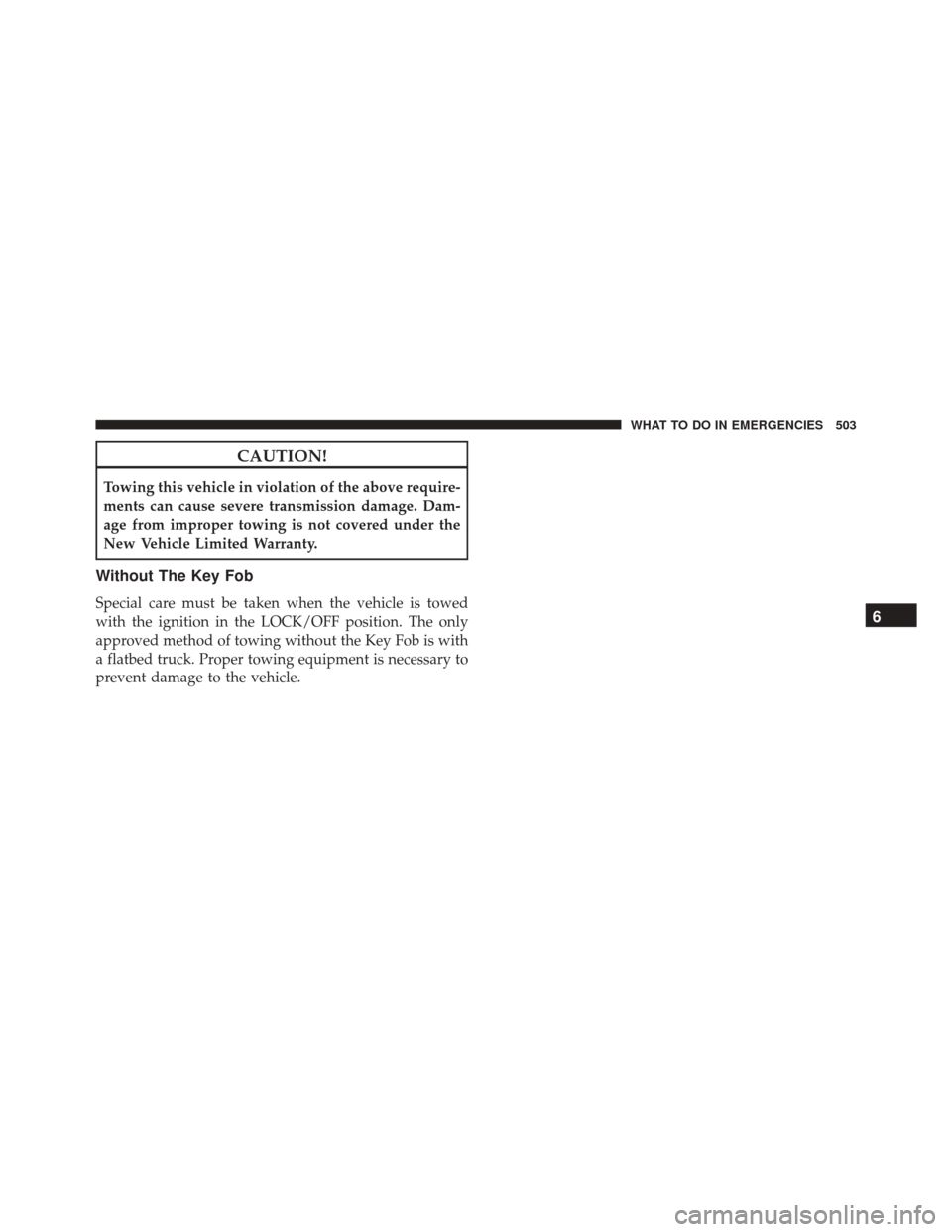
CAUTION!
Towing this vehicle in violation of the above require-
ments can cause severe transmission damage. Dam-
age from improper towing is not covered under the
New Vehicle Limited Warranty.
Without The Key Fob
Special care must be taken when the vehicle is towed
with the ignition in the LOCK/OFF position. The only
approved method of towing without the Key Fob is with
a flatbed truck. Proper towing equipment is necessary to
prevent damage to the vehicle.6
WHAT TO DO IN EMERGENCIES 503
Page 512 of 620
ONBOARD DIAGNOSTIC SYSTEM — OBD II
Your vehicle is equipped with a sophisticated onboard
diagnostic system called OBD II. This system monitors
the performance of the emissions, engine, and automatic
transmission control systems. When these systems are
operating properly, your vehicle will provide excellent
performance and fuel economy, as well as engine emis-
sions well within current government regulations.
If any of these systems require service, the OBD II system
will turn on the “Malfunction Indicator Light (MIL)”. It
will also store diagnostic codes and other information to
assist your service technician in making repairs. Al-
though your vehicle will usually be drivable and not
need towing, see your authorized dealer for service as
soon as possible.
CAUTION!
•Prolonged driving with the MIL on could cause
further damage to the emissions control system. It
could also affect fuel economy and driveability.
The vehicle must be serviced before any emissions
tests can be performed.
• If the MIL is flashing while the engine is running,
severe catalytic converter damage and power loss
will soon occur. Immediate service is required.
Onboard Diagnostic System (OBD II)
Cybersecurity
Your vehicle is required to have an Onboard Diagnostic
system (OBD II) and a connection port to allow access to
information related to the performance of your emissions
controls. Authorized service technicians may need to
510 MAINTAINING YOUR VEHICLE