Page 580 of 702
MANUAL PARK RELEASE
WARNING!
Always secure your vehicle by fully applying the
parking brake, before activating the Manual Park
Release. Activating the Manual Park Release will
allow your vehicle to roll away if it is not secured by
the parking brake or by proper connection to a tow
vehicle. Activating the Manual Park Release on an
unsecured vehicle could lead to serious injury or
death for those in or around the vehicle.
In order to move the vehicle in cases where the transmis-
sion will not shift out of PARK (such as a dead battery),
a Manual Park Release is available.
Follow these steps to activate the Manual Park Release:
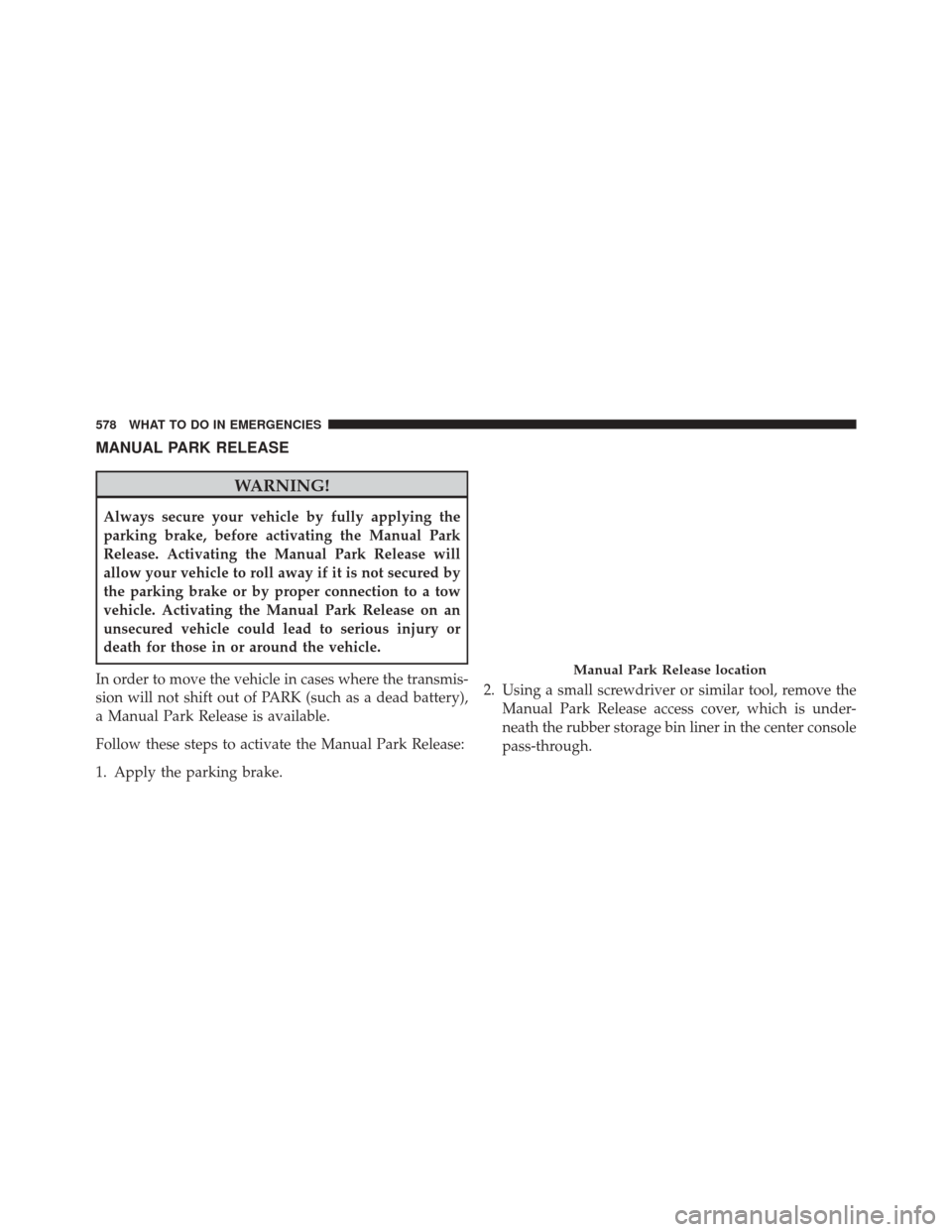
1. Apply the parking brake. 2. Using a small screwdriver or similar tool, remove the
Manual Park Release access cover, which is under-
neath the rubber storage bin liner in the center console
pass-through.
Manual Park Release location
578 WHAT TO DO IN EMERGENCIES
Page 584 of 702
•Vehicles with a discharged battery or total electrical
failure when the electric parking brake (EPB) is en-
gaged, will need a wheel dolly or jack to raise the rear
wheels off the ground when moving the vehicle onto a
flatbed.
Vehicle Recovery Tow Points
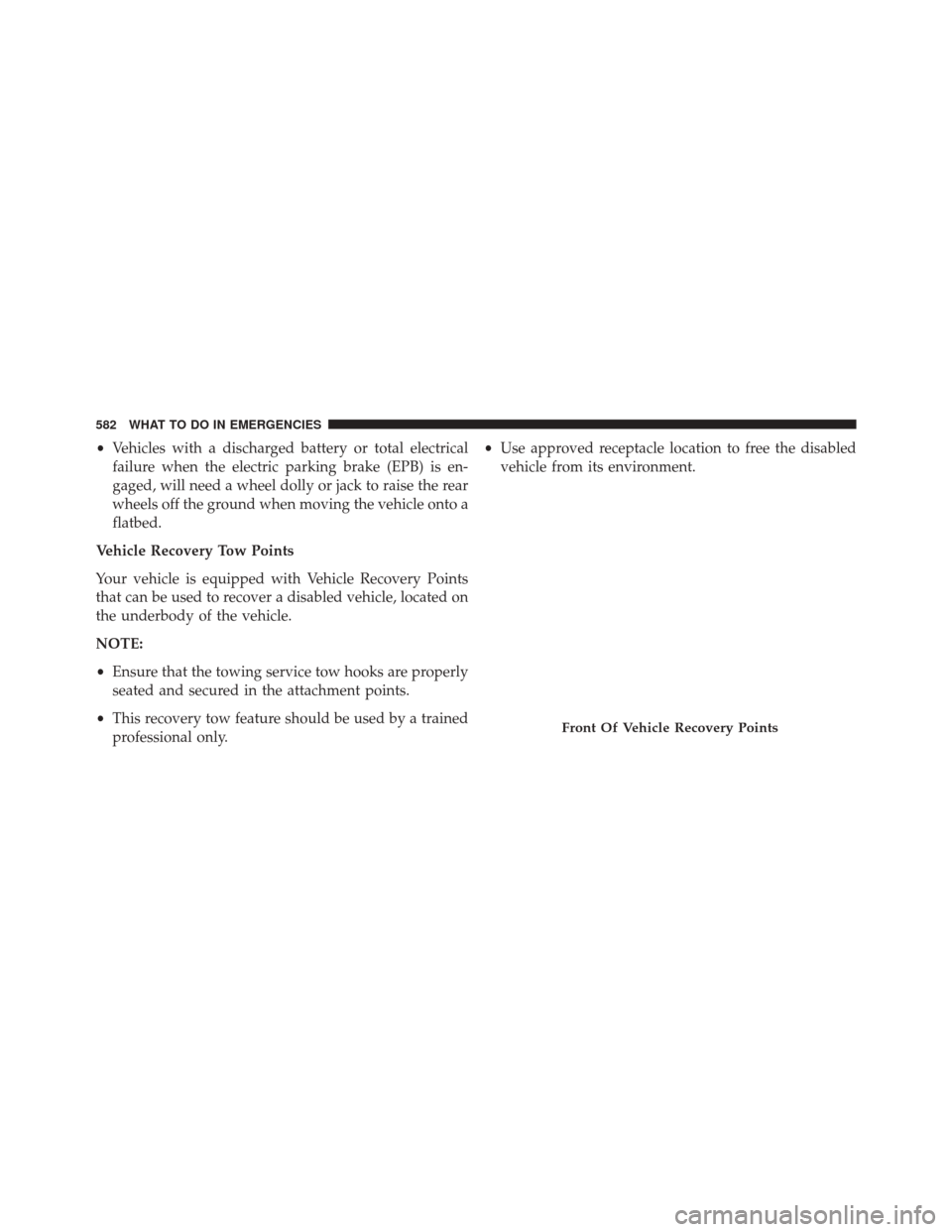
Your vehicle is equipped with Vehicle Recovery Points
that can be used to recover a disabled vehicle, located on
the underbody of the vehicle.
NOTE:
• Ensure that the towing service tow hooks are properly
seated and secured in the attachment points.
• This recovery tow feature should be used by a trained
professional only. •
Use approved receptacle location to free the disabled
vehicle from its environment.
Front Of Vehicle Recovery Points
582 WHAT TO DO IN EMERGENCIES
Page 585 of 702
CAUTION!
Recovery feature:
•Is to be used by a professional ONLY.
• Is used only to provide recovery of the vehicle.
• Is NOT to be used to recover secondary vehicle.
• Is NOT to be used for transporting the vehicle over
the road, i.e. “Flat Towing”.
Recovery load should:
• Be applied at constant speed.
• Be applied parallel to the center line of the length
of the vehicle.
• Not be an abrupt acceleration.
If you must use the accessories (wipers, defrosters, etc.)
while being towed, the ignition must be in the ON/RUN
position, not the ACC position. NOTE:
The Safehold feature will engage the Electric Park
Brake whenever the driver’s door is opened (if the
ignition is ON, transmission is not in PARK, and brake
pedal is released). If you are towing this vehicle with the
ignition in the ON/RUN position, you must manually
disable the Electric Park Brake each time the driver’s
door is opened, by pressing the brake pedal and then
pushing the EPB switch down.
If the key fob is unavailable, or the vehicle’s battery is
discharged, refer to “Manual Park Release” in this section
for instructions on shifting the transmission out of PARK
for towing.
6
WHAT TO DO IN EMERGENCIES 583
Page 589 of 702
MAINTAINING YOUR VEHICLE
CONTENTS
�ENGINE COMPARTMENT — 2.4L ..........589
� ENGINE COMPARTMENT — 3.6L ..........590
� ONBOARD DIAGNOSTIC SYSTEM — OBD II . .591
▫ Loose Fuel Filler Cap Message ............591
� EMISSIONS INSPECTION AND MAINTENANCE
PROGRAMS ......................... .592
� REPLACEMENT PARTS ..................593
� DEALER SERVICE ..................... .594
� MAINTENANCE PROCEDURES ...........594
▫ Engine Oil ......................... .595▫
Engine Oil Filter ..................... .598
▫ Engine Air Cleaner Filter ................599
▫ Maintenance-Free Battery ...............599
▫ Air Conditioner Maintenance .............601
▫ Body Lubrication .....................605
▫ Windshield Wiper Blades ...............605
▫ Adding Washer Fluid ..................606
▫ Exhaust System ..................... .606
▫ Cooling System ..................... .609
▫ Brake System ....................... .615
7
Page 591 of 702
ENGINE COMPARTMENT — 2.4L
1 — Air Cleaner Filter5 — Power Distribution Center (Fuses)
2 — Engine Coolant Pressure Cap 6 — Battery
3 — Oil Fill Cap 7 — Washer Fluid Reservoir
4 — Brake Fluid Reservoir 8 — Engine Oil Dipstick
7
MAINTAINING YOUR VEHICLE 589
Page 592 of 702
ENGINE COMPARTMENT — 3.6L
1 — Engine Coolant Reservoir5 — Washer Fluid Reservoir
2 — Engine Oil Filter Access Cover 6 — Battery
3 — Brake Fluid Reservoir 7 — Engine Oil Fill
4 — Power Distribution Center (Fuses) 8 — Air Cleaner Filter
590 MAINTAINING YOUR VEHICLE
Page 594 of 702

further information. Tighten the fuel filler cap until a
“clicking” sound is heard. This is an indication that the
fuel filler cap is properly tightened. Refer to “Onboard
Diagnostic System” in “Maintaining Your Vehicle” for
further information.
EMISSIONS INSPECTION AND MAINTENANCE
PROGRAMS
In some localities, it may be a legal requirement to pass
an inspection of your vehicle’s emissions control system.
Failure to pass could prevent vehicle registration.For states that require an Inspection and Mainte-
nance (I/M), this check verifies the “Malfunction
Indicator Light (MIL)” is functioning and is not
on when the engine is running, and that the OBD II
system is ready for testing. Normally, the OBD II system will be ready. The OBD II
system may
notbe ready if your vehicle was recently
serviced, recently had a dead battery or a battery replace-
ment. If the OBD II system should be determined not
ready for the I/M test, your vehicle may fail the test.
Your vehicle has a simple ignition actuated test, which
you can use prior to going to the test station. To check if
your vehicle’s OBD II system is ready, you must do the
following:
1. Cycle the ignition switch to the ON position, but do not crank or start the engine.
NOTE: If you crank or start the engine, you will have to
start this test over.
2. As soon as you cycle the ignition switch to the ON position, you will see the Malfunction Indicator Light
(MIL) symbol come on as part of a normal bulb check.
592 MAINTAINING YOUR VEHICLE
Page 595 of 702

3. Approximately 15 seconds later, one of two things willhappen:
• The MIL will flash for about 10 seconds and then
return to being fully illuminated until you turn OFF
the ignition or start the engine. This means that your
vehicle’s OBD II system is not readyand you should
not proceed to the I/M station.
• The MIL will not flash at all and will remain fully
illuminated until you place the ignition in the off
position or start the engine. This means that your
vehicle’s OBD II system is readyand you can proceed
to the I/M station.
If your OBD II system is not ready,you should see your
authorized dealer or repair facility. If your vehicle was
recently serviced or had a battery failure or replacement,
you may need to do nothing more than drive your
vehicle as you normally would in order for your OBD II system to update. A recheck with the above test routine
may then indicate that the system is
now ready.
Regardless of whether your vehicle’s OBD II system is
ready or not, if the MIL is illuminated during normal
vehicle operation you should have your vehicle serviced
before going to the I/M station. The I/M station can fail
your vehicle because the MIL is on with the engine
running.
REPLACEMENT PARTS
Use of genuine MOPAR parts for normal/scheduled
maintenance and repairs is highly recommended to en-
sure the designed performance. Damage or failures
caused by the use of non-MOPAR parts for maintenance
and repairs will not be covered by the New Vehicle
Limited Warranty.7
MAINTAINING YOUR VEHICLE 593