2016 CHEVROLET SS ECU
[x] Cancel search: ECUPage 277 of 397

Chevrolet SS Sedan Owner Manual (GMNA-Localizing-U.S.-9234782) - 2016 -
CRC - 8/24/15
276 Vehicle Care
2. Disconnect the outlet duct byloosening the screw (1) on the
air duct clamp.
3. Remove the retaining clips (2) securing the cover on the air
cleaner/filter housing.
4. Pull straight up on the cover; while holding the cover,
remove the air cleaner/filter.
5. Inspect or replace the air cleaner/filter. See Maintenance
Replacement Parts 0355
ii.
6. Reverse Steps 2-5 to reinstall the cover.
{Warning
Operating the engine with the air
cleaner/filter off can cause you or
others to be burned. The air
cleaner not only cleans the air; it
helps to stop flames if the engine
backfires. Use caution when
working on the engine and do not
drive with the air cleaner/filter off.
Caution
If the air cleaner/filter is off, dirt
can easily get into the engine,
which could damage it. Always
have the air cleaner/filter in place
when you are driving.
Cooling System
1. Coolant Recovery Reservoir
2. Engine Cooling Fans (Out
of View)
3. Radiator Cap
{Warning
An electric engine cooling fan
under the hood can start up even
when the engine is not running
and can cause injury. Keep
hands, clothing, and tools away
from any underhood electric fan.
{Warning
Heater and radiator hoses, and
other engine parts, can be very
hot. Do not touch them. If you do,
you can be burned.
Do not run the engine if there is a
leak. If you run the engine, it
could lose all coolant. That could
cause an engine fire, and you
could be burned. Get any leak
fixed before you drive the vehicle.
ProCarManuals.com
Page 279 of 397

Chevrolet SS Sedan Owner Manual (GMNA-Localizing-U.S.-9234782) - 2016 -
CRC - 8/24/15
278 Vehicle Care
sewers, streams or bodies of water.
Have the coolant changed by an
authorized service center, familiar
with legal requirements regarding
used coolant disposal. This will help
protect the environment and your
health.
Checking Coolant
The vehicle must be on a level
surface when checking the coolant
level.
To check coolant:1. Turn the ignition off.
2. Locate the coolant recovery reservoir. See Engine
Compartment Overview 0270
ii.
3. Turn the coolant recovery
reservoir dipstick cap
counterclockwise and slowly
pull out the dipstick. There are
maximum and minimum
markings on the dipstick.4. When the engine is cold, thecoolant level should be at or
above the minimum mark (1).
After the vehicle has been
driven and the engine is at
normal operating temperature,
the level should be somewhere
between half full and the
maximum mark (2).
5. If the coolant level is correct, replace the coolant recovery
reservoir dipstick cap and turn
clockwise to secure.
ProCarManuals.com
Page 280 of 397

Chevrolet SS Sedan Owner Manual (GMNA-Localizing-U.S.-9234782) - 2016 -
CRC - 8/24/15
Vehicle Care 279
How to Add Coolant to the
Coolant Recovery Bottle
{Warning
You can be burned if you spill
coolant on hot engine parts.
Coolant contains ethylene glycol
and it will burn if the engine parts
are hot enough. Do not spill
coolant on a hot engine.
Caution
This vehicle has a specific
coolant fill procedure. Failure to
follow this procedure could cause
the engine to overheat and be
severely damaged.
To add coolant: 1. Turn the engine coolant recovery reservoir dipstick cap
counterclockwise 1/8 of a turn
and slowly pull out the dipstick. 2. Pour the coolant into the
engine coolant recovery
reservoir.
3. When the level is correct, as per the markings on the
dipstick, replace the coolant
recovery reservoir dipstick cap
and turn clockwise to secure.
How to Add Coolant to the
Radiator
{Warning
You can be burned if you spill
coolant on hot engine parts.
Coolant contains ethylene glycol
and it will burn if the engine parts
are hot enough. Do not spill
coolant on a hot engine.
Caution
This vehicle has a specific
coolant fill procedure. Failure to
follow this procedure could cause
the engine to overheat and be
severely damaged.
{Warning
An electric engine cooling fan
under the hood can start up even
when the engine is not running
and can cause injury. Keep
hands, clothing, and tools away
from any underhood electric fan.
{Warning
Steam and scalding liquids from a
hot cooling system can blow out
and burn you badly. They are
under pressure, and if you turn
the radiator cap —even a
little —they can come out at high
speed. Never turn the cap when
the cooling system, including the
radiator cap, is hot. Wait for the
cooling system and radiator cap
to cool if you ever have to turn
the pressure cap.
ProCarManuals.com
Page 281 of 397
Chevrolet SS Sedan Owner Manual (GMNA-Localizing-U.S.-9234782) - 2016 -
CRC - 8/24/15
280 Vehicle Care
If no coolant is visible in the engine
coolant recovery reservoir, add
coolant as follows:1. Locate the radiator cap. See Engine Compartment Overview
0270
ii.
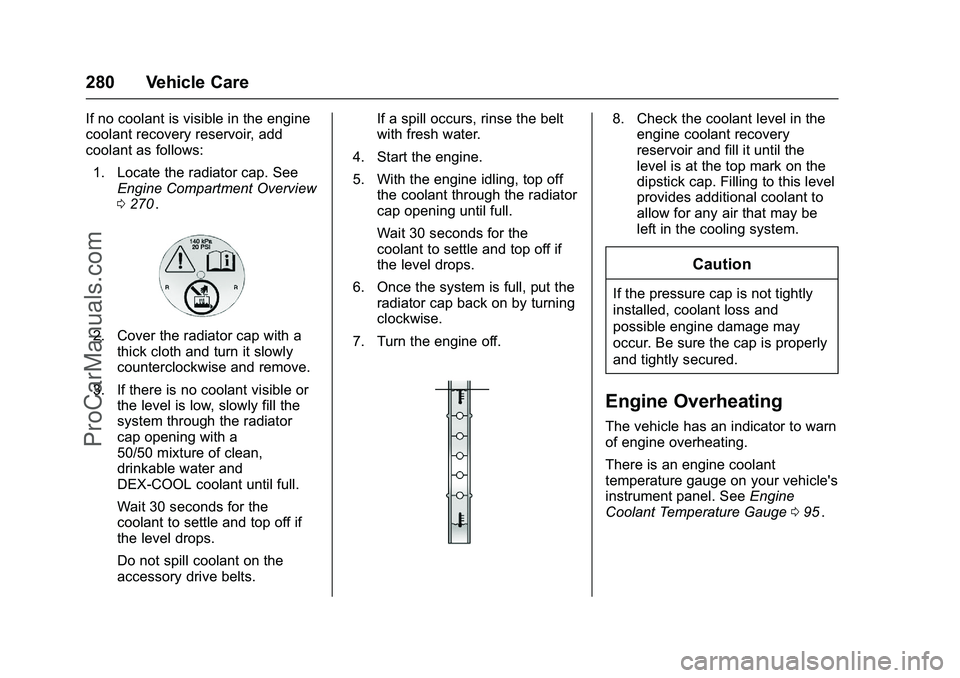
2. Cover the radiator cap with a
thick cloth and turn it slowly
counterclockwise and remove.
3. If there is no coolant visible or the level is low, slowly fill the
system through the radiator
cap opening with a
50/50 mixture of clean,
drinkable water and
DEX-COOL coolant until full.
Wait 30 seconds for the
coolant to settle and top off if
the level drops.
Do not spill coolant on the
accessory drive belts. If a spill occurs, rinse the belt
with fresh water.
4. Start the engine.
5. With the engine idling, top off the coolant through the radiator
cap opening until full.
Wait 30 seconds for the
coolant to settle and top off if
the level drops.
6. Once the system is full, put the radiator cap back on by turning
clockwise.
7. Turn the engine off.
8. Check the coolant level in the engine coolant recovery
reservoir and fill it until the
level is at the top mark on the
dipstick cap. Filling to this level
provides additional coolant to
allow for any air that may be
left in the cooling system.
Caution
If the pressure cap is not tightly
installed, coolant loss and
possible engine damage may
occur. Be sure the cap is properly
and tightly secured.
Engine Overheating
The vehicle has an indicator to warn
of engine overheating.
There is an engine coolant
temperature gauge on your vehicle's
instrument panel. See Engine
Coolant Temperature Gauge 095
ii.
ProCarManuals.com
Page 292 of 397

Chevrolet SS Sedan Owner Manual (GMNA-Localizing-U.S.-9234782) - 2016 -
CRC - 8/24/15
Vehicle Care 291
Headlamp Wiring
An electrical overload may cause
the lamps to go on and off, or in
some cases to remain off. Have the
headlamp wiring checked right away
if the lamps go on and off or
remain off.
Windshield Wipers
If the wiper motor overheats due to
heavy snow or ice, the windshield
wipers will stop until the motor cools
and will then restart.
Although the circuit is protected
from electrical overload, overload
due to heavy snow or ice may
cause wiper linkage damage.
Always clear ice and heavy snow
from the windshield before using the
windshield wipers.
If the overload is caused by an
electrical problem and not snow or
ice, be sure to get it fixed.
Fuses
The wiring circuits in the vehicle are
protected from short circuits by
fuses. This greatly reduces the
chance of fires caused by electrical
problems.
Look at the silver-colored band
inside the fuse. If the band is broken
or melted, replace the fuse. Be sure
you replace a bad fuse with a new
one of the identical size and rating.
Fuses of the same amperage can
be temporarily borrowed from
another fuse location, if a fuse goes
out. Replace the fuse as soon as
you can.
Spare fuses of various ratings are
provided in the Engine
Compartment Fuse Block and Rear
Compartment Fuse Block.
Engine Compartment
Fuse Block
To access the fuse block, remove
the clip-on cover.
Ensure the cover is replaced
securely.
ProCarManuals.com
Page 297 of 397

Chevrolet SS Sedan Owner Manual (GMNA-Localizing-U.S.-9234782) - 2016 -
CRC - 8/24/15
296 Vehicle Care
FusesUsage
F17 LPG Shut-Off Solenoid
F18 Not Used
F19 SWC Backlight
F20 Not Used
F21 Not Used
F22 Shunt 2
F23 Body Control Module 4
F24 Body Control Module 5
F25 Body Control Module 6
CB26 Not Used Fuses
Usage
F27 Body Control Module 8
F28 Blower Fan
F29 Accessories
F30 Body Control Module 7
Relays Relays Usage
R1 Logistics
R2 LPG Shut-Off Solenoid 1
R3 LPG Shut-Off Solenoid 2
Rear Compartment Fuse
Block
The fuse panel is on the left side of
the trunk, above the battery.
.Turn the latch counterclockwise
to remove the cover.
. Replace the cover and turn the
latch clockwise to secure.
ProCarManuals.com
Page 324 of 397

Chevrolet SS Sedan Owner Manual (GMNA-Localizing-U.S.-9234782) - 2016 -
CRC - 8/24/15
Vehicle Care 323
If the tire pressure has not
dropped more than 68 kPa
(10 psi) from the recommended
inflation pressure, inflate the
tire to the recommended
inflation pressure.
21. Wipe off any sealant from the wheel, tire or vehicle.
22. Dispose of the used tire sealant canister (3) and
sealant/air hose (5) assembly
at a local dealer or in
accordance with local state
codes and practices.
23. Replace it with a new canister available from your dealer.
24. After temporarily sealing a tire using the tire sealant and
compressor kit, take the
vehicle to an authorized dealer
within 161 km (100 mi) of
driving to have the tire repaired
or replaced. Using the Tire Sealant and
Compressor Kit without Sealant to
Inflate a Tire (Not Punctured)
To use the air compressor to inflate
a tire with air only and not sealant:
1. On/Off Switch
2. Pressure Gauge
3. Tire Sealant Canister
4. Air Only Hose
5. Sealant/Air Hose
6. Power Plug
If a tire goes flat, avoid further tire
and wheel damage by driving slowly
to a level place. Turn on the hazard
warning flashers. See
Hazard
Warning Flashers 0124
ii. See
If a Tire Goes Flat 0318
iifor
other important safety warnings.
1. Remove the tire sealant and compressor kit from its storage
location. See Storing the Tire
Sealant and Compressor Kit
0 325
ii.
2. Lift the lever and pull the air only hose (4) from the bottom
of the tire sealant and
compressor kit.
3. Remove the power plug (6) from the air compressor.
4. Place the kit on the ground. Make sure the tire valve stem
is positioned close to the
ground so the hose will
reach it.
5. Remove the tire valve stem cap by turning it
counterclockwise.
6. Attach the air only hose (4) onto the tire valve stem and
press the lever down to
secure it.
ProCarManuals.com
Page 335 of 397

Chevrolet SS Sedan Owner Manual (GMNA-Localizing-U.S.-9234782) - 2016 -
CRC - 8/24/15
334 Vehicle Care
Towing the Vehicle
Caution
Incorrectly towing a disabled
vehicle may cause damage. The
damage would not be covered by
the vehicle warranty.
Do not lash or hook to
suspension components. Use the
proper straps around the tires to
secure the vehicle.
Have the vehicle towed on a flatbed
car carrier. A wheel lift tow truck
could damage the vehicle.
Consult your dealer or a
professional towing service if the
disabled vehicle must be towed.
There are two oval-shaped slots (1)
under the front of the vehicle that
should be used to move a disabled
vehicle. Use only these slots to
hook to the vehicle. The slots can
be accessed through the splash
shield. Use an appropriate size T
hook for the slot.
To tow the vehicle behind another
vehicle for recreational purposes,
such as behind a motor home, see
“Recreational Vehicle Towing”
following.
Recreational Vehicle
Towing
Caution
Dolly towing or dinghy towing the
vehicle may cause damage
because of reduced ground
clearance. Always put the vehicle
on a flatbed truck or trailer.
The vehicle was neither designed
nor intended to be towed with any of
its wheels on the ground. If the
vehicle must be towed, see Towing
the Vehicle 0334
ii.
ProCarManuals.com