2016 BMW M4 boot
[x] Cancel search: bootPage 156 of 228
Storage compartments in the
boot
Storage compartment
There is a storage compartment on the left.
On the right-hand side there is a storage com‐
partment for on-board toolkit, see page 193,
and first-aid kit, see page 203.
Net
Smaller objects can be stowed in the net on
the left-hand side.
Bag holders WARNING
Incorrect use of the holders can repre‐
sent a danger, for example if objects fly around
in the case of braking and evasive manoeuvres.
Danger of injury and damage to property. Only
hang light objects, for example shopping bags,
on the holders. Only transport heavy luggage
with suitable means of securing in the boot.◀
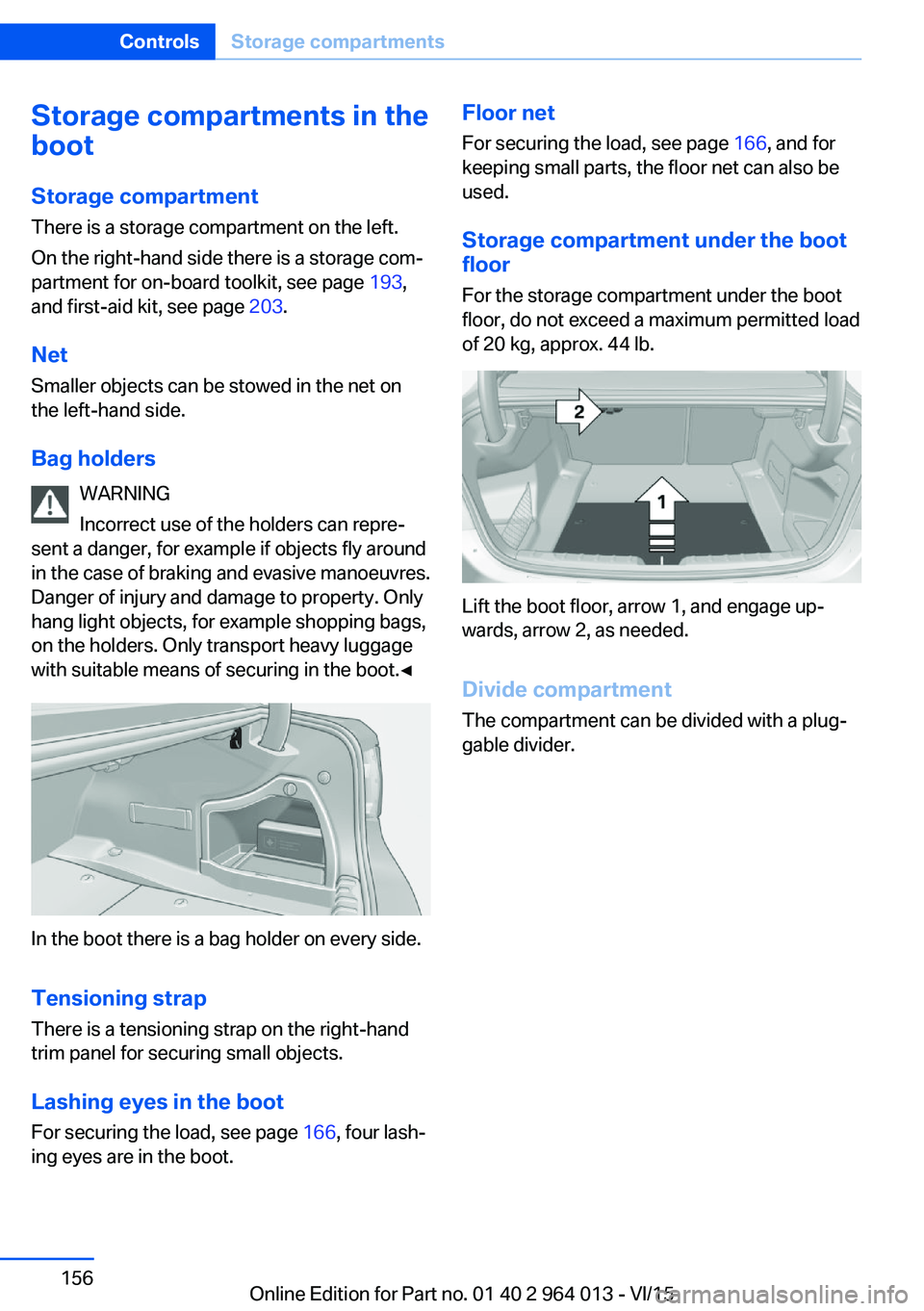
In the boot there is a bag holder on every side.
Tensioning strap
There is a tensioning strap on the right-hand
trim panel for securing small objects.
Lashing eyes in the boot
For securing the load, see page 166, four lash‐
ing eyes are in the boot.
Floor net
For securing the load, see page 166, and for
keeping small parts, the floor net can also be
used.
Storage compartment under the boot
floor
For the storage compartment under the boot
floor, do not exceed a maximum permitted load
of 20 kg, approx. 44 lb.
Lift the boot floor, arrow 1, and engage up‐
wards, arrow 2, as needed.
Divide compartment
The compartment can be divided with a plug‐
gable divider.
Seite 156ControlsStorage compartments156
Online Edition for Part no. 01 40 2 964 013 - VI/15
Page 163 of 228

General driving information
Closing the boot lid WARNING
An open boot lid projects beyond the ve‐
hicle, and in the event of an accident, braking
or avoidance manoeuvres, it can endanger ve‐ hicle occupants and other road users, or dam‐
age the vehicle. There is also the danger of ex‐
haust fumes entering the interior of the
vehicle. Danger of injury or damage to prop‐
erty. Do not drive with the boot lid open.◀
If there is no alternative to driving with the tail‐
gate open:▷Close all windows and the Glass Roof.▷Turn up the blower to a high output level.▷Maintain moderate speed.
Hot exhaust system
WARNING
During driving, high temperatures can be
generated under the body, for example be‐
cause of the exhaust system. If flammable ma‐
terials, for example leaves of grass, come into
contact with hot parts of the exhaust system,
these materials can catch fire. Danger of injury
or damage to property.
Never remove the heat shields fitted here, or
apply underseal to them. Make sure that when driving, idling or parking, no flammable materi‐
als can come into contact with hot vehicle
parts. Do not touch the hot exhaust system.◀
Radio signals WARNING
Certain vehicle functions may be affec‐
ted by interference from high-frequency radio
signals. Such signals are output from a series
of transmission systems, for example, from air
traffic beacons or relay stations for mobile tele‐
communications.
We recommend you consult a Service Partner
or a qualified specialist workshop should you
experience any difficulties.◀
Mobile communication equipment WARNING
The vehicle's electronics and mobile
radio devices can interfere. The transmission
operation of mobile radio devices generates
radiation. Danger of injury or damage to prop‐
erty. If possible, only use mobile radio devices,
e.g. mobile telephones, in the interior with di‐
rect connection to an external antenna to ex‐
clude mutual interference and to dissipate the
radiation from the vehicle's interior.◀
Aquaplaning
On wet or slushy roads, a wedge of water can
form between the tyres and the road.
This situation, known as aquaplaning, means
that the tyre can actually lose contact com‐
pletely with the road surface and the vehicle
can neither be steered nor the brakes properly
applied.
Wading ATTENTION
Driving through excessively deep water
too fast can result in water entering the engine
compartment, electrical system or transmis‐
sion. Danger of damage to property. When
driving through water, do not exceed the maxi‐
mum specified water depth and maximum
fording speed.◀
Only if the water is calm and only up to a water
depth of max. 25 cm, approximately 9.8 inches
and at this depth drive no faster than walking
speed up to 5 km/h, approximately 3 mph.
Safe braking Your vehicle is equipped with ABS as standard.Seite 163Driving precautionsDriving hints163
Online Edition for Part no. 01 40 2 964 013 - VI/15
Page 166 of 228
LoadsVehicle equipment
This chapter describes all standard, national
and special equipment provided in the model
series. Equipment not available in the vehicle is
therefore also described, for example the se‐
lected special equipment or national version.
This also applies to safety-relevant functions
and systems. Comply with the relevant na‐
tional regulations when using the correspond‐
ing functions and systems.
Notes WARNING
A high gross vehicle weight can cause
the tyres to overheat, causing internal damage
and a sudden loss of tyre pressure. Danger of
accidents. Comply with the permitted load in‐
dex of the tyre, and do not exceed the permit‐
ted gross vehicle weight.◀
WARNING
If the permitted total weight and the per‐
mitted axle loads are exceeded, operational
safety of the vehicle is not ensured anymore.
Danger of accidents. Do not exceed the per‐
mitted total weight and permitted axle loads.◀
ATTENTION
Liquids in the boot can cause damage.
Danger of damage to property. Make sure that
no liquids leak out in the boot.◀
WARNING
Loose objects in the interior can be
thrown into the interior during the journey, for
example in an accident or during braking and
evasive manoeuvres. Danger of injury. Secure
loose objects in the interior.◀Stowing transported loads▷Wrap protective material around sharp cor‐
ners and edges of the load.▷Heavy transported load: stow as far for‐
ward and as low down as possible, ideally
directly behind the rear backrests.▷Very heavy transported load: with no pas‐
sengers on the back seat, insert both outer
seat belts into the respective opposite
buckles.▷Fully fold down the rear-seat backrest if
the load is to be stowed accordingly.▷Do not stack storage goods above the up‐
per edge of the backrests.
Securing transported loads
Lashing eyes in the boot
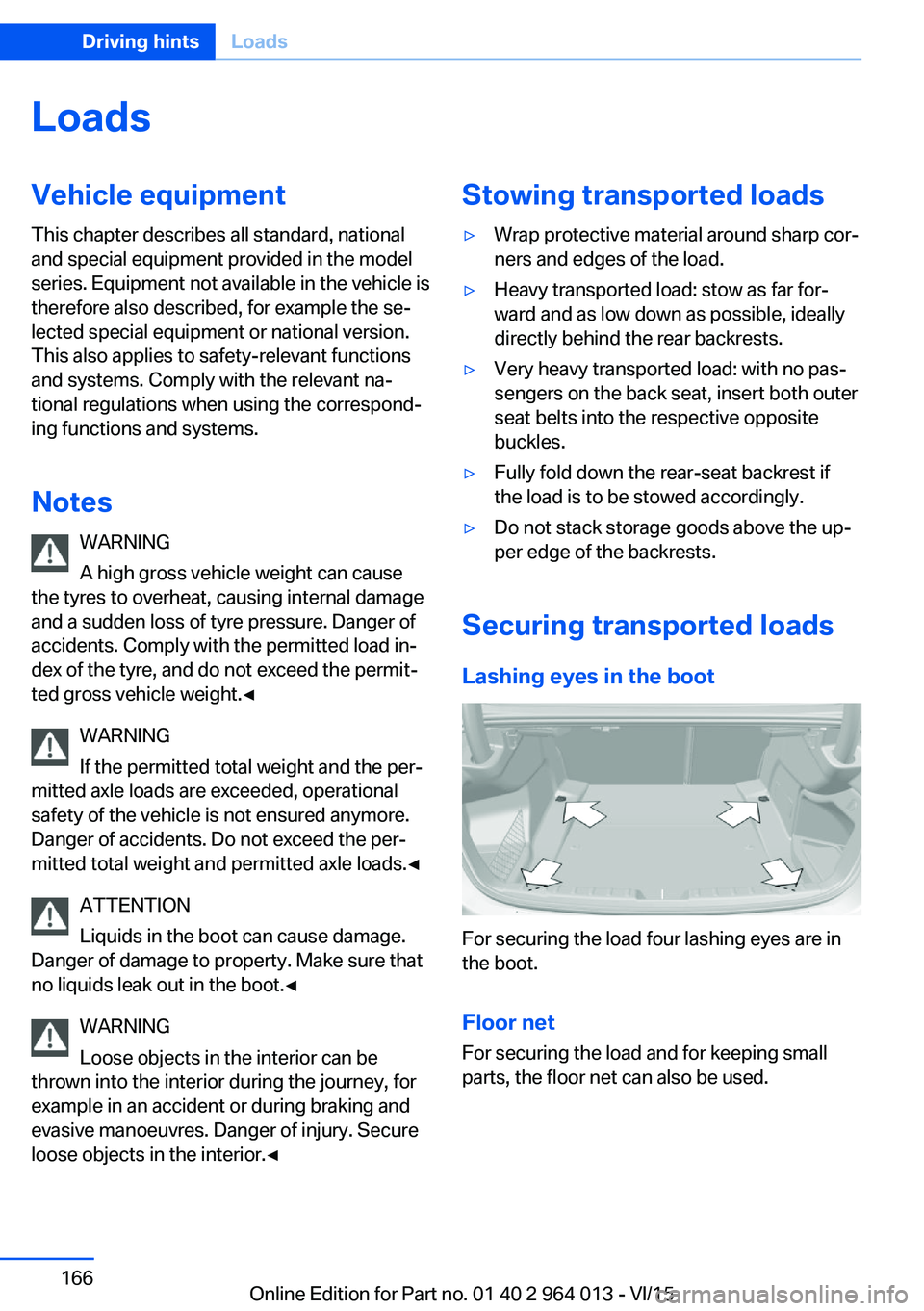
For securing the load four lashing eyes are in
the boot.
Floor net
For securing the load and for keeping small
parts, the floor net can also be used.
Seite 166Driving hintsLoads166
Online Edition for Part no. 01 40 2 964 013 - VI/15
Page 167 of 228
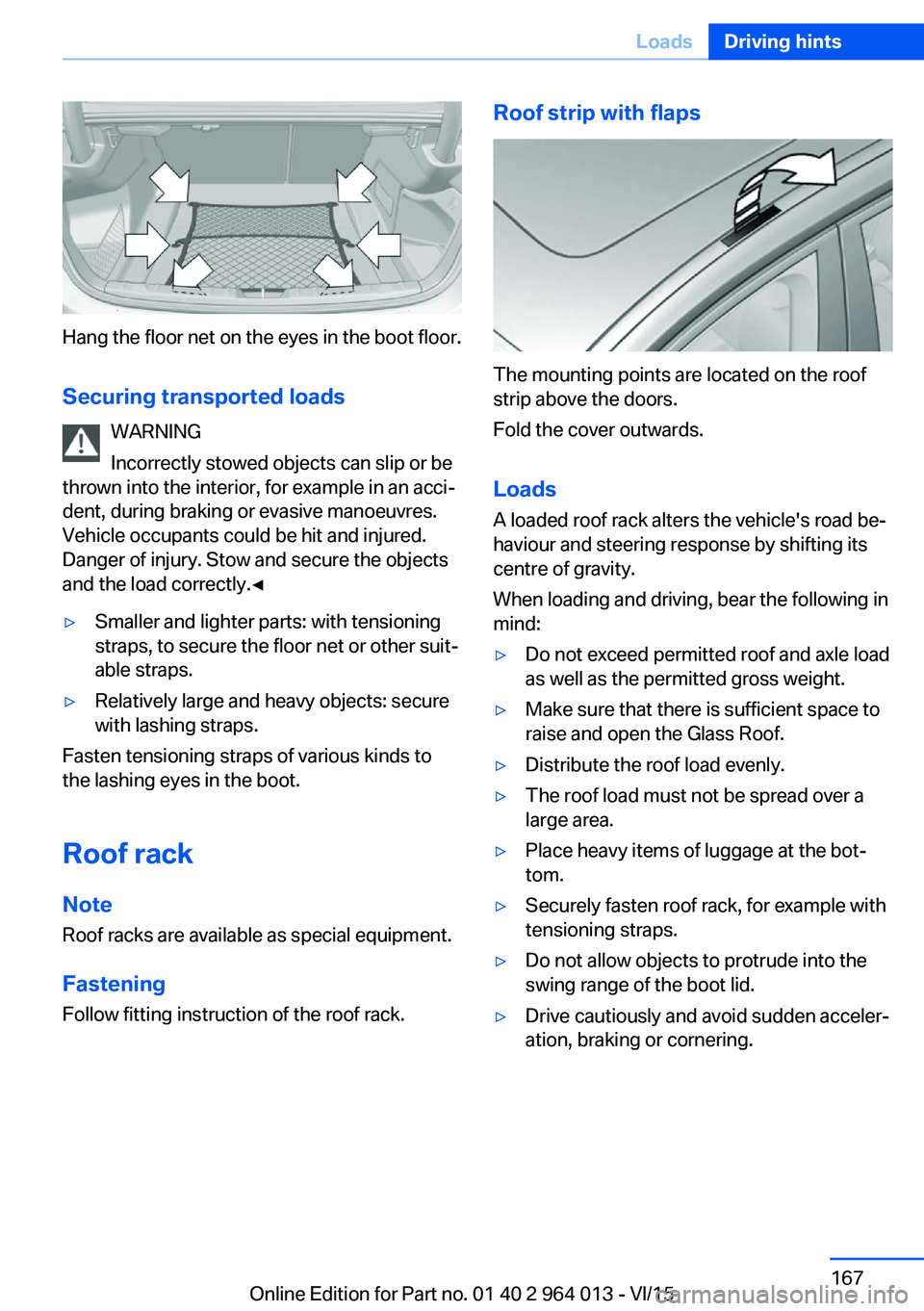
Hang the floor net on the eyes in the boot floor.Securing transported loads WARNING
Incorrectly stowed objects can slip or be
thrown into the interior, for example in an acci‐
dent, during braking or evasive manoeuvres.
Vehicle occupants could be hit and injured.
Danger of injury. Stow and secure the objects
and the load correctly.◀
▷Smaller and lighter parts: with tensioning
straps, to secure the floor net or other suit‐
able straps.▷Relatively large and heavy objects: secure
with lashing straps.
Fasten tensioning straps of various kinds to
the lashing eyes in the boot.
Roof rack Note
Roof racks are available as special equipment.
Fastening Follow fitting instruction of the roof rack.
Roof strip with flaps
The mounting points are located on the roof
strip above the doors.
Fold the cover outwards.
Loads
A loaded roof rack alters the vehicle's road be‐
haviour and steering response by shifting its
centre of gravity.
When loading and driving, bear the following in
mind:
▷Do not exceed permitted roof and axle load
as well as the permitted gross weight.▷Make sure that there is sufficient space to
raise and open the Glass Roof.▷Distribute the roof load evenly.▷The roof load must not be spread over a
large area.▷Place heavy items of luggage at the bot‐
tom.▷Securely fasten roof rack, for example with
tensioning straps.▷Do not allow objects to protrude into the
swing range of the boot lid.▷Drive cautiously and avoid sudden acceler‐
ation, braking or cornering.Seite 167LoadsDriving hints167
Online Edition for Part no. 01 40 2 964 013 - VI/15
Page 172 of 228
RefuellingVehicle equipmentThis chapter describes all standard, national
and special equipment provided in the model
series. Equipment not available in the vehicle is
therefore also described, for example the se‐
lected special equipment or national version.
This also applies to safety-relevant functions
and systems. Comply with the relevant na‐
tional regulations when using the correspond‐
ing functions and systems.
Notes Before refuelling, observe notes on fuel quality,
see page 174.
ATTENTION
If the range drops below 50 km, approx.
30 miles, the engine could not be supplied
anymore with sufficient fuel. Engine functions
are not ensured anymore. Danger of damage
to property. Refuel in good time.◀
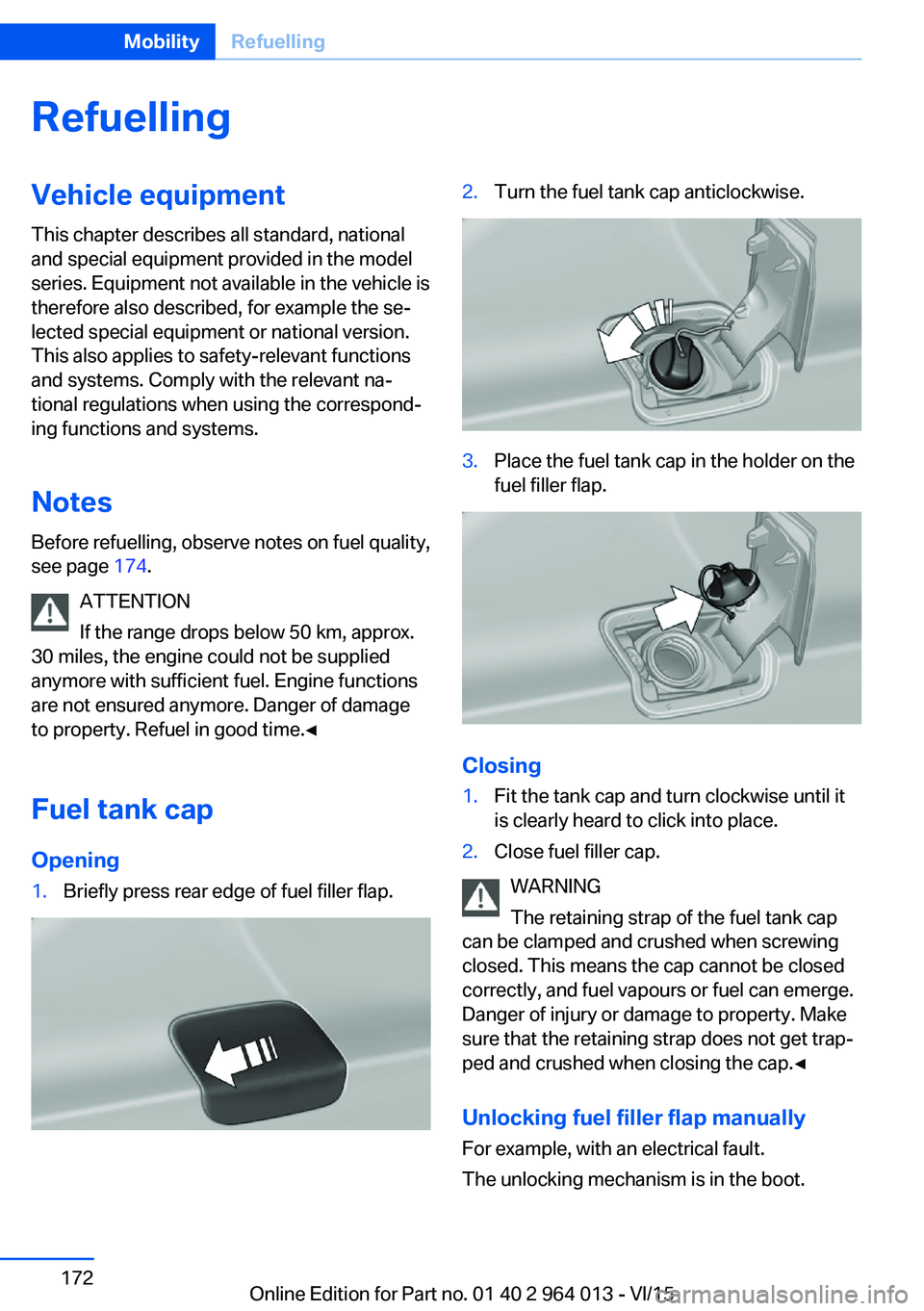
Fuel tank cap Opening1.Briefly press rear edge of fuel filler flap.2.Turn the fuel tank cap anticlockwise.3.Place the fuel tank cap in the holder on the
fuel filler flap.
Closing
1.Fit the tank cap and turn clockwise until it
is clearly heard to click into place.2.Close fuel filler cap.
WARNING
The retaining strap of the fuel tank cap
can be clamped and crushed when screwing
closed. This means the cap cannot be closed
correctly, and fuel vapours or fuel can emerge.
Danger of injury or damage to property. Make
sure that the retaining strap does not get trap‐
ped and crushed when closing the cap.◀
Unlocking fuel filler flap manually
For example, with an electrical fault.
The unlocking mechanism is in the boot.
Seite 172MobilityRefuelling172
Online Edition for Part no. 01 40 2 964 013 - VI/15
Page 178 of 228
ted speed for the tyres fitted must be dis‐
played in the driver's field of view. The sticker
is available from a Service Partner or a qualified
specialist workshop.
If winter tyres are fitted, observe and comply
with the respectively permitted maximum
speed.
Interchanging front and rear wheels
The manufacturer of your vehicle advises
against interchanging the front and rear
wheels. This could impair vehicle handling
Such a change is not permitted in vehicles with
different tyre or rim dimensions on the front
and rear axles.
Tyre storage
Store wheels and tyres in a cool, dry and pref‐
erably dark place when not in use.
Protect tyres against contamination from oil,
grease and fuel.
Do not exceed the maximum tyre pressure in‐
dicated on the tyre's side wall.
Remedying flat tyres Safety measures▷Park the vehicle on a solid surface and as
far away from moving traffic as possible.▷Switch on hazard warning lights.▷Protect the vehicle against rolling, by ap‐
plying the parking brake.▷Engage the steering wheel lock in the
straight ahead position of the wheels.▷Allow all vehicle occupants get out of the
vehicle and guide them out of the danger
area, for example behind the crash barrier.▷Set up warning triangle an appropriate dis‐
tance away.Mobility system
Principle With the mobility system, minor tyre damage
can be quickly sealed, to allow you to drive on.
To do that, liquid sealant is pumped into the
tyres which encloses the damage from the in‐ side when it hardens.
The compressor can be used to check the tyre
inflation pressure.
Notes▷Please observe the notes on the applica‐
tion of the Mobility system which are on
the compressor and the sealant container.▷Applying the Mobility system can be inef‐
fective for tyre damage as from a size of
approximately 4 mm.▷Contact a Service Partner or a qualified
specialist workshop if you are unable to put
the tyre back in operation.▷If possible, foreign matter that has penetra‐
ted the tyre should remain inside the tyre.▷Remove the speed limit sticker from the
sealant container and attach to the steer‐
ing wheel.▷Using sealants can damage the TPM wheel
electronics. If sealant is used, check the
electronics as soon as you get an opportu‐
nity and have them replaced if necessary.
DANGER
A blocked exhaust pipe or inadequate
ventilation can allow harmful exhaust fumes to
penetrate the vehicle. The exhaust gas con‐
tains carbon monoxide, which is colourless and
odourless, but highly toxic. In enclosed spaces,
the exhaust fumes can also build up outside
the vehicle. Danger of fatal injury. Keep the ex‐
haust pipe clear and ensure sufficient ventila‐
tion.◀
Storage
Mobility system is located under boot floor.
Seite 178MobilityWheels and tyres178
Online Edition for Part no. 01 40 2 964 013 - VI/15
Page 181 of 228
3.Take the filler hose of the sealant container
that was previously connected to the tyre
valve and connect it to the free connection
on the sealant container.
This can prevent sealant residues from es‐
caping from the container.4.Pack empty sealant container to avoid soil‐
ing in the boot.5.Store Mobility system in the vehicle again.
Spreading sealant compound
Immediately drive for approximately
10 km/5 mi to evenly distribute the sealing
compound in the tyre.
Do not exceed a speed of 80 km/h/50 mph.
If possible, do not drive slower than
20 km/h/12 mph.
Correcting the tyre inflation pressure
1.Stop in a suitable area.2.Bolt the connecting hose of the compres‐
sor directly onto the tyre valve.3.Insert the plug into the socket on the inside
of the vehicle.4.Correct tyre inflation pressure to 2.5 bar.▷Increase pressure: switch on the com‐
pressor with the engine running or the
ignition switched on.▷Reduce pressure: press the button on
the compressor.
Continuing with journey
Do not exceed maximum permitted speed of
80 km/h, approximately 50 mph.
Reinitialise runflat indicator.
Reinitialise Tyre Pressure Monitor.
Have the punctured tyre and the sealant con‐
tainer of the Mobility system replaced as soon
as possible.
Snow chains
Fine-link snow chains Only certain fine-link snow chains have been
tested, found safe for use in traffic, and cate‐
gorised as suitable by the manufacturer of your
vehicle.
Information regarding suitable snow chains is
available from a Service Partner or a qualified
specialist workshop.
Using Snow chains may only be used in pairs on the
rear wheels with tyres of the following sizes:▷255/40 R 18.▷255/35 R 19.
Observe the snow chain manufacturer's notes.
Ensure that the snow chains are always ade‐
quately taut. Re-tighten them if necessary in
accordance with the chain manufacturer's in‐
structions.
Do not initialise the runflat indicator with snow
chains fitted, as the instrument might other‐
wise issue an incorrect reading.
Do not initialise the Tyre Pressure Monitor with
snow chains fitted, as the instrument might
otherwise issue an incorrect reading.
When driving with snow chains, activate M Dy‐
namic Mode briefly if necessary.
Maximum speed with snow chains
When snow chains are fitted, do not exceed
50 km/h, 30 mph.
Seite 181Wheels and tyresMobility181
Online Edition for Part no. 01 40 2 964 013 - VI/15
Page 193 of 228
Replacing partsVehicle equipmentThis chapter describes all standard, national
and special equipment provided in the model
series. Equipment not available in the vehicle is
therefore also described, for example the se‐
lected special equipment or national version.
This also applies to safety-relevant functions
and systems. Comply with the relevant na‐
tional regulations when using the correspond‐
ing functions and systems.
On-board tool kit
The on-board toolkit is located in a compart‐
ment on the right in the boot. Open the cover.
Replacing the wiper blades Note ATTENTION
The windscreen can be damaged if the
wiper arm drops onto the windscreen without
wiper blades fitted. Danger of damage to prop‐
erty. Hold the wiper arm firmly when changing
the wiper blades and do not put the wipers into
contact with the windscreen unless wiper
blades are fitted.◀
Wiper blades, replacing1.To replace the wiper blades, place the wip‐
ers in the fold-out position, see page 72.2.Fold out wiper arm and hold firm.3.Press together securing spring, arrow 1,
and fold out the wiper blade, arrow 2.4.Take the wiper blade forwards out of the
fitting.5.Insert new wiper blade in the opposite se‐
quence until it engages.6.Fold in wipers.
ATTENTION
When wipers are folded away from the
windscreen, they can be trapped when the
bonnet is opened. Danger of damage to prop‐
erty. Before opening the bonnet, make sure
that the wipers with wiper blades fitted are in
contact with the windscreen.◀
Replacing bulbs
Information
Lights and bulbs
Lights and bulbs are an important aspect of
driving safety.
The manufacturer of the vehicle recommends
that you have the corresponding work carried
out by a Service Partner or a qualified special‐
Seite 193Replacing partsMobility193
Online Edition for Part no. 01 40 2 964 013 - VI/15