2016 AUDI TT COUPE child lock
[x] Cancel search: child lockPage 223 of 322

Downloaded from www.Manualslib.com manuals search engine ..... N
G: CX)
..... I.Cl U"I
..... I.Cl .....
Booster seats and safety belts
Properly used booster seats can help protect
children weighing between about 40 lbs and
80 lbs (18 kg and 36 kg) who are less than 4 ft 9
in (57 in/1.45 m) tall.
Fig. 169 Rear seat; chil d properly restrained in a booster
seat
The vehicle's safety belts alone will not fit most
children until they are at least 4 ft 9 in (57 in/
1.45 m) tall and weigh about 80 lbs (36 kg).
Booster
seats raise these children up so that the
safety belt will pass properly over the stronger
parts of their bodies and the safety belt can help
protect them in a crash.
.. Do not use the convertible locking retractor
when using the vehicle's safety belt to restrain
a child on a
booster seat.
.. The shoulder belt must lie as close to the cen
ter of the child's collar bone as possible and
must lie flat and snug on the upper body. It
must never lie across the throat or neck. The
lap
belt must lie across the pelvis and never
across
the stomach or abdomen. Make sure the
belt lies flat and snug. Pull on the belt to tight
en if necessary .
.. Secure unused safety belts on the rear seat
~page 217.
Children up to at least 8 years old (over 40 lbs or
18 kg) are best protected in child safety seats de
signed for their age and weight. Experts say that
the skeletal structure, particularly the pelvis, of
these children is not fully developed, and they
must not use the vehicle safety belts without a
suitable child restraint.
Child safety
It is usually best to put these children in appro
priate booster seats. Be sure the booster seat
meets all applicable safety standards.
Booster seats raise the seating position of the
child and reposition both the lap and shoulder
parts of the safety belt so that they pass across
the child's body in the right places. The routing of
the belt over the child's body is very important
for the child's protection, whether or not a boos
ter seat is used . Children age 12 and under must
always ride in the rear seat.
Never use the lap belt portion of the vehicle's
safety belt alone to restrain any child, regardless
of how big the child is. Always remember that
children do not have the pronounced pelvic struc
ture required for the proper function of lap belt
portion of the vehicle's three point lap and
shoulder belts. The child's safety absolutely re
quires
that a lap belt portion of the safety belt be
fastened snugly and as low as possible around
the pelvis. Never let the lap belt portion of the
safety belt pass over the child's stomach or abdo
men.
In a crash, airbags must inflate within a blink of
an eye and with considerable force. In order to do
its job, the airbag needs room to inflate so that it
will be there to protect the occupant as the occu
pant moves forward into the airbag .
A vehicle
occupant who is out of position and too
close to the airbag gets in the way of an inflating
airbag.
When an occupant is too close , he or she
will be struck violently and will receive serious or
possibly even fatal injury.
In
order for the airbag to offer protection, it is
important that all vehicle occupants, especially
any children,
who must be in the front seat be
cause
of exceptional circumstances, be properly
restrained and as far away from the airbag as
possible. By keeping room between the child's
body
and the front of the passenger compart
ment, the airbag can inflate completely and pro
vide
supplemental protection in certain frontal
collisions .
221
Page 225 of 322
Downloaded from www.Manualslib.com manuals search engine ride on the front passenger's seat. Children less
than 4 ft 9 in (57 in/1.45 m) tall must sit on a
certified booster seat and properly wear the veh i
cle's three-point lap and shoulder safety belt.
Always
securely latch the passenger seat at the
very rear of its fore and aft adjustment range.
The backrest must be adjusted to an upright po
sition .
A WARNING
If you must install a booster seat child re
straint on the front passenger seat:
-Make sure the booster seat has been de
signed and certified by its manufacturer for
use on a front seat with a passenger front
and side airbag.
- Always follow
the manufacturer's instruc
t i
ons prov ided with the booster seat.
-Always move the passenger seat to the very
rear of its fore and aft adjustment range, as
far away from the airbag as possible .
- Always
make sure that the passenger seat is
securely latched in place before installing
the booster seat. The backrest must be ad
justed to an uprig ht position.
-If the passenger seat cannot be securely
latched in the very rear of its fore and aft
adjustment range, then the passenger front
airbag must be turned off with the ON I OFF
switch.
Securing child seats
Securing a child safety seat using a safety
belt
Safety belts for the rear seats and the front pas
senger can be Locked with the convertible Locking
retractor to properly secure child safety seats.
The safety belts emergency locking retractors for
the rear seats safety belts and for the front pas
senger's seat safety belt have a convertible lock
i ng
retractor for child restraints. The safety belt
must be locked so that belt webbing cannot un
reel. The
retractor can be activated to lock the
safety belt and prevent the safety belt webbing
from loosening up during normal driving. A child
safety seat can only be properly installed when
Child safety
the safety belt is locked so that the chi ld and
child safety seat will stay in place .
Always
remember : Even though your veh icle is
equipped with an Advanced Airbag system, all
children, especia lly those 12 years and younger,
should a lways ride in the back seat properly re
strained for their age and size.
A WARNING
Improperly installed child safety seats in
crease the risk of serious personal injury and
death in a collision.
-
- Always make sure that the safety be lt re
tractor is locked when installing a child
safety seat. An unlocked safety belt retrac
tor cannot hold the child safety seat in place
du ring
normal d riving or in a c rash.
-Always buckle the child safety seat firmly in
place even if a ch ild is not sitting in it. A
loose child
safety seat can fly around during
a
sudden stop or in a co llision.
- Always
make sure that the rear seat back
rest is secu rely latched whenever the rear
safety belt is being used to secure a child re
straint.
-
If the backrest is not secu rely latched, the
chi ld and t he child restraint will be thrown
forward together with the backrest and will
strike parts of the vehicle interior. The child
can
be seriously injured or killed.
- Never
install rear-facing child safety seats
or infant carriers on the front passenger
seat. A child w ill be seriously injured and
can be killed when the passenger a irbag in
f lates.
- The inflating airbag will hit the ch ild safety
seat or infant carrier with great force and
will smash the child safety seat and child
against the backrest, center armrest, door
or roof.
-Always install rear-fac ing ch ild safety seats
or infant carriers on the rear seat.
- Forward-facing child
safety seats or infant
carriers installed on the front passenger's
seat may interfere with the deployment of
the airbag and ca use serious injury to the
child.
223
Page 227 of 322

Downloaded from www.Manualslib.com manuals search engine ...... N
G'. CX)
..... ID IJ' ..... ID .....
Activating the convertible locking retractor
Use the convertible locking retractor to secure a
child restraint.
Always heed the child safety seat manufacturer's
instructions when installing a child restraint in
your vehicle. To activate the convertible locking
retractor:
.. Place the child restraint on a seat, preferably
on the rear seat.
.. Slowly pull the belt all the way out.
.. Route it around or through the child restraint
belt path <:!> .&,..
"'Push the child safety seat down with your full
weight to get the safety belt really tight.
.. Insert the belt tongue into the buckle for that
seating position .
.. Guide the safety belt back into the retractor un
til
the belt lies flat and snug on the child safety
seat.
.. You should hear a "clicking" noise as the belt
winds back into the inertia reel. Test the con
vertible locking retractor by pulling on the belt.
You should no longer be able to pull the belt
out of the retractor. The convertible locking re
tractor is now activated .
.. Make sure that the red release button is facing
away from
the child restraint so that it can be
unbuckled quickly.
.. Pull on the belt to make sure the safety belt is
properly
tight and fastened so that the seat
cannot move forward and sideways more than
1 in (2.S cm).
.&_WARNING
Usi ng the wrong child restraint or an improp
erly installed child restraint can cause serious
personal injury or death in a crash.
- Always
make sure that the safety belt re
tractor is locked when installing a child
safety seat. An unlocked safety belt retrac
tor cannot hold the child safety seat in place
during
normal driving or in a crash.
- Always buckle
the child safety seat firmly in
place even if a child is not sitting in it. A
loose child safety seat can fly around during
a
sudden stop or in a crash.
Child safety
- Always make sure the seat backrest to which
the child restraint is installed is in an up
right position and securely latched into
place and cannot fold forward. Otherwise,
the seatback with the child safety seat at
tached to it could fly forward in the event of
an accident or other emergency situation.
-Always read and heed all WARNINGS when
ever using a child restrained in a vehicle is
being
used <:!>page 212. Special precautions
apply when installing a child safety seat on
the front passenger seat <:!>page 189, Child
restraints on the front seat-some impor
tant things to know.
Deactivating the convertible locking
retractor
The convertible locking retractor for child re
straints will be deactivated automatically when
the
belt is wound all the way back into the re
tractor.
.. Press the red button on the safety belt buckle.
The
belt tongue will pop out of the buckle.
.. Guide the safety belt all the way back into its
stowed position.
Always
let the safety belt retract completely into
its stowed position. The safety belt can now be
used as an ordinary safety belt without the con
vertible locking retractor for child restraints.
If the convertible locking retractor should be ac
tivated inadvertently, the safety belt must be un
fastened and guided completely back into its
stowed position to deactivate this feature. If the
convertible locking retractor is not deactivated,
the safety belt will gradually become tighter and
uncomfortable to wear.
.&. WARNING
Improperly installed child safety seats in
crease the risk of serious personal injury and
death in a collision.
----'
- Never unfasten the safety belt to deactivate
the convertible locking retractor for child re
straints while the vehicle is moving. You
225
Page 230 of 322

Downloaded from www.Manualslib.com manuals search engine Child safety
•Attach both hook-on connectors with the spring
catch release on the child safety seat onto the
LATCH lower anchorage so that the connectors
lock into place Q fig. 173.
• Pull on the connector attachments to make
sure they are properly attached to the LATCH
lower anchorage.
• Pull straps tight following the child restraint
manufacturer's instructions.
Releasing
• Loosen the tension on the straps following the
child restraint manufacturer's instructions.
• Depress the spring catches to release the an
chorage hooks from the lower anchorages.
Remember: Use tether straps to help keep the
child restraint fir m ly in place .
A WARNING
Improper use of the LATCH system can in
crease the risk of serious personal injury and
death in an accident.
- These
anchors were developed only for child
safety seats using the "LATCH" system.
-Never attach other child safety seats, belts
or other objects to these anchors.
- Always
make sure that you hear a click when
la tching
the seat in place. If you do not hear
a click the seat is not secure and could fly
forward
and hit the interior of the vehicle,
or be ejected from the vehicle.
A WARNING
Improper installation of c hild restraints will
increase
the risk of i njury in an accident.
-Always follow the child restraint system
manufacturer's instructions for proper in
stallation of the child restraint system and
proper use of tether straps as well as the
lower anchorages or safety belts in your ve
hicle.
- Always read and
heed the important infor
mation and WARNINGS about child safety
and the installation of child restraint sys
tems Q page 212, Child safety.
228
Tether anchors and tether straps
Fig. 174 Tether anchors : attachment hook locations be·
hind th e rear seatbacks
The tether anchors for the rear seating positions
are located on the backside of the rear seat·
backs.
A
tether is a straight or V-shaped strap that at
taches the top part of a child restraint to special
anchorage points in the vehicle.
The
purpose of the tether is to reduce the for
ward movement of the child restraint in a crash,
in order to help reduce the risk of head injury
that could be caused by striking the vehicle inte
rior.
Forward facing child
restraints manufactured af
ter September 1, 1999, are required by U.S. fed
eral regulations to comply with new child head
movement performance requirements. These
new
performance requirements make a tether
necessary on most new child safety seats.
A WARNING
Improper installation of child restraints will
increase
the risk of injury and death in a
crash.
-Always follow the instructions provided by
the manufacturer of the child restraint you
intend to install in your Audi.
-
Improper use of child restraint anchors (in
cluding tether anchors) can lead to injury in
a collision. The anchors are designed to
withstand only those loads imposed by cor
rectly fitted child restraints.
-Never mount two child restraint systems on
-
one LATCH lower anchor point. ..,.
Page 245 of 322

Downloaded from www.Manualslib.com manuals search engine ...... N
> u. CX> ...... u:>
"' ...... u:> ......
Read and follow the WARNINGS before check
ing anything
in the engine compartment
Qpage236.
Checking the engine coolant level
""Park your vehicle on a level surface.
"" switch the ignition off.
.. Read the coolant level on the coolant expansion
tank
Q page 238, fig. 184. The coolant level
must be between the markings when the en
gine
in cold. When the engine is warm it can be
slightly above
the upper marking.
Adding coolant
Requirement: there must be a res idual amount of
coo l
ant in the expans io n tank c:?(i) .
""Let the engine cool down.
.. Place a cloth over the coolant expansion tank
cap and unscrew
the cap counterclockwise
c:?,8..
""Add coolant mixed in the correct ratio
i:?page 242 up to the upper marking.
""Make sure that the fluid level remains stable.
Add more coolant if necessary.
"" Close the cap securely .
A coolant loss suggests a leak. Immediately drive
your vehicle
to an authorized Audi dealer or au
thorized
Audi Service Facility and have the cool
ing system inspected.
If the cooling system is not
leaking, a loss can come from
the coolant boiling
through overheating and being pushed
out of the
cooling system.
.&. WARNING
-The cooling system is pressurized and can be-
come very hot.
To reduce the risk of burns
from hot coolant:
-
Do not open the coolant expansion tank cap
w ith
the engine hot. There is a risk of burns .
- Stop
the engine and allow it to cool.
-
Protect your face, hands and arms from es-
caping coolant and
steam by covering the
coolant tank cap with a large, thick cloth.
- Turn
the coolant tank cap counterclockwise
slowly and keep light pressure on
the cap.
-
To reduce the risk of burns, do not allow any
antifreeze or coolant to dr
ip onto the ex-
Checking and Filling
ha ust system or hot engine components.
The ethylene glycol in engine coolant can
catch fire under certain circumstances.
- The coolant additive and the coolant can be
dangerous to your health.
For this reason,
keep
the coolant in the original container
away from children. There is a
risk of poi
soning.
-When working in the engine compartment,
remember
that the radiator fan can switch
on even if
the ignition is switched off, which
increases
the risk of personal injury.
CD Note
Do not add coolant if the expans ion tank is
empty . Air could enter the cooling system and
damage
the eng ine. If this is the case, do not
continu e driving. See an authorized
Audi dea l
er or authorized
Audi Service Facility for assis
tance.
Radiator fan
The radiator fan switches on automatically by it
self.
An auxiliary electric radiator fan switches on and
off depending on coolant temperature and other
vehicle operating conditions.
After you switch
the engine off, the auxiliary fan
can continue running for
up to 10 minutes -even
with
the ignit ion off. It can even switch on again
later by itself c:? & . if
- the temperature of
the engine coolant rises due
to
the heat build-up from the engine in the en
gine compartment, or
-
the engi ne compartment heats up because the
vehicle is parked in intense sunlight.
.&. WARNING
-To reduce the risk of personal injury never
touch
the radiator fan.
- The auxiliary electric fan
is temperature
controlled and can switch on suddenly even
when
the engine is not running.
243
Page 246 of 322
Downloaded from www.Manualslib.com manuals search engine Checking and Filling
-The auxiliary radiator fan switches on auto
matically when the engine coolant reaches a
certain temperature and will continue to run
until the coolant temperature drops.
Brake fluid
Checking brake fluid level
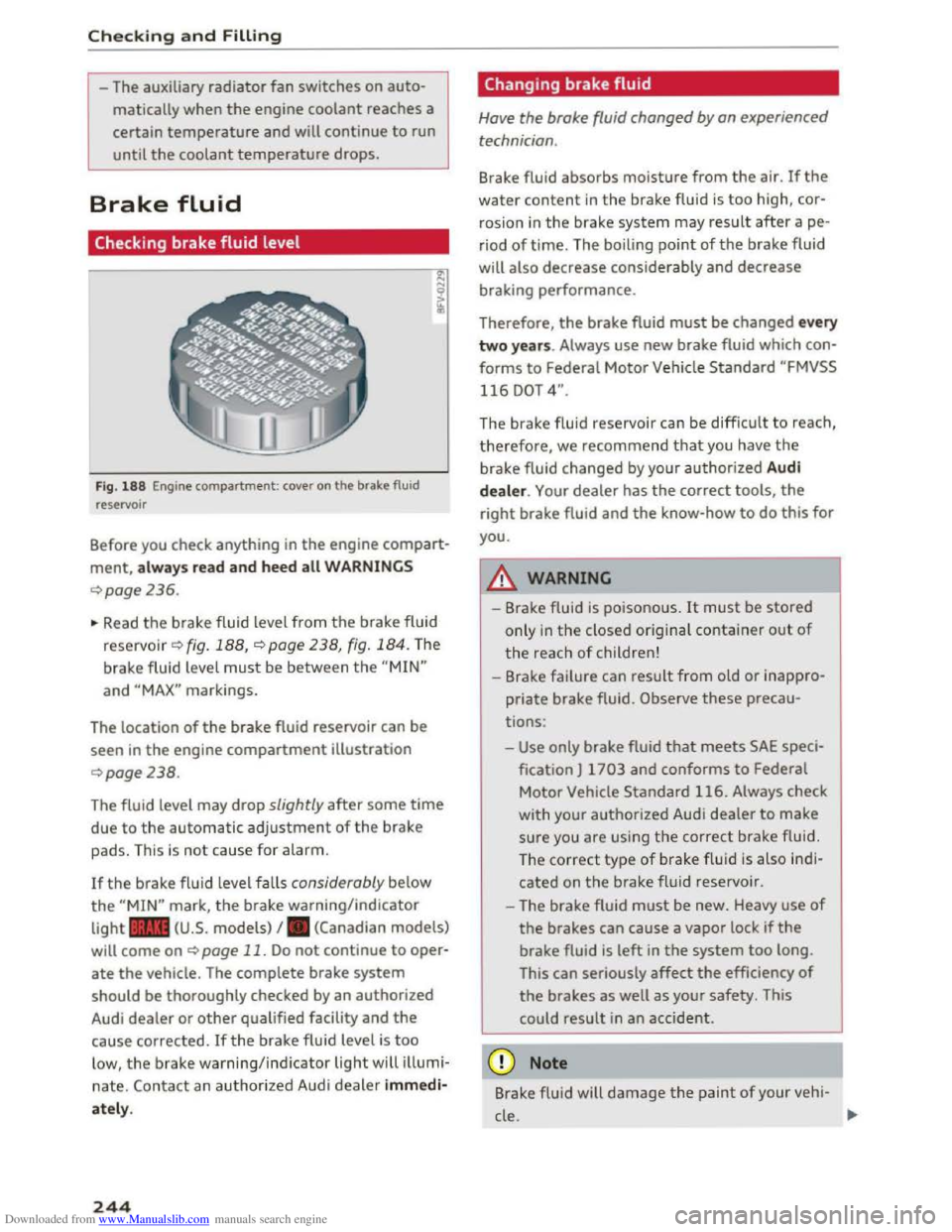
Fig. 188 Engine compartment: cover on the brake fluid
reservoir
Before you check anything in the engine compart
ment, always read and heed all WARNINGS
¢page 236.
~ Read the brake fluid level from the brake fluid
reservo ir ¢ fig. 188, ¢page 238, fig. 184. The
brake fluid level must be between the "MIN"
and "MAX" markings.
The location
of the brake fluid reservoir can be
seen in the engine compartment illustration
¢page238.
The fluid level may drop slightly after some time
due to the automatic adjustment of the brake
pads. This is not cause for alarm.
If the brake fluid level falls considerably below
the "MIN" mark, the brake warning/indicator
light .. (U.S. models) I. (Canadian models)
will come on ¢ page 11. Do not continue to oper
ate the vehicle. The complete brake system
should be thoroughly checked by an authorized
Audi dealer or other qualified facility and the
cause corrected. Ifthe brake fluid level is too
low, the brake warning/indicator light will illumi
nate. Contact an authorized Audi dealer immedi
ately.
244
Changing brake fluid
Have the brake fluid changed by an experienced
technician .
Brake fluid absorbs moisture from the air. If the
water content in the brake fluid is too high, cor
rosion in
the brake system may result after ape
riod of time. The boiling point of the brake fluid
will
also decrease considerably and decrease
braking performance.
Therefore, the brake fluid must be changed every
two years. Always use new brake fluid which con
forms to Federal Motor Vehicle Standard "FMVSS
116 DOT 4".
The brake fluid reservoir can be difficult to reach,
therefore, we recommend that you have the
brake fluid changed by your authorized Audi
dealer. Your dealer has the correct tools, the
right brake fluid and the know-how to do this for
you.
8._ WARNING
- Brake fluid is poisonous. It must be stored
only in the closed original container out of
the reach of children!
-Brake failure can result from old or inappro
priate brake fluid. Observe these precau
tions:
-Use only brake fluid that meets SAE speci
fication
J 1703 and conforms to Federal
Motor Vehicle Standard 116. Always check
with
your authorized Audi dealer to make
sure you are using the correct brake fluid.
The
correct type of brake f lui d is also ind i
cated on the brake fluid reservoir .
- The
brake fluid must be new. Heavy use of
the brakes can cause a vapor lock if the
brake fluid is left in the system too long.
This
can seriously affect the efficiency of
the brakes as well as your safety. This
could
result in an accident.
CD Note
Brake flu id will damage the paint of your veh i-
cle .
JIJ.
Page 303 of 322

Downloaded from www.Manualslib.com manuals search engine ...... N
G'. CX)
...... ID VI ...... ID ......
A
A/C (climate control system) . . . . . . . . . . . . . 53
Accessing media . . . . . . . . . . . . . . . . . . . . . .
159
Accessories . . . . . . . . . . . . . . . . . . . . . . . . . . 296
Active lane assist .
. . . . . . . . . . . . . . . . . . . . . 74
Activating vibration warning . . . . . . . . . . . . 76
Adjusting steering
time . . . . . . . . . . . . . . . . 76
Indicator light . . . . . . . . . . . . . . . . . . . . . . . 75
Messages . . . . . . . . . . . . . . . . . . . . . . . . . . . 75
switching on and
off . . . . . . . . . . . . . . . . . . 7S
Adaptive dampers . . . . . . . . . . . . . . . . . . . . . . 80
Adaptive light (indicator light) . . . . . . . . . . . 17
Adjusting air
distribution (Climate control sys-
tem) . . . . . . . . . . . . . . . . . . . . . . . . . . . . . . . . S3
Adjusting the air vents . . . . . . . . . . . . . . . . . . 54
Adjusting the center console lighting . . . . . . 39
Adjusting the sound (tone) . . . . . . . . . . . . . 169
Adjusting the temperature (climate control
system) . . . . . . . . . . . . . . . . . . . . . . . . . . . . . . 53
Adjusting
the volume
Multifunction steering wheel
Advanced Airbag
System
21,22, 104
Children ...........................
Components ....................... .
Front airbags
...................... .
How
the components work together ... .
Airbag
............................. .
Indicator light ...................... .
Airbag system
....................... .
Advanced Airbag-System
............. .
Care ..............................
Child restraints .....................
Components (front airbags) .......... .
Danger
of fitting a child safety seat on the
front passenger seat ................ .
Disposal
.......................... .
Front airbags
...................... .
How do
the front airbags work? ....... .
How many airbags does
my vehicle have?
Important information ...............
213
19S
193
197
188
15
207
192
202
214
195
189
202
192
197
195
188
Important safety instructions on the knee
airbag system . . . . . . . . . . . . . . . . . . . . . . .
205
Knee airbags . . . . . . . . . . . . . . . . . . . . . . . . 204
Monitoring . . . . . . . . . . . . . . . . . . . . . . . . . 199
PASSENGER AIR BAG OFF light . . . . . . . . . 200
Repairs . . . . . . . . . . . . . . . . . . . . . . . . . . . . 202
Safety instructions . . . . . . . . . . . . . . . . . . . 202
Index
Side airbags . . . . . . . . . . . . . . . . . . . . . . . . 206
Side curtain airbags . . . . . . . . . . . . . . . . . . 209
Warning/Indicator lights . . . . . . . . . . . . . 199
When must the system be inspected? . . . 199
Alarm system
refer to Anti-theft alarm system . . . . . . 25, 30
Alignment pin (tire changing) . . . . . . . . . . . 275
All season tires . . . . . . . . . . . . . . . . . . . . . . . 264
All weather lights . . . . . . . . . . . . . . . . . . . . . . 36
All wheel drive . . . . . . . . . . . . . . . . . . . . . . . . 91
Ambient lighting . . . . . . . . . . . . . . . . . . . . . . 38
AMI
refer to Audi music interface . . . . . . . . . . . 155
Announcements (settings)
refer to Voice guidance . . . . . . . . . . . . . . . 138
Anti-freeze
Windshield washer system . . . . . . . . . . . .
248
Anti-lock braking system (ABS) . . . . . . . . . . . 87
Anti-slip regulation . . . . . . . . . . . . . . . . . . . . 87
Anti-theft alarm system . . . . . . . . . . . . . . . . . 30
Ashtray ............................. . 47
162 Aspect (video) ............. . ..........
Audi connect . . . . . . . . . . . . . . . . . . . . . . . . . 121
Activating . . . . . . . . . . . . . . . . . . . . . . . . . . 121
Configuring . . . . . . . . . . . . . . . . . . . . . . . . 126
Connecting . . . . . . . . . . . . . . . . . . . . . . . . . 121
Connection settings . . . . . . . . . . . . . . . . . . 167
Data connection . . . . . . . . . . . . . . . . . . . . . 127
Data protection . . . . . . . . . . . . . . . . . . . . . 129
Functions
. ......................... 123
Navigation . . . . . . . . . . . . . . . . . . . . . 123, 134
Notes ............................. 128
Options . . . . . . . . . . . . . . . . . . . . . . . . . . . . 125
Preview . . . . . . . . . . . . . . . . . . . . . . . . . . . . 123
Requirements. . . . . . . . . . . . . . . . . . . . . . .
121
Services . . . . . . . . . . . . . . . . . . . . . . . . . . . 123
Audi connect services
Media . . . . . . . . . . . . . . . . . . . . . . . . . . . . .
12S
Navigation . . . . . . . . . . . . . . . . . . . . . . . . . 12S
Telephone . . . . . . . . . . . . . . . . . . . . . . . . . . 12S
Audi music interface . . . . . . . . . . . . . . . ....
Audi music stream
refer to Wi-Fi audio player ........... .
Audio files
. . . . . . . . . . . . . . . . . . . . . . . . . . .
Audio player
Bluetooth audio player
.............. .
Wi-Fi audio player
.................. .
15S
1S3
159
152
153
301
Page 305 of 322

Downloaded from www.Manualslib.com manuals search engine c
Cable (USB adapter/AUX connection cable) 1S5
California Proposition 65 Warning . . . . . . . 237
Battery specific . . . . . . . . . . . . . . . . . . . . . 246
Call
Accepting/rejecting . . . . . . . . . . . . . . . . . . 113
Holding/resuming . . . . . . . . . . . . . . . . . . . 113
Call list . . . . . . . . . . . . . . . . . . . . . . . . . . . . . 112
Call waiting (telephone) . . . . . . . . . . . . . . . . 119
Canceling route guidance . . . . . . . . . . . . . . . 136
Capacities
Fuel tank. . . . . . . . . . . . . . . . . . . . . . . . . . . 299
Washer fluid reservoir . . . . . . . . . . . . . . . . 299
Care . . . . . . . . . . . . . . . . . . . . . . . . . . . . . . . . 270
Cargo area
refer to Luggage compartment . . . . . . . . . 176
Catalytic converter . . . . . . . . . . . . . . . . . . . . 23S
CD ..... .. .. .. .. ............. .. . 150, 151
Cell phone
Audi phone box . . . . . . . . . . . . . . . . . . . . . 111
Connecting . . . . . . . . . . . . . . . . . . . . . . . . . 110
Playing music . . . . . . . . . . . . . . . . . . . . . . . 152
also refer to Telephone . . . . . . . . . . . . . . . 110
Cell phone compartment
refer to Audi phone box.......... .. .. . 111
Central locking . . . . . . . . . . . . . . . . . . . . . . . . 2S
Central locking switch . . . . . . . . . . . . . . . . . 29
Convenience key . . . . . . . . . . . . . . . . . . . . . . 28
Emergency locking . . . . . . . . . . . . . . . . . . . . 30
Luggage compartment lid . . . . . . . . . . . . . . 30
Power windows . . . . . . . . . . . . . . . . . . . . . . 32
Remote control key . . . . . . . . . . . . . . . . . . . 27
Setting . . . . . . . . . . . . . . . . . . . . . . . . . . . . . 29
Certification . . . . . . . . . . . . . . . . . . . . . . . . . 297
Changing engine oil . . . . . . . . . . . . . . . . . . . 241
Changing light bulbs . . . . . . . . . . . . . . . . . . 287
Changing the scale . . . . . . . . . . . . . . . . . . . . . 20
Characters
Map... .. .. .. .. ............. .. .. .. . 139
Navigation . . . . . . . . . . . . . . . . . . . . . . . . . 139
Charging the battery .............. 111, 155
Child restraint
Danger of using child restraints in the front
seat... .. .. .. .. ............. .. ..... 189
Index
Child restraints
Where can I get additional information
about child restraints and their use? . . . . 230
Child restraint system anchors . . . . . . . . . . 226
Child safety . . . . . . . . . . . . . . . . . . . . . . . . . . 212
Important safety instructions for us ing child
safety seats . . . . . . . . . . . . . . . . . . . . . . . . 215
Tether anchors . . . . . . . . . . . . . . . . . . . . . . 228
Tether straps . . . . . . . . . . . . . . . . . . . . . . . 228
Child safety seat
Unused safety belts on the rear seat 217
Child safety seats
Booster seats . . . . . . . . . . . . . . . . . . . . . . . 221
Convertible child seats . . . . . . . . . . . . . . . 219
How do I properly install a child safety seat
in my vehicle? .. .. ................... 215
Infant seats . . . . . . . . . . . . . . . . . . . . . . . . 218
Installing a child restraint using the LATCH
system ......... .. ................. 227
LATCH system . . . . . . . . . . . . . . . . . . . . . . 227
Lower anchorages . . . . . . . . . . . . . . . . . . . 227
Mounting and releasing the anchorage
hook ....... .. .. ................... 227
Safety instructions................... 215
Child seats . . . . . . . . . . . . . . . . . . . . . . . . . . 218
Securing . . . . . . . . . . . . . . . . . . . . . . . . . . . 223
Cigarette lighter . . . . . . . . . . . . . . . . . . . . . . . 47
City events (Audi connect) . . . . . . . . . . . . . . 123
Cleaning . . . . . . . . . . . . . . . . . . . . . . . . . . . . 270
Cleaning/removing ice from windows . . . . . 272
Cleaning Alcantara . . . . . . . . . . . . . . . . . . . . 273
Cleaning artificial leather . . . . . . . . . . . . . . . 273
Cleaning carbon parts . . . . . . . . . . . . . 272, 273
Cleaning controls . . . . . . . . . . . . . . . . . . . . . 272
Cleaning decorative parts and trim ... 271, 272
Cleaning displays . . . . . . . . . . . . . . . . . . . . . 272
Cleaning exhaust tail pipes . . . . . . . . . . . . . 271
Cleaning plastic parts . . . . . . . . . . . . . . . . . . 272
Cleaning rims . . . . . . . . . . . . . . . . . . . . . . . . 271
Cleaning seat covers . . . . . . . . . . . . . . . . . . . 273
Cleaning tail lights . . . . . . . . . . . . . . . . . . . . 271
Cleaning textiles . . . . . . . . . . . . . . . . . . . . . . 273
Cleaning the Audi virtual cockpit . . . . . . . . . 272
Cleaning the instrument cluster . . . . . . . . . 272
303