2016 AUDI S3 engine oil
[x] Cancel search: engine oilPage 34 of 328
Driver information system
Lap timer and engine oil
temperature indicator
Introduction
Applies to vehicles: with lap timer (S models)
The engine oil temperature is only shown in the
lap timer display.
Lap timer
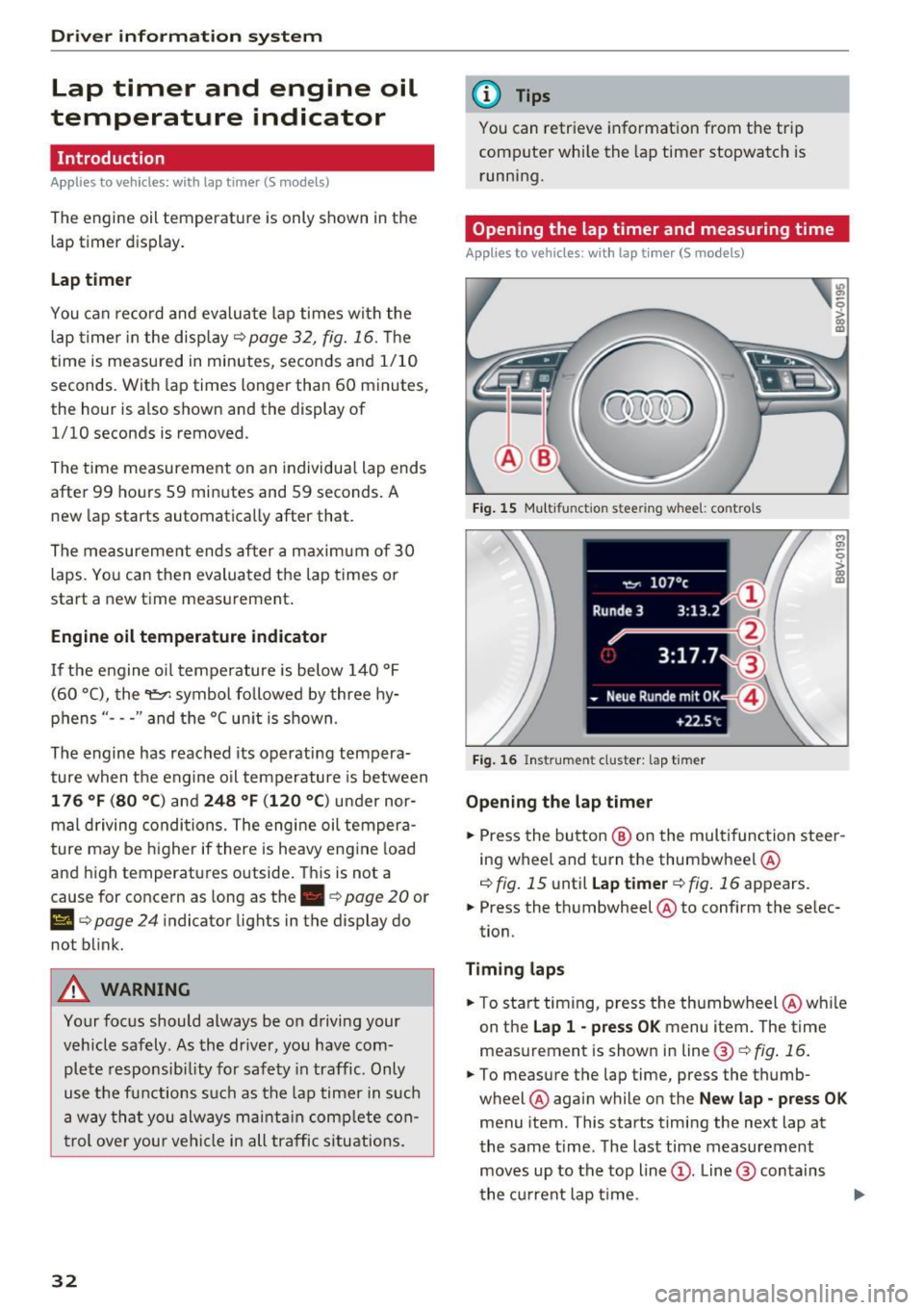
You can record and evaluate lap times with the
lap timer in the display
i=:,page 32, fig. 16. Th e
time is measured in minutes, seconds and
1/10
seconds . With lap times longer than 60 minutes,
the hour is also shown and the display of
1/10 seconds is removed.
The time measurement on an individua l lap ends
after
99 hours 59 minutes and 59 seconds. A
new lap starts automatically after that .
The measurement ends after a maximum of
30
laps. You can then evaluated the lap times or
start a new time measurement .
Engine oil temperature indicator
I f the engine o il temperature is below
140 °F
(60 °C), the 'l=:1: symbol followed by three hy
phens"- --" and the °C un it is shown .
The engine has reached its operating tempera
ture when the engine oil temperature is between
176 °f (80 °C) and 248 °f (120 °C) under nor
mal d riving conditions. The engine oil tempera
ture may be higher if there is heavy eng ine load
and high temperatures outside. This is not a
cause for concern as long as the .¢
page 20 or
Ill i=:,page 24 indicator lights in the display do
not blink.
A WARNING
Your focus should always be on driving your
vehicle safely . As the driver, you have com
plete responsibility for safety in traffic . Only
use the functions such as the lap timer in such
a way that you always maintain complete con
trol over your vehicle in all traffic s ituations.
32
.
@ Tips
You can retrieve information from the trip
computer while the lap timer stopwatch is
running.
Opening the lap timer and measuring time
Applies to vehicles: with lap timer (S models)
Fig. 15 Multi functio n stee ring whee l: co ntro ls
Fig. 16 Instrumen t cluster: lap timer
Opening the lap timer
M 0,
0
> g;:
.. Press the button @ on the multifunction steer
ing wheel and turn the thumbwheel
®
i=:, fig. 15 until Lap timer ¢ fig. 16 appears.
.. Press the thumbwheel
® to confirm the selec
tion.
Timing laps
.. To start timing, press the thumbwheel @while
on the
Lap 1 - press OK menu item. The time
measurement is shown in line @¢
fig. 16.
.. To measure the lap time, press the thumb
wheel
® again while on the New lap· press OK
menu item. This starts timing the next lap at
the same time . The last time measurement
moves up to the top line@. Line @ contains
the current lap t ime .
Page 80 of 328

Driving
If you anticipate what you need to do next and
drive economically, you can easily cut your fuel
consumption by 10-15 percent. This section will
give you some tips on how you can help the envi ronment and your pocketbook.
(D Tips
The consumption estimates as published by ENVIRONMENTAL PROTECTION AGENCY
(EPA) and Transport Canada may not corre
spond to your actual consumption on the
road, which will vary depending upon vehicle
load and speed, road and weather conditions,
trip length, etc.
Drive smoothly and keep a lookout ahead
Vehicles use the most fuel when they are acceler
ating.
.. Avoid unnecessary accelerating and braking .
Vehicles use the most fuel when they are acceler
ating. If you anticipate what is going to happen next, you will need to brake less and, thus, accel
erate less. Let the vehicle coast whenever possi
ble -for example when you see that the next traf
fic light is red.
Avoid full throttle
Driving at moderate speeds saves fuel and im
proves your mileage.
.. Try and keep well below your car's maximum
speed .
Accelerating gently reduces fuel consumption,
engine wear, and does not disturb the environ ment.
Fuel consumption, exhaust emissions and engine
noise increase disproportionately at high speeds.
If you drive at approximately three quarters of
top speed, fuel consumption will be reduced by
one half . Never drive faster than the posted
speed limit and weather conditions permit.
78
· Reducing unnecessary idling
Even when your car is just idling it burns up fuel .
.. Shut the engine off when you are not driving
the vehicle .
.,. Do not warm up the vehicle by letting the en-
gine run at idle .
It is efficient to switch off the engine when stop
ped at railroad crossings and long red lights.
Turning the engine off for just 30 -40 seconds
saves more fuel than is burned by starting the
engine again .
It takes a long time for the engine to warm up
fully when it is running at idle . However, wear
and noxious emissions are especially high when
the engine is warming up . So you should drive
away as soon as you start the engine and avoid running at high rpms while the engine is still
warming up .
@ Note
Do not leave engine idling unattended after
starting. If warning lights should come on to
indicate improper operation, they would go
unheeded. Extended idling also produces
heat, which could result in overheating or
other damage to the vehicle or other proper
ty.
Regular maintenance
A badly tuned engine unnecessarily wastes a lot
of fuel.
.. Have your vehicle serviced at regular intervals.
By having your vehicle regularly serviced by an
Audi dealer helps to ensure that it runs properly
and economically. The condition of your vehicle
not only affects its safety and ability to hold its
value, it also affects
fuel consumption.
Check your oil each time you fill your tank.
The amount of oil used is related to engine load
and speed.
It is normal for the oil consumption of a new en
gine to reach its lowest value after a certain mile -
age has been driven . ..,.
Page 164 of 328

Intelligent Technology
A WARNING
-New brake pads do not achieve their full
braking effect during the first 250 mi
-
(400 km). They must be "broken in" first .
However, you can compensate for the
slightly reduced braking force by pressing
firmly on the brake pedal. Avoid heavy brak
ing during the break-in period.
- Only apply the brakes for the purpose of
cleaning the brake system when road and
traffic conditions permit. You must not en
danger other road users. This increases the
risk of an accident.
- On steep slopes, reduce the speed and se
lect a lower gear or lower selector lever po
sition. Drive as little as possible while press
ing the brake pedal and avoid putting your
left foot on the brake pedal while driving.
This could cause the brakes to overheat and
impair the efficiency of the brakes.
- Do not let the brakes "grind" by always
keeping your foot on the brake pedal. This
can cause the brakes to overheat, increase
wear and increase braking distance unneces
sarily.
- Certain weather and operating conditions
such as driving through water, driving in heavy rain or driving after washing your ve
hicle can impair the effectiveness of the
brakes . In the winter, ice may build up on
the brake pads, rotors and drums. Check
these components by braking carefully. Ap
plying the brakes carefully several times
dries the brakes and removes ice build-up .
- The efficiency of the brakes can also be im
paired by driving for long stretches on roads
covered with salt without using the brakes.
You can remove salt deposits from the brake rotors and pads by carefully applying
the brakes several times.
- If the front spoiler is damaged or you install
another spoiler, make sure the front wheel brakes are ventilated properly . Otherwise,
the brake system could overheat, which re
duces their effectiveness .
- Failure of a brake circuit impairs braking
performance, which increases braking dis -
162
tance. Avoid driving the vehicle and have it
towed it to the nearest authorized Audi
dealer or authorized Audi Service Facility.
- Never let the vehicle roll while the engine is
stopped because this increases the risk of an
accident .
- If the brake booster is not working, you will
have to press much harder on the brake
pedal to compensate for the lack of the
booster.
(D Note
- Never let the brakes "rub" by pressing the
pedal lightly when braking is not really nec
essary. This causes the brakes to overheat
and increases braking distance and causes
wear .
- Before driving on a long stretch with steep
slopes, reduce your speed and shift to the
next lower gear This makes use of the en
gine braking effect and relieves the brakes.
If you need to brake additionally, brake in
intervals and not continuously.
(D Tips
- If the brake booster is not working, you
must press the brake pedal with much more
force than normal.
- If you retrofit your vehicle with a front spoil
er, wheel covers or similar items, make su re
that the air flow to the front wheels is not
interrupted. Otherwise the brake system
can become too hot.
Electromechanical
steering
The electromechanical steering supports the
driver's steering movements.
Power steering adapts electronically based on
the vehicle speed .
The vehicle still has full steering functionality if
the power steering fails or when the engine is
stopped (towing) . To steer, you must apply much
more force than usual. .,.
Page 231 of 328

,....,
N
0 > co ,....,
not a particular fuel blend meets the speci
ficat ions, ask your service station or its fuel
supplier.
- Do not use fuel for which the contents can
not be identified.
- Fuel system damage and performance prob
lems resulting from the use of fue ls diffe r
ent from those specified are not the respon
s ibility of Audi and are not covered under
the New Veh icle or the Emiss ion Control
System Warrant ies .
- If you experience a loss of fue l economy or
driveability and pe rformance prob lems due
to the use of one of these fuel blends, we r ecommend that you switch to unblended
fuel.
Gasoline additives
A ma jor concern among many auto manufactur
ers is carbon deposit build-up ca used by the type
of gasoline yo u use.
A lthough gasoline gr ades d iffer from one manu
facturer to another, they have cer tain things in
common . A ll gasoline grades contain substances
that can cause deposits to collect on vita l engine
parts, such as fue l injectors and intake valves. Al
though most gasoline brands include additives to
keep engine and fuel systems clean, they are not
equally effective .
Aud i recommends using TOP TIER Detergent Gas
oline. For more informat ion on TOP TIER Dete r
gent Gasoline, please go to the official website (www.toptiergas .com) .
After an extended period of using inadequate
fuels, carbon deposit build-ups can rob your en
g ine of peak performance.
(D Note
Damage o r malfunction due to poo r fuel q ual
ity is not covered by the Aud i New Vehicle
Limited Warranty.
Ch eck ing and Filling
Diesel fuel
Applies to vehicles: wi th diesel engine
Always use U LSD (Ultra Low Sul fur Diesel) No. 2 .
The ULSD No . 2 meets the ASTM D97S.
D iesel f ue l w it h con cen tratio ns of b iod iesel h igh
er than 5% such as B11, B2 0 or B100 are strictly
prohib ited .
Se rvice station fuel pumps are labe led with the
correct f uel info rmation for easy recog nition by
the user. If the d iesel f uel pump is no t labeled
ask the station operator wha t fu el is being dis
pensed before filling up your vehicle .
UL SD No. 2 m ay not be available outside the USA
and Can ada . Be s ure to che ck before traveling to
other countries .
UL SD No . 2 can become thic ke r i n ve ry co ld tem
peratures, and th is can imp air the engine's s tart
ing and running. Depend ing on the season, gas
stations provide ULS D No . 2 that flows be tter in
cold temperatures so that you can continue oper
at ing your vehicle as usual.
(D Note
- Your vehicle's diese l engine was designed
soley for use w ith ULSD No . 2 . Therefo re,
neve r use gasoline, heating oil, other fuels
or flow imp rovers. These contain substances
that will severely damage the fuel system and the engine . Such damage will not be
covered by yo ur New Vehicle Limi ted War
ranty .
- If you put a ny amo unt of incorrect fuel in
the fuel tank, do not sta rt the eng ine under
any circumstances. Immed iately contact the
nea res t author ized A udi dealer or author
ize d Aud i Serv ice Facili ty fo r ass ist ance.
T hese f uels conta in su bstances tha t can se
verely damage the fuel system an d the en
gine if the engine is started.
- If the diese l fuel quality is poo r, it may be
necessary to have the wate r drained from
the water sepa rato r in the
fuel filter more
often t han spec ified in the maintenance
schedule. This can help reduce engine mal
functions <=>
page 24.
229
Page 235 of 328

,....,
N
0 > co ,....,
¢ page 242, Adding engine oil
The cata lytic converter is an efficient "clean -up"
device bui lt into the exhaust system of the vehi
cle. The catalytic converter burns many of the
pollutants in the exhaust gas before they are re
leased into the atmosphere.
The exclusive use of unleaded fue l is critica lly im
portant for the life of the catalytic converter and
proper functioning of the engine.
A WARNING
The temperature of the exhaust system is
high, both when driving and after stopping
the engine.
- Never touch the exhaust tail pipes once they
have become hot. This could result i n burns .
- Do not park or operate the vehicle in areas
where the hot exhaust system may come in
contact with dry grass, brush, fuel spill or
other material which can cause a fire .
-Do not apply additional undercoating or
rustproofing o n or near the exhaust mani
fold, exhaust pipes, catalytic converte r o r
heat s hields. During dr iving, t he substance
used for under coati ng could ove rheat and
c ause a fire.
(D Note
- Be aware that just one tank filling with
leaded fue l wi ll al ready ser iously degrade
the pe rformance of the ca talytic converter.
- Do not ex ceed the correct eng ine o il level
~page 242.
- Do not d rive until the fuel tank becomes
complete ly empty. The engine co uld m is
fire. Unburned fuel could also get in to the
exhaust system and this co uld cause t he
cata lytic converter to overheat .
- Do no t sw itch off t he igni tion while t he vehi
cle is moving.
- Do no t continue to operate your vehicle un
der these cond it ions, as othe rwise fue l can
reach the catalytic converter. This cou ld re
su lt in overheating of the converter, req uir
i ng its replacement.
Ch eck ing and Filling
-To ass ure eff icient operat ion of the Emis
sion Contro l System:
- Have yo ur vehicle maintained p roperly and
i n accordance with the serv ice recommen
dat ions in yo ur War ranty
& Ma intenance
booklet.
- L ack of proper ma intenance as well as im
p roper use of the ve hicle will impa ir the
f u nction of t he emission control system
a nd could lead to damage.
~ For the sake of the environment
Eve n when the Em iss ion Control System is op
era ting properly, t he exhaus t gas can have a
su lf ur -li ke exhaus t gas sme ll under some op
erating s tates . This depends on the sul fur
content of the fuel being used. Using a differ
ent brand of fuel may help, or fi lling the tank
with lead-free super grade gasoline.
Diesel particulate filter
Appl ies to vehicles: wit h diesel eng ine
The diese l particu late filter filte rs nearly all of
the soot part icles out of the exhaust. The filter
cleans itself automatically under norma l driving
condit ions. If the filter cannot clean itself (for ex
amp le, because yo u are o nly dr iving short distan
ces), the filte r becomes clogged with soot and
the
II symbol fo r the diese l par ticu late filter il
l u minates
¢page 23.
A WARNING
-Do not park your veh icle over flammab le
materia ls such as grass or leaves because
the high temperature of the diesel particu
late filte r cou ld start a fi re.
-
- Do not app ly an underbody protectant in the
exhaust system area or a fire could start .
233
Page 239 of 328

.... N
0 > CX)
.... I.Cl U"I
.... I.Cl ....
to moving components (such as the ribbed belt, alternator and radiator fan) and from
the high-voltage ignition system.
- Never reach into the radiator fan. The elec
tric auxiliary fan is controlled by tempera
ture and can switch on suddenly.
- Pay attention to the following warnings list ed when work on the fuel system or on the
electrical equipment is required.
- Always d isconnect the vehicle battery
from the vehicle electrical system
- Do not smoke
- Never work near open flames
- Always have a working fire extinguisher nearby
- To reduce the risk of electric shock and in
jury, never touch the following components when the eng ine is running or is being start
ed:
- Ignition cable
- Other components in the electronic h igh -
voltage ignition system
- If you must check or perform work on the engine while it is running:
- Set the parking brake and place the selec
tor lever in the P (park) position first .
- Always proceed with extreme caution so
that clothing, jewelry or long ha ir do not
become caught in the radiator fan, fan
be lt or other moving components or do
not come into contact with hot compo
nents. Tie back long hair before beginning
work and do not wear cloth ing that can
hang down into the engine.
- L imit your exposure to exhaust and chemi
cals to as short a time as possible~&.
_& WARNING
California Proposition 65 Warning:
- Engine exhaust, some of its constituents,
and certain vehicle components contain or
em it chem icals known to the State of Cali
fornia to cause cancer and birth defects and reproductive harm. In addition, certain flu
ids contained in vehicles and certain prod
ucts of component wear contain or emit
chemicals known to the State of California
C hecki ng an d Fill in g
to cause cancer and birth defects or other
reproductive harm.
- Battery posts, terminals and related acces
sories contain lead and lead compounds,
chemicals known to the State of California
to cause cancer and reproductive harms.
Wash hands after handling.
(D Note
When filling fluids, be sure not to mix the f lu
i ds up. Otherwise severe malfunctions and en
gine damage will occur.
@ For the sa ke of the environment
You should regularly check the ground under
your vehicle in order to detect leaks quickly. If there are visible spots from oil or other fluids, bring your veh icle to an authorized Audi deal
er or authorized Aud i Serv ice Facility to be
checked.
Opening the hood
The hood is released from the interior .
Fig. 191 Sectio n from t he driver 's side footwell: release
lever
Fig. 192 Rocker switch under the hood
237
Page 241 of 328
.... N
0 > CX)
.... I.Cl U"I
.... I.Cl ....
Checking and Filling
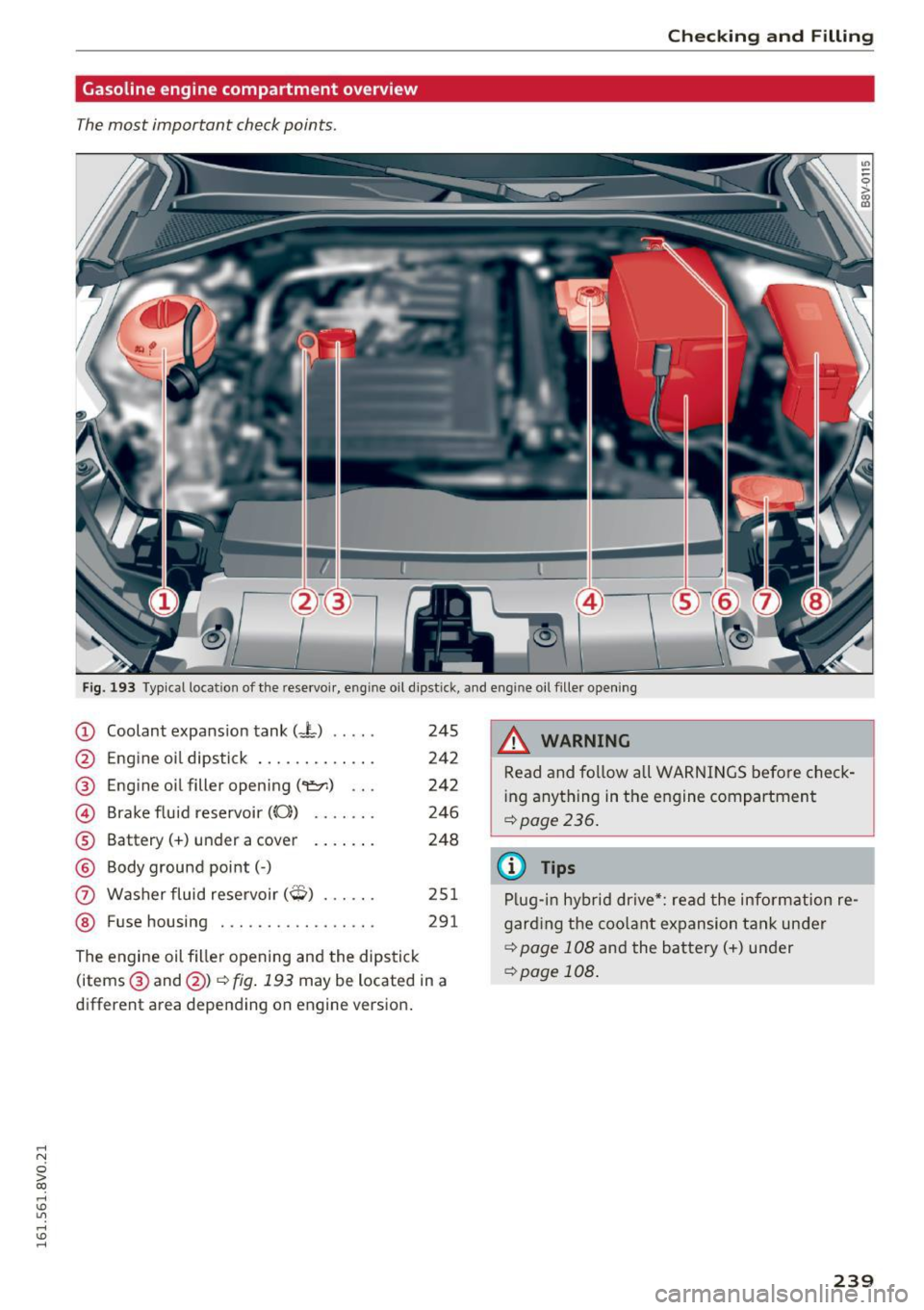
Gasoline engine compartment overview
The most important check points .
Fig. 193 Typical location of the rese rvoir , engine oil dipst ick, and engine oil filler opening
CD
@
®
©
®
©
(J)
®
Coolant expansion tank (-L) .... .
Engine oil dipstick ............ .
Engine oil filler opening(~) .. .
Brake fluid reservoir (0))
Battery(+) under a cover ..... . .
Body ground point(-)
Washer fluid reservoir
(O) ..... .
Fuse housing . .... .... ....... .
245
242
242
246
248
251 291
The engine oil filler opening and the dipstick
(items ® and @)
q fig. 193 may be located in a
different area depending on engine version .
_& WARNING
=
Read and follow all WARNINGS before check-
i ng anything in the engine compartment
¢page 236.
(D Tips
Plug-in hybrid drive*: read the information re
garding the coolant expansion tank under
¢page 108 and the battery(+) under
¢ page 108 .
239
Page 242 of 328

Checking and Filling
Diesel engine compartment overview
The most important check points.
Fig. 194 Typical location of the rese rvoir, engine o il dipstick, and engine oil fille r opening
(D Coolant expansion tank (- L) .. ...
@
®
©
®
®
0
®
Engine oil dipstick ............ .
Engine oil filler opening
(9=:r.) .. .
Brake fluid reservoir ((0))
Battery(+) under a cover
Body ground point( -)
Washer fluid reservoir
(q) ..... .
Fuse housing .. .............. .
245
242
242
246
248
251 291
The engine oil fi ller opening and the dipstick
(items @ and @)¢
fig. 194 may be located in a
different area depending on engine version.
,& WARNING
Read and follow all WARNINGS before check
ing anything in the engine compartment
¢page 236.
240
Engine oil
Engine oil specifications
The engine oil used must conform to exact speci
fications.
The service interval display in the instrumen t
cluster of your vehicle will inform you when it is
time for an oi l change. We recommend that you
have your oi l changed by an authorized Audi Serv
ice Advisor.
If you have to top off the oil between oil changes,
use the Audi oil quality standard specified in the
table .
Audi oil quality standard
Gasoline
VW 502 00 or
engine vw 504 00
Diesel vw 507 00
engine