2016 AUDI RS7 SPORTBACK wheel
[x] Cancel search: wheelPage 228 of 282

Wheels
-For technical reasons, it is not possible to use tires from oth
er vehicles - in some cases,
you cannot even use tires from
the same vehicle model.
-Make sure that the tires you select have enough clearance
to the vehicle. Replacement
tires should not be chosen
simply based on the nominal size, because tires with a dif
ferent construction can differ greatly even if they are the
same size. If there is not enough clearance, the tires or
the vehicle can be damaged and this can reduce driving
safety and increase the risk of
an accident.
-Only use tires that are more than 6 years old when abso
lutely necessary and drive
carefully when doing so.
-Do not use run-flat tires on your vehicle. Using them when
not permitted can lead to ve
hicle damage or accidents.
-If you install wheel covers on the vehicle, make sure they al
low enough air circulation to
cool the brake system. If they
do not, this could increase the
risk of an accident.
226
Tire wear/damage
Fig. 191 Tire profile : treadwear indica
tor
Tire wear
Check the tires regularly for wear.
-Inflation pressure that is too low or high can increase tire wear
considerably.
-Driving quickly through curves, rapid acceleration and heavy
braking increase tire wear.
-Have an authorized Audi dealer
or authorized Audi Service Facili
ty check the wheel alignment if
there is unusual wear.
-Have the wheels rebalanced if an imbalance is causing noticeable
vibration in the steering wheel. If you do not, the tires and other
vehicle components could wear
more quickly.
Treadwear indicator
The original tires on your vehicle have 1/16 inch (1.6 mm) high
"wear indicators" ¢fig.
191 ...
Page 229 of 282
... N oi '-' ":
running across the tread. Marks
on the tire sidewall (for example "TWI" or other symbols) indicate
the positions of the tread wear in
dicators.
The tires have reached the mini mum tread depth
l ) when they
have worn down to the treadwear
indicators . Replace the tires with
new ones
¢ ,1,. .
Wheel rotation
Rotating the wheels regularly is
recommended to ensure the tires
wear evenly. To rotate wheels, in
stall the wheels from the rear
axle on the front axle and vice
versa. This will allow the tires to
have approximately the same
length of service life.
For unidirectiona l tires, make
sure the tires are installed accord
ing to the running direction indi
cated on the tire sidewall
¢page 247 .
Hidden damage
Damage to tires and rims can of
ten occur in locations that are hidden. Unusual vibrations in the
vehicle or pulling to one side may
~ l) Obey any applicable regulations in your
~ country . ...
Wheels
indicate that there is tire damage.
Reduce your speed immediately.
Check the tires for damage. If no
damage is visible from the out
side, drive slowly and carefully to
the nearest authorized Audi deal
er or authorized Audi Service Fa
cility to have the vehicle inspect
ed.
&_ WARNING
-
Tread that has worn too low or
different tread depths on the
tires can reduce driving safety.
This can especially have a nega tive effect on handling, on the
risk aquaplaning when driving
through water, when driving
through curves and when brak ing, which increases the risk of
an accident.
227
Page 230 of 282

Wheels
Tire pressure
Fig. 192 Driver's side 8-pillar: tire pres
sure label
io
-
r~ . --c =-- -- ~-,ucu -~- ::- .- :""'- -- .- =...-- .)-@-:- -. l i
n,.....,...__ ........ .,._... ..... ._....,. .... _ ... l ..................... ......,....,..,.......,.... ... ..
1W IIZE COlD tW. l"flCSIUIIE.
PNE U ~ """'°"' OU "CU$ A ffllOII>
- KP a PSI
- KPA.
a PSI
- KPA. -PSl
Fig. 193 Tire pr essur e lab el
SEf.OWNU "S MANUAL FOR ADDmONAl IHJOAMATlON V091JU:MAHUC1. 0U"'Ol"IIETA.Qlll POUJIIPlUSDf
,U:NSEIGrEME"ITS
J
The correct tire pressure for tires
installed at the factory is listed on
a label. The label is located on the B-pillar
¢fig. 192, ¢fig. 193.
Use the tire pressure specified for
a normal vehicle load when the
vehicle is partially loaded¢
table
on page 230 .
If driving the vehi
cle when fully loaded, you must increase the tire pressure to the
maximum specified pressure¢.&-
228
Checking/correcting tire
pressure
,..Check the tire pressure at least
once per month and also check it before every long drive .
.,..Always check the tire pressure
when the tires are
cold. Do not
reduce the pressure if it increas
es when the tires are warm.
.,.Check the labe l¢
fig. 193 for
the correct tire pressure based
on vehicle load .
.,..Correct the tire pressure if nec
essary .
.,..Vehicles with Tire Pressure Mon
itoring System*: store the modi
fied tire pressure in the Infotain ment system ¢
page 23 7.
A WARNING
Always adapt the tire pressure
to your driving style and vehicle
load.
-Overloading can lead to loss of vehicle control and increase
the risk of an accident. Read
and follow the important safe
ty precautions in ¢
page 230,
Tires and vehicle load limits.
-The tire must flex more if the tire pressure is too low or if
the vehicle speed or load are too high. This heats the tire up .,.
Page 231 of 282
too much. This increases the risk of an accident because it
can cause the tire to burst and result in loss of vehicle con
trol.
-Incorrect tire pressure in
creases tire wear and has a
negative effect on driving and
braking behavior, which in
creases the risk of an accident .
(D Note
Replace lost valve caps to re
duce the risk of damage to the
tire valves.
Tire pressure table
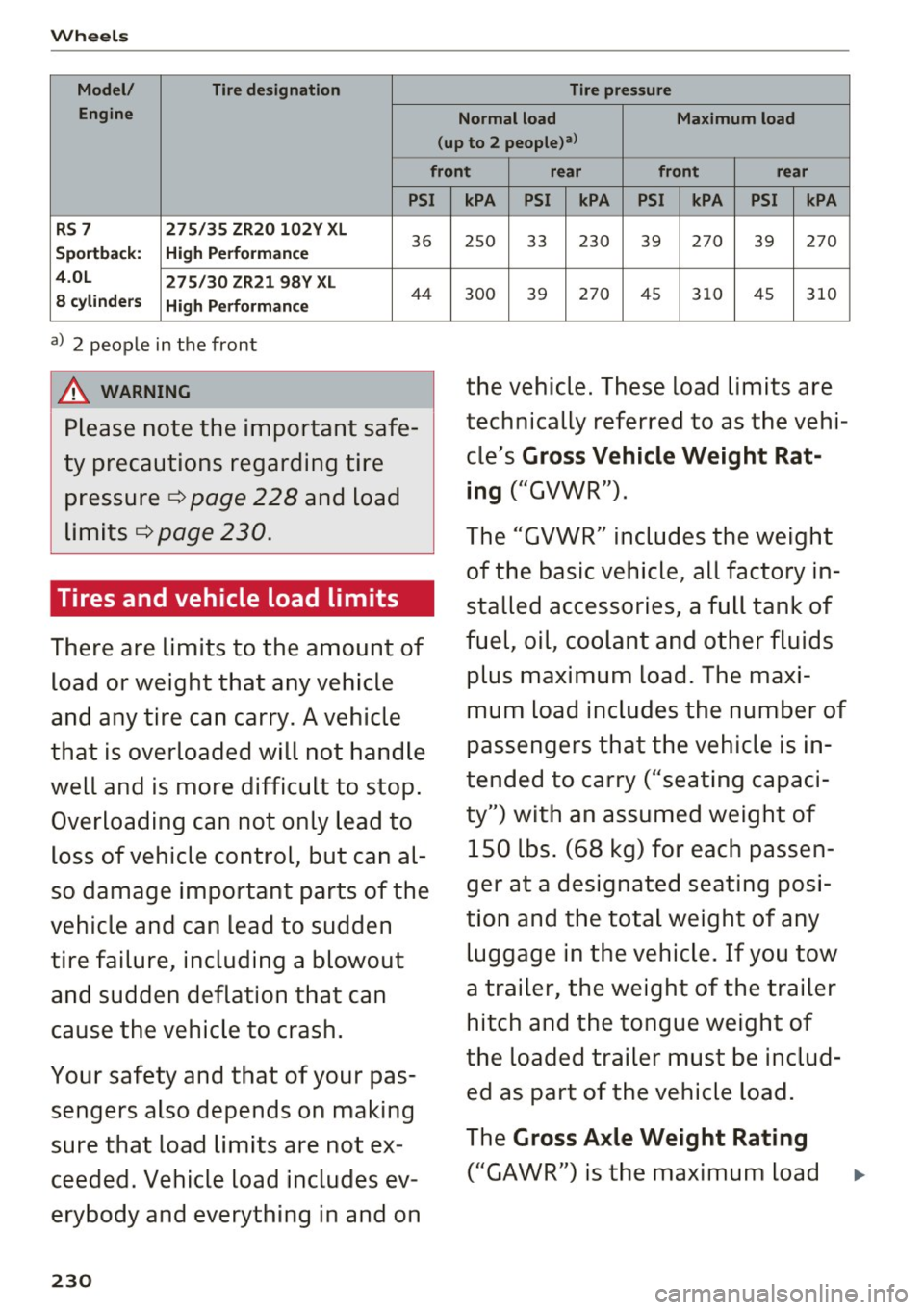
Please note that the information
contained in the following table
was correct at the time of print ing, and the information is sub
ject to change. If there are differ
ences between this information
and the tire pressures specified
on the label on the driver's side B pillar, always follow the specifica
tion on the B-pillar label
¢ page 228, fig. 192.
Wheels
'® For the sake of the environment
Tire pressure that is too low in
creases fuel consumption .
Audi recommends using the
tire pressure specified for a normal load
¢ table on
page 230
or for a full load
when the vehicle is partially
loaded.
Make sure that the tire designa
tion on your tire matches the des ignation on the tire pressure label
and the tire pressure table.
The following table lists recom
mended tire pressures in cold
tires according to the load and
the size of the tires installed . .,.
229
Page 232 of 282
Wheels
Model/ Tire designation Tire pressure
Engine Normal load Maximum load
(up to 2 people)a>
front rear front rear
PSI
RS 7 275/35 ZR20 102Y XL
Sportback: High Performance
36
4.0L 275/30 ZR21 98Y XL
8 cylinders High Performance
44
a) 2 people in the front
A WARNING
Please note the important safe
ty precautions regarding tire
pressure ¢
page 228 and load
limits ¢
page 230.
Tires and vehicle load limits
There are limits to the amount of
load or weight that any vehicle
and any tire can carry. A vehicle
that is overloaded will not handle
well and is more difficult to stop. Overloading can not only lead to
loss of vehicle control, but can al
so damage important parts of the
vehicle and can lead to sudden
tire failure, including a blowout and sudden deflation that can
cause the vehicle to crash.
Your safety and that of your pas sengers also depends on making
sure that load limits are not ex
ceeded . Vehicle load includes ev
erybody and everything in and on
230
kPA PSI kPA PSI kPA PSI kPA
25 0 33 230 39 270
39 270
30 0 39 270 45 310 45
310
the vehicle. These load limits are
technically referred to as the vehi
cle's
Gross Vehicle Weight Rat
ing
("GVWR").
The "GVWR" includes the weight of the basic vehicle, all factory in
stalled accessories , a full tank of
fuel, oil, coolant and other fluids
plus maximum load. The maxi
mum load includes the number of
passengers that the vehicle is in
tended to carry ("seating capaci
ty") with an assumed weight of 150 lbs. (68 kg) for each passen
ger at a designated seating posi
tion and the total weight of any luggage in the vehicle. If you tow
a trailer, the weight of the trailer hitch and the tongue weight of
the loaded trailer must be includ ed as part of the vehicle load.
The
Gross Axle Weight Rating
("GAWR") is the maximum load
Page 233 of 282
that can be applied at each of the
vehicle's two axles.
The fact that there is an upper
limit to your vehicle 's Gross Vehi
cle Weight Rating means that the
total weight of whatever is being carried in the vehicle (including
the weight of a trailer hitch and
the tongue weight of the loaded
trailer) is limited. The more pas sengers in the vehicle or passen
gers who are heavier than the
standard weights assumed mean
that less weight can be carried as luggage.
The Gross Vehicle Weight Rating and the Gross Axle Weight Rating
are listed on the safety compli
ance sticker label located on the
driver 's side 8-pillar
¢ page 228,
fig. 192.
& WARNING
-
Overloading a vehicle can cause
loss of vehicle control, a crash
or other accident, serious per
sonal injury, and even death.
-Carrying more weight than
your vehicle was designed to carry will prevent the vehicle
from handling properly and increase the risk of the loss of
vehicle control.
Wheels
-The brakes on a vehicle that
has been overloaded may not
be able to stop the vehicle
within a safe distance.
-Tires on a vehicle that has
been overloaded can fail sud
denly, including a blowout and
sudden deflation, causing loss
of control and a crash.
-Always make sure that the to
tal load being transported -
including the weight of a trail
er hitch and the tongue
weight of a loaded trailer - does not make the vehicle
heavier than the vehicle's
Gross Vehicle Weight Rating.
Determining correct load
limit
Use the example below to calcu
late the total weight of the pas
sengers and luggage or other
things that you plan to transport
so that you can make sure that
your vehicle will not be overload ed.
Steps for Determining Correct Load Limit
1. Locate the statement "THE
COMBINED WEIGHT OF OCCU-
PANTS AND CARGO SHOULD .,.
231
Page 234 of 282
Wheels
NEVER EXCEED XXX KG OR XXX
LBS"on your vehicle's placard
(tire inflation pressure label)
¢page 228, fig. 192.
2. Determine the combined
weight of the driver and pas
sengers that will be riding in
your vehicle.
3. Subtract the combined weight
of the driver and passengers
from
"XXX" kilograms or "XXX"
pounds shown on the sticker
¢ page 228, fig. 192.
4. The resulting figure equals the
available amount of cargo and
luggage load capacity. For ex
ample, if the "XXX" amount
equals 1400 lbs. and there will
be five 150 lbs. passengers in
your vehicle, the amount of available cargo and luggage
load capacity is 650 lbs.
(1400-750 (5 X 150) = 650
lbs.)
5. Determine the combined
weight of luggage and cargo being loaded on the vehicle.
That weight may not safely ex ceed the available cargo and
luggage load capacity calculat
ed in Step 4.
6. If your vehicle will be towing a trailer, load from your trailer
232
will be transferred to your ve
hicle. Consult this manual to
determine how this reduces
the available cargo and lug
gage load capacity of your vehi
cle.
~check the tire sidewall
(¢page 218, fig. 190) to deter
mine the designated load rating
for a specific tire.
Wheel bolts and rims '
Wheel bolts
Wheel bolts must be clean and loosen/tighten
easily.
Rims
Rims with a bolted rim ring* or with bolted wheel
covers* consist of multiple pieces. These compo
nents were bolted together using special bolts
and a special procedure . You must not repair or
disassemble them
9 &. .
_&. WARNING
Wheel bolts that are tightened or repaired in
correctly can become loose and result in loss
of vehicle control, which increases the risk of
an accident. For the correct tightening specifi
cation, refer to
9 page 244, After changing a
wheel .
-Always keep the wheel bolts and the
threads in the wheel hub clean and free of
grease .
- Only use wheel bolts that fit the rim.
- Always have damaged rims repaired by an
authorized Audi dealer or authorized Audi
Service Facility. Never repair or disassemble
rims yourself, because this increases the risk
of an accident.
Page 235 of 282
Winter tires
Winte r ti res s ignificantly improve the veh icle's
handling when driving in winter condit ions. Be
cause of the ir construction (width, compound,
tread pattern), summer tires provide less trac
tion o n ice and snow.
,.. Use w inter t ires on all fo ur wheels.
,.. Only use winter t ires that are approved for your
vehicle.
,.. Please note that the maximum permitted
speed may be lower with winter tires
9 &, . An
authorized Audi dealer or authorized Audi Serv
ice Facility can inform you about the maximum
permitted speed for your tires.
,.. Check the tire press ure after installing wheels
9page 228.
The effectiveness of winter tires is reduced great
ly when the tread is worn down to a depth of
0 .1 57 inch (4 mm). The character istics of winter
tires a lso dec rease great ly as the tire ages, re
ga rdless of the remaining tread.
_& WARNING
- Never drive faster than the maxim um per
mitted speed for your tires. This cou ld cause
the tires to heat up too much . Th is increases
the risk of an accident because it can cause
the tire to burst.
- Always adapt your dr iv ing to the road and
traff ic conditions. Drive carefully and reduce
your speed on icy or slippery roads. Even
winter tires can lose traction on black ice.
@ For the sake of the environment
Reinstall summer ti res at the appropriate
time, because they provide better handling
when roads are free of snow and ice. Summer tires cause less road noise, t ire wear and fuel
consumption.
You ca n also use all season tires instead of
w inter t ires. Please note that in some coun
tries where w inter t ires are required, only
w inter t ires with the
& symbol may be per
m itted.
-
Wh eel s
Snow chains
Snow chains improve traction in the snow .
,.. On ly install snow chains on the front wheels.
,.. Check and correct the seating of the snow
chains if necessary after driving a few feet. Fol
low the instruct ions from the manufacturer.
,.. Note the maximum permitted speed when dr iv
ing wit h snow chains. Do not exceed 30 mph
(SO km/h) .
Snow cha ins not o nly improve the
driving in win
te r road condit ions, but also the
braking.
Use of snow chains is only permitted with certa in
rim/tire comb inat ions due to technical reasons.
Check with an authorized Audi dealer or author
ized Audi Service Facili ty to see if you may use
snow c ha ins.
You must remove the chains when driving on roads that are
free of snow . When roads are free
of snow, snow chai ns can impa ir handling and
damage the tires, and the chains will qu ic kl y be
dest royed.
_& WARNING ~
Using incorrect snow chains or ins tall ing snow
chains incorrect ly can resu lt in loss of veh icle
control, which increases the risk of a n acci
dent.
(D Note
- Snow chains can damage the rims/wheel
covers* if the chains come into direct con
tact with them . Remove the wheel covers*
first. Use coated snow chains.
- Using snow c hains that add more than 0.4
inch ( 10.5 mm) of height can severely dam
age the whee l housings and other vehicle
components.
- Do not insta ll and use snow chains if there is
a malfunction in the adapt ive a ir suspen
sion*, because the vehicle he ight will be
very low. If you drive with snow chains any
way, the wheel housings and other vehicle
components can be seve rely damaged.
233