2016 AUDI RS7 SPORTBACK lock
[x] Cancel search: lockPage 212 of 282

Checking and Filling
should be between the "min " and "max" mark
ings. When the engine is warm, the level may
be slightly above the "max" marking.
The location of the coolant expansion tank can be
seen in the engine compartment illustration
<::> page 205.
To obtain an accurate reading, the engine must
be switched off.
The expansion tank in your vehicle is equipped
with an electric coolant level sensor.
When the coolant level is too low, the warning
light in the Auto-Check System <::>
page 15 will il
luminate until you add coolant and the level has
been restored to normal. Even though there is an
electric coolant level sensor, we still recommend
you check the coolant level from time to time.
Coolant loss
Coolant loss may indicate a leak in the cooling
system. In the event of coolant loss, the cooling
system should be inspected immediately by your
authorized Audi dealer. It is not enough merely
to add coolant.
In a
sealed system, losses can occur only if the
boiling point of the coolant is exceeded as a re
sult of overheating.
A WARNING
The cooling system is under pressure and can
get very hot. Reduce the risk of scalding from
hot coolant by following these steps.
-Turn off the engine and allow itto cool down.
- Protect your face, hands and arms from es caping fluid and steam by covering the cap
with a large, thick rag.
- Turn the cap slowly and very carefully in a counter-clockwise direction while applying
light, downward pressure on the top of the
cap.
- To avoid being burned, do not spill anti
freeze or coolant on the exhaust system or
hot engine parts . Under certain conditions,
the ethylene glycol in engine coolant can
catch fire .
210
(D Note
Do not add any type of radiator leak sealant
to your vehicle's engine coolant. Adding radia
tor repair fluid may adversely affect the func
tion and performance of your cooling system
and could result in damage not covered by
your New Vehicle Limited Warranty .
Adding coolant
Be very careful when adding engine coolant.
Before you check anything in the engine compart
ment,
always read and heed all WARNINGS
<::>.& in Working in the engine compartment on
page 203 .
.. Requirement: There must be a residual amount
of coolant in the expansion tank
i:::>Q) .
.. Turn off the engine .
.. Let the engine cool down .
.. Place a thick rag over the coolant expansion
tank <::>
page 209, fig. 186 and carefully twist
the cap counter-clockwise
c::> &,.
.. Add coolant mixed in the correct ratio
<::> page 209, Coolant up to the MAX marking.
.. Make sure that the fluid level remains stable.
Add more coolant if necessary.
.. Twist the cap on again
tightly.
Replacement engine coolant must conform to ex
act specifications <::>
page 209, Coolant.
We recommend using only coolant additive G12+
+, G13 or in an emergency G12+ . Do
not use a
different additive. In an emergency use plain wa
ter until you can get the correct additive and can
restore the correct ratio. This should be done as
soon as possible.
If you have lost a considerable amount of cool
ant, then you should add cold antifreeze and cold
water only when the engine is cold.
Always use
new engine coolant when refilling.
Do not fill coolant above the "MAX" mark . Excess
coolant will be forced out through the pressure
relief valve in the cap when the engine becomes
hot.
~
Page 213 of 282
,&_ WARNING
-The cooling system is under pressure and
can get very hot. Reduce the risk of scalding
from hot coolant by following these steps.
- Turn off the engine and allow it to cool
down.
- Protect your face, hands and arms from
escaping fluid and steam by covering the
cap with a large, thick rag.
- Turn the cap slowly and very carefully in a
counter-clockwise direction while applying light, downward pressure on the top of
the cap.
- To avoid being burned, do not spill ant i
freeze or coolant on the exhaust system or
hot engine parts. Under certa in condi
tions, the ethylene glycol in engine cool
ant can catch fire.
- Antifreeze is poisonous. Always store anti
freeze in its original container and well out
of the reach of children.
- If you drain the coolant, it must be caught
and safely stored in a proper container
clearly marked "poison" .
(D Note
-Do not add coolant if the expansion tank is
empty. Air could enter the cooling system
and damage the eng ine. If this is the case,
do not continue driving. Seek professional
assistance.
- Coolant pollutes the environment and could
cause an engine fire. Excess coolant will be
forced out through the pressure relief valve
i n the cap when the engine becomes hot .
- If, in an emergency, only water can be add ed, the correct ratio between water and an
tifreeze
¢ page 209 must be restored as
soon as possible.
@ For the sake of the environment
Drained coolant should not be reused. Always
dispose of used coolant while observing all
environmental regulat ions.
-
Checking and Filling
Radiator fan
The radiator fan switches on automatically by it
self .
An auxiliary electric radiator fan switches on and
off depending on coolant temperature and other
vehicle operating conditions.
After you switch the engine off, the auxiliary fan
can continue running for up to 10 minutes -even
with the ignition off. It can even switch on again later by itself ¢&. , if
- the temperature of the engine coolant rises due
to the heat build-up from the engine in the en gine compartment, or
- the engine compartment heats up because the
vehicle is parked in intense sunlight.
A WARNING
--
- To reduce the risk of personal injury never
touch the radiator fan .
- The auxiliary electric fan is temperature
controlled and can switch on suddenly even
when the engine is not running .
- The auxiliary radiator fan switches on auto
matically when the engine coolant reaches a
certa in temperature and will continue to run
until the coolant temperature drops.
Brake fluid
Checking brake fluid level
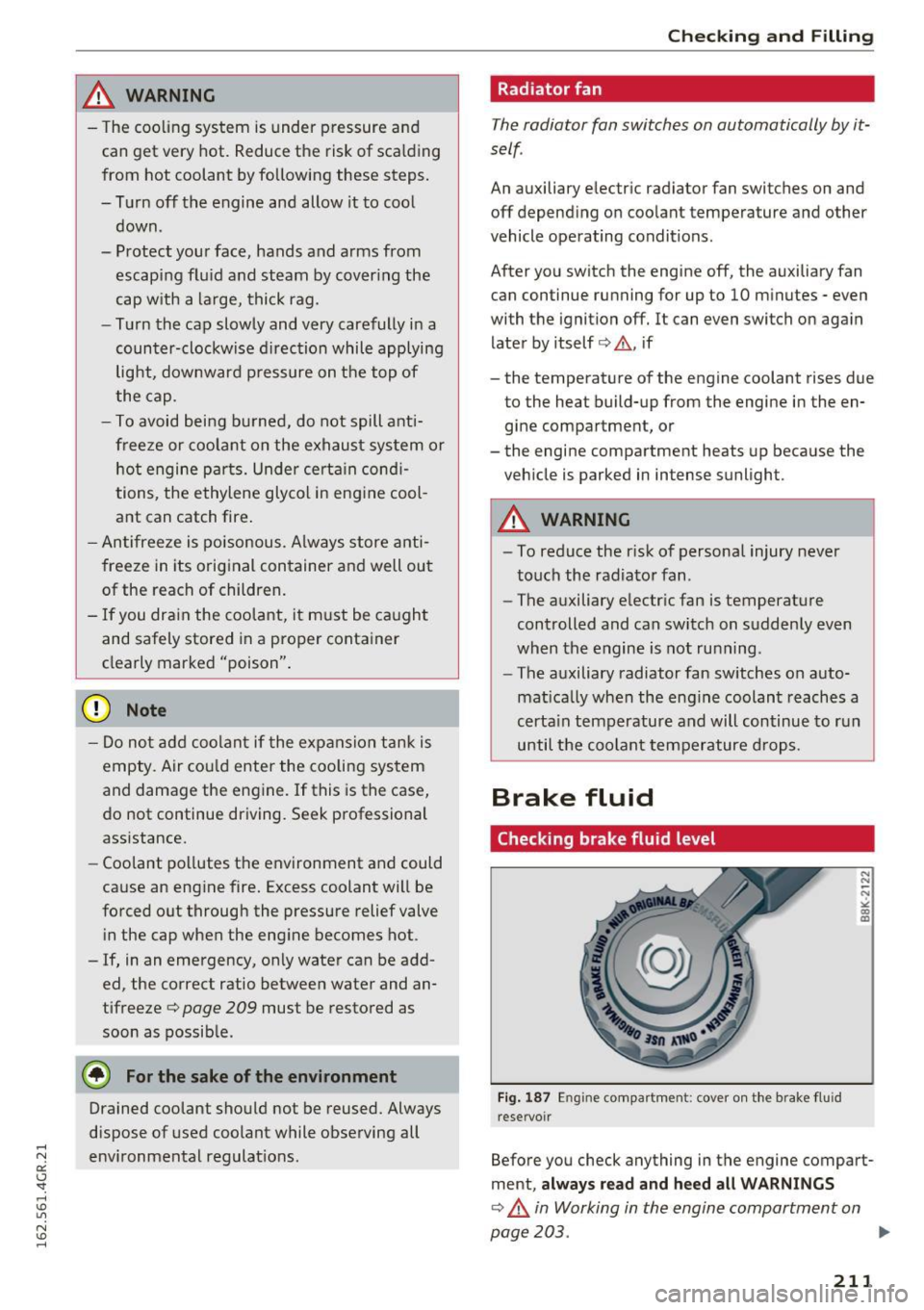
Fig. 187 En g in e compar tment: cover on the b rake fluid
rese rvoir
Before you check anything in the engine compart
ment,
always read and heed all WARNINGS
¢ & in Working in the engine compartment on
page 203 . .,.
211
Page 214 of 282

Checking and Filling
"' Read the brake fluid level from the brake fluid
reservoir
¢ fig. 187, ¢page 205, fig. 183. The
brake fluid level must be between the "MIN"
and "MAX" markings.
The location of the brake fluid reservoir can be
seen in the engine compartment illustration
c>page205.
The fluid level may drop slightly after some time
due to the automatic adjustment of the brake
pads. This is not cause for alarm.
If the brake fluid level falls considerably below
the "MIN" mark, the brake warning/indicator
light
1111 (U.S. models)/ . (Canadian models)
will come on¢
page 14. Do not continue to oper
ate the vehicle. The complete brake system
should be thoroughly checked by an authorized
Audi dealer or other qualified facility and the
cause corrected . If the brake fluid level is too
low, the brake warning/indicator light will illumi
nate. Contact an authorized Audi dealer
immedi
ately.
Changing brake fluid
Have the brake fluid changed by an experienced
technician.
Brake fluid absorbs moisture from the air . If the
water content in the brake fluid is too high , cor
rosion in the brake system may result after a pe
riod of time. The boiling point of the brake fluid
will also decrease considerably and decrease
braking performance.
Therefore, the brake fluid must be changed
every
two years.
Always use new brake fluid which con
forms to Federal Motor Vehicle Standard "FMVSS
116 DOT 4".
The brake fluid reservoir can be difficult to reach,
therefore, we recommend that you have the
brake fluid changed by your authorized
Audi
dealer.
Your dealer has the correct tools, the
right brake fluid and the know-how to do this for
you.
212
A WARNING
-
- Brake fluid is poisonous. It must be stored
only in the closed original container out of
the reach of children!
- Brake failure can result from old or inappro
priate brake fluid. Observe these precau
tions:
- Use only brake fluid that meets SAE speci
fication
J 1703 and conforms to Federal
Motor Vehicle Standard 116. Always check
with your authorized Audi dealer to make
sure you are using the correct brake fluid.
The correct type of brake fluid is also indi
cated on the brake fluid reservoir .
- The brake fluid must be new. Heavy use of
the brakes can cause a vapor lock if the
brake fluid is left in the system too long .
This can seriously affect the efficiency of
the brakes as well as your safety. This
could result in an accident.
(D Note
Brake fluid will damage the paint of your vehi
cle.
@ For the sake of the environment
Because of the problem of proper disposal of
brake fluid as well as the special tools re
quired and the necessary expertise, we rec
ommend that you have the brake fluid
changed by your authorized Audi dealer .
Battery
General information
Under normal operating conditions, the battery
in your Audi does not need any maintenance.
With
high outside temperatures or long daily
drives we recommend that you have the electro
lyte level checked by a service facility. The elec
trolyte level should also be checked each time
the battery is charged ¢
page 214.
Have the battery checked when you take your ve
hicle in for service. You are well advised to re
place a battery that is older than S years.
Page 241 of 282
Emergency assistance
Equipment
Warning triangle
Applies to: ve hicles with warning triangle
D
Fig. 196 Luggage co mpa rtment lid : w arnin g tria ngle
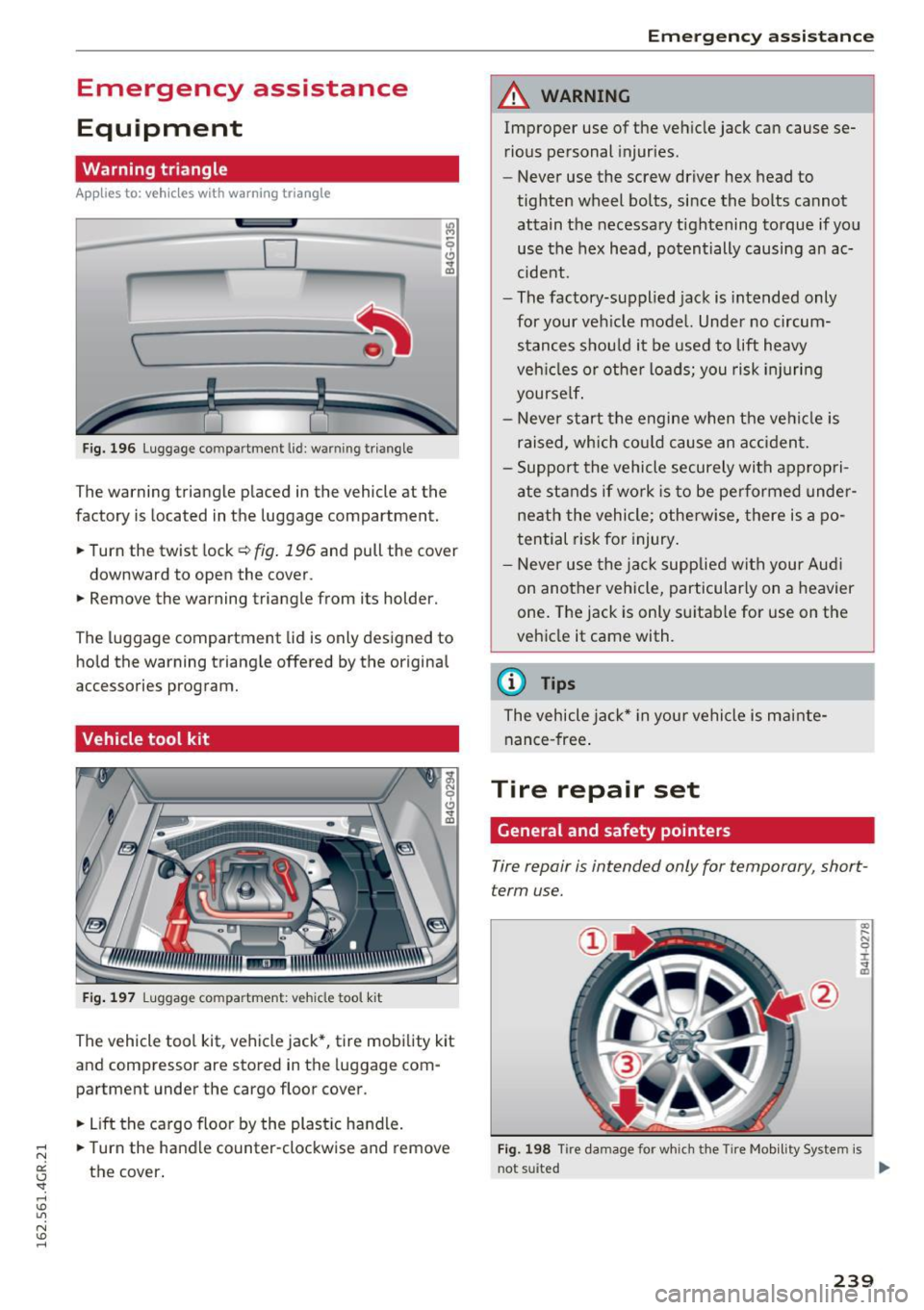
The warning triangle placed in the vehicle at the
factory is located in the luggage compartment.
• Turn the twist lock ¢
fig. 196 and pull the cover
downward to open the cover .
• Remove the warning triangle from its holder.
The luggage compartment lid is only designed to hold the warning triang le offered by the original
accessories program.
Vehicle tool kit
F ig. 197 Luggage co mpa rtment : veh icle tool kit
The vehicle tool kit , vehicle jack*, tire mobi lity kit
and compressor are stored in the luggage com
partment under the cargo floor cover .
• Lift the cargo floor by the plastic handle.
• Turn the handle counter-clockwise and remove
the cover .
Emergen cy a ssis tanc e
A WARNING
-Improper use of the veh icle jack can cause se-
rious pe rsonal injuries.
- Never use the screw driver hex head to
tighten wheel bolts, since the bolts cannot
attain the necessary tightening torque if you
use the hex head, potentially causing an ac
cident.
- The factory-supplied jack is intended only
for your veh icle model. Under no circum
stances s hou ld it be used to lift heavy
veh icles o r othe r loads; you risk in juring
yourse lf .
- Neve r start the engine when the ve hicle is
raised, which co uld cause an acciden t.
- Support the vehicle securely with appropri
ate stands if work is to be pe rformed under
neath the vehicle; otherwise, there is a po
t ential risk for injury .
- Neve r use the ja ck supplied w ith your Aud i
on anot her vehicle, particularly on a heavier
one. The jack is only s uitable for use on the
vehicle it came with.
(D Tips
The vehicle jack* in your vehicle is m ainte
nance -free .
Tire repair set
General and safety pointers
Tire repair is intended only for temporary, short
term use.
F ig. 198 Tire damage for wh ich the Tire Mob ility Sys tem is
not s uited
IIJI,
239
Page 245 of 282
Replacing wheels
Before changing a wheel
Observe the following precautions for your own
and your passenger's safety when changing a
wheel.
.,. After you experience a tire failure, pull the car
well away from moving traffic and try to reach
level ground before you stop¢.,&..
.. All passengers should
leave the car and move
to a safe location (for instance, beh ind the
guardrail)¢ .,&. .
.,. Engage the
parking brake to prevent your vehi
cle from rolling unintentionally¢ .,&..
.. Move
selector lever to position P ¢ .,&. .
.. Take the
jack out of the luggage compartment
c:>page 239.
A WARNING
You or your passengers could be injured while
chang ing a wheel if you do not follow these
safety precautions:
- If you have a flat tire, move a safe distance
off the road. Turn off the engine, turn the
eme rgency flashers on and use other warn
ing devices to alert other motorists.
- Make sure that passengers wait in a safe
place away from the vehicle and well away
from the road and traffic.
- To help prevent the vehicle from moving
sudden ly and possibly slipping off the jack,
always fully set the parking brake and block
the wheel diagonally opposite the wheel be
ing changed . When one front wheel is lifted
off the ground, placing the Automatic
Transmission in P (Park) will
not prevent the
vehicle from moving.
- Before you change a wheel, be sure the
ground is level and firm. If necessary, use a
sturdy board under the jack.
- Always store the veh icle tool k it, the jack
and the replaced tire in the luggage com
partment
c> page 124.
(D Note
If you are changing the whee l on a steep in
cline, use a rock or similar object to b lock the
Emergency assistance
opposite wheel to prevent the vehicle from
moving.
(D Tips
- Before changing the wheel, you must acti
vate the jacking mode, so that the automat
ic controls for the Adaptive Air Suspension*
do not make it more difficu lt to lift the vehi
cle with the jack
c> page 245.
- Obey all laws .
Changing a wheel
When you change a wheel, follow the sequence
described below step-by-step and in exactly thot
order .
1. Activate the vehicle jack mode* c> page 245.
2. Remove the
wheel bolt caps*. For more de
tails see also
¢ page 244, Wheels with
wheel bolt caps.
3. Loosen the wheel bolts c:> page 244.
4. Locate the proper mounting point for the
jack and align the jack below that point
~page 245.
5. Raise the car with the jack c:> page 245.
6. Remove the
wheel with the flat tire and then
install the other whee l¢
page 246.
7. Tighten all whee l bolts lightly.
8.
Lower the vehicle with the jack.
9. Use the wheel bolt wrench and
firmly tighten
all wheel bolts
c> page 244.
10. Replace the
wheel bolt caps*.
11. Deact ivate the vehicle jack mode* in the
MMI:
I CARI funct ion button> (C ar )* systems
contro l butto n > Servicing & checks > Air
susp.: jack mode >
Off.
The vehicle jack mode* switches off automat ical
ly at speeds above 6 mph (10 km/h) .
A WARNING
-
Always read and follow all WARNINGS and in-
formation
¢ .&. in Raising the vehicle on
page
245 and ¢ page 247.
243
Page 246 of 282

Emerg ency assis ta nce
After changing a wheel
A wheel change is not complete without the do
ing the following.
• Always store the vehicle tool kit, the jack* and
the replaced tire in the luggage compartment
<=>page 124.
• As soon as possible, have the tightenin g tor
qu es
on all whee l bolts checked with a torque
wrench. The correct tightening torque is 90 ft lb (120 Nm).
• Have the flat tire
replac ed as soon as possible.
(D Tips
- If yo u notice that the whee l bolts are cor
roded and difficu lt to turn wh ile changing a
tire, they should be replaced before you
check the tightening torque.
- Drive at reduced speed until you have the
tightening torques checked .
- After changing a w heel, the tire pressure in
a ll four tires must be checked/corrected and
the tire pressure monitoring indicator must be stored in the MMI
c> page 23 7.
Wheels with wheel bolt caps
A ppl ies to: ve hicles w ith whee l bolts w it h ea ps
The caps must be removed first from the wheel
bolts before the bolts can be unscrewed .
Fig. 201 Chang ing a wheel : removing the whee l bo lt caps
Removing
• Push the
pla stic clip (provided with the veh icle
tool kit) over the wheel bolt cap unt il the inner
retainers on the clip align wit h the edge of the
cover.
244
• Remove the cap with t he pla stic clip (vehicle
tool kit)
c> fig. 201.
Refitt ing
• Place t he caps over the wheel bolts and push
them back on.
The caps are to protect and keep the wheel bo lts
clean.
Loosening and tightening the wheel bolts
The wheel bolts must be loosened before raising
the vehicle .
Fig. 202 Chang ing a whee l: loosening the wheel bolts
Lo ose ning
• Slide the
w hee l w ren ch onto the wheel bo lt as
far as it will go.
• Take tight hold of the
end of the wrench hand le
and turn the wheel bolts
count er-clo ckwis e
about one single turn in the direction of arrow
¢fig. 202.
Tightening
• Slide the wheel wrench onto the wheel bo lt as
far as it will go.
• Take tight hold of the
end of the wrench handle
and turn each wheel bolt
clockwis e until it is
seated .
_&. WARNING
- Do not use force or hurry when changing a
wheel -you can cause the veh icle to slip off
the jack and cause serious persona l injuries.
- Do not loosen the wheel bo lts more than
one turn
before you raise the veh icle w ith
the jack. -You r is k an injury.
Page 249 of 282

~ Then remove the other wheel bolts as described above.
~ Takeoff the wheel leaving the a lignment pin in
the bolt ho le ¢ (D.
Putting on th e oth er w heel
~ Lift the whee l and carefully slide it over the
alignment pin to guide it in place ¢(D.
~ Use the hexagonal socket in the screwdriver
handle to screw in and tighten all whee l bolts
sligh tly.
~ Remove the alignment pin and insert and tight
en the remaining wheel bolt slightly like the
rest .
~ Turn the jack handle counter-clockwise to lower
the vehicle until the jack is fu lly re leased.
~ Use the wheel bolt wrench to tighten all wheel
bolts firmly ¢
page 244 . Tighten them cross
wise,
from one bolt to the (approximately) op
posite one, to keep the whee l centered .
When removing or installing the whee l, the
rim could hit the brake rotor/ceramic brake
rotor* and damage the rotor. Work carefully
and have a second person help you.
(D Tips
Never use the hexagonal socket in the handle
of the screwdriver to loosen or tighten the
wheel bo lts.
- Pu ll the reversible blade from the screwdriv
er before you use the hexagonal socket in
the handle to turn the wheel bo lts.
- When mounting tires w ith
u nidirectio nal
tre ad design
make sure the tread pattern is
po inted the r ight way ¢
page 247.
-The wheel bolts should be clean and easy to
turn . Check for d irt and corrosion on the
mating surfaces of both the wheel and the
hub . Remove all dirt from these surfaces be
fo re remo unt ing the wheel.
Em ergenc y ass is tanc e
Tires with unidirectional tread design
Tires with unidirectional tread design must be
mounted with their tread pattern pointed in the
right direction .
Using a repl acement t ire w ith a tread pattern
intend ed for use in a sp ecific direction
When using a rep lacement tire with a tread pat
tern intended for use in a spec ific d irection ,
please note the follow ing:
- The direction of rotation is marked by an arrow
on the side of the tire .
- If the replacement tire has to be installed in
the incorrect direction, use the replacement tire only temporarily s ince the t ire w ill not be
ab le to achieve its optimum perfo rmance char
acter istics with rega rd to aquap lan ing, no ise
and wear.
- We recommend that you pay pa rt icu lar atten
tion to th is fact d uring wet weather and that
you adjust your speed to match road cond i
tions .
- Rep lace the flat tire w ith a new one and have it
installed on your veh icle as soon as possib le to
restore the hand ling advantages of a unidirec
tional tire.
Notes on wheel changing
Please read the information ¢ page 225, New
tires or wheels
if you a re go ing to u se a replace
ment t ire wh ich is different from the t ires on
you r vehicle .
After you change a tire:
- Check the tire pre ssure on the r epl acement
tire immed iatel y afte r in st a llat ion .
- Have th e whe el bolt tight ening torqu e
c hecked with a torque w rench as s oon as pos
s ible b y your authorized Audi de aler o r a
qualified ser vice st ation.
- With steel and allo y wheel rim s, the wheel
bolt s are co rr ectl y ti ghtened at a torque of 90
ft lb
( 1 20 Nm) .
-If you notice that the wheel bolts are corroded
and diffi cult to turn while changing a ti re ,
the y should be r eplaced before you chec k the
tightening torque. ..,.
247
Page 253 of 282

Front passenger side
cockpit fuse assignment
F ig. 21 0 Front passenger side cockpit: f use pane l w it h
p las tic bracket
Fuse panel @ (red )
No . Equipment
1 Infotainment, CD changer
2 I
nf otainment (disp lay)
Fuse panel @ (brown )
No . Equipment
1 Climate control system
2 Climate cont
rol sys tem (blowe r)
3 Diagnostic interface
4 Ele ctrical ignit io n lock
5 Electronic steering column lock
6 Steer ing col umn sw itch module
7 Power steering column adjustment
8 Light switch
9 Head-up display
1 0 I
nst rument cluste r
1 1 Infotainment, DVD changer
Fuses
Luggage compartment
fuse assignment
F ig . 2 1 1 Luggage compa rtment: fuse panel with p last ic
b racket
Fuse panel @ (black )
No . Equipment
1 Tra
iler hitc h/220 volt socket
2 Tra ile r hi tc h /climati zed cup holder
3
Tra iler hitch/ad justing front passenger's
seat from the rear
4 El ec tromec ha nic al pa rking brake
5 Electromec hanical parking brake
6 F ront door (front passenger's s ide)
7 Rear exterior lighting
8 Cen tral locking, closi ng a id
9 Seat heating (front)
1 1 Seat heating (rear), climate control system
12 Tra ile r hitc h
Fuse panel @ (red)
No . Equipment
1 L
eft safety belt tensioner
2 R igh t safety be lt tens ione r
3 Ad B lue tank (diesel engine)/fuel pump
4 Ad B lue tank (diesel engine)/eng ine mo unt
(gaso line e ngine)
s
Sensor-controlled l uggage compartment
li d
6 Air s uspension, adaptive dampers
7 Rear door (front passenger's side)
8 Tail lights
9 Luggage compartmen t lid
251
...