2016 AUDI RS7 SPORTBACK light
[x] Cancel search: lightPage 173 of 282

-Always move the passenger seat into its
rearmost position in the seat's fore and aft
adjustment range, as far away from the air
bag as possible before installing the for
ward-facing child restra int. The backrest
must be adjusted to an upright posit ion.
- Make sure that the
PA SSEN GER AIR BAG
OFF
light comes on and stays on all the time
whenever the ignition is switched on.
A WARNING
Rearwa rd-facing child restra ints:
- A ch ild in a rearward-facing child safety seat
installed on the front passenger seat wi ll be
seriously injured and can be killed if the
front airbag inflates - even with an Ad
vanced Airbag System .
- The inflating a irbag w ill hit the child safety
seat or infant carrier with great force and
will smash the chi ld safety seat and chi ld
against the backrest, center armrest, door
or roof.
- Always be especially careful if you must in
stall a rearward facing child safety seat on
the front passenger seat in exceptional c ir
cumstances.
- Make sure that the
PAS SENGER AIR BA G
OFF
light comes on and stays on all the time
whenever the ignition is switched on.
- If the
PASSENGER AIR BAG OFF light does
not come on and stay on, immediately in
stall the rear-facing ch ild safety seat in a
rear seat ing pos ition and have the airbag
system inspected by your Aud i dealer .
Activating the convertible locking retractor
Use the convertible locking retractor to secure a
child restraint.
Always heed the child safety seat manufacturer's
instructions when installing a child restraint in
your vehicle. To act ivate the convertible locking
retractor:
.. Place the child restraint on a seat, preferab ly
on the rear seat.
.. Slowly pull the belt all the way out .
Child safety
.. Route it around or through the child restraint
be lt path ¢
A.
.. Push the ch ild safety seat down with your full
weight to get the safety belt really tight.
.. Insert the belt tongue into the buckle for that
seating position .
.. Guide the safety belt back into the retractor un
til the belt lies flat and snug on the child safety
seat .
.. You shou ld hear a "cl icking" noise as the belt
winds back into the inertia reel. Test the con
vertible locking retractor by pulling on the belt.
You shou ld no longer be able to pull the belt
out of the retractor. The convertib le locking re
tractor is now activated.
.. Make sure that the red release button is facing
away from the child restraint so that it can be
unbuckled quickly .
.. Pull on the belt to make sure the safety belt is
properly t ight and fastened so that the seat
canno t move fo rwa rd or s ideways mo re than
one inch (2.S cm).
A WARNING .......... -
Using the wrong ch ild restraint or an improp
erly installed child restraint can cause serious
personal injury or death in a crash.
- Always make sure that the safety belt re-
tractor is locked when installing a child
safety seat. An unlocked safety be lt retrac
tor cannot hold the ch ild safety seat in place
during normal driving or in a crash .
- Always buckle the child safety seat firmly in
place even if a ch ild is not sitt ing in it. A
loose child safety seat can fly around dur ing
a sudden stop or in a crash .
- Always make sure the seat backrest to which
the child restraint is installed is in an up
right position and securely latched into
place and cannot fo ld forward. Othe rw ise,
the seatback with the child safety seat at
tached to it could fly forward in the event of
an accident or other emergency situation.
- Always read and heed all WARNINGS when
ever using a child restrained in a vehicle is
being used ¢
page 159. Special precautions
apply when instal ling a child safety seat on
the front passenger seat
¢page 136, Child II>
171
Page 177 of 282
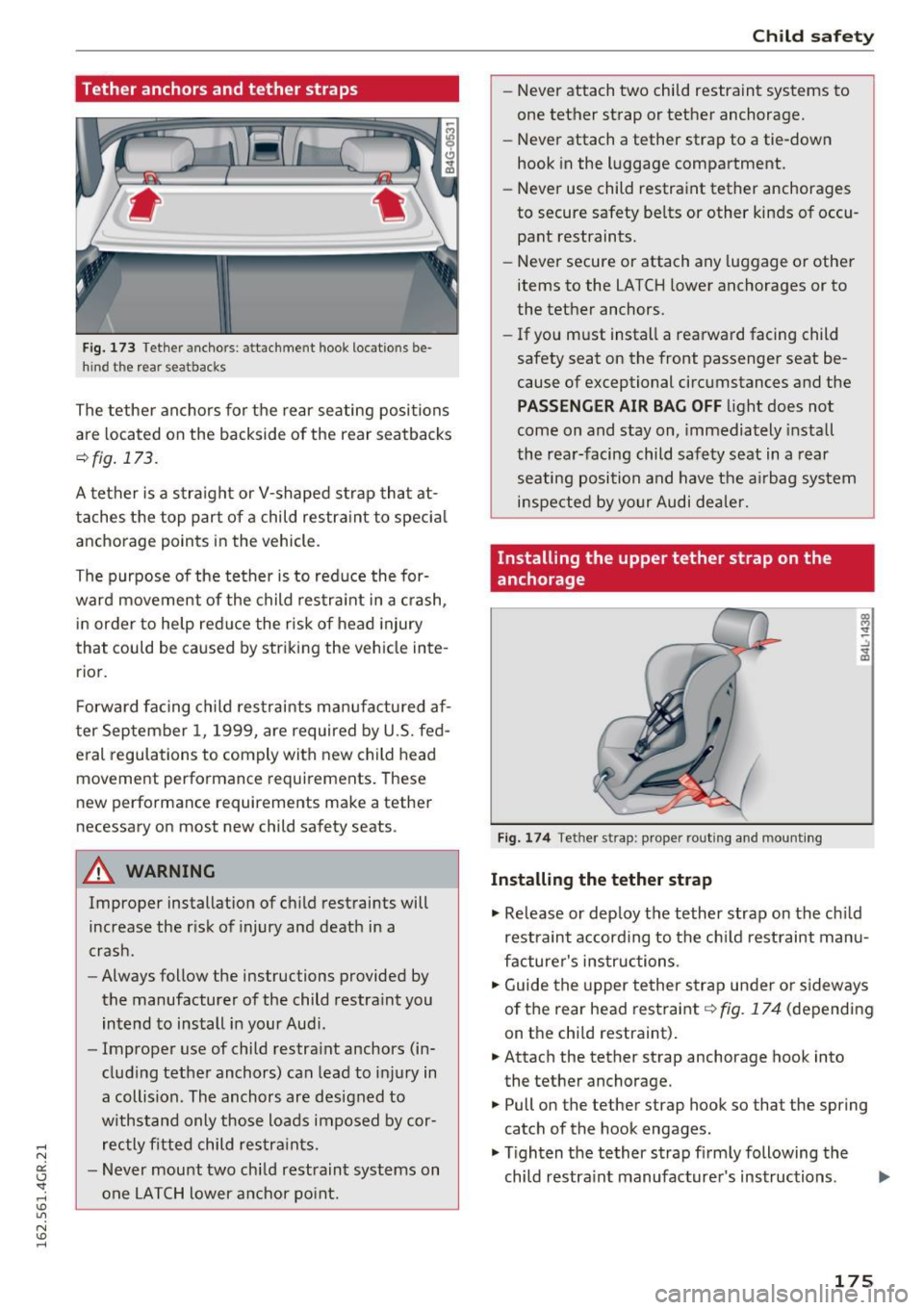
Tether anchors and tether straps
Fig. 173 Te the r ancho rs: att achm ent hook locatio ns be
hi nd the rea r seatbacks
The tether anchors for the rear seating positions
are located on the backside of the rear seatbacks
¢ fig. 173.
A tether is a stra ight or V-shaped strap that at
taches the top part of a child restra int to special
anchorage points in the vehicle .
The purpose of the tether is to reduce the for
ward movement of the child restra int in a crash,
in order to he lp red uce the risk of head injury
that could be caused by striking the veh icle inte
rio r.
F orwa rd facing ch ild restraints manufactured af
ter September 1, 1999, are required by U.S. fed
eral regulations to comply with new child head movement performance requirements. These
new perfo rmance requirements make a tether
necessary on most new child safety seats .
A WARNING
Improper installation of child restraints will
increase the r isk of injury and death in a
crash .
- Always follow the instructions provided by
the manufacturer of the child restra int you
intend to install in your Aud i.
- Improper use of child restra int anchors (in
cluding tether anchors) can lead to injury in
a collision . The anchors are designed to
withstand only those lo ads imposed by cor
rectly fitted child restra ints.
- Never mou nt two chi ld restraint systems on
one LATCH lower a nchor po int.
Ch ild sa fety
- Never attach two child restraint systems to
one tether strap or tether anchorage.
- Never attach a tether strap to a tie-down
hook in the luggage compartment.
- Never use child restraint tether anchorages
to secure safety be lts or other kinds of occu
pant restraints.
- Never secure or attach any luggage or other
items to the LATCH lower anchorages or to
the tether anchors.
- If you must install a rearward facing child
safety seat on the front passenger seat be
cause of exceptional circumstances and the
PAS SEN GER AIR BAG OFF light does not
come on and stay on, immediately install
the rear-facing child safety seat in a rear seating position and have the a irbag system
inspected by your Audi dealer.
Installing the upper tether strap on the
anchorage
Fig . 1 74 Tet her strap : p roper rout ing and mount ing
Installing the tether st rap
... Re lease or dep loy t he tether strap on the ch ild
restraint according to the ch ild restraint manu
facture r's ins tructions .
... Guide the upper tether strap under or s ideways
of the rear head rest raint
q fig . 174 (dependi ng
on the chi ld restraint) .
... Attach the tether strap ancho rage hook into
the tether anchorage.
... Pull on the tether strap hook so that the spring
catch of the hook engages .
.,. Tighten the tether strap fi rm ly following the
child restra int manufacture r's instructions.
175
Page 178 of 282

Child safety
Releasing the tether strap
.,. Loosen the tension following the child restraint
manufacturer's instructions.
.,. Depress the spring catch on the hook and re
leas e it from the anchorage.
(D Note
If you leave the child restraint with the tether
strap firmly installed for several days, this
could leave a mark on the upholstery on the
seat cushion and backrest in the area where
the tether strap was installed. The upholstery
would also be permanently stretched around the tether strap . This applies especially to
leather seats.
Using tether straps on rearward-facing
child restraints
Currently, few rear-facing child restraint systems
come with a tether. Please read and heed the
child restraint system manufacturer's instruc
tions carefully to determine how to properly in
stall the tether.
A WARNING
A child in a rearward-facing child safety seat
installed on the front passenger seat will be
seriously injured and can be killed if the front
airbag inflates -even with an Advanced Airbag
System.
- The inflating airbag will hit the child safety
seat or infant carrier with great force and
will smash the child safety seat and child
against the backrest, center armrest, or
door.
- If you must install a rearward facing child
safety seat on the front passenger seat be
cause of exceptional circumstances and the
PASSENGER AIR BAG OFF light does not
come on and stay on, immediately install
the rear-facing child safety seat in a rear
seating position and have the airbag system
inspected by your Audi dealer.
176
Additional information
· Sources of information about child
restraints and their use
There are a number of sources of additional in
formation about child restraint selection, instal
lation and use :
NHTSA advises that the best child safety seat is
the one that fits your child and fits in your vehi
cle, and that you will use correctly and consis
tently.
Try before you buy!
U.S National Highway Traffic Safety Administra
tion
Tel.: 1-888-327-4236 (TTY: 1-800-424-9153)
www .nhtsa .gov
National SAFE KIDS Campaign
Tel.: (202) 662-0600
www .safekids.org
Safety BeltSafe U.S.A
Tel.: (800) 745-SAFE (English)
Tel.: (800) 747-SANO (Spanish)
www.carseat.org
Transport Canada Information Centre
Tel.: 1-800-333-0371 or call 1-613-998-8616 if
you are in the Ottawa area
http://www.tc.gc .ca/ eng/roadsafety/menu .htm
Audi Customer Relations
Tel.: (800) 822-2834
Page 179 of 282
Audi pre sense Preventative passenger
protection
Applies to: ve hicles with Audi pre sense
Pre sense can initiate steps to protect vehicle oc
cupants in certain dangerous situations. The
functions described are available depending on
veh icle equ ipment:
Pre sense basic*
The following functions can be triggered in cer
tain driving situations:
- Tightening of the safety belts (for examp le,
during emergency braking): the front safety
belts have reversib le belt pretensioners. If a
collision does not occur, the safety belts loosen
slightly and are ready to trigger aga in.
- Closing the w indows and the sunroof* (for ex
ample, when over- or understeering) : the win
dows and the sunroof* close until there is only
a small gap open .
Audi pre sense basic functions can be triggered at
speeds above 20 mph (30 km/h). Drive select: the deployment time is adapted in
Dynamic mode .
Pre sense front (vehicles with adaptive cruise
control*)
Pre sense front contains the functions of pre
sense basic . In addition, the likelihood of a rear
end collision with the vehicle ahead is also calcu
lated, within the limi ts of the system. If the risk
of a collision is detected, the following functions
can trigger:
- Braking guard
c> page 85
- Tensioning of the safety belts
- Closing the windows and the sunroof*
Pre sense rear (vehicles with side assist*)
Pre sense rear contains the functions of pre sense
bas ic. In addit ion, the lik el ihood of a rear-end
coll is ion from the vehicle behind is also calculat
ed, within the limits of the system. If the risk of a
collision is detected, the following functions can
trigger:
Audi pre sense
-Tensioning of the safety belts
- Closing the windows and the sunroof*
Pre sense plus*
Pre sense plus contains the functions of pre
sense front and pre sense rear .
Error message
Aud i pre sense: Unavailable
Preventative passenger protection is not availa
ble. Drive to your authorized Audi dealer or au
thorized Audi Service Facility immediately to have
the malfunction corrected.
A WARNING
=
Pre sense cannot overcome natural phys ica l
laws . It is a system designed to assist and it
cannot prevent a collision . Do not let the in
creased safety provided tempt you into taking
risks. This could increase your risk of a colli
sion.
- The system can dep loy incorrectly .
- Please note that the sensors do not always
detect all objects . This increases the risk of
a collision.
- Pre sense does not react to people or ani
mals or objects that are crossing the vehi
cle's path or are difficu lt to detect
.:>page 79.
-Reflective objects such as guard ra ils or the
entrance to a tunnel, heavy rain and ice can
affect the function of the radar sensors and
the system's ability to detect a collision risk.
(D Note
The sensors can be displaced by impacts or
damage to the bumper, wheel housing and
un derbody. Pre sense can be impaired by this.
Have an authorized Audi dealer or authorized
Audi Service Facility check their function .
(D Tips
-Certain pre sense front functions switch off
when sport mode is switched off or when
driving in reverse. ..,.
177
Page 182 of 282

Intelligent Technology
shared, please see your contract with the
wireless te lecommunications provider and the
"About Aud i connect" tab in your vehicle's
MMI:
! MENUI button> Audi connect > About
Audi connect .
Electronic Stabilization
Control (ESC)
Description
E SC helps to imp rove ro ad hold ing and vehicle
dynamics to help reduce the probab ility of skid
d ing and loss of veh icle control. It works only
when the engine is runn ing . ESC detects certain
d iffic ult dr iving situat io ns, including when the
ve hicl e is begin ning to spin (yaw) o ut of contro l
and h elps you to ge t the veh icle b ack u nde r con
trol by se lectively bra king the wheels, and/or re
ducing engine powe r and providing steering as
sistance to help hold the vehicle on the driver's
intended course. The indicator light
GI in the in
strument cluster blinks when ESC is tak ing action
t o he lp you contro l the vehicle.
ESC has lim itations. It is important to remembe r
that ESC cannot overcome the laws o f physics. It
will not a lways be able to help out under all con
d itions you may come up aga inst . For example,
ESC may not always be ab le to help you master
situations where there is a sudde n change in the
coeff ic ie nt of fr iction of the road surface. W hen
there is a se ction of dry roa d that is sudde nly cov
e red with w ater, slush o r sn ow , ESC c annot pe r
form the same way i t wou ld on the dry s urface. If
the vehicle hydrop lanes (rides on a cushion of wa
ter instead of t he road su rface), ESC w ill not be
ab le to he lp you stee r the veh icle because contact
with the pavement has been inte rru pted and the
ve hicle cannot be b raked or steered . Dur ing fast
cor nering, part icu la rly on w inding roads, ESC
can not always deal as effect ive ly w it h difficult
d riving situat ions than a t lowe r speeds .
Always ad just yo ur speed and driving sty le to
road, traffic and weath er cond itions . ESC canno t
over ride the vehicle's phys ical lim its, increase the
ava ilab le traction, o r keep a ve hicle on t he road if
roa d depa rture is a re su lt of driver in attention .
I nstead, ESC imp roves the possibili ty of keep ing
180
t h e veh icle unde r contro l and on t he road d uring
extreme mane uvers by using the driver's steer ing
i nputs to help keep the veh icle go ing in the in
tended direction. If you are traveling at a speed
that causes you to run off the road before ESC
can p rovide any assistance, you may not exper i
ence the be nefits of ESC.
ESC is switc hed on all the time. In certa in s itua
tions when you need less tract ion, you can sw itch
off ASR by press ing the button
[g] c:> page 181,
fig . 175 . Be sure to switc h ASR on aga in whe n
you no longer nee d less tract ion.
The following systems are integrated in the ESC:
Anti-lock braking system (ABS)
A BS prevents the w heels from locking w hen bra k
i ng . The veh icle can still be steered even dur ing
hard braking. App ly steady p ressure to the brake
pedal. Do not pump the pedal. A pulsing in the
brake peda l ind icates that the system is act ing to
stab ilize the veh icle.
Brake a ssist system
The brake assist system can decrease b raking dis
tance. It increases b raking powe r whe n the dr iver
presses the b rake peda l quickly in emergency sit
uat ions. You must press a nd hold the brake peda l
u nt il the dange rous situation is over . In vehicles
with adaptive cruise co ntrol*, the brake ass ist
syste m is more se nsitive if the distance detected
t o t he veh icle ah ead is too sm all. On vehicle s wi th
a ctiv ate d a nd fun ctioni ng nigh t vis ion assi st*, the
brake assis t sys tem can respond more sensit ively
i f there is a warning .
Anti-slip regulation (ASR )
ASR reduces e ngine powe r whe n the d rive whee ls
begin s pin nin g and ad apts the force to the ro ad
con ditions. This m akes i t easier to s tar t, a cce ler
ate and drive up incl ines .
Electronic differential lock (EDL)
E DL applies t he b rakes to a whee l th at s tarts
sp inning a nd transfers the dr ive power to the
othe r drivi ng whee ls . This fu nction is n ot a vail a-
b le at hig he r sp eeds . .,..
Page 184 of 282

Intelligent Technology
- Driving in deep snow or on loose ground
ESC levels
- Driv ing with snow chains
Sport mode on ESC/ASR off Sport mode off or
ESC/ASRon
Beha vior
The ESC and ASR stabiliza- The stabiliza tion function is The f ull stabilization tune-
tion f unctions are limited not available ¢
,&. ESC and
tion of the ESC and ASR is
¢
&. . ASR are switched off . avai
lab le aga in .
Op eration Press the I B OFF I button Press and hold the !B OFFI Press the IB OFFI button
briefly . button longer than 3 sec- again.
onds.
I n d ica to r II turns on. II and lit turn on. II turns off or II and II
light s turn off .
Driver me s- Stabili zation cont rol (E SC): S tabilization control (E SC ):
Stabili zation cont rol
s age s Sport Warning ! Redu ced Off Wa
rning! Reduced sta - (ESC ): on
st abilit y
A WARNING
You should only switch sport mode on or
switch ESC/ ASR off if your driving abilities
and road conditions permit.
bility
- The stabilization function is limited when
sport mode is sw itched on. The driving
wheels co uld spin and the vehicle could
swerve , espec ially on s lick o r slippery road
s u rfaces.
- The re is no vehicle stab ilizat ion when ESC/
ASR a re swi tched off .
(D Tips
-ESC/ASR cannot be switched off or sport
mode cannot be switched on if the cru ise
control system* or the adaptive cruise con
tro l* is switched on .
- If the rear spoiler system malfunct ions,
sport mode may not switch on or it may switch off ag ain automatically .
Braking
What affects braking efficiency?
New brake pads
During the first 250 miles (400 km), new brake
pads do not possess the ir full braking effect, they
have to be "broken in" first¢&, . The b reak-in pe
riod can be considerably longe r fo r vehicles with
182
ceramic brake rotors* . You can compensate for
this slightly reduced braking power by pushing harder on the brake pedal. Avoid heavy braking
l oads during the break-in per iod.
Op erating c ondition s and dri ving habits
The brak es on today 's automobiles are still sub
ject to wear, depending large ly on operating con
dit ions and driving habits ¢&, . On vehicles that
are either driven mostly in stop-and-go city traf
fic or are driven hard, the brake pads shou ld be
checked by your authorized Audi dealer more of
ten than specified in the
Warr ant y & Maint e
nance booklet .
Failure to have your brake pads
i nspected ca n result in red uced b rake perfo rm
ance.
On steep slopes, you should use the brak ing ef
fect of the engine . Th is way, you prevent unnec
essa ry wea r on the brake system. If you must use
you r brakes, do not ho ld the brakes down contin
u ous ly. P ump the brakes at intervals.
Operating noi se
Noises may occur when brak ing depending on the
speed, braking force and outside conditions such as temperature and h umid ity.
Due to the nature of the mater ials used in ceram
i c brake rotors*, no ises may become more appa-
rent at low speeds. ..,.
Page 186 of 282

Intelligent Technology
-Driving for an extended period of time on
salt-covered roads without using your
brakes can also affect braking efficiency .
Clean off accumulated salt coating from
brake discs and pads with a few careful
brake applications .
- If you damage the front spoiler, or if you in stall a different spoiler, be sure the air flow
to the front brakes is not obstructed. Other
wise the brake system could overheat reduc
ing the effectiveness of the entire brake sys
tem.
- Failure of one brake circuit will impair the
braking capability resulting in an increased
stopping distance. Avoid driving the vehicle
and have it towed to the nearest Audi dealer
or qualified workshop.
- Never let the vehicle roll to a stop with the
engine shut off.
- If the brake booster is not working, the
brake pedal must be pressed considerably
harder to make up for the lack of booster
assistance.
Electromechanical
steering, dynamic
steering
The electromechanical steering supports the
driver's steering movements.
Power steering adapts electronically based on
the vehicle speed .
Indicator lights and messages
• Do not drive vehicle: Steering defective
If this indicator light turns on and stays on and
this message appears, the power steering may
have failed .
Stop the vehicle in a safe location as soon as pos
sible. Do
not continue driving. See an authori zed
Audi dealer or authorized Audi Service Facility for
assistance.
'Jij Steering: System fault You can continue
driving
184
If the indicator light turns on and the message
appears, the steering may be more difficult to move or more sensitive than usual. The steering
wheel may also be at an angle when driving
straight.
Drive slowly to your authorized Audi dealer or au
thorized Audi Service Facility to have the mal
function corrected.
':r-ij Dynamic steering: Initializing
If the indicator l ight is blinking and this message
appears, dynamic steering* is being initialized.
The steering wheel will be easy to move after
starting the engine. Re-initialization might be
necessary if the steering wheel was moved hard
to the left and right while the veh icle was not
moving. The display turns off if the initialization
was successful.
(D Tips
- If the . or ':r-ij indicator light only stays on
for a short time, you may continue driving.
- The dynamic steering stability systems
opage 180 are not availab le in the event of
a system malfunction.
- For additional information on dynamic
steering, refer to
c> page 95.
All wheel drive (quattro)
Applies to: vehicles with all wheel drive
In all wheel drive, all four wheels are powered.
General information
In all wheel drive, the driving power is divided be
tween all four wheels. This happens automatical
ly depending on your driving behavior as well as
the current road conditions. Refer to
c> page 180,
Electronic Stabilization Control (£SC).
A center differential distributes the driving power
variably to the front and rear axle. It works to
gether with selective wheel torque control, which
activates when driving through curves
<=> page 181 . With the sport differential*, power
distribution to the rear wheels is variable and can
be adjusted with drive select
q page 95 . .,..
Page 187 of 282

The all wheel drive concept is designed for high
engine power. Your vehicle is exceptionally pow
erful and has excellent driving characterist ics
both under normal driving conditions and on
snow and ice. Always read and follow safety pre
cautions
¢ ,&. .
Winter tires
By using all wheel drive, your vehicle has good
forward motion with standard tires in winter con ditions . However, in winter we recommend using
winter or all season tires on all four wheels, be
cause this will improve the braking effect.
Snow chains
If there are snow chain laws, snow chains must
also be used on vehicles with all wheel drive
¢ page 233, Snow chains .
Replacing tires
For vehicles with all wheel drive, only wheels with
the same rolling circumference should be used .
Avoid wheels with different tread depths
¢ page 225, New tires or wheels.
Offroad vehicle?
Your Audi is not an offroad vehicle -there is not
enough ground clearance. For this reason, avoid
difficult terrain.
A WARNING
-Also, in vehicles with all wheel drive, adapt
your driving style to the current road and
traffic conditions. Do not let the increased
safety provided tempt you into taking risks,
because th is increases the r isk of an acci
dent.
- The braking ability of your veh icle is limited
to the tract ion of the wheels . In this way, it
is not diffe rent from a two wheel drive vehi
cle. Do not be tempted to accelerate to a
high speed when the road is slippery this in
creases the risk of an accident.
- Note that on wet streets, the front wheels
can "hydroplane" if driving at speeds that
are too high . Unlike front wheel drive
vehicles, the engine does not rev higher sud
denly when the vehicle begins hydroplaning.
Intelligent Technology
For this reason, pay attention to the road
conditions reg a rd less of your speed to re
duce the risk of an accident .
Rear spoiler
The extendable rear spoiler increases driving sta
bility .
Fig. 176 Center console: button for t he rear spoiler
The rear spoiler retracts and extends. Var ious op
erating modes (automatic or manua l mode) can
be activated .
Automatic mode (normal operation)
-Automatic deployment : At a speed of about 80
mph (130 km/h), the rear spoiler deploys auto
mat ically .
- Automatic retraction: When speed drops be low
about SO mph (80 km/h), the rear spoiler re
tracts automatically.
Manual mode
-Manual deployment: Tapping briefly on the
switch<=:>
fig. 176 deploys the rear spoiler.
- Manual retraction: At speeds up to about
10 mph (20 km/h), retract the rear spoiler by
pressing and holding the switch. At speeds be
tween 10 mph (20 km/h) and 80 mph (130
km/h), retract the rear spoiler by tapping on
the switch.
Indicator lights
l'J /. Rear spoiler: malfunction!
The rear spoiler may not have extended due to a
malfunction . This could change the vehicle's driv
ing character istics at high speeds . Do not exceed
85 mph (140 km/h). Drive to your authorized ..,.
185