2016 AUDI Q5 lock
[x] Cancel search: lockPage 208 of 300

Trailer mod e
Parking on a slope
Do not park on a slope with a trailer. If it cannot
be avoided, do so only after doing the following:
When parking:
.,. Apply the foot brake .
.,. Have someone place chocks under both the ve
hicle and the trailer wheels .
.,. With chocks in p lace, slowly release the brakes
unt il the wheel chocks absorb the load .
.,. Turn the wheels towards the curb .
.,. Apply the pa rking brake .
.,. Move the selector lever to P .
When resta rting after parking:
.,. Apply the foot brake .
.,. Start the engine .
.,. Move the selector leve r to 0/5 .
.,. Release t he pa rking brake and slow ly pull out
and away from the wheel chocks.
"' Stop and have someone retrieve the wheel
chocks.
(D Tips
If you move the se lector lever of the automat
ic transmission to P before applying the park
ing brake and before blocking the wheels, you may have to use more force later to move the
lever out of the P position .
206
Page 211 of 300
,....,
N
co
er::
co
,....,
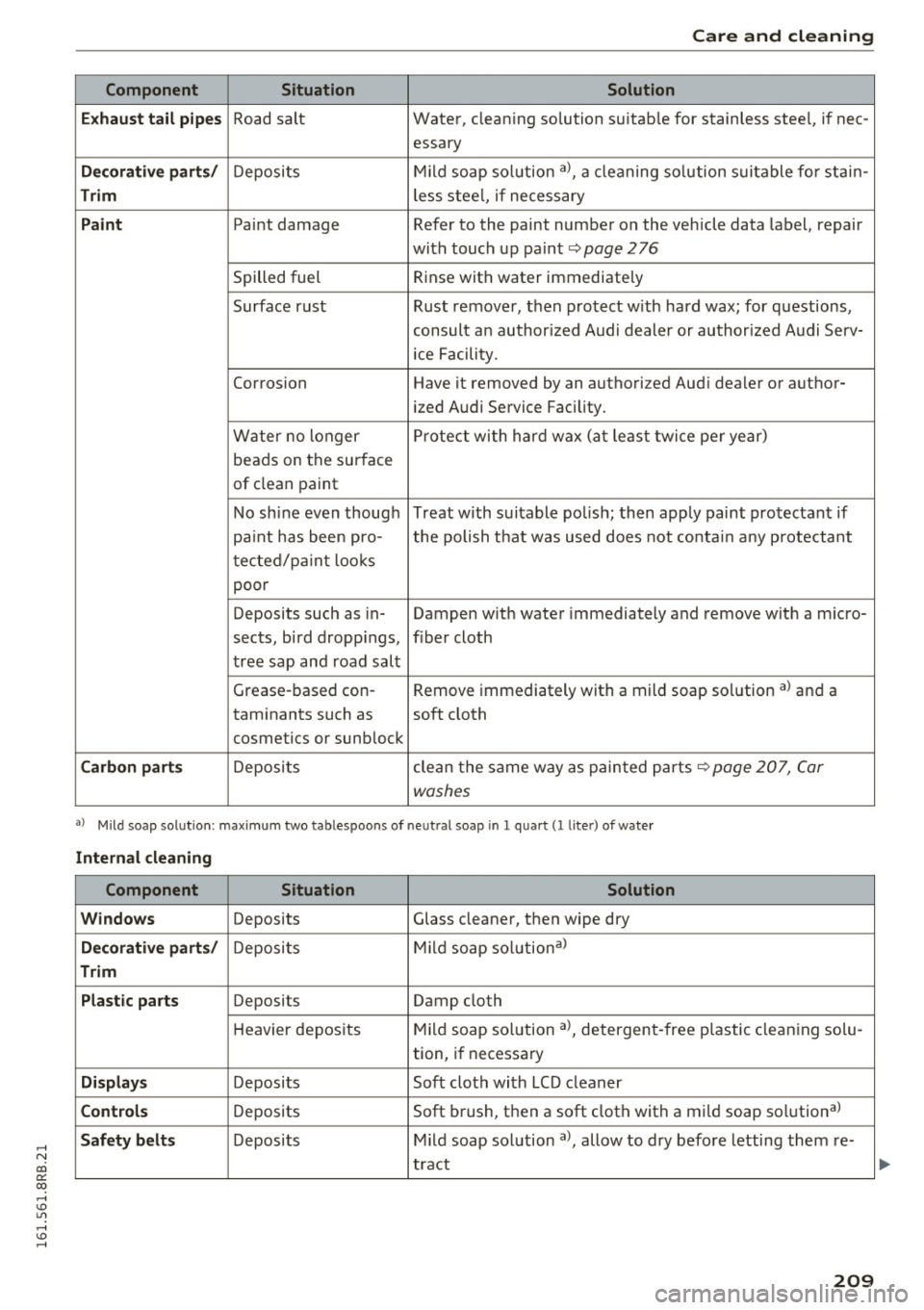
Component Situation Solution
Ex haust t ail p ip es
Road salt Water, cleaning solution suitab le for stainless steel, if nee-
essary
D eco rative p art s/ Deposits Mild soap solution
al, a cleaning so lution suitable for stain-
Trim less stee l, if necessary
Paint Paint damage Refer to the paint number on the vehicle data label, repair
with touch up paint
c:::;, page 276
Spilled fuel R
inse with water immediately
Surface rust Rust remover, then protect w ith hard wax; for questions,
consult an author ized Audi dealer or author ized Audi Serv-
ice Facility.
Corrosion Have it removed by an authorized Audi dealer or author-
ized Audi Service Facility.
Water no longer P
rotect with hard wax (at least twice per year)
beads on the surface
of clean paint
No sh ine even though Treat with suitable po lish; then apply paint protectant if
pa int has been pro- the polish that was used does not contain any protectant
tected/pa int loo ks
poor
Deposits such as in- Dampen w ith water immediately and remove wit h a m icro-
sects, bird dropp ings, fiber cloth
tree sap and road salt
Grease-based con- Remove immediately with a mild soap solution al and a
taminants such as
soft cloth
cosmetics or sunb lock
C arbon p art s Deposits clean the same way as painted parts c:::;, page 207, Car
washes
a) Mil d soap solution: maximum two tables po ons of neu tral soap in 1 quar t (l lite r) of wate r
Internal cl ea ning
Component Situation Solution
Windows
Deposits Glass cleaner, then wipe dry
Decorativ e part s/ Deposits M
ild soap solutional
Trim
Pla st ic par ts
Deposits Damp doth
H eavier deposits M
ild soap solution al, detergent-free p lastic clea ning so lu -
tion, if necessary
D ispla ys Deposits Soft cloth with LCD cleaner
Cont ro ls Deposits Soft brush,
then a soft cloth with a mild soap solution al
Safety bel ts Deposits Mild soap solution al, allow to dry before letting them re-
tract
209
Page 216 of 300

Fuel and R efu eli ng
Gasoline additives
Applies to veh icles: w ith gaso li ne engine
A major concern among many auto manufactur
ers is carbon deposit build- up ca used by the type
of gasoline you use.
Although gasoline grades d iffer from one manu
facturer to another, they have certain things in
common. All gaso line grades contain substances
that can cause deposits to collect on v ita l engine
parts, such as fue l injectors and intake valves . Al
though most gasoline brands include additives to keep engine and fuel systems clean, they are not
equally effective.
Audi recommends using TOP TIER Detergent Gas
oline. For more information on TOP TIER Deter
gent Gasoline, please go to the official website (www.toptiergas.com).
After an extended pe riod of using inadequate
fue ls, built-up carbon depos its can rob your en
gine of peak performance.
(D Note
- Damage or ma lfunction due to poor fue l
quality is not covered by the Audi New Vehi
cle Limited Warranty.
- Do not add aftermarket fuel additive prod
ucts to yo ur fuel tank.
Diesel fuel
Applies to veh icles: w ith d iese l e ngine
Always use ULSD (Ultra Low Su lfur Diesel) No. 2 .
The ULSD No . 2 meets the ASTM D97S.
Diese l fuel with concentrations of biodiesel high
er than S % such as 811,820 or 8100 are strictly prohibited.
Service station f uel pumps are labeled with the
correct fue l information for easy recognition by
the user.
If the diesel fuel pump is not labeled
ask the station operator what fuel is be ing dis
pensed before filling up your vehicle .
ULSD No . 2 may not be availab le outside the USA
and Canada . Be sure to check before traveling to
other countries .
214
ULSD No. 2 can become thicke r in very cold tem
peratures, and this can impair the engine's start
i ng and running. Depend ing on the season, gas
stations provide ULSD No. 2 that flows better in
cold temperatures so that you can continue oper
at ing your vehicle as usual.
(D Note
- Your vehicle's diese l eng ine was designed
so ley for use w ith ULSD No. 2. Therefore,
never use gasoline, heating oil, other fuels
or flow improvers. These contain substances
that will severely damage the fuel system and the engine. Such damage will no t be
c ove red by your New Vehicle Limited War
ranty .
-If you pu t any amo unt of inco rre ct fuel in
the fuel tank, do not start the engine u nder
any circumstances. Immed iate ly contact the
nearest authorized Audi dealer or author
ized Audi Serv ice Facility for ass istance .
These fuels contain substances that can se
verely damage the fuel system and the en gine if the engine is started .
Refueling
Fuel filler neck
The fuel filler neck is located on the right rear
s ide panel behind the fuel filler flap .
If the power lock ing system shou ld fai l, you can
still open the flap manually -fo r detailed instruc
tions see
¢ page 216 .
You can find the fuel tan k capacity of your vehicle
in ¢ page277.
The label on the inside of the fuel filler flap tells
you the correct fuel for your veh icle. For more in
fo rmat ion about fuel specifications, see
¢ page 212.
Your vehicle f uel tank has an on-board refuelling
vapor recovery system . Th is feature helps to pre
ven t fue l vapors from escaping from the tank and
po lluting the environment wh ile you refue l yo ur
vehicle. In order to fill the tank properly wh ile
protecting the environment, p lease follow this
refue ling procedure carefully .
Page 217 of 300

..... N
co ~ CX)
..... I.Cl U"I
..... I.Cl .....
,&_ WARNING
Under normal operating conditions, never car
ry additiona l fue l containers in your car. Gas
canisters and other containers used to trans
port fuel can be dangerous. Such containers,
full or empty, may leak and could cause a fire
in a collision. If you must transport fuel to
use for your lawn mower, snow blower, etc.,
be very careful and a lways observe local and
state laws regarding the use, transportation
and storage of such fue l conta iners. Make cer
tain the container meets industry standards
(ANSI/ASTM F852 -86) .
(D Note
Never d rive your vehicle unt il the fuel tank is
completely empty. The irregu lar supply of
fue l can cause misfiring. Gasoline cou ld enter
the exhaust system and damage the catalytic
converter.
Refuelling
Fig . 190 Righ t rear vehicle side: Opening the fuel fille r flap
Fig . 191 Fuel filler flap wit h attac hed fuel cap
When activating the central locking, the fuel fill
er flap is automatically unlocked or locked. Re
fuel the vehicle with the ignition turned
off .
Fue l an d Re fuelin g
Taking the fuel c ap off
.,. Press the left side of the f uel filler flap to open
it¢fig.190-arrow-.
.,. Unscrew fuel cap counter-clockwise and hang it
on the fuel filler flap¢
fig. 191 .
.,. Check the label on the inside of the fuel filler
flap to determine if the vehicle must be fueled
w ith gasoline or diesel fuel.
Refu ellin g pr ocedure
.,. Insert the fuel nozzle from the gasoline pump
into the fuel fill er neck as far as it will go.
.,. Select a medium refuelling rate so that the
nozzle switches off automatically when the
tank is full.
Pu tting th e fuel cap ba ck on
.,. After filling your tank, twist the fuel cap clock-
wise as far as it will go.
.,. Close the fuel filler flap.
T o avoid fuel spilling or evaporating from the fuel
tank always close fue l cap properly and com
pletely. An improperly closed fuel filler cap may
also cause the MIL lamp ¢
page 26 to come on
(only vehicles with gasoline engine).
A WARNING
-
Improper refueling or handling of fuel can
cause fire, explosion and severe burns . -
- Fuel is highly flammable and can cause se
vere burns and other injuries.
- Fa ilure to shut the engine off while refuel
ing and/or to insert the pump nozzle fully
into the fue l filler neck could cause fuel to
spray out of fi ller ne ck or to overflow. Fue l
spray and overflowing f uel can cause a fire.
- Never use a cellular telephone while refue l
ing. The electromagnetic rad iat ion can
cause sparks that can ignite fuel vapors and
cause a fire.
- Never get back into your vehicle while refu
eling. If in exceptional circumstances you
must get back in your vehicle whi le refuel
ing, make certa in that you close the door
and touch metal to discharge static electric-
ity before touching the filler nozzle again. ..,
215
Page 218 of 300

Fuel and Refueling
Static electricity can cause sparks that can
ignite fuel vapors released during refueling .
- Never smoke or have an open flame any
where in or near your vehicle when refueling
or filling a portable fuel container.
- For your safety, we strongly recommend
that you do not travel with a portable fue l
container in your vehicle. The container, full
or empty may leak and could cause a fire, especially in a crash.
- If, under exceptional circumstances , you
must transport a portable fuel container,
please observe the follow ing :
- Never fill a portable fuel container while it
is anywhere in or on the vehicle (for exam
ple, in the luggage compartment, or on
the trunk) . Static electricity can build up
while filling and can ignite fuel vapors
causing a fire.
- Always place a portable fuel container on
the ground before filling .
- Always keep the filler nozzle completely
inside the portable container before and
during filling .
- If filling a portable container made of
metal, the filler nozzle must always be in
contact w ith the container . This will help
prevent static electric ity from discharg ing
and cause a fire.
- Never spill fuel inside the vehicle or lug
gage compartment . Fuel vapors are highly
f lam mable.
- Always observe local and state/provincial
laws regard ing the use, storage and trans
portation of fuel containers.
- Make certain the fuel conta iner meets in
dustry standards (ANSI/ ASTM F852-86).
(D Note
If any fuel has spilled onto the car, it should
be removed immediately to prevent damage
to the paint .
@ For the sake of the environment
As soon as the correctly operated nozzle switches off automatically for the first time,
the tank is full. Do not try to add more fuel
216
because fuel may spill out. In addition, the
expansion space in the fuel tank will be filled -
causing the fue l to overf low when it becomes
warm and pollute the environment.
(D Tips
- Running your engine white refuelling may
cause vapors to escape or even cause fuel to
spill out of the tank. This wou ld then shut
off the fuel nozzle before the tank is full.
- Do not refuel your vehicle with the ignition
turned on. The fuel gauge may otherwise not indicate the correct fuel level after refu
elling .
- Diesel vehicles* are equipped with a diesel
misfueling protector. It allows the vehicle
to be fueled only with a diesel fuel pump
nozzle. A worn or damaged nozzle or a noz
zle that is too small may not be able to open
the diesel misfueling protector . If this is the
case, try turning the nozzle before inserting
it in the fuel filler neck, use a different fuel
pump or see your authorized Audi dealer or
authorized repair facility for assistance.
- Th e fue l fi ller f lap of your vehicle is not
locked when you lock the vehicle from the
inside.
Unlocking the fuel filler flap
by hand
You can open the fuel filler flap by hand if the
pow er locking syst em should fail .
Fig. 192 Lu ggage compa rt men t: Em ergency open ing of
fu el filler fl ap
Th e emergency open ing mechanism is located
behind the right side trim panel in the luggage
compar tment.
.. Open the right side trim panel.
Page 220 of 300

Fuel and R efue li ng
Filling AdBlue
Applies to veh icles: w ith selective cata ly ti c reduction
Fig. 193 Right rear side of the vehicle: removing the AdBl
ue cap
The Ad Blue tank opening is located near the die
sel tank opening. Add at least 1 gallon (3.8 lit
ers) of Ad Blue. This is the minimum amount re
quired to ensure the system detects the refilling
and to start the engine. You can fill a maximum
of 6 gallons (23 liters).
Requirement: The request to add Ad Blue must
appear in the instrument cluster display.
• Switch the ignition off.
• Open the tank door
r::!) page 215.
• Turn the filler neck cap counter-clockwise using
the wheel wrench from the vehicle tool kit to
remove it
¢ fig . 193.
• Fill the Ad Blue with the bottle¢ page 218 or
the canister ¢
page 219.
A WARNING
AdBlue can irr itate the skin, eyes and resp ira
tory system. If there is contact with the fluid,
flush immediately with plenty of water. Con sult a physician if necessary.
CD Note
- Only use Ad Blue that conforms to the
standard ISO 22241-1. Do not mix any addi
tives w ith the AdBl ue and do not d ilute it
wi th water.
- Do not add Ad Blue to the diesel ta nk or add
diesel f uel to the AdBlue tan k. Do not start
the engine under any circumstances if the
wrong fue l is filled in the tank. There is a
risk of damaging the fuel tank system and
218
the engine . See an authorized Audi dea le r or
authorized Audi Service Facility for assis
tance.
- Ad Blue attacks surfaces such as painted ve
hicle components, p lastic and carpet. Re
move the fluid as quickly as possible with a
damp cloth and plenty of cold water. If the
AdBlue has a lready crystall ized, use warm
water and a sponge. Ad Blue residue that is
not removed w ill crystall ize and can damage
t he affected s urface.
- Do not store refill bottles or canisters per
manently in the vehicle. If the container
leaks, the escaping Ad Blue could damage
the vehicle inte rior.
- Do not allow Ad Blue to come into contact
with cloth ing. If t here is contac t w ith the
fluid, flush immediately wi th plenty of wa
ter.
(0 Tips
Fo llow the AdBlue manufacture r's instruc
tions for use and storage.
Refilling Ad Blue w ith a bottle
App lies to vehicles : wi th selec tive cata lyt ic reduct ion
• Remove the cap from the refill bott le ¢ &. in
Filling AdBlue on page 218,
¢ 0 in Filling
AdBlue on page 218.
• Posit ion the bottle on the filler tube and turn
the bottle clockwise until it stops turning.
• Press lightly against the bottom of the bottle
to empty it . Cont inue pressing the bottom of
the bottle unt il it is empty or until fluid stops
flowing into the tank.
• Remove the bottle and close the filler neck
¢ page 219, Completing .
CD Note
Only use refill bott les tha t are approved for
you r vehicle. Using other systems can cause
Ad B lue to leak.
(0 Tips
- You can obtain refill bottles from an author
ized Audi dea le r or authorized Audi Service
Facility.
Page 221 of 300

-A permitted refill bott le contains approxi
mately 0.5 gallons (1.9 liters) of Ad Blue.
Refilling Ad Blue with a canister
A pp lies to vehicles: with selective ca taly tic reduc tion
®
+®
F ig . 194 Ca nister wi th att ach ab le hose
.,. Remove the cover on the refi ll canis ter ¢.&. in
Filling AdBlue on page 218, ¢(Din Filling
AdBlue on page 218 .
.. Secure the end of the hose (I) on the opening in
the can ister @ by turning the hose to the right.
.. Remove the cap @from the other end of the
hose @.
.. Pos ition the end of the hose@on the f iller
neck in the vehicle and turn the hose to the
right to tighten it.
.,. Lift the caniste r up and then tip it. Continue
holding the ca nister in a tipped position unt il it
is empty or until no more fluid flows into the
tank .
.. Remove the canister and close the f iller neck
¢ page 219, Comple ting .
(D Note
On ly use refi ll canisters t hat are approved for
your veh icle. Using other systems can cause
Ad Blue to leak.
(D Tips
- An authorized Audi dealer or authorized
Audi repa ir facility can tell you which ref ill
canisters are approved for your vehicle.
- A pe rm itted refill canister contains approxi-
~ mately 1.3 gallons (5 liters) of AdBlue.
co
er::
co
,....,
Completing
App lies to vehicles : wi th selective cata lytic re du ctio n
Closing the filler neck
.. Turn the cap to the r ight on the fille r neck w ith
the wheel w rench until the cap clicks into place .
This tighte ns the cap to the specification ¢
&,
in Filling AdBlue on page 218 , ¢@ in Filling
AdBlue on page 218 .
.. Then press on the left side of the tank door un-
til you hear it lock.
Afte r filling
T he vehicle must be driven so that the system
recogni zes that the Ad Blue was refilled. This
process can take several minutes.
.,. If the re was no AdB lue left in the tank and a
range of
O mi (0 km ) was shown in the d isplay,
sw itch the ignition on for about 30 seconds be
fore starting the engine .
(D Tips
Ad B lue can freeze at very low temperatures .
If this happens, the system will not detect
that the Ad B lue was refilled and it will contin
ue to inform you of the low AdBl ue leve l. This
message w ill turn off as soon as the tank de
frosts aga in.
219
Page 222 of 300

Checking and Filling
Checking and Filling Hood
Releasing the engine hood
The engine hood is released from inside the vehi
cle .
Fig. 195 Driver's side footwell : eng ine hood release lever
.. With the driver's door open, pull the lever un
der the instrument panel in the direction of the
arrow ¢
fig. 195.
The hood pops up slightly under spring pressure.
Opening the engine hood
CJ
Fig. 196 Release lever under t he e ngi ne hood
Before opening the engine hood, make sure that
the windshield wipers are flat against the w ind
shield. Otherwise, they could damage the paint
on the hood.
.,. Pull up on the release under the hood
¢
fig . 196. This releases the catch.
.,. Open the hood all the way ¢.&_ .
,& WARNING
Hot engine coo lant can burn you.
220
-To reduce the r isk of being burned, never
open the hood if you see or hear steam or
coo lant escaping from the engine compart
ment. Wait until no steam or coolant can be
seen or heard before carefully opening the
hood .
Closing the engine hood
.,. Pull the hood down until the pressu re from the
struts is reduced .
.. Let the hood
drop down and latch in place. Do
not try to push it shut;
it may fail to engage
~A -
A WARNING
A hood that is not completely latched could
fly up and block your view while driving.
- When you close the engine hood, check it to
make sure the safety catch has properly en
gaged . The hood should be flush with the
surrounding vehicle body parts .
- If you notice while driv ing that the hood is
not secured properly, stop at once and close
it .
Working in the engine compartment
Be especially careful whenever you work in the
engine compar tment.
-
Whenever you must perform any work in the
engine compartment , for example checking and
filling different fluids, there is a risk of injury,
burns and accidents. To prevent personal injury
always observe the following WARNINGS. The
engine compartment of any vehicle is a hazard
ous area ¢.&, .
A WARNING
To help avoid injury, before you check any
thing und er the hood:
- Turn off the engine.
- Remove the ign ition key .
- Apply the parking brake.
- Move selector lever of automatic transm is-
sion to P (Park).
-