2016 AUDI Q3 belt
[x] Cancel search: beltPage 149 of 252

.... N
c:i :::J CX)
.... I.Cl U"I
N I.Cl ......
Tether anchors and tether straps
Fig. 138 Tether ancho rs: attachment hook locatio ns be
h ind the rear seatbacks
The tether anchors for the rear seating positions
are located on the backside of the rear seatbacks
¢fig. 138.
A tether is a straight or V-shaped strap that at
taches the top part of a child restraint to special anchorage points in the vehicle.
The purpose of the tether is to reduce the for
ward movement of the child restraint in a crash,
in order to help reduce the risk of head injury
that could be caused by striking the vehicle inte
rior.
Forward facing child restraints manufactured af
ter September 1, 1999, are required by U.S. fed
eral regulations to comply with new child head
movement performance requirements. These
new performance requirements make a tether
necessary on most new child safety seats.
A WARNING
Improper installation of child restraints will
increase the risk of injury and death in a
crash.
- Always follow the instructions provided by
the manufacturer of the child restraint you intend to install in your Audi.
- Improper use of child restraint anchors (in
cluding tether anchors) can lead to injury in
a collision. The anchors are designed to
withstand only those loads imposed by cor rectly fitted child restraints .
- Never mount two child restraint systems on
one LATCH lower anchor point .
Child safety
- Never attach two child restraint systems to
one tether strap or tether anchorage.
- Never attach a tether strap to a tie-down
hook in the luggage compartment.
- Never use child restraint tether anchorages
to secure safety belts or other kinds of occu
pant restraints.
- Never secure or attach any luggag e or other
items to the LATCH lower anchorages or to
the tether anchors.
- If a tether or other strap is used to attach a
child restraint to the front passenger seat,
make sure that it is not so tight, that it
causes the weight-sensing mat to measure more weight than is actually on the seat.
- The heavier weight registered can make the
Advanced Airbag System work as though an
adult were on the seat and deploy the Ad
vanced Airbag when it must be suppressed
causing serious or even fatal injury to the
child.
- If you must install a rearward facing child
safety seat on the front passenger seat be
cause of exceptional circumstances and the
PASSENGER AIR BAG OFF light does not
come on and stay on, immediately install
the rear-facing child safety seat in a rear
seating position and have the airbag system
inspected by your Audi dealer.
147
Page 151 of 252

Additional information
Sources of information about child
restraints and their use
There are a n umber of so urces of ad d it ional in
formation about child restraint se lection, insta l
l ation and use :
N HTSA advises th at th e best child s afety se at is
the one that fits you r ch ild and fits in yo ur vehi
cle, and that you will use co rrectly and consis
tently.
T ry before you buy !
U.S National Highway Traffic Safety Administra
tion
Tel.: 1-888-3 27-42 36 ( TTY: 1- 800-42 4-9 15 3)
h tt p :/ /www. nhts a.gov
National SAFE KIDS Campaign
Tel.: (202) 662-0600
ht tp :/ /www.s afe kids.o rg
Safety BeltSafe U.S.A
Tel.: (800) 7 45-SAFE ( Eng Lish)
T el.: (800) 747-SA NO (Spa nish)
http ://www.carseat. org
Transport Canada Information Centre
Tel.: 1-800-333-037 1 or call 1-613-998-8616 if
you are in the Ottawa area
h ttp ://www.tc.gc. ca/ eng/roa dsafe ty/menu .h tm
Audi Customer Relations
Tel.: (800) 82 2-2834
Child safety
149
Page 152 of 252

Intelligent Technology
Intelligent Technology
Notice about data
recorded by the Event
Data Recorder and
vehicle control modules
Event Data Re corder
This vehicle is equipped wi th an Event Data Re
corder (EDR) . The main purpose of an E DR is to
record, in certain crash or near crash -like situa
tions, such as an airbag deploym ent or h itting a
road obstacle, data that will assist in understand
ing how a veh icle 's systems performed . The EDR
is designed to record data related to veh icle dy
namics a nd safety systems for a sho rt period of
time, typically 30 seconds or less . The E DR in this
veh icle is designed to reco rd s uch data as :
- How various systems in your vehicle were oper
at ing;
- Whether or not the driver and passenger safety
belts were buckled/fastened;
- How far ( if at all) the driver was depressing the
acce lerator and/or brake peda l; and,
- How fast the ve hicle was trave ling.
These data can help provide a better understand ing of the ci rc u mstances in which c rashes and in
juries occur. NOT E: EDR data are recorded by yo ur
veh icle only if a non-trivia l crash situat ion occurs;
no data are recorded by the EDR under normal
driving conditions and no personal data (e .g .,
name, gender, age, and crash location) a re re
corded . H owever , other pa rties , such as law en
forcement, cou ld combine the EDR data w it h the
type o f person ally identifyi ng dat a routine ly ac
qu ired dur ing a crash invest igat ion .
To read data reco rded by an EDR, specia l equip
men t is req uire d, and access to the veh icle or the
E DR is needed. In ad dition to the vehicle manu
facturer, other parties, s uch a s law enforcement,
that have t he specia l equipment, can read the in
formation if they have access to the vehicle or the E DR.
Some s tate laws restrict the re trieva l or down
loading of data stored by ED Rs insta lled in a vehi
cle fo r the express purpose of retrieving data af -
150
ter an accident or crash event withou t the own
er 's consent.
Audi will not access the EDR and /or sim ilar data
o r g ive it to others -
- unless t he ve hicle ow ner (o r lessee if the vehi
cle has been leased) ag rees; o r
- upon the offic ial request by the police; or
- upon the order of a court of law or a govern-
ment agency; or
- for the defense of a lawsuit through the jud icia l
discovery process.
- Audi may also use the data for research about
veh icle operation and safety perfo rmance or
prov ide the data to a th ird party for research
purposes w itho ut identify ing t he specific vehi
cle or info rmat ion about the ident ity of its own
er or lessee and only afte r th e re co rded vehicle
d ata has been a ccessed.
Vehicle control modules
You r vehicle is also equ ipped with a number of
e lectronic cont rol modules for va rious vehicle
syste ms, such as engine ma nagement, em iss io n
contro l, air bag s, a nd safety be lts.
These electronic control modules record data
dur ing norma l vehicle operation t hat may be
n eeded by tra ined techn ic ians for d iagnost ic and
r ep air pur poses. The re cording capab ility of these
modules is lim ited to dat a (no sou nd is recor d
ed). Only a sma ll amount of data is actually re
corded over a very limited period of time, or stor
ed when a system fault is detected by a contro l
module . Some of the data stored may relate to
vehicle speed, direction, or braking, as well as re
straint system use and performance in the event
of a crash . Stored data can also only be read a nd
down loaded w it h specia l equipment that is d i
r ec tly connec ted to the vehicle.
(D Tips
Your vehicle may be e quipped w it h Aud i con
n ect . Yo ur use of certain Aud i connect fea
tures requires wire less services that are p ro
v ided by a third party wireless telecomm uni
cations provider. Fo r de tails regarding how in
fo rmation obtained through Aud i connect is
collecte d, processe d, transmitted, use d, an d ..,.
Page 172 of 252

Care and cleaning
Component Situation Solution
Paint
Paint damage Refer to the paint number on the vehicle data label, repair
with touch up paint
c::;, page 229
Spilled fuel Rinse with water immediately
Surface rust Rust remover, then protect with hard wax; for questions,
consult an 1 authorized Audi dealer or authorized Audi Serv-
ice Facility.
Corrosion Have
it removed by an authorized Audi dealer or authorized
Audi Service Facility.
Water no longer Protect with hard wax (at least twice per year)
beads on the surface
of clean paint
No shine even though Treat with suitable polish; then apply paint protectant if
paint has been pro -the polish that was used does not contain any protectant
tected/paint looks
poor
Deposits such as in-Dampen with water immediately and remove with a micro-
sects, bird droppings, fib er cloth
tree sap and road salt
Grease-based con- Remove immedia tely with a m ild soap solution al and a
taminants such as soft cloth
cosmetics or sunb lock
Carbon parts Deposits clean the same way as painted parts c::;, page 168 , Car
washes
• > M ild soap so lution: ma xim um tw o tabl espoo ns of n eu tral soap i n 1 quart (1 li ter) of w ater
Internal cleaning
Component Situation Solution
Windows
Deposits Glass
cleane r, then wipe dry
Decorative parts/ Deposits Mild soap solutiona l
Trim
Plastic parts
Deposits Damp cloth
Heavier deposits Mild soap so lution al, detergent-free p lastic cleaning solu-
tion, if necessary
Displays Deposits Soft cloth with LCD cleaner
Controls Deposi ts Soft
brush, then a soft cloth w ith a mild soap solutiona)
Safety belts Deposits Mild
soap so lution a>, allow to dry before letting them re-
tract
170
Page 174 of 252

Care and cleaning
avoid scratches, move the scraper on ly in
one direction and not back and forth.
- Never remove snow or ice from door win
dows and mirrors using warm or hot water
because this could cause cracks to form .
- To avoid damage to the rear w indow de
fogger, do not apply any stickers on the
heating wires on the inside of the window .
- Decorati ve parts /trim
- Never use chrome care or cleaning prod-
ucts.
- Paint
- To red uce the risk of scratches, the vehicle
must be free of dirt and dust before pol
ishing or waxing .
- T o prevent pa int damage, do not polish or
wax the veh icle in direct sunlight.
- To red uce the risk of pa int damage, do not
polish away rust spots.
- Remove cosmetics and sunscreen immedi
ately -these could damage the paint.
- Di spla ys
- To avoid scratches, do not use dry cleaning
methods on displays .
-Controls
- Make sure that no fluids enter the con-
trols, because this could cause damage.
- Safety belts
- Do not remove the safety belts to clean
them.
- Never clean safety belts o r th eir compo
nents chemically or with cor rosive fl uids
or so lvents and neve r al low sha rp objects
t o come into con ta ct w ith the safe ty belts.
T his could cause damage to the belt web
bing .
-If there is damage to the webbing, the
connections, the retractors or the buckles,
have them replaced by an author ized Audi
dealer or authorized Audi Service Facility.
- Textiles /art ificial leather/ Alcantara
- Never treat artificia l leather/ Alcantara
w ith leather care products, so lvents, floor
polish, shoe polish, spot remove or similar
prod uct s.
- Have a specialist remove st ubborn stains
to prevent damage.
172
- Never use steam cleaners, brushes, hard
sponges, etc . when cleaning .
- D o not turn on the seat heating* to dry the
seat.
- Objects w ith sharp edges s uch as zippe rs,
rivets on clothing or be lts can cause dam
age to the surface .
- Open hook and loop fasteners, fo r exam
p le on clothing, can damage seat covers.
Make sure hook and loop fastene rs are
closed.
- Natu ral leathe r
- Never treat leather with solvents, floor
polish, shoe polish, spot remover or sim i
lar p roducts .
- Objects w ith sharp edges such as zippe rs,
rivets on clothing or belts can cause dam
age to the surface.
- Never use steam cleaners, brushes, hard
sponges, etc. when cleaning.
- Do not turn on the seat heating * to dry the
seat.
- To he lp prevent the leather from fad ing,
do not leave the vehicle in d irect sunlight
for long periods of time . If leav ing the ve
h icl e parked fo r long pe riods of time, you
should cove r the leathe r to pro te ct it from
d irec t sunlight.
{D Tips
- Insects are easier to remove from paint that
has been freshly waxed.
- Regular waxing can prevent rust spots from
forming.
Page 180 of 252

Checking and Filling
-Keep children away from the engine com
partment.
- Never spill fluids on hot engine compo
nents. They can cause a fire.
- Never touch the radiator fan. The auxiliary
electric fan is temperature controlled and
can switch on suddenly.
- Never open the coolant reservoir cap when
the engine is still warm. The coolant system
is pressurized and hot coolant could spray
out.
- Protect your face, hands and arm from steam or hot engine coolant by placing a
thick rag over the cap when you open the
coolant reservoir .
- Do not remove the engine cover under any
circumstances. This increases the risk of
burns .
- If work on the fuel system or the electrical
system is necessary:
-Always disconnect the battery.
- Never smoke or work near heaters or open
flames. Fluids in the engine compartment
could start a fire.
- Keep an approved fire extinguisher imme
diately available.
- To avoid electrical shock and personal injury
while the engine is running or being started,
never touch:
- Ignition cables
- Other components of the high voltage
electronic ignition system.
- If you must perform a check or repair with
the engine running:
- First, fully apply the parking brake, move
selector lever of automatic transmission
to "P" (Park).
- Always use extreme caution to prevent
clothing, jewelry, or long hair from get-
178
ting caught in the radiator fan, V-belts or
other moving parts, or from contacting
hot parts. Tie back hair before starting,
and do not wear clothing that will hang or
droop into the engine.
- Minimize exposure to emission and chemi
cal hazards
c::> & .
A WARNING
California Proposition 65 Warning:
- Engine exhaust, some of its constituents,
and certain vehicle components contain or
emit chemicals known to the State of Cali
fornia to cause cancer and birth defects and
reproductive harm. In addition, certain flu
ids contained in vehicles and certain prod
ucts of component wear contain or emit
chemicals known to the State of California
to cause cancer and birth defects or other
reproductive harm .
- Battery posts, terminals and related acces
sories contain lead and lead compounds,
chemicals known to the State of California
to cause cancer and reproductive harms.
Wash hands after handling.
([) Note
When adding fluids, always make sure that
they are poured into the proper container or
filler opening, otherwise serious damage to
vehicle systems will occur.
@ For the sake of the environment
To detect leaks in time, inspect the vehicle
floor pan from underneath regularly. If you
see spots from oil or other vehicle fluids, have
your vehicle inspected by an authorized Audi dealer .
Page 187 of 252

A WARNING ,~
- The cooling system is under pressure and
can get very hot. Reduce the risk of scald ing
from hot coolant by following these steps.
- Turn
off the engine and allow it to coo l
down.
- Protect you r face, hands and arms from
escaping fluid and steam by cover ing the
cap with a large, thick rag.
- Turn the cap slowly and very carefully in a
counter-clockwise d irection while applying
light, downward p ressure on the top of
the cap.
- To avoid being burned, do not spill anti
freeze or coolant on the exhaust system or
hot engine parts. Under certa in cond i
tions, the ethylene glycol in eng ine cool
ant can catch fire.
- Antifreeze is poisonous. Always store anti
freeze in its orig inal container and well out
of the reach of children.
- If you dra in the coolant, it must be caught
and safely stored in a proper conta iner
clearly marked "poison".
- Do not add coolant if the expansion tank is
empty. Air cou ld enter the cooling system
and damage the eng ine. If this is the case,
do not continue driving . Seek professional
ass istance.
- Coolant pollutes the env ironment and could
cause an eng ine fire. Excess coolant will be
fo rced o ut through the pressure relief valve
i n the cap when the e ng ine be comes hot.
- If, in an emergency, only wate r can be add
ed, the co rrect r atio betwee n wate r and an
tifree ze
Q page 183 must be res to red as
soon as possib le.
{® For the sake of the environment
Dra ined coolant sho uld not be reused. Always
disp ose of used coolant while obse rving all
....
"' environment al regulat ions. ci ::, co ....
Ch eck ing and Filling
Rad iator fan
The radiator fan switches on automatically by it
self .
The radiator fan is driven by the engine via the V
belt. The viscous clutch regulates th e speed of
the fan accord ing to the temperature of the cool
ant .
An auxiliary e lectr ic radiator fan* switches on and
off depending on coo lant temperature and other
vehicle operating conditions.
After you switch the engine
off, the auxiliary fan
can continue running for up to 10 m inutes -even
with the ignition
off. It can even switch on aga in
later by itself
Q .& , if
- the temperature of the engine coolant rises due
to the heat build-up from the engine in the en
gine compartment, or
- the engine compartment heats up beca use the
veh icle is parked in intense sunlight.
A WARNING
- To reduce the r isk of persona l injury neve r
touch the radia to r fan .
- The auxiliary e lectr ic fan is temperature
controlled and can switch on s uddenly even
when the engine is not ru nning .
- The a uxiliary radiator fan sw itches on auto
mat ically when the eng ine coolant reaches a
certa in temperature a nd will continue to run
until the coolant temperature d rops.
185
Page 239 of 252
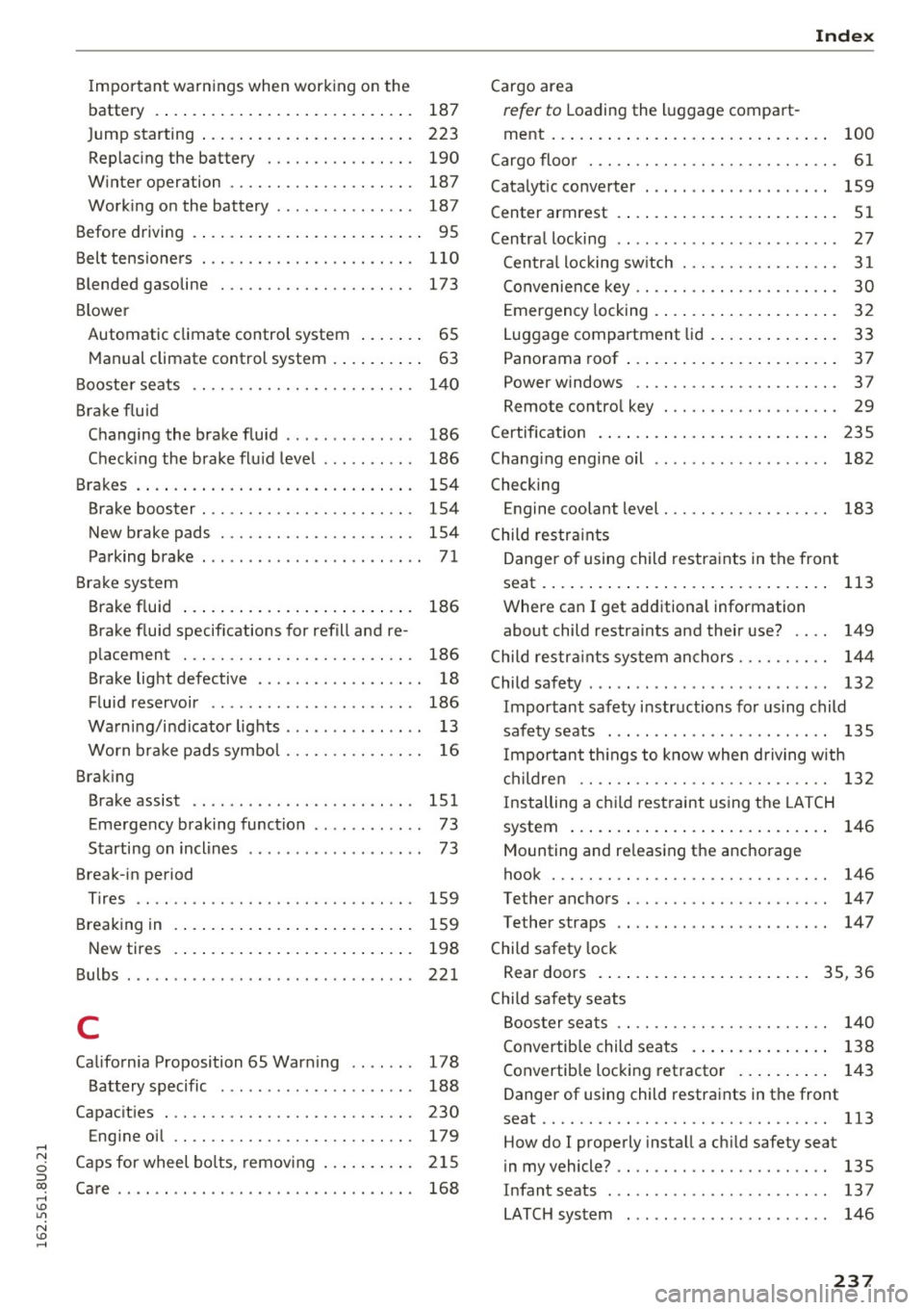
Important warnings when working on the
battery . . . . . . . . . . . . . . . . . . . . . . . . . . . .
187
Jump starting . . . . . . . . . . . . . . . . . . . . . . . 223
Replacing the battery . . . . . . . . . . . . . . . . 190
Winter operation . . . . . . . . . . . . . . . . . . . . 187
Working on the battery . . . . . . . . . . . . . . . 187
Before driving . . . . . . . . . . . . . . . . . . . . . . . . . 95
Belt tensioners . . . . . . . . . . . . . . . . . . . . . . . 110
Blended gasoline . . . . . . . . . . . . . . . . . . . . . 173
Blower
Automatic climate control system . . . . . . .
65
Manual climate control system . . . . . . . . . . 63
Booster seats . . . . . . . . . . . . . . . . . . . . . . . . 140
Brake fluid
Changing the brake fluid . . . . . . . . . . . . . .
186
Checking the brake fluid level . . . . . . . . . . 186
Brakes . . . . . . . . . . . . . . . . . . . . . . . . . . . . . . 154
Brake booster . . . . . . . . . . . . . . . . . . . . . . . 154
New brake pads . . . . . . . . . . . . . . . . . . . . . 154
Parking brake . . . . . . . . . . . . . . . . . . . . . . . . 71
Brake system
Brake fluid . . . . . . . . . . . . . . . . . . . . . . . . .
186
Brake fluid specifications for refill and re
placement . . . . . . . . . . . . . . . . . . . . . . . . . 186
Brake light defective . . . . . . . . . . . . . . . . . .
18
Fluid reservoir . . . . . . . . . . . . . . . . . . . . . . 186
Warning/indicator lights . . . . . . . . . . . . . . . 13
Worn brake pads symbol . . . . . . . . . . . . . . . 16
Braking
Brake assist . . . . . . . . . . . . . . . . . . . . . . . .
151
Emergency braking funct ion . . . . . . . . . . . . 73
Starting on inclines . . . . . . . . . . . . . . . . . . . 73
Break-in period
Tires . . . . . . . . . . . . . . . . . . . . . . . . . . . . . .
159
Breaking in . . . . . . . . . . . . . . . . . . . . . . . . . . 159
New tires . . . . . . . . . . . . . . . . . . . . . . . . . . 198
Bulbs . . . . . . . . . . . . . . . . . . . . . . . . . . . . . . . 221
C
California Proposition 65 Warning . . . . . . . 178
Battery specific . . . . . . . . . . . . . . . . . . . . . 188
Capacities . . . . . . . . . . . . . . . . . . . . . . . . . . . 230
Engine oil . . . . . . . . . . . . . . . . . . . . . . . . . . 179
Caps for wheel bolts , removing . . . . . . . . . . 215
Care . . . . . . . . . . . . . . . . . . . . . . . . . . . . . . . . 168
Index
Cargo area
refer to Loading the luggage compart-
ment...... ... .. .. .................
100
Cargo floor . . . . . . . . . . . . . . . . . . . . . . . . . . . 61
Catalytic converter . . . . . . . . . . . . . . . . . . . . 159
Center armrest . . . . . . . . . . . . . . . . . . . . . . . . 51
Centra l locking . . . . . . . . . . . . . . . . . . . . . . . . 27
Central locking sw itch . . . . . . . . . . . . . . . . . 31
Convenience key . . . . . . . . . . . . . . . . . . . . . . 30
Emergency locking . . . . . . . . . . . . . . . . . . . . 32
Luggage compartment lid . . . . . . . . . . . . . . 33
Panorama roof . . . . . . . . . . . . . . . . . . . . . . . 37
Powe r windows . . . . . . . . . . . . . . . . . . . . . . 3 7
Remote control key . . . . . . . . . . . . . . . . . . .
29
Certification . . . . . . . . . . . . . . . . . . . . . . . . . 235
Changing engine oil . . . . . . . . . . . . . . . . . . . 182
Checking
Engine coolant level . . . . . . . . . . . . . . . . . .
183
Child restraints
Danger of using child restraints in the front
seat....... ... .. .. ................ .
113
Where can I get additional information
about child restraints and their use? . . . .
149
Child restraints system anchors. . . . . . . . . . 144
Child safety . . . . . . . . . . . . . . . . . . . . . . . . . .
132
Important safety instructions for using child
safety seats . . . . . . . . . . . . . . . . . . . . . . . .
135
Important th ings to know when driving with
children . . . . . . . . . . . . . . . . . . . . . . . . . . .
132
Installing a child restraint using the LATCH
system . . . . . . . . . . . . . . . . . . . . . . . . . . . .
146
Mounting and re leasing the anchorage
hook . . . . . . . . . . . . . . . . . . . . . . . . . . . . . .
146
Tether anchors . . . . . . . . . . . . . . . . . . . . . . 147
Tether s traps . . . . . . . . . . . . . . . . . . . . . . . 147
Child safety lock
Rear doors . . . . . . . . . . . . . . . . . . . . . . .
35, 36
Child safety seats
Booster seats . . . . . . . . . . . . . . . . . . . . . . .
140
Convertible child seats . . . . . . . . . . . . . . . 138
Convertible locking retractor . . . . . . . . . . 143
Danger of using child restraints in the front
seat...... .... .. .. ............... ..
113
How do I properly install a child safety seat
in my vehicle? . . . . . . . . . . . . . . . . . . . . . . .
135
Infant seats . . . . . . . . . . . . . . . . . . . . . . . . 137
LATCH system . . . . . . . . . . . . . . . . . . . . . . 146
237