2016 AUDI Q3 height
[x] Cancel search: heightPage 112 of 252

Safety belts
The shou lder belt should lie as close to the center
of the collar bone as possib le and should fit well
on the body
c::> A in Safety belt position on
page 108.
"' Push
the loop -around fittings up c::> fig. 120 @,
or
"'squeeze together the (D button, and push the
loop-around fittings down@.
"'Pull the belt to make sure that the upper at
tachment is properly engaged .
A WARNING
Always read and heed all WARNINGS and oth er important informat ion
c::> page 106.
(D Tips
With the front seats, the height adjustment of the seat can also be used to adjust the po
sition of the safety belts.
Improperly worn safety belts
Incorrectly positioned safety belts can cause se
vere injuries.
Wearing safety belts improperly can cause seri
ous injury or death. Safety belts can only work
when they are correctly positioned on the body.
Improper seating positions reduce the effect ive
ness of safety belts and will even inc rease the
risk of injury and death by mov ing the safety belt
to cr it ica l areas of the body. Improper seating
positions a lso increase the risk of serious injury
and death when an airbag deploys and strikes an
occupant who is not in the correct seating pos i
tion. A driver is responsible for the safety of all
veh icle occupants and especially for children.
Therefore:
"' Never permit anyone to assume an incorrect
sitting position in the vehicle while traveling
c>_& .
A WARNING
Improperly worn safety belts increase the risk
of serious personal injury and death whenever
a vehicle is being used.
110
- Always make sure that all vehicle occupants
are correctly restrained and stay in a correct
seating position whenever the vehicle is be
ing used.
- Always read and heed all WARNINGS and
other important information
c::> page 106.
Belt tensioners
How safety belt pretensioners work
In front, side and rear-end collisions above a
particular severity and in a rollover, safety belts ore tensioned automatically.
The safety belts are equipped w ith safety belt
pretensioners . The system is activated by sensors
i n front, side and rear-end collisions of great se
verity and in a rollover. This tightens the belt and
takes up belt slack
c::> & in Service and disposal of
safety belt pretensioner on page 111.
Taking up
the slack helps to reduce forward occupant
movement during a collision.
(D Note
Never let the belt remain over a rear seatback
that has been folded forward .
@ Tips
The safety belt pretensioner can only be acti
vated once.
- Th e safety belt pretensioners do not deploy
in minor frontal, side and rear-end colli
sions.
- When the safety belt pretensioners are acti
vated, a fine dust is released. This is normal
and is not caused by a fire in the vehicle.
- Th e relevant safety requirements must be
observed when the vehicle or components
of the system are scrapped. An authorized
Audi dealer or qualified workshop is familiar
with these regulations and will be pleased
to pass on the information to you.
- Be sure to observe all safety, environmental
and other regulations if the vehicle or indi
vidual parts of the system, particularly the
safety belt or airbag, are to be disposed. We
recommend you have your authorized Aud i
dealer perform this service for you.
Page 142 of 252

Child safety
Booster seats and safety belts
Properly used booster seats can help protect
children weighing between about 40 lbs . and 80
lbs. (18 kg and 36 kg) who are less than 4
ft. 9
in. (57 inches/1.45 meters) tall .
Fig. 133 Rear seat: ch ild proper ly restrained in a booster
seat
The vehicle's safety belts alone will not fit most
children until they are at least 4
ft . 9 in. (57 in
ches/1.45 meters) tall and weigh about 80 lbs .
(36 kg). Booster seats raise these chi ld ren up so
that the safety belt will pass properly
over the
stronger parts of their bodies and the safety belt
can help protect them in a crash.
• Do not use the convertible locking retractor
when using the vehicle's safety belt to restrain
a chi ld on a booster seat.
• The shoulder be lt must lie as close to the cen
ter of the child's collar bone as possible and
must lie flat and snug on the upper body. It
must never lie across the throat or neck. The
lap belt must lie across the pelv is and never
across the stomach or abdomen . Make sure the
belt lies flat and snug. Pull on the belt to tight
en if necessary .
• If you must transport an older child in a boos
te r seat on the front passenger seat , you can
use the safety belt height adjustment to help
adjust the shoulder portion properly .
• Secure unused safety belts on the rear seat
c> page 137.
Children up to at least 8 years old (over 40 lbs. or
18 kg) are best protected in child safety seats de
signed for their age and weight. Experts say that
the skeletal structure, particularly the pelvis, of
these children is not fully developed, and they
140
must not use the vehicle safety belts without a
suitable child restraint .
It is usually best to put these children in appro
pr iat e booste r seats. Be sure the booster seat
meets all applicab le safety standards.
Booster seats raise the seating position of the
child and reposition both the lap and shoulder
parts of the safety belt so that they pass across
the child's body in the right places. The routing of
the be lt
over the chi ld's body is very important
for the child's protection, whether or not a boos
ter seat is used. Children age 12 and under m ust
always ride in the rear seat.
Ch ildren who are at least 4
ft. 9 in. (57 inches/
1.45 meters) ta ll can generally use the vehicle 's
three point lap and shoulder belts . Never use the
lap belt portion of the vehicle's safety belt alone
to restrain any child, regard less of how big the
c hi ld is. Always remember that children do not
have the p ronounced pelvic structure required for
the proper function of lap belt portion of the
ve
hicle's three point lap and shoulder belts. The
c hi ld's safety absolutely requ ires that a lap belt
portion of the safety belt be fastened snugly and
as low as possible around the pe lvis. Never let
the lap belt portion of the safety belt pass over
the child's stomach or abdomen.
In a crash, airbags must inflate within a blink of
an eye and with considerab le force . In order to do
i ts job, the airbag needs room to inflate so that it
will be there to protect the occupant as the occu
pant
moves forward into the airbag.
A ve hicle occ upant who is out of position and too
close to the a irbag gets in the way of an inflating
airbag. When an occupant is too close, he or she
will be struck vio lently and will receive serious or
possibly even fatal injury .
In order for the a irbag to offer protection, it is
important that all vehicle occupants, especially
any ch ildren, who must be in the front seat be
cause of exceptional c ircumstances, be properly
re stra ined and as far away from the a irbag as
possible. By keeping room between the child's .,..
Page 194 of 252

Wheels
(D Tires for passenger vehicles
(if applicable)
P indicat es a tire for a passenger
vehicle. T indicates a tire desig
nated for temporary use.
@ Nominal width
Nominal width of the tire be
tween the sidewalls in millime
ters. In general: the larger the
number, the wider the tire.
@ Aspect ratio
Height/width ratio expressed as a
percentage.
@ Tire construction
R indicates a radial tire.
® Rim diameter
Size of the rim diameter in inches.
@ Load index and speed rating
The load index indicates the tire's
load-carrying capacity.
The speed rating indicates the maximum permitted speed
¢ & in
W inter tires on page 206.
"EXTRA LOAD", "xl" or "RF" indi
cates that the tire is reinforced or
is an Extra Load tire.
Speed rat- Maximum permitted speed
ing
p
up to 93 mph (1 50 km/h)
Q up to 99 mph (160 km/h)
192
Speed rat- Maximum permitted speed
Ing
R
up to 106 mph (170 km/h)
s up to 110 mph (180 km/h)
T up to 118 mph (190 km/h)
u up to 124 mph (200 km/h)
H up to 130 mph (210 km/h)
V up to 149 mph (240 km/h)al
z above 149 mph (240 km/h)al
w up to 168 mph (270 km/h)al
y up to 186 mph (300 km/h)al
a) For tires above 149 mph (240 km/h),
tire manufact urers sometimes use the
code "ZR".
(j) US DOT number (TIN) and
manufacture date
The manufacture date is listed on
the tire sidewall (it may only ap
pear on the inner side of the tire):
DOT ... 2215 ...
means, for example, that the tire
was produced in the 22nd week of
the year 2015.
@ Audi Original equipment
tires
Audi Original equipment tires
with the designation "AO" or "RO"
have been specially matched to
your Audi. When used correctly,
these tires meet the h ighest
standards of safety and handling.
An authorized Audi dealer or au
thorized Audi Service Facility will .,..
Page 209 of 252

of snow, snow chain s can imp air handling and
damage the t ires, and t he chains will quickly be
destroyed.
A WARNING
Using incorrect snow chains or installing snow
chains incorrect ly can result in loss of vehicle
co ntrol, which increases the risk of an acc i
dent .
Snow chains can damage the r ims/wheel cov
ers* if the chains come into d irect contact
w ith them. Remove the wheel covers* first.
Use coated snow chains .
Low aspect ratio tires
Your Audi is facto ry-equipped with low aspect ra
tio ti res. These t ires have been tho rough ly tested
and been se lected specifically for yo ur model fo r
thei r superb per formance, road feel and handling
under a variety of driving conditions. Ask your au
thorized Audi dealer for more details .
The low aspect ratio of these t ires is indica ted by
a numera l of
55 or les s in the tire's size designa
tion. The numeral represents the ratio of the
tire's sidewall height i n relation to its tread width
expressed in percentage. Conventional tires have
a height/w idth ratio of 60 or more.
Th e performance of low-aspect- ratio tire s is par
ticularly sensit ive to improper inflation pre s·
sure . It is therefore important that low aspect
ratio tires are inflated to the specified pressure
and that the inflation pre ssure is regul arly
ch ecked and ma intained . Tire pre ssure s should
be checked at least once a month and a lways
before a long tr ip
c> page 201.
What you can do to avoid tire and rim
damage
L ow aspect rat io tires can be damaged more easi
ly by impact wi th pot holes, c urbs, gull ies or
r idges on the ro ad, p articul arly if the tire is un
de rinflated.
I n o rder to minimize the occurrence of impact
damage to the t ires of your ve hicl e, we recom-
Wh eel s
mend that you observe the following preca u
tions:
- Always ma in tain recommended inflat io n pres
sures. Check yo ur tire pressure every 2,0 00
m iles (3,000 km) and add air if necessary .
- Dr ive c arefully on roads w it h potholes, deep
gullies or ridges . The impac t from dr iving
through or over such obstacles can damage
your tires. Impact with a curb may a lso cause
damage to your tires.
- After any impact, immediate ly inspect your
tires or have them inspected by the nearest au
thorized Audi dealer. Replace a damaged tire as
soon as possible.
- Inspect your tires every 2,000 m iles (3,000 km)
for damage and wear. Damage is not always
easy to see . Damage can lead to loss of air and
underinflation, wh ich could even tually cause
tire fa ilure. If yo u believe that a tire may have
been damaged, replace the tire as soon as pos
sib le.
- These tires may wear more quickly tha n others .
- Please also remember that, while these tires
delive r responsive ha nd ling, they may ride less
comfortably a nd make mo re noise than other
choi ces.
Reduced performance in winter /cold se ason
conditions
All t ires are des igned for certai n purposes. The
low aspect ratio, ultra high performance tires
o rigi na lly installed on your veh icle are intended
f or maximum dry and wet road performance and
handling . They are not suitable for co ld, snowy or
icy weather conditions . If you drive under those
c ircumstances, you should equip yo ur vehicle
with all-season or winter tires, which offer better
tract ion under those conditions. We suggest you
u se the recommended snow or all-season tires
spec ified for your veh icle, or their equiva lent .
Refer to
c> page 206 for more detailed informa
t ion regarding winter tires.
Uniform tire quality grading
- Tread wear
- Traction AA ABC
- Temperature ABC
207
Page 246 of 252
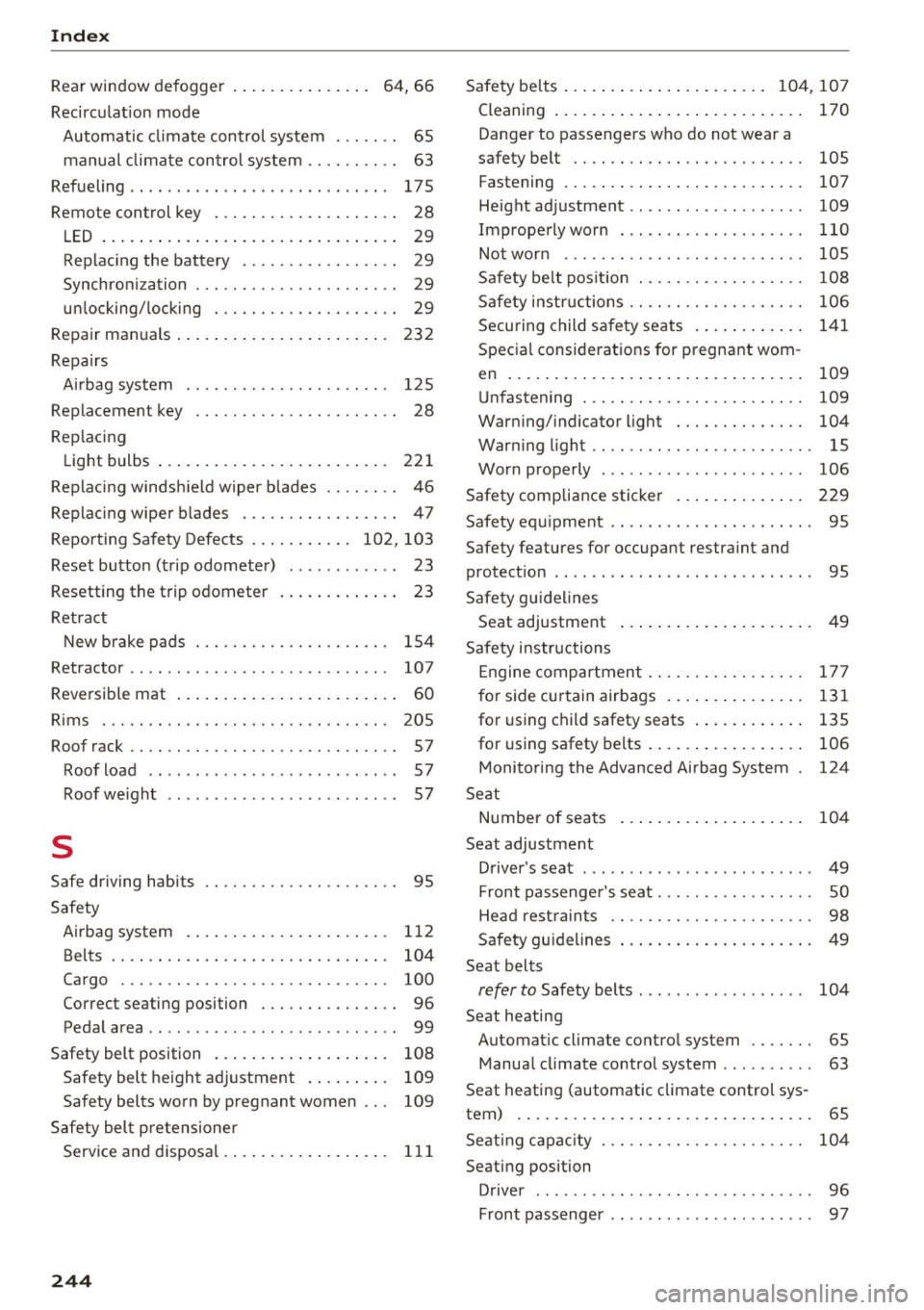
Index
Rear window defogger 64,66
Recirculation mode Automatic climate control system . . . . . . . 65
manual climate control system . . . . . . . . . . 63
Refueling .. .. .. .. ... . ...... ... .. .. .. . 175
Remote control key . . . . . . . . . . . . . . . . . . . . 28
LED . . . . . . . . . . . . . . . . . . . . . . . . . . . . . . . . 29
Replacing the battery . . . . . . . . . . . . . . . . . 29
Synchroni zation . . . . . . . . . . . . . . . . . . . . . . 29
unlocking/locking . . . . . . . . . . . . . . . . . . . . 29
Repair manuals . . . . . . . . . . . . . . . . . . . . . . . 232
Repairs Airbag system . . . . . . . . . . . . . . . . . . . . . . 125
Replacement key . . . . . . . . . . . . . . . . . . . . . . 28
Replacing Light bulbs . . . . . . . . . . . . . . . . . . . . . . . . . 221
Replacing windsh ield wiper b lades . . . . . . . . 46
Replacing wiper blades . . . . . . . . . . . . . . . . . 47
Reporting Safety Defects . . . . . . . . . . . 102, 103
Reset button (trip odometer) . . . . . . . . . . . . 23
Resetting the trip odometer . . . . . . . . . . . . . 23
Retract New brake pads . . . . . . . . . . . . . . . . . . . . . 154
Retractor . . . . . . . . . . . . . . . . . . . . . . . . . . . . 107
Reversible mat . . . . . . . . . . . . . . . . . . . . . . . . 60
Rims . . . . . . . . . . . . . . . . . . . . . . . . . . . . . . . 205
Roof rack . . . . . . . . . . . . . . . . . . . . . . . . . . . . . 57
Roof load . . . . . . . . . . . . . . . . . . . . . . . . . . . 57 Safety belts
. . . . . . . . . . . . . . . . . . . . . . 104, 107
Cleaning . . . . . . . . . . . . . . . . . . . . . . . . . . . 170
Danger to passengers who do not wear a
safety belt . . . . . . . . . . . . . . . . . . . . . . . . . 105
Fastening . . . . . . . . . . . . . . . . . . . . . . . . . . 107
Height adjustment . . . . . . . . . . . . . . . . . . . 109
Improperly worn . . . . . . . . . . . . . . . . . . . . 110
Not worn ....................... .. . 105
Safety belt pos ition . . . . . . . . . . . . . . . . . . 108
Safety instructions . . . . . . . . . . . . . . . . . . . 106
Securing child safety seats . . . . . . . . . . . . 141
Special considerations for pregnant wom-
en . . . . . . . . . . . . . . . . . . . . . . . . . . . . . . . . 109
Unfastening . . . . . . . . . . . . . . . . . . . . . . . . 109
Warning/indicator light . . . . . . . . . . . . . . 104
Warning light . . . . . . . . . . . . . . . . . . . . . . . . 15
Worn properly . . . . . . . . . . . . . . . . . . . . . . 106
Safety compliance sticker . . . . . . . . . . . . . . 229
Safety equ ipment . . . . . . . . . . . . . . . . . . . . . . 95
Safety features for occupant restraint and protection . . . . . . . . . . . . . . . . . . . . . . . . . . . . 95
Safety guidelines Seat adjustment . . . . . . . . . . . . . . . . . . . . . 49
Safety instructions Engine compartment . . . . . . . . . . . . . . . . . 177
for side curtain airbags . . . . . . . . . . . . . . . 131
for using child safety seats . . . . . . . . . . . . 135
for using safety belts . . . . . . . . . . . . . . . . . 106
Monitoring the Advanced Airbag System 124
Roof weight . . . . . . . . . . . . . . . . . . . . . . . . . 57 Seat
s
Safe driving habits . . . . . . . . . . . . . . . . . . . . . 95
Safety Airbag system . . . . . . . . . . . . . . . . . . . . . . 112
Belts . . . . . . . . . . . . . . . . . . . . . . . . . . . . . . 104
Cargo . . . . . . . . . . . . . . . . . . . . . . . . . . . . . 100
Correct seating position . . . . . . . . . . . . . . . 96
Pedal area . . . . . . . . . . . . . . . . . . . . . . . . . . . 99
Safety belt position . . . . . . . . . . . . . . . . . . . 108
Safety belt height adjustment . . . . . . . . . 109
Safety belts worn by pregnant women . . . 109
Safety belt pretensioner Service and disposal.............. .... 111
244
Number of seats 104
Seat adjustment Driver 's seat . . . . . . . . . . . . . . . . . . . . . . . . . 49
Front passenger's seat . . . . . . . . . . . . . . . . . 50
Head restraints . . . . . . . . . . . . . . . . . . . . . . 98
Safety guidelines . . . . . . . . . . . . . . . . . . . . . 49
Seat belts
refer to Safety belts . . . . . . . . . . . . . . . . . . 104
Seat heating Automatic climate control system . . . . . . . 65
Manual climate control system . . . . . . . . . . 63
Seat heating (automatic climate control sys-
tem) . . . . . . . . . . . . . . . . . . . . . . . . . . . . . . . . 65
Seating capac ity . . . . . . . . . . . . . . . . . . . . . . 104
Seating position Driver . . . . . . . . . . . . . . . . . . . . . . . . . . . . . . 96
Front passenger . . . . . . . . . . . . . . . . . . . . . . 97