2016 AUDI A4 ABS
[x] Cancel search: ABSPage 194 of 278

Trailer mode
Trailer mode notes
Important to know
Your vehicle handles different ly when tow ing a
tra iler because of the additional weight and dif
ferent weight distr ibution. Safety, performance
and economy w ill great ly depend on how careful
ly you load your trailer and operate your rig.
Before you actua lly tow your trailer, practice
turning, stopping and backing up in an area away
from traffic . Keep practicing until you have be
come completely familiar with the way your vehi
cle-trailer combination behaves and responds.
Backing up is d ifficult and requires practice.
Backing up with a trailer generally requires steer
ing action opposite to that when backing up your
vehicle without a trailer.
Maintain a greater distance between your vehicle
and the one in front of you. You w ill need more
room to stop . To compensate for the trai ler, you
will need a larger than norma l turning radius.
When passing, remembe r that you cannot accel
erate as fast as you normally would because of
the added load. Make sure you have enough room
to pass. After passing, allow plenty of room for
your trai ler before chang ing lanes again.
Avoid jerky starts, sharp turns or rapid lane
changes.
(D Tips
- Do not tow a trailer during the break-in peri
od of you r vehicle.
- If you tow a trailer, your Audi may require
more frequent maintenance due to the ex
tra load~
page 258.
Parking on a slope
Do not pork on a slope with a trailer. If it cannot
be avoided, do so only ofter doing the following:
When parking:
.,. Apply t he foot brake .
.,. Have someone place chocks under both the ve
hicle and the trailer wheels.
192
.. With chocks in place, slowly release the brakes
until the wheel chocks absorb the load.
.. Turn the whee ls towards the curb .
.. App ly the parking brake .
.. Place an automat ic transmission* in P, respec
tively a manual transmission in first or reverse
gear .
When restarting after parking:
.. App ly the foot brake.
.. Start the engine.
.. Move the selector lever to 0/5, respectively a
manual transmission in first gear.
.. Release the parking brake and slowly pull out
and away from the whee l chocks.
.,. Stop and have someone ret rieve the wheel
chocks.
(D Tips
If you move the selector lever of the automat
ic transmission* to P before applying the
parking brake and before blocking the wheels,
you may have to use more force later to move
the lever out of the P position.
Page 198 of 278

Care and cleaning
Component Situation Solution
Te xtil es
Deposits adhering to Vacuum cleaner
a rt ifici al le ather , the surface
Alcant ara Water-based deposits Absorben
t cloth and mild soap solutiona>
such as coffee, tea,
blood, etc.
O il-based deposits Apply a m ild soap solution a), blot away the dissolved oil or
such as oil, make-up, dye, treat afterward with water, if necessary
etc.
Special deposits such Special stain remover, b lot with absorbent material, treat
as ink, na il polish, la- afterward with mild soap solution, if necessary a)
tex paint, shoe pol-
ish, etc.
Natural leather Fresh stains Wool cloth with a mild soap so
lutiona)
Water-based deposits fresh sta ins: absorbent cloth
such as coffee, tea, d ried stains: stain remover suitable for leather
blood, etc.
Oil-based deposits Fresh staiins: absorbent cloth and stain remover suitable
such as oil, make-up, for leather
etc. dried stains: oil cleaning spray
Special deposits such Spot remover suitab le for leather
as ink, nai l polish, la -
tex paint, shoe pol-
ish, etc.
Ca re Regularly apply cond ition ing cream that protects from
light and penet rates into the materia l. Use specia lly-co l-
ored conditioning cream, if necessary.
Carbon parts Deposits clean the same way as plastic parts
a) Mild soap solution: maximum two tablesp oons of neutral soap in 1 quart (l liter) of water
_& WARNING
The windshie ld may not be trea ted with wa
ter-repelling windshield coating agents. Un
favorable conditions s uch as wetness, dark
ness, or low sun can result in increased glare .
Wiper blade chatter is also possible.
(D Note
- Headlights/tail light s
-Never clean headlights or tail lights with a
dry cloth or sponge.
- Do not use any cleaning product that con
tains alcohol, because they could cause
cracks to form.
- Wheels
196
-
- Never use any paint polish or other abra
sive materials.
- Damage to the protect ive layer on the
rims such as stone chips or scratches must
be repaired immediately.
- Sensors /camera lenses
- Neve r use wa rm or ho t wa ter to remove
snow or ice from the camera lens . This
could cause the lens to crack .
- N eve r use ab rasive cleaning materials or
a lcohol to clea n the camera lens . This
could cause scratches and cracks .
-Doo r window s
-Remove snow and ice on windows and ex-
terior mirrors with a plast ic scraper. To
Page 214 of 278

Check ing and F illing
The brake fluid rese rvoir is located at the rear
partition of the engine compartment on the l eft
side ¢
page 205 .
The fl uid level may drop slightly after some time
due to the automatic adjustment of the brake
pads . This is not cause for alarm.
If th e b rake fl uid level fa lls considerably be low
the "M IN" mark, the b rake warning/ind icator
lig ht ( U.S. mode ls :
1111 , Canadian models:. )
will come on ¢
page 15. Do not contin ue to oper
ate the vehicle . T he comp lete brake system
should be thoroughly checked by an authori zed
Aud i dealer or qualified workshop and the cause
corrected . If the brake flu id level is too low, the
b rake warning/indicator light will i llum inate.
Contact a n author ized Audi dealer
immediately .
{D) Tips
The brake fluid reservoir is located under
neath the cover .
Changing brake fluid
Have the brake fluid changed by an experienced
technician .
Brake fluid absorbs mo isture from the air. If the
water content in the b rake fluid is too high, cor
rosion in the brake system may resu lt afte r ape
riod of t ime. The boiling poi nt of the brake flu id
will also decrease cons iderably and decrease
b raking perfo rman ce.
Therefore, the brake fluid must be changed
every
two year s.
Always use new brake fluid wh ic h con
forms to Fede ral Motor Veh icle Standard "FMVSS
1 16 DO T 4".
The brake fluid reservoir can be diff icult to reach,
therefore, we recommend that yo u have the
brake fl uid changed by yo ur autho rized
Audi
dealer .
Your dealer has t he corre ct tools, t he
right brake fluid and the know-how to do this for
you.
A WARNING
- Brake fluid is poisonous. It must be stored
only in the closed orig inal container out of
the reach of chi ldren!
212
- Bra ke fa ilure ca n result from old or inapp ro
priate brake fluid . Observe these precau
tions:
- Use only brake fluid t hat meets SA E speci
fi ca ti on
J 170 3 and con forms to Federa l
Motor Ve hicle Standard 116 . Always check
wi th yo ur autho rized Audi dea le r to make
s ur e yo u are using the correct brake fluid .
The correct type of brake flu id is also ind i
cated on the b rake fluid reservo ir .
- The brake fluid m ust be new . Heavy use of
the brakes can cause a vapo r lock if the
brake fluid is left in the system too long .
This can se riously affect the efficiency of
the b rakes as well as your safety . This
could resu lt in an accident .
(D Note
Brake fluid will damage the paint of your veh i
cle.
@ For the sake of the environment
Because of the problem o f proper d isposa l o f
brake fluid as well as the spec ial too ls re
q ui red a nd the necessary expertise, we rec
omme nd that you have the bra ke f luid
changed by yo ur autho rized Aud i dea le r.
Battery
, General information
U nder normal operating condit ions, the battery
i n your Audi does not need any maintenance.
With
high outside temperatures or long daily
drives we recommend that you have the elect ro
lyte level c hecked by an au thorized Aud i dealer o r
qualified workshop. The electro lyte level shou ld
a lso be che cked each time the battery is c ha rged
~ page 214.
Have the batte ry chec ked when you take yo ur ve
hicle in for service. You are we ll adv ised to re
pla ce a battery tha t is older than 5 yea rs.
With certain types of airbag deployment, t he
batte ry is d iscon nected from the ve hicle electri
ca l system for safety reasons ¢.&.
in Repair, care
and disposal of the airbags on page 151. .,.
Page 215 of 278

..... N
0 ::..:: co .....
Some vehicle func tion s (p ower w indow reg ula
tors, for example) are lost i f th e battery termi
na ls are d isconnected. These functions have to be
relearned afte r the battery termina ls are con
nected aga in. To prevent th is, the batte ry shou ld
only be disconnected from the vehicle e lectr ica l
system w hen abso lute ly necessary for repairs.
Vehicles not driven for long periods
If yo u do not drive you r vehicle over a period of
seve ral days or weeks, e lectrical components a re
g radually c ut back or sw itched off. This reduces
e nergy consumption and ma inta ins starting ca
pability over a longer pe riod
c> page 182.
Some o f the conven ience f unctions may not ope r
ate, s uch as the inte rior lights or the power seat
ad justment. The convenience functions will be
ava ila ble aga in whe n you tu rn o n the ignition and
start the engine .
Winter operation
During the winter months, battery capacity tends
to dec rease as temperatu res dr op. This is be
cause more power is also consumed wh ile start
in g, and the head lights , rear wi ndow defogge r,
etc., are used more of ten .
Avoid un necessa ry power consumption, part icu
l arly in city traffic or when t rave ling on ly short
d ista nces . Let your authorized Audi dealer check
the capaci ty of the vehicle battery be fore w inte r
sets in
r=;, pag e 214. A well cha rged batt ery w ill
n o t onl y preven t st arti ng p roble ms w hen the
wea ther is cold, but will also last l on ger .
(D Tips
If your v ehicle is left stand ing fo r se ve ral
wee ks at extre mely low tem per at ures, the ve
hicle b attery sh ould be re moved and stor ed
w here it will not free ze . Th is will preve nt i t
from being dama ged and hav ing to be re
placed .
Checking and Filling
Working on the battery
Be especially careful when working on or near
the battery.
The battery is located in the luggage compart
ment under the floor. Befo re you check anything
i n the luggage compart ment ,
read and heed all
WARNINGS
c> &_ .
Always heed the safety warnings , when working
o n the veh icle batte ry or t he ve hicle elec trical
system to prevent in jury .
The following WARNINGS are very important
when working on the battery :
Always heed the following WARNING SYM-
BOLS and safety precautions when wo rking on
the battery.
®
Always wear eye protection.
A
Battery acid contains sulfuric acid. Al-
ways wear gloves and eye protection.
@
No
- sparks
- flames
- smoking.
~
When a battery is charged , it produces
hydrogen gas which is explosive and
could cause personal injury.
®
Always keep the battery well out of reach
of children.
A WARNING
= -
Whenever working on t he battery or on the
e lectr ica l system, the re is the r isk of injury,
accide nt a nd eve n fire. Read and he ed the fol
l ow ing W AR NIN GS:
- Always wear eye protection. Do not let bat
tery acid or any l ead particles ge t on you r
skin o r clothing. Shield yo ur eyes. E xplosiv e
g ases can ca use b lindne ss or other in jury.
- Ba tte ry acid contai ns sulfur ic acid. Sulfu ric
acid can ca use blindness and s evere burns.
- Always wea r gloves and eye protection . Do
n ot tilt t he batte ry because aci d could lea k
out of the ventilation openings. ""
213
Page 227 of 278

different tire speeds. For this reason, in case of emergency, only
use a spare tire* that is the same
circumference as the regular
tires.
&_ WARNING -
-Only use tire/rim combina tions and suitable wheel bolts
that have been approved by
Audi. Otherwise, damage to
the vehicle and an accident could result.
-For technical reasons, it is not possible to use tires from oth
er vehicles - in some cases,
you cannot even use tires from
the same vehicle model.
-Make sure that the tires you
select have enough clearance
to the vehicle . Replacement
tires should not be chosen
simply based on the nominal
size, because tires with a dif
ferent construction can differ
greatly even if they are the
same size. If there is not
enough clearance, the tires or
the vehicle can be damaged and this can reduce driving
safety and increase the risk of
an accident.
Wheels
-Only use tires that are more
than 6 years old when abso lutely necessary and drive
carefully when doing so.
-If you install wheel covers on
the vehicle, make sure they al
low enough air circulation to
cool the brake system. If they
do not, this could increase the
risk of an accident.
Tire wear/damage
Fig. 189 Tire profile : treadwear indica
tor
Tire wear
Check the tires regularly for wear .
-Inflation pressure that is too low
or high can increase tire wear
considerably.
-Driving quickly through curves, rapid acceleration and heavy
braking increase tire wear .
-Have an authorized Audi dealer
or authorized Audi Service Facili
ty check the wheel alignment if
there is unusual wear. ..
225
Page 237 of 278
..... N
0 ::..:: co .....
The temperature grade for this tire is established for a tire that is properly inflated and
not overloaded. Excess ive speed, underinfla
tion, or excessive loading, either separately or
in combination, can cause heat buildup and
possible tire failure.
& WARNING
-
-
Temperature grades apply to tires that are properly inflated and not over or underinflat
ed.
Tire pressure monitoring system
U) General notes
App lies to vehicles: with tire pressure mo nitoring system
Each tire, including the spare (if provided),
should be checked monthly when cold and inflat
ed to the inflation pressure recommended by the
ve hicle manufact urer on the vehicle placa rd o r
tire inflat ion press ure label.
(If your vehicle has
tires of a different size than the size indicated on
the vehicle placard or tire inflation pressure la
be l, you should determine the proper tire infla
tion pressure for those tires).
As an added safety feature, your vehicle has been
eq uipped with a tire pressu re monitoring system
(TPMS) that illuminates a low tire pressure te ll
tale when one or more of your t ires is significant
ly under- inflated. Accordingly, when the low tire
pressure tellta le illuminates, you should stop and
check your tires as soon as possible, and inflate
them to the proper press ure. Driving on a s ignifi
cantly under-inflated tire causes the tire to ove r
h eat and can lead to t ire failure. Unde r-inflation
a lso reduces fuel e fficiency and tire tread life,
and may a ffec t the vehicle's handling and stop
p ing ability .
P lease note that the TPMS is not a substit ute for
p roper tire main tenance, and i t is the drive r's re
sponsib ility to ma intain correct tire pressure,
even if under-inflation has not reached the level
to trigger illumination of the TPMS low tire pres
sure telltale .
Wh eel s
Your vehicle has also been equipped with a TPMS
malfunction indicator to indicate when the sys
tem is not ope rating properly. The TPMS ma l
funct ion indicator is combined with the low t ire
pressure telltale. When the system detects a
malfunction, the telltale will flash for app roxi
mately one m inute and t hen rema in continuously
illuminated. This seque nce w ill cont inue upon
s u bsequent vehicle star t-ups as long as the mal
funct ion exists.
When the malfunction indicator is illum inated,
the system may not be able to detect o r signal
l ow tire p ressure as intended. TPMS malfunct ions
may occur fo r a v arie ty of reaso ns, including the
insta llation of replacement or al ternate tires or
whee ls on the vehicle that p revent the TPMS
from functioning proper ly . Always check the
TPMS ma lfunction te lltale after replacing one or
more tires or wheels on yo ur vehicle to ensure
that the rep lacement or a lternate tires and
wheels allow the TPMS to continue to function prope rly.
' If the Tire Pressure Monitoring System
indicator appears
Applies to vehicles: wi th t ire pressure monitoring system
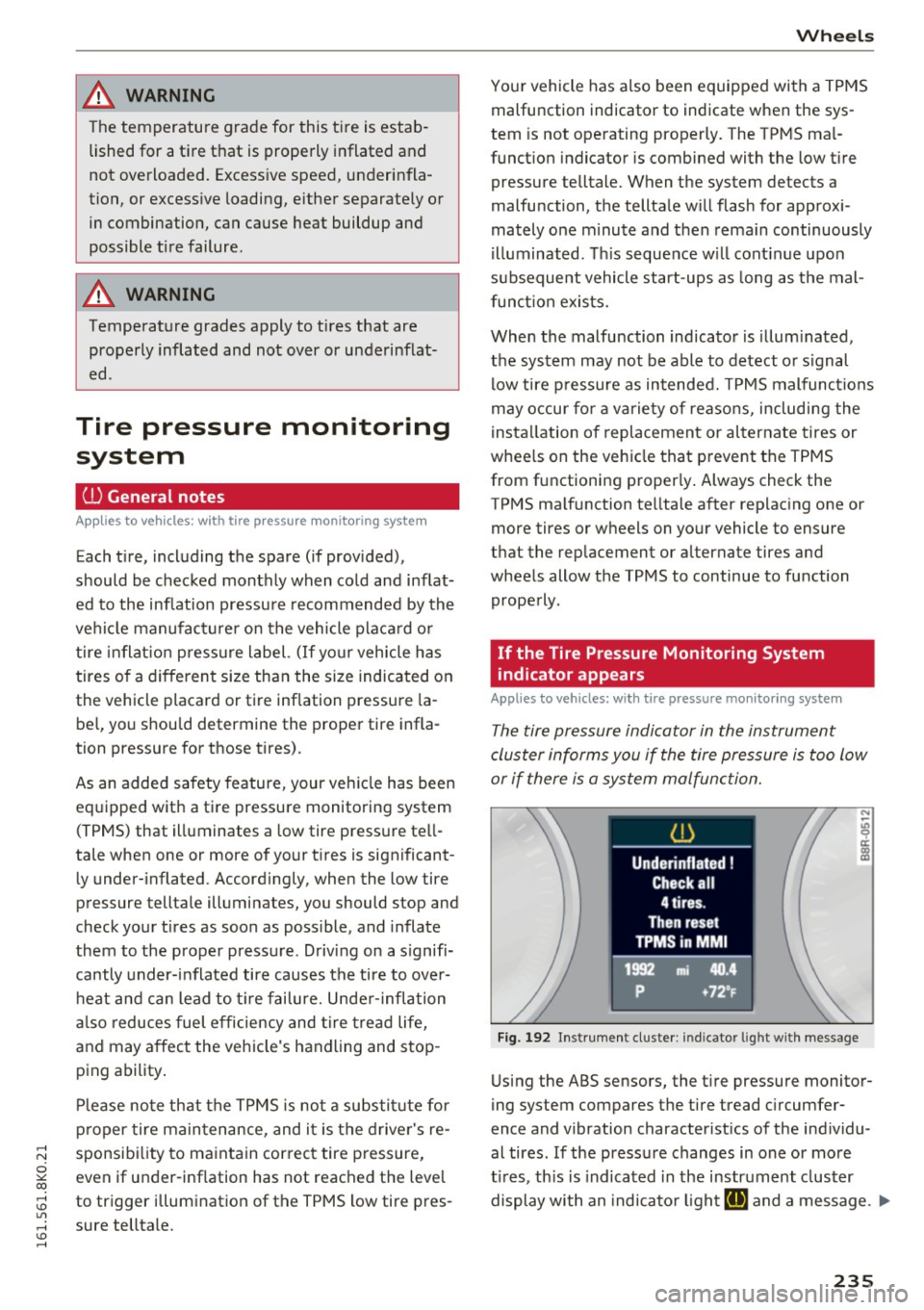
The tire pressure indicator in the instrument
cluster informs you if the tire pressure is too low
or if there is a system malfunction.
Fi g. 192 Instrument cluster: indicator light with message
Using the ABS sensors, the tire pressure monito r
ing system compares the tire tread c ircumfer-
ence and v ibration characterist ics of the ind ividu-
al tires. If the press ure changes in one or mo re
t ir es, th is is indicated in the instrument clust er
display with an indicato r light
RI] and a message . .,.
235
Page 275 of 278

..... N
0 ::..:: co .....
36
by remote control . . . . . . . . . . . . . . . . . . . . 34
with the central locking switch . . . . . . . . . . 35
with the convenience key . . . . . . . . . . . . . . . 34
Use of jumper cables . . . . . . . . . . . . . . . . . . 251
V
Valet parking . . . . . . . . . . . . . . . . . . . . . . . . . 44
Vanity mirrors . . . . . . . . . . . . . . . . . . . . . . . . . 53
Vehicle
Care/cleaning . . . . . . . . . . . . . . . . . . . . . . .
193
Out of service . . . . . . . . . . . . . . . . . . . . . . . 197
Veh icle control modules......... .. .. .. . 176
Vehicle electrical system . . . . . . . . . . . . . . . . 16
Vehicle identification label . . . . . . . . . . . . . 255
Veh icle Identification Number (V IN) . . . . . . 255
Vehicle jack . . . . . . . . . . . . . . . . . . . . . . . . . . 242
Vehicle key . . . . . . . . . . . . . . . . . . . . . . . . . . . 32
Vehicle shut-down . . . . . . . . . . . . . . . . . . . . 186
Vehicle tool kit . . . . . . . . . . . . . . . . . . . . . . . 23 7
Vent ilation . . . . . . . . . . . . . . . . . . . . . . . . . . .
76
Warning/indicator lights . . . . . . . . . . . . . . . . 13
A irbag system . . . . . . . . . . . . . . . . . . . . . . . 19
Anti-lock braking system (ABS) . . . . . . . . . . 19
Brake system . . . . . . . . . . . . . . . . . . . . . . . . 15
Electromechanical parking brake . . . . . . . . 16
Electronic power control . . . . . . . . . . . . . . . 20
Electronic Stabilization Control ( ESC) . . . . . 18
Generator . . . . . . . . . . . . . . . . . . . . . . . . . . . 16
Malfunction Indicator Lamp (MIL) . . . . . . . 20
Safety belt . . . . . . . . . . . . . . . . . . . . . . . . . . 16
Safety systems . . . . . . . . . . . . . . . . . . . . . . . 19
Turn signa ls . . . . . . . . . . . . . . . . . . . . . . . . . 22
Warning/Indicator lights
Airbag system . . . . . . . . . . . . . . . . . . . . . .
148
Warranty coverages . . . . . . . . . . . . . . . . . . . 258
Washer reservoir . . . . . . . . . . . . . . . . . . . . . 216
Washing matte finish paint . . . . . . . . . . . . . 193
We ights. . . . . . . . . . . . . . . . . . . . . . . . . . . . . 255
What happens if you wear your safety belt too
loose? . . . . . . . . . . . . . . . . . . . . . . . . . . . . . .
134
What happens to unbelted occupants? . . . . 131
Index
What impairs driving safety? . . . . . . . . . . . . 122
Wheel bolts . . . . . . . . . . . . . . . . . . . . . . . . . 232
Wheels .... .. .. .. .. ............... .. 217
Cleaning . . . . . . . . . . . . . . . . . . . . . . . . . . . 194
Glossary of tire and loading terminology . 219
Replacing . . . . . . . . . . . . . . . . . . . . . . . . . . 240
Tires and vehicle load limits . . . . . . . . . . . 229
When must a safety belt be replaced? . . . . 132
When must the a irbag system be inspected? .148
Window regulators . . . . . . . . . . . . . . . . . . . . .
41
Power locks . . . . . . . . . . . . . . . . . . . . . . . . . 42
Windows
Cleaning/removing ice . . . . . . . . . . . . . . . .
195
defrosting . . . . . . . . . . . . . . . . . . . . . . . . . . . 78
Windshield
Cleaning . . . . . . . . . . . . . . . . . . . . . . . . . . . .
54
defrosting . . . . . . . . . . . . . . . . . . . . . . . . . . . 78
Windsh ield washer fluid
Low leve l . . . . . . . . . . . . . . . . . . . . . . . . . . . .
21
Windshield washer system . . . . . . . . . . . . . . 54
Windshield wipers
Cleaning . . . . . . . . . . . . . . . . . . . . . . . . . . . .
55
Folding up . . . . . . . . . . . . . . . . . . . . . . . . . . 56
Indicator light . . . . . . . . . . . . . . . . . . . . . . . 21
Replacing windshield wiper blades . . . . . . . 56
Switching on/off ... ...... ....... .. .. . 54
216
Washer reservoir
Winter driving Snow chains . . . . . . . . . . . . . . . . . . . . . . . .
233
Tires . . . . . . . . . . . . . . . . . . . . . . . . . . . . . . 232
Winter operation
Coolant system . . . . . . . . . . . . . . . . . . . . .
208
Defrosting windows . . . . . . . . . . . . . . . . . . . 78
Seat heating . . . . . . . . . . . . . . . . . . . . . . . . . 78
Tires . . . . . . . . . . . . . . . . . . . . . . . . . . . . . . 182
Winter tires. . . . . . . . . . . . . . . . . . . . . . . . . . 232
Winter use
Car washes . . . . . . . . . . . . . . . . . . . . . . . . .
193
Removing ice from windows 195
X
Xenon head lights .. ............. 48, 50, 249
273