2016 AUDI A4 heating
[x] Cancel search: heatingPage 185 of 278

..... N
0 ::..:: co .....
of the battery is extended.
Basically, energy management consists of
bat
t e ry di agno sis, idl ing curr ent mana gement
and
dy namic en ergy management .
Battery diagnosis
Battery diagnosis continuous ly determines the
state of the batte ry . Sensors dete rm ine battery
voltage, batte ry current and battery tempera
ture . This determ ines the current state of charge
and the power of the battery.
Idling current management
Idling current management reduces energy con
sumpt io n while the veh icle is stand ing . With the
i gn it ion sw itched off, it controls the energy sup
p ly to the various ele ctrical components . Data
from battery diagnosis is considered.
D epending on the battery's state of charge, ind i
vid ual consume rs a re gradually turned off to p re
vent excessive discharge of the battery and thus
maintain starting capability.
Dynam ic energy management
While the vehicle is being driven, dynamic energy
management dist ributes the ene rgy generated
accord ing to the needs of the individual compo
nents . It regulates cons umption, so that mo re
e lectrica l energy is not being used than is being
generated and ensures an optimal state of
charge for the battery.
@ Tips
- But even energy management cannot neg
ate the limits of physics. Consider that the power and life of a battery are limited.
- If starting ability is threatened, the indica
tor light
(•j appears 9 page 16.
What you should know
The highest priority is given to maintaining start
ing capability.
The ba tte ry is severely taxed in short -d istance
driving, in city traffic and d uring the co ld time of
year. Abundant electrical energy is requ ired, but
Intellig ent Technology
on ly a little is generated . It is a lso critical if the
engine is not running and electrical components
are turned on. In this instance energy is being
consumed but none is being generated.
It is in precisely these situations that you will no
tice energy management actively regulating the distribution of energy .
Vehicle stands for an extended period
If you do no t drive your vehicle ove r a period of
severa l days o r weeks, electrical components are
gradually cut back or switched off. This reduces
energy consumption and maintains starting ca
pability over a longer period. Some of the con
venience functions may not operate, such as the interior lights or the power seat adjustment. The
convenience functions will be ava ilable aga in
when you switch on the ignition and start the en
gine.
With the engine turned off
If you listen to the rad io, for example, with the
engine turned off or use other MMI funct ions,
the battery is being d ischarged .
If starting capab ility is jeopardized due to energy
consumption, a message appears in the MMI dis
play . The message ind icates that the system will
be switched off automat ica lly in a moment . If
you w ish to continue using the funct ions, you
have to sta rt the eng ine.
With the engine running
Although e lectr ical energy is generated when the
vehicle is being driven, the battery can become
discharged. This happens mostly when little en
ergy is being generated and a great dea l con
s u med and the batte ry's state of charge is not
optimal.
T o bring the energy balance back into equilibr i-
um, consumers w hich require espec ia lly large
amounts of ene rgy are tempo rar ily cut back o r
swi tched off . Hea ting systems in particular re-
quire a great de al of energy. If yo u no tice, fo r ex
amp le, that the heated seats * or the heated rear
window are not heating, they have been tempo
rarily cut bac k or switched off. These systems will .,..
183
Page 189 of 278

..... N
0 ::..:: co .....
tion, maintenance and storage . Pay attention to
addit ional information concerning the battery .
Refer to
c::;, poge 212.
Economical and environ
mentally-friendly driving
General
Your personal style of driving will determine the
economy of your vehicle, as well as exhaust and
noise levels.
F ue l economy, environmenta l impact, and we ar
on your engine, brakes and tires la rgely depend
on three factors :
- you r persona l dr iving sty le
- operating conditions
- technical lim itations
If you anticipate what you need to do next and
drive economically, you can eas ily cut your fue l
consumption by
10-15 percen t. This section will
g ive you some tips on how you can help the envi
ronment and yo ur pocketbook .
(!) Tips
The consumpt ion estimates as published by
ENVIRONMENTAL PROTECTION AGENCY (EPA) and Transport Canada may not cor re
spond to your actual consumption on the
road, which will va ry depending upon vehicle
load and speed, road and wea ther condi tions,
t rip length, etc.
Drive smoothly and keep a lookout ahead
Vehicles use the most fuel when they are acceler
ating.
" Avoid unnecessary accelerating a nd braking .
Veh icles use the most fuel when they are acceler
ating . If you anticipate what is going to happen
next , you will need to brake less and, thus, accel
e rate less . let the vehicle coast wheneve r possi
b le -fo r example when yo u see that the next traf
fic light is red .
Driving and the envir onment
Avoid full throttle
Driving at moderate speeds saves fuel and im
proves your mileage .
"Try and keep well below your car 's maximum
speed.
Acce lerating gently reduces fuel consumption,
engine wear, and does not disturb the environ
ment.
Fuel consumption, exhaust emissions and engine
noise increase disproport ionately at high speeds.
If you drive at approximately three quarters of
top speed, fuel consumption will be reduced by
one half. Never drive faster than the posted
speed limit and weather cond itions permit .
Reducing unnecessary idling
Even when your car is jus t idling it burns up fuel.
" Shut the eng ine off when you are not driving
the vehicle.
" Do not warm up the vehicle by lett ing the en-
gine run at idle.
It makes sense to shut off the engine in traffic
jams, when waiting for trains to pass at railroad cross ings, or at traff ic lights that have long waits
on red . Turning the engine off for just
30 -40 sec
onds saves more f uel than is burned starting the
. . engine again.
It takes a long time for the eng ine to warm up
fully when it is running at idle . However, wear
and noxious emissions are especially h igh when
the engine is warming up . So yo u should dr ive
away as soon as you start the eng ine and avoid
runn ing at high rpms w hile the engine is st ill
warming up .
(D Note
Do not leave eng ine idling unattended after
s tart ing. If wa rning lights sho uld come on to
i ndicate improper operation, they would go
unheeded . Extended idling also prod uces
heat, which could resu lt in overheating or
other damage to the vehicle or other proper
ty.
187
Page 199 of 278

..... N
0 ::..:: co .....
one direction and not back and forth.
- Never remove snow or ice from door win
dows and mirrors using warm or hot water
because this could cause cracks to form.
- To avoid damage to the rear window de
fogger, do not apply any stickers on the
heating wires on the inside of the window.
- Decorative parts/trim
- Never use chrome care or cleaning prod-
ucts.
-Paint
- To reduce the risk of scratches, the vehicle
must be free of dirt and dust before pol
ishing or waxing.
- To prevent paint damage, do not polish or
wax the vehicle in direct sunlight.
- To reduce the risk of paint damage, do not
polish away rust spots.
- Remove cosmetics and sunscreen immedi
ately- these could damage the paint.
-Displays
-To avoid scratches, do not use dry cleaning
methods on displays.
-Controls
- Make sure that no fluids enter the con-
trols, because this could cause damage.
- Safety belts
- Do not remove the safety belts to clean
them.
- Never clean safety belts or their compo
nents chemically or with corrosive fluids
or solvents and never allow sharp objects
to come into contact with the safety belts.
This could cause damage to the belt web
bing.
- If there is damage to the webbing, the
connections, the retractors or the buckles,
have them replaced by an authorized Audi
dealer or authorized Audi Service Facility.
- Textiles/artificial leather/ Alcantara
- Never treat artificial leather/ Alcantara
with leather care products, solvents, floor
polish, shoe polish, spot remove or similar
products.
- Have a specialist remove stubborn stains
to prevent damage .
Care and cleaning
-Never use steam cleaners, brushes, hard
sponges, etc. when cleaning.
- Do not turn on the seat heating* to dry the
seat.
- Objects with sharp edges such as zippers,
rivets on clothing or belts can cause dam
age to the surface.
- Open hook and loop fasteners, for exam
ple on clothing, can damage seat covers.
Make sure hook and loop fasteners are
closed.
- Natural leather
- Never treat leather with solvents, floor
polish, shoe polish, spot remover or simi
lar products.
- Objects with sharp edges such as zippers, rivets on clothing or belts can cause dam
age to the surface.
- Never use steam cleaners, brushes, hard
sponges, etc. when cleaning.
- Do not turn on the seat heating* to dry the
seat.
- To help prevent the leather from fading,
do not leave the vehicle in direct sunlight
for long periods of time. If leaving the ve
hicle parked for long periods of time, you
should cover the leather to protect it from
direct sunlight.
(D Tips
-Insects are easier to remove from paint that
has been freshly waxed.
- Regular waxing can prevent rust spots from
forming.
Placing your vehicle out
of service
If you would like to take your vehicle out of serv
ice for a longer time, contact your authorized
Audi dealer or qualified repa ir facility. They will
advise you of important measures, su ch as corro
sion protection, maintenance and storage proce
dures. Also follow the information about the bat
tery
~ page 212.
197
Page 210 of 278

Check ing and F illing
@ For the sake of the environment
- Under no circumstances can the oil come in
contact with the sewage network or the soil.
- Observe and fo llow legal regulations when
disposing of empty oil containers .
Changing the engine oil
We recommend that hove your oil changed by on
authorized Audi dealer or a qualified service sta
tion .
Before you che ck anything in the eng ine compart
ment,
always read and heed all WARNINGS ¢ A
in Working in the engine comportment on
page 203.
The engine oil must be changed according to the i n tervals specified in your Warranty
& Mainte
nance booklet . This is very important because the
lubricat ing propert ies of oil diminish gradually
during normal vehicle use.
Under some circ umstances the eng ine oi l sho uld
be changed more frequently. Change oil more of
ten if yo u drive most ly short distances, operate
the vehicle in dusty areas or under predominantly
stop-and-go traffic cond it ions , or have your vehi
cle where temperatures remain below freezing
for extended periods .
Detergent additives in the oil will make fresh oil
look dark after t he engine has been run ning for a
short t ime . T his is normal and is not a reason to
cha nge the oil mo re often than recommended .
Because of the prob lem of proper disposal, along
with the special tools and necessary expertise re
qu ired, we strongly recommend that you have
your oil c hanged by an aut ho rized
Audi dealer o r
a qualif ied se rvice station .
If you choose to change your o il yourself , please
note the following important informat ion:
A WARNING
To re duce the risk of pe rsonal injury if you
must c hange t he engine oil in your ve hicle
yo urs elf:
- W ear eye protection .
208
-
-To reduce the r is k of burns from hot engine
oil, let the engine cool down to the touch .
- W hen removing the oil drain plug with your
fingers, stay as far away as possible. Always
keep your forearm pa rallel to the ground to
he lp prevent hot oil from run ning down your
arm .
- Drain t he oil into a container designed for
this purpose, one large enough to hold at
leas t the tota l amou nt of oil in you r engine.
- Engi ne oil is poisonous . Keep it well out of
the reach of childre n.
- Continuous contact wit h used engine o il is
ha rmf ul to your skin. Always protect your
skin by washi ng oil
off thoroughly with soap
and wate r.
(D Note
Neve r mix oil additives with yo ur engine oil.
These additives can damage your e ngine and
adverse ly affect your A udi L imi ted New Vehi
cle Warranty .
@ For the sake of the environment
-Be fore chang ing you r oi l, first make sure
you know where you can properly dispose o f
t h e used oil.
- Always dispose of used e ngine o il pro perly .
Do not d ump it on garden so il, wooded
areas, into op en streams o r down sewage
drains.
- Recycle used e ngine o il by tak ing it to a used
eng ine oil collect io n fa cil ity in you r area, o r
c o nta ct a servi ce st ation .
Cooling system
Coolant '
The engine coolant performs two functions: it
keeps the engine from overheating and it pro
tects the engine from free zing in the winter.
The coolin g system is sealed and generally re
quires little attention .
The coo lin g sys tem h as been filled a t the fac to ry
wi th a pe rmanent coolan t which does not need to
be changed. The coo lant consists of a mixture of .,.
Page 211 of 278
..... N
0 ::..:: co .....
er's g lycol-bas edcoo lant additive Gl3 antifreeze
with anticorrosion additives (50% for USA mod
e ls; 60% for Canadian models). This m ixture
both assures the necessary frost protection and
protects metal components in the engine's cool
ing system from corrosion and scaling.
It also
raises the boiling point of the coolant .
Do not reduce the concentration of the coolant in
the summer by adding p lain water .
The propor
tion of coolant addit ive must be at l eas t 50° /4
but not more th an 60 %
to maintain antifreeze
p rotection and cooling effic iency. If the coolant
frost protec tion is too low, the coolant co uld
freeze and damage the vehicle heating and en
gine cooling system.
F or yea r-round driving, antifreeze is added at the
factory for temperatures down to :
- -31 °F (- 35 °C) USA
- -40 °F ( - 40 °C) Canada.
If you must add coolant, use a mixture of water
and coolant addit ive. Mixing the coolant additive
with d istilled water is recommended.
A WARNING
Before you check anything in the engine com
partment, always read and heed all WARN
INGS
Q &. in Working in the engine compart
ment on page 203.
(D Note
- Before winter sets in, have the coolant
checked to see if the coolant additive in your
vehicle is sufficient to meet the climate con
dit ions. This is especially important if you
li ve in a reg ion where the w inte r is ext reme
l y co ld. If ne cessary, in cre ase the proport io n
of coo lant add itive to 60%.
- When addi ng coolant addit ive to you r cool
i ng system, remember:
- We recommend using only coolant addi
tive Gl2 ++ or Gl3 for your ve hicle. T his
coolant additive is available at authorized
Audi dea lers. Othe r types of antifreeze can
significant ly reduce cor ros ion p rotection .
Ch eck ing and Filling
The resulting co rrosion can cause a loss of
coolant and serious engine damage.
- Do not add any type of radiator lea k sealant
to your vehicle's engine coolant. Adding ra
diator repair fluid may adversely affect the
function and performance of your cooling
system and cou ld resu lt in damage not cov
ered by your New Veh icle Limited Warranty.
Checking the engine coolant level
The engine coolant level can be checked with a
quick glance.
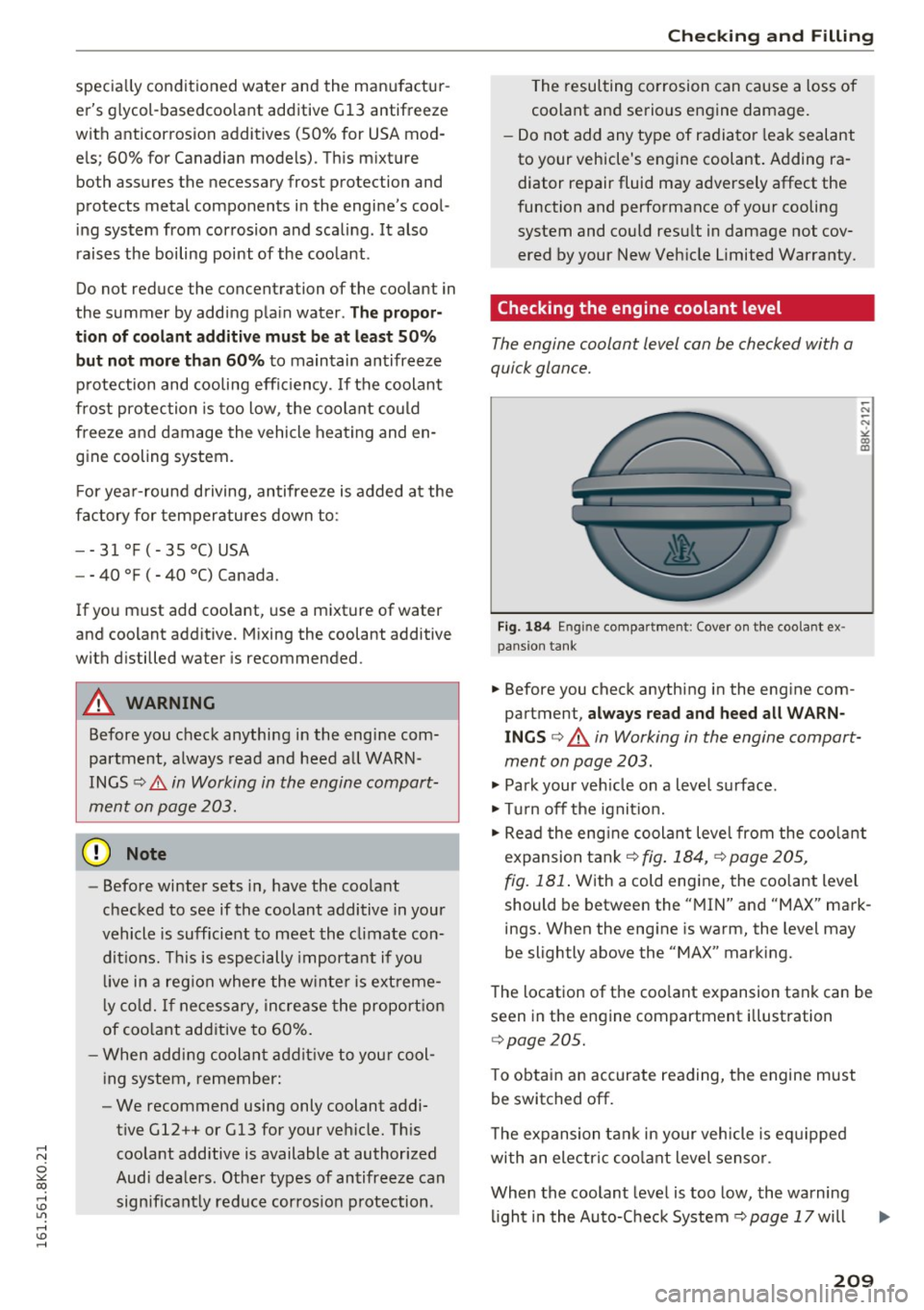
F ig. 184 En gin e co mpa rt men t: Cover o n the coo la nt ex
pans ion t ank
.. Before you check anything in the eng ine com
partment,
al ways read and heed all WARN
INGS
q ..&. in Working in the engine compart
ment on page 203 .
.. Park your ve hicle on a leve l sur face .
.. Tu rn off the ignit io n .
.. Read the eng ine coolan t level from the coo lant
expansion tank
q fig . 184, Q page 205,
fig. 181 .
With a cold engine, the coolant level
should be between the " MIN" and "MAX" mark
ings. When the engine is warm, the level may
be slightly above the "MAX" marking.
The location of the coo lant expansion tank can be
seen in the engine compartment illustration
q page 205.
To obtain an accurate reading, the engine must
be switched off.
T he expansion ta nk in your veh icle is eq uipped
with an electric coo lant level senso r.
When the coolant leve l is too low , the warning
light i n the Auto-Check System
Q page 17 will
209
Page 212 of 278
Check ing and F illing
blink until you add coolant and the level has been
restored to normal. Even though there is an e lec
tr ic coolant level sensor, we still recommend you
check the coo lant level from time to time.
Coolant los s
Coolant loss may indicate a l e ak in the cooling
system. In the event of coolant loss, the cooling
syst em should be insp ected immediately by your
authorized Audi dealer. It is not enough merely
to add coolant.
I n a
s e aled system, losses can occur only if the
boiling point of the coo lant is exceeded as a re
sult of overheating.
A WARNING
The cooling system is under pressure and can get very hot. Reduce the risk of scalding from
hot coolant by following these steps.
- Turn off the eng ine and allow it to cool
down .
- Protect your face, hands and arms from es
caping fluid and steam by covering the cap
with a large, thick rag.
- Turn the cap slowly and very carefully in a
counter-clockwise direction wh ile apply ing
l ight, downward pressure on the top of the
cap .
- To avo id being burned, do not sp ill anti
freeze or coolant on the exhaust system or
hot eng ine parts . Under certain conditions,
the ethy lene g lycol i n engine coolant can
catch fire.
{Q) Note
Do not add any type of radiator leak seala nt
to your veh icle's engine coolant . Adding radia
to r repa ir fluid may adversely affec t the func
tion and performance of yo ur cooling system
and could result in damage not covered by
your New Vehicle Limited Warranty.
Adding coolant
Be very careful when adding engine coolant.
Before you check anyth ing in the eng ine compart
ment,
a lwa ys re ad an d heed all WARNINGS
210
¢ A in Working in the engine compartment on
page 203.
Requireme nt: The re must be a res idual amount
of coo lant in the expans ion tank
~CD-
.,,. Turn off the engine .
.,,. Let the engine cool down.
.,,. Place a thick rag over the coolan t expa nsion
tank ¢ page 209, fig. 184 and
carefull y turn
the cap counter-clockwise ¢.&_ .
.,,. Add coo lant mixed in the correct ratio
~ page 208, Coolant up to the MAX marking.
.,,. Make sure that the fluid level remains stab le.
Add more coolant if necessary .
.,,. Twist the cap on aga in tightly.
Replacement engine coolant must conform to ex
act specifications ¢ page 208, Coolan t.
We recommend using only coo lant additive
G l2 +
+ , Gl3
or in an emergency Gl2+. Do not use a
different additive . In an emergency use plain wa
ter unt il you can get the correct addit ive and can
restore the correct rat io. Th is should be done as
soon as possible.
If you have lost a considerable amount of cool
ant, then you should add cold antifreeze and cold
water only when the engine is cold.
Always use new engine coo lant when refilling .
Do not fi ll coolant above the "MAX " mark. Excess
coolant will be forced out th rough the pressure
relief valve in the cap when the engine becomes
hot.
A WARNING
- The cooling system is under pressure and can get very hot. Reduce the risk of scalding
from hot coolant by following these steps.
- Turn off the engine and a llow it to cool
down.
- Protect your face, hands and arms from
escaping fluid and steam by covering the
cap with a large, thick rag.
- Turn the cap s low ly and very ca refully in a
counter-clo ckwise direction wh ile app ly ing
li ght, downward pressure on the top o f
the cap.
~
Page 242 of 278

Emergency assistance
"'Let the compressor run until the va lue specified
on the tire pressure label is reach ed
¢ page 227, fig. 191 . Switch the compressor
off after running for 12 minutes at the mos t -
danger of overheating!
A WARNING
The compressor and the tire filler hose can become extremely hot while they are running
- danger of burns!
CD Note
Switch the compressor off after running for
12 minutes at the most -danger of overheat
ing! Allow the compressor to cool down for a
few minutes before you use it again.
Replacing wheels
Before changing a wheel
Observe the following precaut ions for your own
and your passenger's safety when changing a
wheel.
"' After you experience a tire failure, pull the car
well away from moving traffic and try to reach
level ground before you stop ¢.&_ .
"' All passengers shou ld
leave the car and move
to a safe location (for instance, behind the
guardrail) ¢.&_ .
"' Engage the
parking brake to prevent your vehi
cle from rolling unintentionally ¢&_ .
"' Sh ift into
1st gear on vehicles w ith manual
transmission, or move the
selector lever to the
P position
on vehicles with automatic transmis
sion .
"' If you are towing a trailer: unhitch the trailer
from your vehicle.
"' Take the
jack¢ page 237 and the spare tire
¢ page 238 out of the luggage compartment .
A WARNING
You or your passengers could be injured wh ile
chang ing a wheel if you do not follow these
safety precautions :
- If you have a flat tire, move a safe distance
off the road . Turn off the engine, turn the
240
emergency flashers on and use other warn
ing devices to alert other motorists.
- Make sure that passengers wait in a safe
place away from the vehicle and well away
from the road and traffic.
- To help prevent the vehicle from moving
suddenly and possibly slipping off the jack,
always fully set the parking brake and block
the wheel diagonally opposite the wheel be ing changed with the folding chocks or oth
er objects . When one front whee l is lifted
off the ground, placing the Automat ic
T ransmission in "P" (Par k) w ill
not prevent
the vehicle from moving.
- Before you change a wheel, be sure the
ground is level and firm . If necessary, use a
sturdy board under the jack.
- Always store the vehicle tool kit, the jack*
and the replaced tire in the luggage com
partment
¢ page 126.
CD Note
If you a re changing the wheel on a steep in
cline, use a rock or similar object to block the
opposite wheel to prevent the vehicle from
moving.
(D Tips
Obey all laws.
Changing a wheel
When you change a wheel, follow the sequence
described below step-by-step and in exactly that
order .
1. Remove the decorative wheel cover* or the
wheel bolt caps* . For more details see also
¢ page 241, Decorative wheel covers or
¢ page 241, Wheels with wheel bolt cops.
2. Loosen the wheel bolts ¢page 242.
3. Locate the proper mounting point for the
jack and align the jack below that point
¢ page 242.
4. Lift the car with the jack¢ page 242.
5. Remove the wheel with the flat tire and then
install the
spare tire ¢page 243.
6. Tighten all whee l bolts lightly .
Page 249 of 278

.... N
0
""' CX)
.... I.Cl U"I
.... I.Cl ....
Fuse panel @ (black)
No . Consumer
1 Dynamic steering
2 Electronic Stabilization Cont rol (mod ule)
A/C system press ure sensor, elect rome -
chan ica l park ing brake , Homelink, auto-
3 mat
ic dimming interior rear v iew mirror,
air q uality/outside a ir sensor, Electronic
Stabili zation Cont rol (button)
5 Sound actuator
6 Headlight range control/
headlight (cor-
ne ring light)
7 Headlight (corner ing light)
Con trol modules (e lectrom echan ica l par k-
8 ing brake , s hock ab so rbe r, q uattro s port),
DCDC converter
9 Adapt ive cru ise control
1 0 Shift ga te/clu tch se nsor
1 1 Side assist
12 Headlight range control
, p arkin g sys tem
13 Airbag
14 Rear wiper (a
llroad)
1 5 Auxiliary fuse (instrument panel)
1 6 Auxiliary fuse terminal 15 (engine area
)
Fuse panel@ (brown)
No . Consumer
2 Brake light senso r
3 Fuel pump
4 Clutch sensor
5
Left seat heating w it h /w it h out seat venti-
l a tion
6 Electronic Stabili zation Cont rol (e lectr ic)
7 Ho rn
8
F ront left door (window regulator, central
locki ng, mirror, switch, lig hting)
9 Windshield wiper moto r
10 Electronic Stabilization Cont rol (va lves)
Fuses and bulbs
No . Consumer
Two-door mode ls: rear left w indow reg ula-
1 1 tor; Four-door mode
ls: rear left door (w in-
dow regu lator, central locking, switch,
li ght ing)
1 2 Rain and
light sensor
Fuse panel © (red)
No . Consumer
3 Lumbar support
4 Dynam ic steering
5 Inter
io r ligh ting ( Cabr io let)
6 W
indshie ld washer system, headlight
wash er system
7 Vehicle e lectrica l system control module 1
8 Ve hicl e e lec trica l sy stem con trol module 1
9
Left rear window regu lator motor (Cabr io-
l et)/s unroof
1 0 Vehicle e lec tric al system con trol module 1
1 1 R
ight rear window regulator (Cabriolet)/
su n shade motor
1 2 A
nti- theft alarm warning system
Right cockpit fuse assignment
Fig. 20 7 Rig h t cockp it : f use pane l wit h plast ic cl ip
247