2016 AUDI A3 safety
[x] Cancel search: safetyPage 59 of 328

,....,
N
0 > co ,....,
General information
Important information
A WARNING
Refer to the chapter Driving Safely
r::!> page 166, Driving safety for important in
formation, tips, suggestions and warnings
that you should read and follow for your own
safety and the safety of your passengers.
Why is your seat adjustment so important?
The safety belts and the airbag system con only
provide maximum protection if the front seats ore correctly adjusted.
There are various ways of adjusting the front
seats to provide safe and comfortable support
for the driver and the front passenger. Adjust
your seat properly so that:
- you can easily and quick ly reach all the switches
and contro ls in the instrument pane l
- your body is properly supported thus reducing
physical stress and fatigue
- the safety belts and airbag system can offer
maximum protection
r::!> page 184.
I n the following sections, you will see exact ly
how you can best adjust your seats.
There are spec ial regulations and instructions for
in stalling a ch ild seat on the front passenger's
seat. Always fo llow the information rega rding
chi ld safety provided in
r::!> page 209, Child safe
ty.
A WARNING
Incorrect seating position of the driver and all
other passengers can result in serious person
al injury.
- Always keep yo ur feet on the floor when the
vehicle is in motion -never put your feet on
top of the instrument pane l, out of the win
dow or on top of the seat cushion. Th is ap
plies especially to the passengers. If your
seating pos it ion is inco rrect, you increase
Seat s and sto rage
the risk of injury in the case of sudden bra k
ing or an accident. If the airbag inflates and
the seating posit ion is incorrect, th is could
result in persona l injury or even death.
- It is important for both the driver and front
passenger to keep a distance of at least
10 inches (25 cm) between themselves and
the steering wheel and/or instrument pan
el. If you're sitt ing any closer than this, the
ai rbag system cannot protect you properly.
I n addition, the front seats and head re
str aints must be adjusted to you r body
height so that they can give you maximum
protection.
- Always try to keep as much dis tance as pos
sible between yourself and the steering
wheel or instrument pane l.
- Do not adjust the driver's o r front passeng
er's seat while the vehicle is moving . Your
seat may move unexpectedly, causing sud
den loss of vehicle contro l and personal in
jury. If you ad just your seat while the veh icle
is moving, you are o ut of pos ition.
Driver's seat
The correct seat position is important for safe
and relaxed driving.
We recommend that you adjust the driver's seat
in the following manner:
.. Adj ust the seat in fore and aft direction so that
you can easi ly push the pedals to the f loor
while keeping yo ur knees slight ly bent
r::!> A in
Why is your seat adjustment so important? on
page
57.
.. Adjust the backrest so that when you sit w ith
your back against the backrest, yo u can st ill
grasp the top of the stee ring wheel.
.. For ad justab le head rest raints: adjust the head
restraint so the upper edge is as even as possi
b le with the top o f your head . If tha t is not pos
sible, t ry to adjust the head rest raint so that it
is as close to this position as possible
r::!> page 60. Move the head restraint so that it
is as close to the back of the head as poss ible.
Ill>
57
Page 60 of 328

Seats and storage
_& WARNING
Never place any objects in the driver's foot
well. An object could get into the pedal area and interfere with pedal function. In case of
sudden braking or an accident, you would not
be able to brake or accelerate.
Front passenger's seat
Always move the front passenger seat into the
rearmost position.
To avoid contact with the airbag while it is de
p loy ing, do not sit any closer to the instrument
panel than necessary and always wear the three
point safety belt provided adjusted correctly. We
recommend that you adjust the passenger's seat
in the following manner:
• Bring the backrest up to an (almost) upright
position.
Do not ride with the seat reclined .
• For adjustable head restraints: adjust the head
restraint so the upper edge is as even as possi
ble with the top of your head . If that is not pos
sible, try to adjust the head restraint so that it
is as close to this position as possible
q page 60. Move the head restraint so that it
is as close to the back of the head as possible.
• Place your feet on the floor in front of the pas
senger's seat .
Front seats
Manual seat adjustment
Appl ies to v eh icles : w ith manu ally a djustabl e seats
Fig . 47 Front seat: manual seat ad jus tm ent
~ 0
>
"' m
@ -Moving the seat forward/back: pull the lever
and slide the seat.
58
@-Lengthening/shorteni ng the upper thigh
support*:
lift the handle.
@-Adjusting the angle of the seat surface*.
Pull/press the lever.
@-Adjusting the lumbar support*: press the
button in the desired direction.
®-Moving the seat up/down : pull/press the lev
er.
® -Adjusting the backrest angle: turn the ad
justing wheel.
_& WARNING
- Only adjust the front seat with when the ve
hicle is stationary. Otherwise, this increases
the risk of an accident
- Exercise caution when adjusting the seat
height. Adjusting the seat carelessly or
w ithout check ing can p inch hands and fin
gers.
- The front seat backrests must not be re
clined too far back when driving, because
this impairs the effectiveness of the safety
belts and airbag system, which increases
th e risk of injury.
- To reduce the risk of injury during sudden
braking or in a collision, the driver and front
passenger should not have their backrests in
the reclined position while driving or riding.
The safety belts and airbag system can pro
vide the greatest protection possible when
the backrests are in the upright position and
the safety belts are worn correctly. The more a backrest is reclined, the greater the
risk of injury due to an incorrect seating po
sition and safety belt position.
Page 61 of 328
.... N
0 > CX)
rl I.Cl U"I
rl I.Cl ....
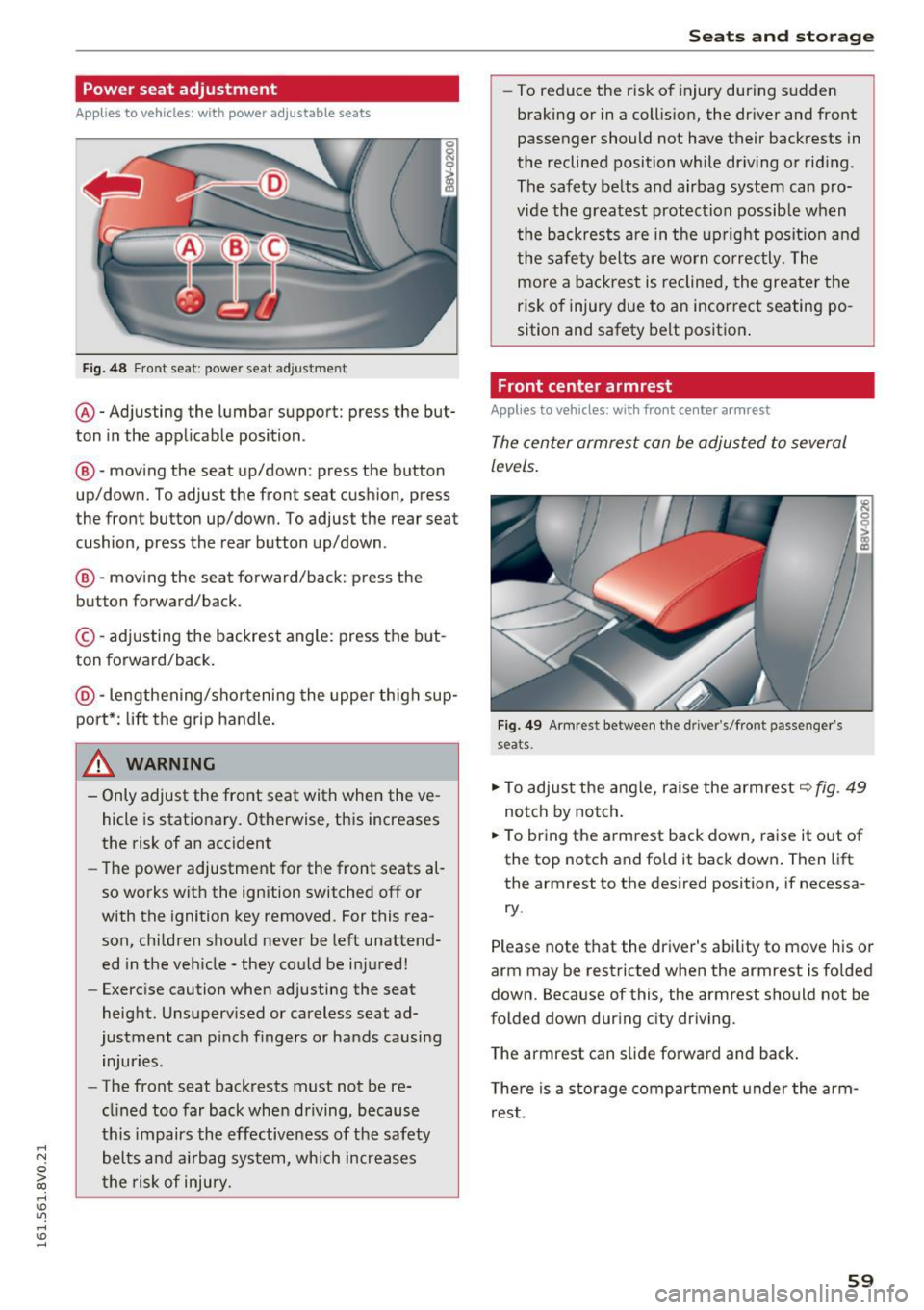
Power seat adjustment
Applies to vehicles: with power adjustable seats
Fig. 48 Front se at: po wer se at adjust men t
@ -Adjusting the lumbar support: press the but
ton in the applicable position .
@-moving the seat up/down : press the button
up/down. To adjust the front seat cushion, press
t he fron t button up/down. To adjust the rear seat
cushion, press the rear button up/down .
@-moving the seat forward/back: press the
but ton forward/back.
© -adjusting the backrest angle : press the but
ton forward/back.
@ -lengthening/shortening the upper thigh sup
port* : lift the grip handle.
A WARNING
- Only adjust the front seat with when the ve
hicle is stationary. Otherwise, this increases
the risk of an accident
- The power adjustment for the front seats al
so works with the ignition switched off or
with the ignition key removed. For this rea
son, children should never be left unattend
ed in the vehicle - they could be injured!
- Exercise caution when adjusting the seat
height. Unsupervised or careless seat ad
justment can pinch fingers or hands causing
injuries .
- The front seat backrests must not be re
clined too far back when driving, because
this impairs the effectiveness of the safety
belts and airbag system, which increases
the risk of injury.
Seats and storage
-To reduce the risk of injury during sudden
braking or in a collision, the driver and front
passenger should not have their backrests in
the reclined position while driving or riding .
The safety belts and airbag system can pro
vide the greatest protection possible when
the backrests are in the upright position and
the safety belts are worn correctly. The
more a backrest is reclined, the greater the
risk of injury due to an incorrect seating po
sition and safety belt position.
Front center armrest
Applies to vehicles: with front center a rm rest
The center armrest can be adjusted to several
l e ve ls.
Fig. 49 Armre st between th e driv er's /fro nt pa ssenger 's
s eats.
.,. To adjust the angle, raise the armrest~ fig. 49
notch by notch.
.,. To bring the armrest back down, raise it out of
the top notch and fold it back down. Then
lift
the armrest to the desired position, if necessa
ry.
Please note that the driver 's ability to move his or
arm may be restricted when the armrest is folded
down. Because of this, the armrest should not be
folded down during city driving .
The armrest can slide forward and back.
There is a storage compartment under the arm
rest .
59
Page 62 of 328

Seats and storage
Rear center armrest
Applies to vehicles: with rear center armrest
The storage compartment and cup holder are in
tegrated in the armrest.
Fig. SO Rear a rmrest
Folding the armrest down
• Tilt the armrest all the way down.
Opening the storage compartment
• Lift the cover on the upper rim.
~I
gl
~
For more information on the use of the cup hold
ers , see ¢
page 62 .
Head restraints
Front head restraints
Applies to veh icles: with adjustable head restraints
-
'
' F ig. 51 Front seat: adjust ing the head restra int
Applies to vehicles w ith super sport seats* (not
pictured): the head restraint is integ rated in the
backrest and is therefore not adjustable
Adjust the head restra ints so the upper edge is as
even as possible with the top of your head. If that
is not possible, try to adjust as close to this posi
tion as possible . Push the head restraint as close
as poss ible to the back of the head.
60
• To move the head restra int up or forward, slide
it unti l it locks into place.
• To move the head restra int down or back, press
the side button -arrow-¢
fig. 51 and slide the
head restraint until it locks into place.
Refer to ¢
page 170, Proper adjustment of head
restraints
for guidelines on how to adjust the
height of the front head restraints to suit the oc
cupant's body size.
A WARNING
- Dr iving without head restra ints or head re
stra ints that are not adjusted correctly dra
matically increases the risk of serious or fa
tal nec k injuries.
- Read and following the WARNINGS in
¢ page 170, Proper adjustment of head re
straints.
@ Tips
Head restraints that are adjusted correctly
and safety belts are an extremely effective
combination of safety equipment.
Rear head restraints
ro -0
Fig. 52 Outer rea r head restra ints : re lease point
- 0 > :g
If there are passengers in the rear seat, fold the
head restraints up on the occ upied seats at least
to the next notch ¢
,& .
Adjusting the head restraints
• To move the head restra int up, hold it at the
sides with both hands and slide it upward until
you feel it click into place . .,.
Page 65 of 328

.... N
0 > CX)
.... I.Cl U"I
.... I.Cl ....
A WARNING
Spilled hot liquid can increase the risk of acci
dents and injuries.
- Never drive with containers that contain hot
liquid such as coffee or tea. The hot liquid
could spill and cause burns during a colli
sion, sudden braking or other vehicle move
ment. Spilled hot liquid can also increase
the risk of accidents and injuries.
- Only use soft containers in the cup holders .
Hard cups and glasses can increase the risk
of injury during a collision.
- Never use the cup holder or the adapter as
an ashtray - this is a fire hazard.
(D Note
Beverage containers in the cup holders should
always have a lid . Otherwise, beverages could
spill and cause damage to vehicle equipment
or stain the seat covers.
Glove compartment
Fig. 58 Glove compartmen t
Opening/closing
.. To open the glove compartment, pull the han
dle in the direction of the arrow.
.. To close the glove compartment , swing the lid
upward until it clicks into place .
The glove compartment can be locked using the
vehicle key .
A WARNING
Always leave the lid on the glove compart
ment cover closed while driving to reduce the
risk of injury.
Seats and storage
Additional storage compartments
There are additional storage compartments,
compartments and holders at other locations in
the vehicle:
- In the upper part of the glove compartment.
- In the center console under the center arm -
rest* .
- On the back of the right front seat . The com
partment* can hold a maximum weight of 2 lbs
(1 kg) .
- Garment hooks on the B -pillar
c:> ,& .
A WARNING ,~ -- Do not place any objects on the instrument
panel. Objects that are not stored securely
can slide around in the vehicle while driving ,
when accelerating or braking or when turn
ing.
- Make sure that objects cannot fall out of the
center console storage compartment or oth
er compartments and into the footwell
while driving. These objects could prevent
you from braking or accelerating during
sudden braking maneuvers.
- Garments hung on the hooks must not ob
struct the driver's view . The garment hooks
are only designed for light objects. Do not hang any garments with hard, sharp or
heavy objects in the pockets on the garment
hooks . These objects could injure vehicle oc
cupants during sudden braking or in a colli
sion -especially if the airbags deploy .
-Always keep the glove compartment closed
while driving to reduce the risk of injury dur
ing a collision or heavy braking .
- Read and following the WARNINGS in
¢ page 204, Important safety instructions
on the side airbag system.
- Hang garments so that they do not obstruct
the driver's view .
- The garment hooks should only be used for
light articles of clothing. Do not leave any
heavy or sharp-edged objects in the pockets
that could interfere with the side airbags
unfolding and cause injuries in the event of
a collision.
63
Page 66 of 328

Sea ts and stor age
- Do not use coat hangers to hang garments,
because th is could reduce the effect iveness
of the side curtain airbags.
- Do not hang any heavy objects on the gar
ment hooks, because they could cause injury
during heavy braking.
- Beca use of their load capac ity, the hooks
should only be used to secure objects that
weigh a maximum of 10 lbs (5 kg). Heavy
objects w ill not be secured suff ic iently, and
this increases the risk of injury.
Luggage compartment
Loading luggage compartment
Luggage items must be stowed securely.
F ig. 59 Place heavy objects as far forward as poss ible (ex
amp le).
Note the following to preserve the vehicle's good
handling character istics .
• Distribute t he load as evenly as possible.
• Place heavy objects as far forward as possib le
¢ fig. 59.
• Secure luggage i tems with the cargo net* or
with non-elastic retai ning straps to the tie
down rings *
¢page 66.
A WARNING
-
-Loose objects in the luggage compartment
can slide about suddenly and alter the vehi
cle's handling characterist ics.
- Loose objects in the passenger compart
ment can fly forward during abrupt maneu
vers or acc idents and injure occupants.
64
- Always store objects in the luggage com
partment and use su itab le straps, particu
larly w ith heavy objects.
- When you transport heavy objects, always
remember that a change in the center of
gravity may result in a change in the vehi
cle's handling characteristics.
- Follow all warnings¢
page 166, Driving
safety.
@ Tips
The tire pressure must be adjusted to the load
- see the tire pressure sticker located on the
driver's side 8-pillar.
General information
_&. WARNING
Refer to the chapter Dr iv ing Safely
¢
page 166, Driving safety for important in
formation, tips, suggestions and warnings that you should read and follow for your own
safety and the safety of your passengers.
Luggage compartment cover
Applies to vehicles: With luggage co mpa rtment cover
(A3 Spo rtback)
The luggage compartment cover prevents the
view into the luggage compartment.
Fig . 60 Open luggage compartme nt lid wit h luggage com
pa rtment cove r
Removin g
• Unhinge the straps (D and pull the cover @in
the direction of the arrow out of the holder @. .,..
Page 67 of 328

Installing
• Slide the cover@ hor izontally into the desig
nated ho lder @in the side bracket until the
cover is lined up.
• Hook the straps into the l uggage compartment
lid @ ¢
A.
A WARNING
-To prevent accidents, never install the lug
gage compartment cove r unsec ured.
- The luggage compartment cover is not a
surface for storing objects. Objects placed
on the cover increase the r isk of injury to all
vehicle occupa nts dur ing sudden bra king
mane uvers o r when i nvo lved in an accident .
Increasing the size of the luggage
compartment
-
The rear seat backre sts can be folded forward ei
ther separately or together.
F ig. 61 Backrest: re lease lever (le ft s ide, examp le)
Folding the backr est forward
• Push the corresponding head restraint down
ward
¢ page 60.
• Press the release lever @ in the direct ion of the
arrow .
• Fold the backrest forward .
Folding the backrest back into the upright
position
• Fold the backrest down until it latches secure ly
¢ ,& .When you can no longer see the red mark
;::: on the pin @, the seat is la tched .
0 > CX)
rl I.Cl U"I
rl I.Cl rl
Seats and storag e
A WARNING
-~
-The backrest must be latched securely to
e nsu re that the safety belt is p rotecti ng the
center seating position .
- The bac krest must be securely latched so
objects cannot slide fo rward out of the lug
gage compartment during sudde n braking .
- Always make su re the backrest is latched
completely by pull ing fo rwa rd on it .
- Make sure the safety belt is not caught in
the door hinges or the seat fittings and
damaged.
- To rn or frayed safety be lts can break, and
be lt anchors can b reak dur ing a col lision .
C heck the safety be lts regu la rly. Safety
be lts wi th noticeable damage to the we b
b in g, b indings, bu ckles or ret ra cto rs m ust
be repla ced.
(D Note
- If you move the front seat back when the
rear seat backrest is fo lded fo rwa rd, yo u
c o ul d d am age the head restra in ts on t he
rear sea t. If necessary, remove the rear sea t
head restraint be fore mov ing the front seat
back
- Make sure the sa fe ty belt is not pinche d in
the back rest lock a nd damage d when the
rear seat backrest if folded back . Othe r ob
jects should be removed from the rear
bench seat to protect the rear backrest from
damage .
65
Page 68 of 328

Sea ts and stor age
Lowering the cargo floor
Applies to veh icles: w ith adj ustable cargo f loor
The cargo floor can lower to expand the storage
area in the luggage compartment.
F ig. 62 L uggage compartment: lowered cargo floor
The cargo floor can also be inse rted at a lower
point depending on vehicle eq uipment .
., Lift the cargo floor in order to lower it.
., Pull the cargo floor back slightly a nd insert it in
the lowe r pos it ion
@ .
To make loading and un load ing eas ier, br inging
the cargo floo r back into position @ afte r trans
port ing b ulky i tems is recommended.
Tie-downs and cargo net
The cargo net* prevents small objects from slid
ing.
F ig . 63 Luggage compartment: location of the tie -downs
66
F ig. 6 4 Luggage compartment: luggage compartment net•
spread out
., Secure the cargo to the tie-downs c::> fig. 63
-arrows- .
., To secure the cargo net, first hang the front
hooks in the tie-downs then hang the rear
hooks -arrows-
c::> fig. 64.
., Obse rve
the safety precaut ions c::> page 172,
Storing cargo correctly .
.&_ WARNING
Weak, damaged or fau lty straps used to se
cure objects to the tie-downs can fail during
heavy braking or a co llision and lead to seri
ous injur ies .
- Always use s uitable straps and secure ob
jects to the tie-downs in the luggage com
partment to prevent objects from shifting
and sliding forward.
- Never secure a child seat restraint to a tie
down.
- Because of their load capacity, the hooks
should only be used to secure objects that
weigh a maximum of 10 lbs (5 kg). Heavy
objects will not be secured sufficiently, and
this increases the risk of inju ry.
-