2016 Alfa Romeo MiTo Rain
[x] Cancel search: RainPage 78 of 280

IMPORTANT On both sides of the passenger side sun visor there is a
label advising that it is compulsory to deactivate the airbag if a
rearward facing child restraint system is fitted. Always comply with the
instructions on the sun visor (see the "Front airbags" paragraph in
chapter "Safety").
EXTINGUISHER
(for versions/markets, where provided)
This is located on the right side of the luggage compartment fig. 53.
ELECTRIC SUN ROOF
(for versions/markets, where provided)
The extensively glazed sun roof comprises a moving glass panel and a
sun blind.
The glazed panel, when closed, allows light from the outside to enter
and makes it possible to see the outside from the passenger
compartment.
OPERATION
The sun roof can be operated only with the ignition key turned to MAR.
The controls A and B fig. 54 on the trim next to the front courtesy light
operate the sun roof opening/closing functions.
Roof opening
Pressing button A fig. 54 permits two opening modes for the front
glass panel.
fig. 53A0J0190fig. 54A0J0329
74
GETTING TO
KNOW YOUR CAR
SAFETY
STARTING AND
DRIVING
IN AN EMERGENCY
SERVICING AND
MAINTENANCE
TECHNICAL
SPECIFICATIONS
INDEX
the mirror to be used even in poor visibility conditions.
Lift cover A fig. 52 to access the mirror.with roof light isfitted on the back of the visors. The light allows A courtesy mirror ( f o r versions/markets, where provided)
Page 86 of 280

Emergency opening from the inside
Proceed as follows:
❒remove the rear head restraints and completely fold back the seats
(see the paragraph “Expanding the luggage compartment”);
❒push lever A fig. 62.
CLOSING
Lower the tailgate, pressing near the lock until you hear it click into
place.
Pull the tab A fig. 63 and lower the tailgate, pressing next to the lock
until it clicks.
IMPORTANT Before closing the luggage compartment make sure that
you have the keys since the luggage compartment is automatically
locked.
LUGGAGE COMPARTMENT
INITIALISATION
IMPORTANT If the battery is disconnected or the protection fuse blows,
the luggage compartment opening/closing mechanism must be
initialised as follows:
❒close all the doors and the luggage compartment;
❒Press the
button on the remote control;
❒Press the
button on the remote control.
fig. 62A0J0178fig. 63A0J0079
82
GETTING TO
KNOW YOUR CAR
SAFETY
STARTING AND
DRIVING
IN AN EMERGENCY
SERVICING AND
MAINTENANCE
TECHNICAL
SPECIFICATIONS
INDEX
Page 87 of 280
EXTENDING THE LUGGAGE
COMPARTMENT
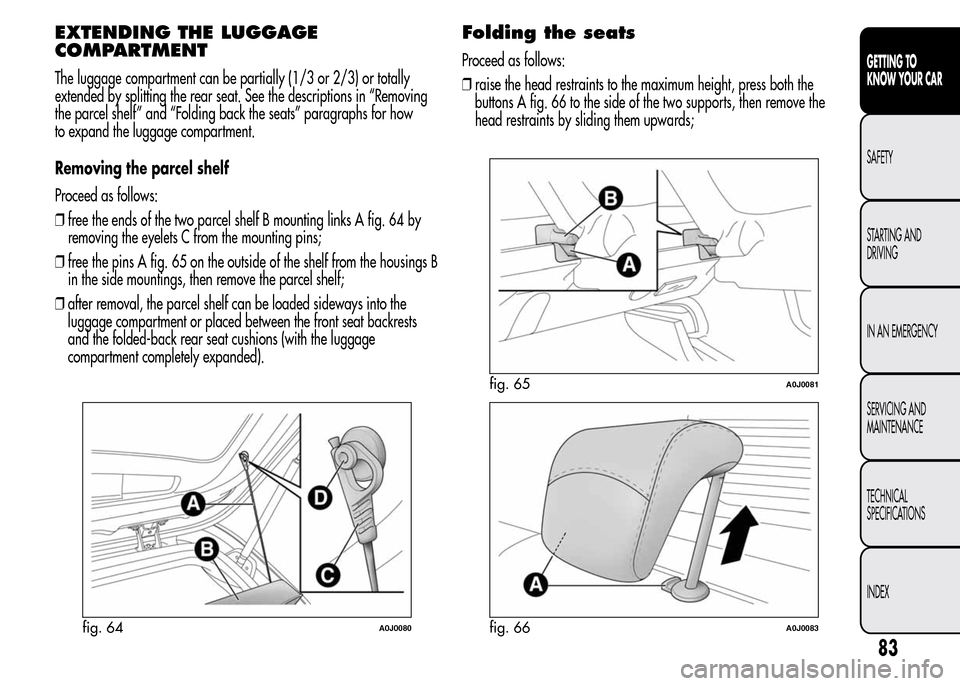
The luggage compartment can be partially (1/3 or 2/3) or totally
extended by splitting the rear seat. See the descriptions in “Removing
the parcel shelf” and “Folding back the seats” paragraphs for how
to expand the luggage compartment.
Removing the parcel shelf
Proceed as follows:
❒free the ends of the two parcel shelf B mounting links A fig. 64 by
removing the eyelets C from the mounting pins;
❒free the pins A fig. 65 on the outside of the shelf from the housings B
in the side mountings, then remove the parcel shelf;
❒after removal, the parcel shelf can be loaded sideways into the
luggage compartment or placed between the front seat backrests
and the folded-back rear seat cushions (with the luggage
compartment completely expanded).
Folding the seats
Proceed as follows:
❒raise the head restraints to the maximum height, press both the
buttons A fig. 66 to the side of the two supports, then remove the
head restraints by sliding them upwards;
fig. 64A0J0080
fig. 65A0J0081
fig. 66A0J0083
83
GETTING TO
KNOW YOUR CAR
SAFETY
STARTING AND
DRIVING
IN AN EMERGENCY
SERVICING AND
MAINTENANCE
TECHNICAL
SPECIFICATIONS
INDEX
Page 88 of 280

❒move the seat belts to the side, making sure that they are correctly
extended and not twisted;
❒lift the backrest retaining levers A fig. 67 and fold the desired
cushion forwards (a red band indicates that lever A is raised).
Repositioning the rear seat
Move the seat belts to the side making sure that they are correctly
extended and not twisted.
Raise the previously folded backrest until you hear the click of the
locking mechanism, visually checking that the red band on lever A fig.
67 has disappeared. The red band indicates that the backrest is not
secured.
Finally, reposition the head restraints, inserting them into their
housings.BONNET
OPENING
Proceed as follows:
❒pull lever A fig. 68 in the direction indicated by the arrow;
❒pull lever B in the direction indicated by the arrow;
❒lift the bonnet and, at the same time, release bonnet stay C fig. 69
from its locking device. Then, insert the end in housing D, making
sure that the stay is engaged in the smallest opening of the retaining
clip.
IMPORTANT Before lifting up the bonnet make sure that the windscreen
wipers are in the rest position and not operational.
fig. 67A0J0082fig. 68A0J0085
84
GETTING TO
KNOW YOUR CAR
SAFETY
STARTING AND
DRIVING
IN AN EMERGENCY
SERVICING AND
MAINTENANCE
TECHNICAL
SPECIFICATIONS
INDEX
Page 95 of 280

DST SYSTEM (Dynamic Steering
Torque)
This function integrates Dual Pinion active steering into the operation of
ESC. For particular manoeuvres, the ESC system controls the steering
to actuate a steering torque and assist the driver in the best possible
way.
The system operates the brakes and steering in a coordinated manner
to increase the suspension and safety level of the car as a whole.
The steering provides additional torque on the steering wheel.
“Alfa DNA” SYSTEM (Car
dynamic control system)
This device allows, using lever A fig. 74 (on the central tunnel), three
car response modes to be selected according to driving style and road
conditions:
❒d = Dynamic (sports driving mode);
❒n = Natural (mode for driving in normal conditions);
❒a = All Weather (mode for driving in poor grip conditions, such as
rain and snow).
The device also acts on the dynamic car control systems (engine,
steering, VDC system, instrument panel).
fig. 74A0J0090
91
GETTING TO
KNOW YOUR CAR
SAFETY
STARTING AND
DRIVING
IN AN EMERGENCY
SERVICING AND
MAINTENANCE
TECHNICAL
SPECIFICATIONS
INDEX
Page 102 of 280

JUMP STARTING
When jump starting, never connect the negative lead (–) of the
auxiliary battery to the negative pole A fig. 83 of the car battery, but
rather to an engine/gearbox earth point.
Before opening the bonnet, make sure the engine is off and
the ignition key is in the STOP position. Follow the
indications on the plate underneath the bonnet fig. 84. It is
advisable to extract the key when there are other people in the car.
Leave the car only after having removed the ignition key or having
turned it to STOP. During refuelling, make sure that the engine is off
and that the ignition key is in the STOP position.
DYNAMIC SUSPENSION
(active shock absorber system)
(for versions/markets, where provided)
This system interacts with the “Alfa DNA” system (see paragraph “Alfa
DNA”).
The “Alfa DNA” system lever allows you to choose three different
driving settings depending on the route type and on the road surface:
❒d = Dynamic (sports driving mode);
❒n = Natural (mode for driving in normal conditions);
❒a = All Weather (mode for driving in poor grip conditions, such as
rain and snow).
fig. 83A0J0388fig. 84A0J0341
98
GETTING TO
KNOW YOUR CAR
SAFETY
STARTING AND
DRIVING
IN AN EMERGENCY
SERVICING AND
MAINTENANCE
TECHNICAL
SPECIFICATIONS
INDEX
Page 103 of 280

In “Natural” and “All Weather” operating mode, the active shock
absorbers adjust the car suspension to suit the route type and
the driving stresses, thus considerably improving driving comfort in
particular on rough terrain.
The "Dynamic" operating mode produces a sports driving setting
characterised by more responsive acceleration and greater effort on
the steering wheel to give a sporty feeling. The shock absorber
damping action is also adjusted and divided, to guarantee higher
precision and reactivity of the car, while maintaining a good comfort
level.
The car is more precise when entering bends and quicker in changing
direction.EOBD SYSTEM
(European On Board Diagnosis)
(for versions/markets, where provided)
The aim of the EOBD system (European On Board Diagnosis) is to:
❒monitor the system efficiency;
❒indicate an increase in emissions;
❒indicate the need to replace damaged components.
The car also has a diagnostic connector that can be interfaced with
appropriate tools, which makes it possible to read the error codes
stored in the electronic control units together with a series of specific
parameters for engine operation and diagnosis. This check can also be
carried out by the traffic police.
IMPORTANT After eliminating a fault, to check the system completely,
Alfa Romeo Authorised Services are obliged to run tests and, if
necessary, road tests which may also call for a long journey.
99
GETTING TO
KNOW YOUR CAR
SAFETY
STARTING AND
DRIVING
IN AN EMERGENCY
SERVICING AND
MAINTENANCE
TECHNICAL
SPECIFICATIONS
INDEX
Page 107 of 280

OPERATION WITH TRAILER
Parking sensor operation is deactivated automatically when the trailer
electric cable plug is fitted into the car tow hook socket. The sensors
are automatically enabled again when the trailer's cable plug is
removed.
The sensor must be free of mud, dirt, snow or ice in order
for the system to work. Be careful not to scratch or damage
the sensors while cleaning them. Avoid using dry, rough
or hard cloths. The sensors should be washed using clean water with
the addition of car shampoo if necessary. When using special washing
equipment such as high pressure jets or steam cleaning, clean the
sensors very quickly keeping the jet more than 10 cm away.
When repainting the bumpers or touching up paint in
the sensor area, contact Alfa Romeo Authorized
Services only. Incorrect paint application could affect
the operation of the parking sensors.
Parking manoeuvres however are always the driver’s
responsibility. When carrying out such manoeuvres,
always ensure that the manoeuvring area is free of
people (particularly children) and animals. The parking sensor is
designed to assist drivers, who must still never allow their
attention to lapse during potentially dangerous manoeuvres even
if performed at low speed.
GENERAL WARNINGS
During parking manoeuvres, pay the utmost attention to any obstacles
that could be located above or below the sensors.
Objects located near the rear of the car are not detected under certain
circumstances and could therefore cause damage to the car or be
damaged.
The following conditions may influence the performance of the parking
sensor system:
❒reduced sensor sensitivity and a reduction in the parking assistance
system performance could be due to the presence on the surface of
the sensor of: ice, snow, mud, thick paint
❒the sensors may detect a non-existent obstacle (echo interference)
due to mechanical interference, for example when washing the
car, in rain (strong wind), hail;
❒The signals sent by the sensors can also be altered by the presence
of ultrasonic systems (e.g. pneumatic brake systems or pneumatic
drills) near the vehicle.
❒sensor performance can also be influenced by the position of the
sensors. For example by a change in the ride setting (caused by
the wear of the shock absorbers, suspension), overloading the
vehicle and carrying out specific tuning operations that require the
vehicle to be lowered;
❒The detection of obstacles at the top part of the car may not be
guaranteed because the system detects obstacles that could cause an
impact with the car in the bottom part.
103
GETTING TO
KNOW YOUR CAR
SAFETY
STARTING AND
DRIVING
IN AN EMERGENCY
SERVICING AND
MAINTENANCE
TECHNICAL
SPECIFICATIONS
INDEX