2016 Alfa Romeo MiTo ESP
[x] Cancel search: ESPPage 98 of 280

ENGAGEMENT/DISENGAGEMENT OF
“All Weather” MODE
Engagement
Move lever A fig. 74 downwards (to the letter “a”) and hold in this
position for 0.5 seconds until the corresponding LED lights up or the
word “All Weather” appears on the display (see fig. 79).
ESC and ASR systems:intervention thresholds aimed at
guaranteeing the maximum safety in low grip driving conditions. It is
recommended to activate the "All Weather" mode when fitting snow
chains.
Steering wheel tuning:maximum comfort.
DST:higher braking control coordinated with ABS/ESC. Standard
control over lateral acceleration. Oversteering compensation
depending on the ESC/ASR intervention thresholds: a slight movement
on the steering wheel encourages the driver to carry out the most
appropriate manoeuvre.
Engine:standard response.Disengagement
To deactivate “All Weather” mode and return to “Natural”, carry out
the same procedure described for “Dynamic” mode, but move lever A
fig. 74 to “a”.
IMPORTANT
❒It is not possible to switch directly from “Dynamic” mode to “All
Weather” mode and vice versa. You must always first go back
to “Natural” mode and then select the other mode.
❒The driving mode engaged before the engine stops is maintained
when it is next started.
❒In the event of system failure or a fault with lever A fig. 74, no
driving modes can be selected. The display will show a warning
message.
fig. 79A0J1511
94
GETTING TO
KNOW YOUR CAR
SAFETY
STARTING AND
DRIVING
IN AN EMERGENCY
SERVICING AND
MAINTENANCE
TECHNICAL
SPECIFICATIONS
INDEX
Page 100 of 280

ENGINE STOPPING FAILURE
CONDITIONS
When the system is operating, due to comfort, emission control and
safety reasons, the engine does not stop in some conditions, among
which:
❒engine still cold;
❒especially cold outside temperature;
❒battery not sufficiently charged;
❒particulate filter regeneration (DPF) in progress (diesel engines only);
❒driver's door not shut;
❒driver's seat belt not fastened;
❒reverse gear engaged (for example, for parking manoeuvres);
❒for versions equipped with dual zone automatic climate control (for
versions/markets, where provided), if an adequate level of thermal
comfort has not been reached or with MAX-DEF function activation;
❒during the first period of use, to initialise the system.
If the climate comfort is to be favoured, the Start&Stop
system can be deactivated, for a continuous operation of
the climate control system.
ENGINE RESTARTING CONDITIONS
Due to comfort, emission control and safety reasons, the engine can
restart automatically without any action by the driver, under special
conditions, such as:
❒battery not sufficiently charged;
❒reduced braking system vacuum (e.g. if the brake pedal is pressed
repeatedly);
❒car moving (e.g. when driving on roads with a gradient);
❒engine stopping by Start&Stop system for over 3 minutes;
❒for versions equipped with dual zone automatic climate control
system (for versions/markets, where provided), if an adequate level
of thermal comfort has not been reached or MAX-DEF function
activation.
With gear engaged, automatic engine restarting is possible only by
fully depressing the clutch pedal. The driver is informed by the
displaying of a message on the display and - for versions/markets,
where provided - by the flashing of the symbol
.
Notes
If the clutch is not pressed, about 3 minutes after the engine stops, the
engine can be restarted only using the ignition key.
In cases when the engine stops and this is not desired, due for example
to the clutch pedal being released sharply with a gear engaged, if the
Start&Stop system is activated, the engine can be restarted by fully
depressing the clutch pedal or by placing the gear lever in neutral.
96
GETTING TO
KNOW YOUR CAR
SAFETY
STARTING AND
DRIVING
IN AN EMERGENCY
SERVICING AND
MAINTENANCE
TECHNICAL
SPECIFICATIONS
INDEX
Page 103 of 280

In “Natural” and “All Weather” operating mode, the active shock
absorbers adjust the car suspension to suit the route type and
the driving stresses, thus considerably improving driving comfort in
particular on rough terrain.
The "Dynamic" operating mode produces a sports driving setting
characterised by more responsive acceleration and greater effort on
the steering wheel to give a sporty feeling. The shock absorber
damping action is also adjusted and divided, to guarantee higher
precision and reactivity of the car, while maintaining a good comfort
level.
The car is more precise when entering bends and quicker in changing
direction.EOBD SYSTEM
(European On Board Diagnosis)
(for versions/markets, where provided)
The aim of the EOBD system (European On Board Diagnosis) is to:
❒monitor the system efficiency;
❒indicate an increase in emissions;
❒indicate the need to replace damaged components.
The car also has a diagnostic connector that can be interfaced with
appropriate tools, which makes it possible to read the error codes
stored in the electronic control units together with a series of specific
parameters for engine operation and diagnosis. This check can also be
carried out by the traffic police.
IMPORTANT After eliminating a fault, to check the system completely,
Alfa Romeo Authorised Services are obliged to run tests and, if
necessary, road tests which may also call for a long journey.
99
GETTING TO
KNOW YOUR CAR
SAFETY
STARTING AND
DRIVING
IN AN EMERGENCY
SERVICING AND
MAINTENANCE
TECHNICAL
SPECIFICATIONS
INDEX
Page 104 of 280
ELECTRIC POWER STEERING
This only operates with the key turned to MAR-ON and the engine
started. Power steering allows the force required at the steering wheel
to be adapted to driving conditions.
The different power assistance modes can be selected via the "d,n,a"
positions of the “Alfa DNA System” lever (see “Alfa DNA System”
paragraph).
It is absolutely forbidden to carry out any after-market
operation involving steering system or steering column
modifications (e.g.: installation of anti-theft device)
that could badly affect performance and safety, invalidate the
warranty and also result in non-compliance of the car with
type-approval requirements.
Before performing any maintenance operations,
always turn off the engine and remove the key from
the ignition to lock the steering column, especially
when the car’s wheels are not touching the ground.
INSTALLING ELECTRICAL/
ELECTRONIC DEVICES
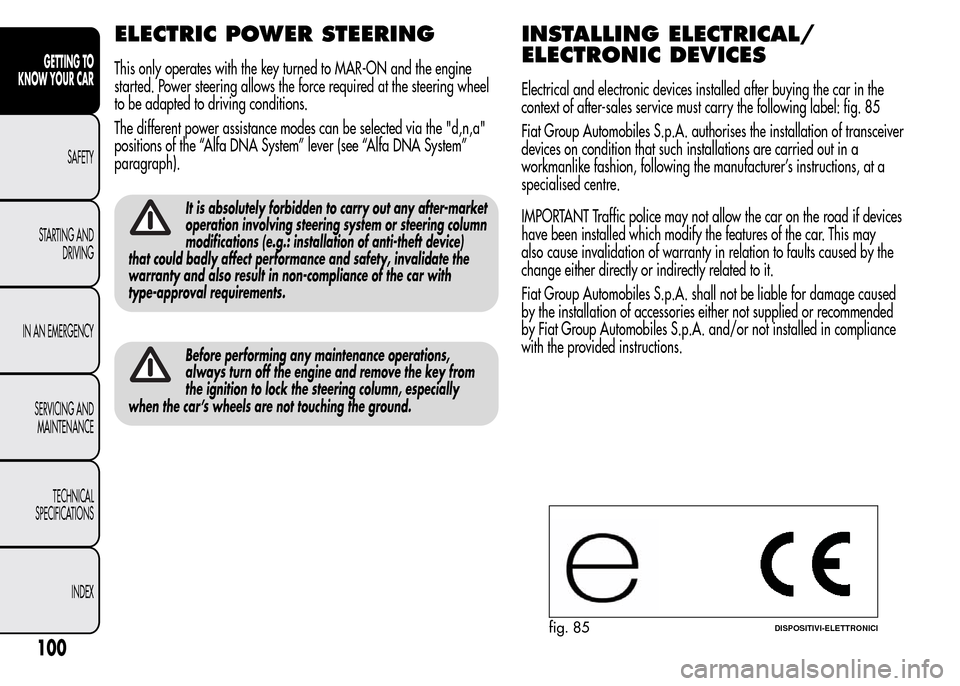
Electrical and electronic devices installed after buying the car in the
context of after-sales service must carry the following label: fig. 85
Fiat Group Automobiles S.p.A. authorises the installation of transceiver
devices on condition that such installations are carried out in a
workmanlike fashion, following the manufacturer’s instructions, at a
specialised centre.
IMPORTANT Traffic police may not allow the car on the road if devices
have been installed which modify the features of the car. This may
also cause invalidation of warranty in relation to faults caused by the
change either directly or indirectly related to it.
Fiat Group Automobiles S.p.A. shall not be liable for damage caused
by the installation of accessories either not supplied or recommended
by Fiat Group Automobiles S.p.A. and/or not installed in compliance
with the provided instructions.
fig. 85DISPOSITIVI-ELETTRONICI
100
GETTING TO
KNOW YOUR CAR
SAFETY
STARTING AND
DRIVING
IN AN EMERGENCY
SERVICING AND
MAINTENANCE
TECHNICAL
SPECIFICATIONS
INDEX
Page 107 of 280

OPERATION WITH TRAILER
Parking sensor operation is deactivated automatically when the trailer
electric cable plug is fitted into the car tow hook socket. The sensors
are automatically enabled again when the trailer's cable plug is
removed.
The sensor must be free of mud, dirt, snow or ice in order
for the system to work. Be careful not to scratch or damage
the sensors while cleaning them. Avoid using dry, rough
or hard cloths. The sensors should be washed using clean water with
the addition of car shampoo if necessary. When using special washing
equipment such as high pressure jets or steam cleaning, clean the
sensors very quickly keeping the jet more than 10 cm away.
When repainting the bumpers or touching up paint in
the sensor area, contact Alfa Romeo Authorized
Services only. Incorrect paint application could affect
the operation of the parking sensors.
Parking manoeuvres however are always the driver’s
responsibility. When carrying out such manoeuvres,
always ensure that the manoeuvring area is free of
people (particularly children) and animals. The parking sensor is
designed to assist drivers, who must still never allow their
attention to lapse during potentially dangerous manoeuvres even
if performed at low speed.
GENERAL WARNINGS
During parking manoeuvres, pay the utmost attention to any obstacles
that could be located above or below the sensors.
Objects located near the rear of the car are not detected under certain
circumstances and could therefore cause damage to the car or be
damaged.
The following conditions may influence the performance of the parking
sensor system:
❒reduced sensor sensitivity and a reduction in the parking assistance
system performance could be due to the presence on the surface of
the sensor of: ice, snow, mud, thick paint
❒the sensors may detect a non-existent obstacle (echo interference)
due to mechanical interference, for example when washing the
car, in rain (strong wind), hail;
❒The signals sent by the sensors can also be altered by the presence
of ultrasonic systems (e.g. pneumatic brake systems or pneumatic
drills) near the vehicle.
❒sensor performance can also be influenced by the position of the
sensors. For example by a change in the ride setting (caused by
the wear of the shock absorbers, suspension), overloading the
vehicle and carrying out specific tuning operations that require the
vehicle to be lowered;
❒The detection of obstacles at the top part of the car may not be
guaranteed because the system detects obstacles that could cause an
impact with the car in the bottom part.
103
GETTING TO
KNOW YOUR CAR
SAFETY
STARTING AND
DRIVING
IN AN EMERGENCY
SERVICING AND
MAINTENANCE
TECHNICAL
SPECIFICATIONS
INDEX
Page 116 of 280

PRETENSIONERS
The car is equipped with front seat belt pretensioners, which draw
back the seat belts by several centimetres in the event of a violent
frontal impact. This guarantees the perfect adherence of the seat belts
to the occupants’ bodies before the restraining action begins.
It is evident that the pretensioners have been activated when the belt
withdraws towards the reel.
The car is also equipped with a second pretensioner (in the kick plate
area). Its activation is signalled by the shortening of the metal cable.
A slight discharge of smoke may be produced during the activation of
the pretensioner. This is not harmful and does not indicate the start
of a fire.
IMPORTANT To obtain the highest degree of protection from the action
of the pretensioner, wear the seat belt tight to the chest and pelvis.
The pretensioner does not require any maintenance or lubrication: any
changes to its original conditions will invalidate its efficiency. If, due
to unusual natural events (floods, sea storms, etc.), the device has been
affected by water and/or mud, contact Alfa Romeo Authorised
Services to have it replaced.
The pretensioner may be used only once. Once it has
been activated, contact Alfa Romeo Authorised Services
to have it replaced.
Operations which lead to impacts, vibrations or localised
heating (over 100°C for a maximum of six hours) in the
area around the pretensioner may damage or deploy it.
Contact Alfa Romeo Authorised Services should intervention be
necessary on these components.
LOAD LIMITERS
To increase protection, the front seat belt reels contain a load limiter
which controls the force acting on the chest and shoulders during
the belt restraining action in the event of a head-on collision.
GENERAL INSTRUCTIONS FOR USING
THE SEAT BELTS
Respect and ensure that all the other occupants of the car respect the
local laws in force regarding the use of seat belts. Always fasten the
seat belts before starting off.
Seat belts must also be worn by pregnant women: the risk of injury in
the event of an accident is reduced for them and the unborn child if
they are wearing a seat belt.
Pregnant women must position the lower part of the belt very low
down so that it passes over the pelvis and under the abdomen fig. 93.
The belt must not be twisted. The upper part must pass over the
shoulder and cross the chest diagonally. The lower part must adhere to
the pelvis fig. 94, not to the abdomen of the occupant. Never use
devices (clips, clamps, etc.) to hold the seat belt away from your body.
112
GETTING TO KNOW
YOUR CAR
SAFETY
STARTING AND
DRIVING
IN AN EMERGENCY
SERVICING AND
MAINTENANCE
TECHNICAL
SPECIFICATIONS
INDEX
Page 121 of 280

GROUP 2
The diagram is indicative and for assembly purposes
only. Fit the child seat according to the instructions,
which must be included.
Children from 15 to 25 kg may use the car seat belts directly fig. 98.
In this case, the child restraint system is used to position the child
correctly with respect to the seat belts so that the diagonal belt section
crosses the child’s chest and not the neck, and the lower part is snug
on the pelvis not the abdomen.
GROUP 3
The diagram is indicative and for assembly purposes
only. Fit the child seat according to the instructions,
which must be included.
For children between 22 kg and 36 kg, there are dedicated restraint
systems that allow the seat belt to be worn correctly.
fig. 99 shows an example of correct child seat positioning on the rear
seat.
Children over 1.50 m in height can wear seat belts like adults.
fig. 98A0J0099fig. 99A0J0100
117
GETTING TO KNOW
YOUR CAR
SAFETY
STARTING AND
DRIVING
IN AN EMERGENCY
SERVICING AND
MAINTENANCE
TECHNICAL
SPECIFICATIONS
INDEX
Page 127 of 280

FRONT AIRBAGS
“SMART BAG” SYSTEM (MULTISTAGE
FRONT AIRBAGS)
The car is equipped with multi-stage front airbags (“Smart bags”) for
the driver and passenger and knee bags for the driver.
The front airbags (driver's and passenger's) and the driver's knee bag
have been designed to protect the occupants in the event of head-on
crashes of medium-high severity, by placing cushions between the
occupant and the steering wheel or dashboard.
Therefore non-deployment in other types of impacts (side impacts, rear
shunts, roll-overs, etc.) does not indicate a system malfunction.
Airbags are not a replacement of but complementary to the seat belts,
which you are recommended to always wear. In the event of impact,
those not wearing a seat belt are projected forwards and may come
into contact with the bag which is still inflating. The protection offered
by the bag is compromised in these circumstances.
Front airbags may not activate in the following situations:
❒frontal impacts against highly deformable objects not involving the
front surface of the car (e.g. wing collision against guard rail, etc.);
❒jamming of the car underneath other vehicles or protective barriers
(e.g. underneath a truck or a guard rail) as, in this case, the bags
would offer no additional protection with respect to the seat belt and
their deployment would be inappropriate. In these cases, non-
deployment does not indicate a system malfunction.
Do not apply stickers or other objects on the steering
wheel, on the dashboard in the passenger side airbag
area, on side upholstery on the roof or on the seats.
Never put objects (e.g. mobile phones) on the passenger's side
dashboard since they could interfere with correct inflation of the
airbag and also cause serious injury to the passengers.
FRONT DRIVER SIDE AIRBAG
This consists of an instantly inflating bag contained in a special
compartment in the centre of the steering wheel fig. 103.
Always drive keeping your hands on the steering
wheel rim so the airbag can inflate freely if necessary.
Do not drive with your body bent forward. Keep the
back of your seat upright and lean back into it.
fig. 103A0J0047
123
GETTING TO KNOW
YOUR CAR
SAFETY
STARTING AND
DRIVING
IN AN EMERGENCY
SERVICING AND
MAINTENANCE
TECHNICAL
SPECIFICATIONS
INDEX