Page 155 of 280

CHANGING A BULB
GENERAL INSTRUCTIONS
❒Before changing a bulb check the contacts for oxidation;
❒blown bulbs must be replaced with others of the same type and
power;
❒after replacing a headlight bulb, always check its alignment;
❒when a light is not working, check that the corresponding fuse is
intact before changing a bulb. For the location of fuses, refer to
the paragraph “Replacing fuses” in this section.
Halogen bulbs must be handled holding the metal part
only. Touching the transparent part of the bulb with your
fingers may reduce the intensity of the emitted light and
even reduce the lifespan of the bulb. In case of accidental contact, wipe
the bulb with a cloth moistened with alcohol and let the bulb dry.
Modifications or repairs to the electric system that are
not carried out properly or do not take the system
technical specifications into account can cause
malfunctions leading to the risk of fire.
Halogen bulbs contain pressurised gas which may
cause small fragments of glass to be projected
outwards if the bulb is broken.
IMPORTANT When the weather is cold or damp or after heavy rain or
washing, the surface of headlights or rear lights, may steam up and/or
form drops of condensation on the inside. This is a natural
phenomenon due to the difference in temperature and humidity
between the inside and the outside of the glass which does not indicate
a fault and does not compromise the normal operation of lighting
devices. The mist disappears quickly when the lights are turned on,
starting from the centre of the diffuser, extending progressively towards
the edges.
151
GETTING TO KNOW
YOUR CAR
SAFETY
STARTING AND
DRIVING
IN AN
EMERGENCY
SERVICING AND
MAINTENANCE
TECHNICAL
SPECIFICATIONS
INDEX
Page 166 of 280
FUSE LOCATION
Fuses are grouped together in three fuse boxes located in the engine
compartment, dashboard and luggage compartment.
Engine compartment fuse box
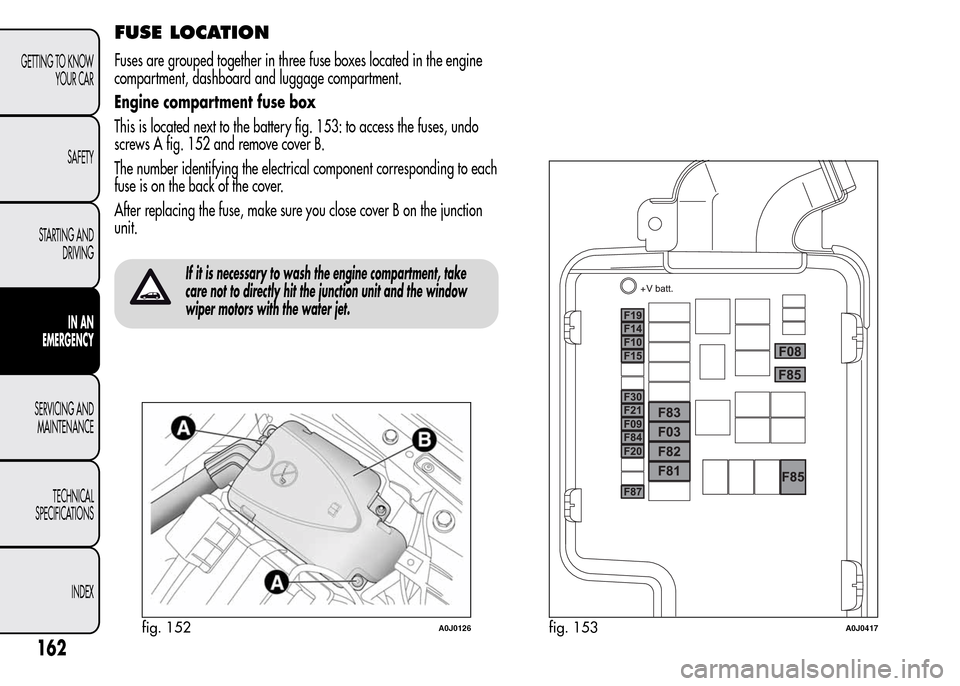
This is located next to the battery fig. 153: to access the fuses, undo
screws A fig. 152 and remove cover B.
The number identifying the electrical component corresponding to each
fuse is on the back of the cover.
After replacing the fuse, make sure you close cover B on the junction
unit.
If it is necessary to wash the engine compartment, take
care not to directly hit the junction unit and the window
wiper motors with the water jet.
fig. 152A0J0126fig. 153A0J0417
162
GETTING TO KNOW
YOUR CAR
SAFETY
STARTING AND
DRIVING
IN AN
EMERGENCY
SERVICING AND
MAINTENANCE
TECHNICAL
SPECIFICATIONS
INDEX
Page 176 of 280

SCHEDULED SERVICING PLAN
PETROL VERSIONS
Thousands of miles 9 18 27 36 45 54 63 72 81 90
Thousands of kilometres 15 30 45 60 75 90 105 120 135 150
Years12345678910
Check tyre condition/wear and adjust pressure, if necessary. Check
“Fix&Go Automatic” kit recharge expiry date●●●●●●●●●●
Check operation of lighting system (headlights, direction indicators,
hazard warning lights, luggage compartment, passenger
compartment, glove compartment, instrument panel warning lights,
etc.)●●●●●●●●●●
Check and, if necessary, top up fluid levels (engine coolant, hydraulic
clutch/brakes, screen washer, battery, etc.)●●●●●●●●●●
Check exhaust emissions/smokiness●●●●●●●●●●
Use the diagnosis socket to check supply/engine management system
operation, emissions and, for versions/markets, where provided,
engine oil degradation●●●●●●●●●●
Visually inspect condition of: exterior bodywork, underbody
protection, pipes and hoses (exhaust, fuel system, brakes), rubber
elements (boots, sleeves, bushes, etc.)●●●●●
Check windscreen/rear window wiper blade position/wear●●●●●
Check operation of windscreen wiper/washer system and adjust jets,
if necessary●●●●●
Check cleanliness of bonnet and luggage compartment locks, as well
as cleanliness and lubrication of linkages●●●●●
172
GETTING TO KNOW
YOUR CAR
SAFETY
STARTING AND
DRIVING
IN AN EMERGENCY
SERVICING AND
MAINTENANCE
TECHNICAL
SPECIFICATIONS
INDEX
The checks listed in the Scheduled Servicing Plan, after reaching 120,000 km/8 years, must be cyclically repeated starting from the first interval,
thus following the same intervals as before.
Page 179 of 280

DIESEL VERSIONS
Thousands of miles 12 24 36 48 60 72 84 96 108 120
Thousands of kilometres 20 40 60 80 100 120 140 160 180 200
Years12345678910
Check tyre condition/wear and adjust pressure, if necessary. Check
“Fix&Go Automatic” kit recharge expiry date●●●●●●●●●●
Check operation of lighting system (headlights, direction indicators,
hazard warning lights, luggage compartment, passenger
compartment, glove compartment, instrument panel warning lights,
etc.)●●●●●●●●●●
Check and, if necessary, top up fluid levels (engine coolant, hydraulic
clutch/brakes, screen washer, battery, etc.)●●●●●●●●●●
Check exhaust emissions/smokiness●●●●●●●●●●
Use the diagnosis socket to check supply/engine management system
operation, emissions and, for versions/markets, where provided,
engine oil degradation●●●●●●●●●●
Visually inspect condition of: exterior bodywork, underbody
protection, pipes and hoses (exhaust, fuel system, brakes), rubber
elements (boots, sleeves, bushes, etc.)●●●●●
Check windscreen/rear window wiper blade position/wear●●●●●
Check operation of windscreen wiper/washer system and adjust jets,
if necessary●●●●●
Check cleanliness of bonnet and luggage compartment locks, as well
as cleanliness and lubrication of linkages●●●●●
Check handbrake lever travel and adjust, if necessary●●●●●
Visually inspect condition and wear of front and rear disc brake pads●●●●●●●●●●
175
GETTING TO KNOW
YOUR CAR
SAFETY
STARTING AND
DRIVING
IN AN EMERGENCY
SERVICING AND
MAINTENANCE
TECHNICAL
SPECIFICATIONS
INDEX
The checks listed in the Scheduled Servicing Plan, after reaching 120,000 km/6 years, must be cyclically repeated starting from the first interval,
thus following the same intervals as before.
Page 181 of 280
PERIODIC CHECKS
Every 1,000 km or before long journeys, check and restore the
following if necessary:
❒engine coolant, brake fluid and windscreen washer fluid level;
❒tyre inflation pressure and condition;
❒operation of lighting system (headlamps, direction indicators,
hazard warning lights, etc.);
❒operation of window washer/wiper system and positioning/wear of
windscreen/rear window wiper blades
Check and top up, if required, the engine oil level every 3,000 km.
HEAVY-DUTY USE OF THE CAR
If you use the car mainly under one of the following conditions:
❒towing a trailer or caravan;
❒dusty roads;
❒short, repeated journeys (less than 7-8 km) at sub-zero outside
temperatures;
❒engine often idling or driving long distances at low speeds or long
periods of idleness;
the following checks must be performed more frequently than indicated
in the Scheduled Servicing Plan:
❒check front disc brake pad conditions and wear;
❒check cleanliness of bonnet and boot locks, cleanliness and
lubrication of linkage;
❒visually inspect conditions of: engine, gearbox, transmission, pipes
and hoses (exhaust - fuel system - brakes) and rubber elements
(boots - sleeves - bushes - etc.);
❒check battery charge and battery fluid level (electrolyte);
❒visually inspect condition of the accessory drive belts;
❒check and, if necessary, change engine oil and replace oil filter;
❒check and, if necessary, replace pollen filter;
❒check and, if necessary, replace air cleaner.
177
GETTING TO KNOW
YOUR CAR
SAFETY
STARTING AND
DRIVING
IN AN EMERGENCY
SERVICING AND
MAINTENANCE
TECHNICAL
SPECIFICATIONS
INDEX
Page 193 of 280
Remember that the road holding qualities of your car
also depend on the correct inflation pressure of the
tyres.
If the pressure is too low the tyre overheats and can be
seriously damaged.
Do not cross switch the tyres, moving them from the
right of the car to the left and vice versa.
Never submit alloy rims to repainting treatments
requiring the use of temperatures exceeding 150°C.
The mechanical properties of the wheels could be
impaired.
WINDSCREEN/REAR WINDOW
WIPER
BLADES
We recommend replacing the blades once a year.
A few simple precautions can reduce the possibility of damage to the
blades:
❒if the temperature falls below zero, make sure that ice has not frozen
the rubber against the glass. Use a de-icing product to release it if
required;
❒remove any snow from the window;
❒do not operate the windscreen/rear window wipers on dry glass.
Driving with worn windscreen/rear window wiper
blades is a serious hazard, because visibility is reduced
in bad weather.
189
GETTING TO KNOW
YOUR CAR
SAFETY
STARTING AND
DRIVING
IN AN EMERGENCY
SERVICING AND
MAINTENANCE
TECHNICAL
SPECIFICATIONS
INDEX
Page 194 of 280
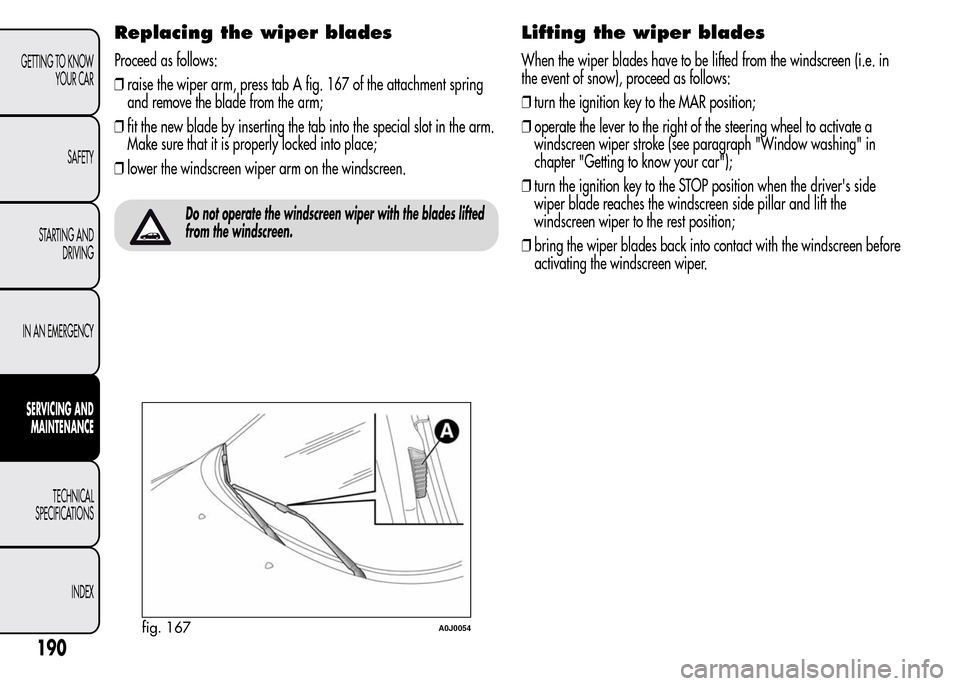
Replacing the wiper blades
Proceed as follows:
❒raise the wiper arm, press tab A fig. 167 of the attachment spring
and remove the blade from the arm;
❒fit the new blade by inserting the tab into the special slot in the arm.
Make sure that it is properly locked into place;
❒lower the windscreen wiper arm on the windscreen.
Do not operate the windscreen wiper with the blades lifted
from the windscreen.
Lifting the wiper blades
When the wiper blades have to be lifted from the windscreen (i.e. in
the event of snow), proceed as follows:
❒turn the ignition key to the MAR position;
❒operate the lever to the right of the steering wheel to activate a
windscreen wiper stroke (see paragraph "Window washing" in
chapter "Getting to know your car");
❒turn the ignition key to the STOP position when the driver's side
wiper blade reaches the windscreen side pillar and lift the
windscreen wiper to the rest position;
❒bring the wiper blades back into contact with the windscreen before
activating the windscreen wiper.
fig. 167A0J0054
190
GETTING TO KNOW
YOUR CAR
SAFETY
STARTING AND
DRIVING
IN AN EMERGENCY
SERVICING AND
MAINTENANCE
TECHNICAL
SPECIFICATIONS
INDEX
Page 195 of 280
Replacing the rear window wiper
blade
Proceed as follows:
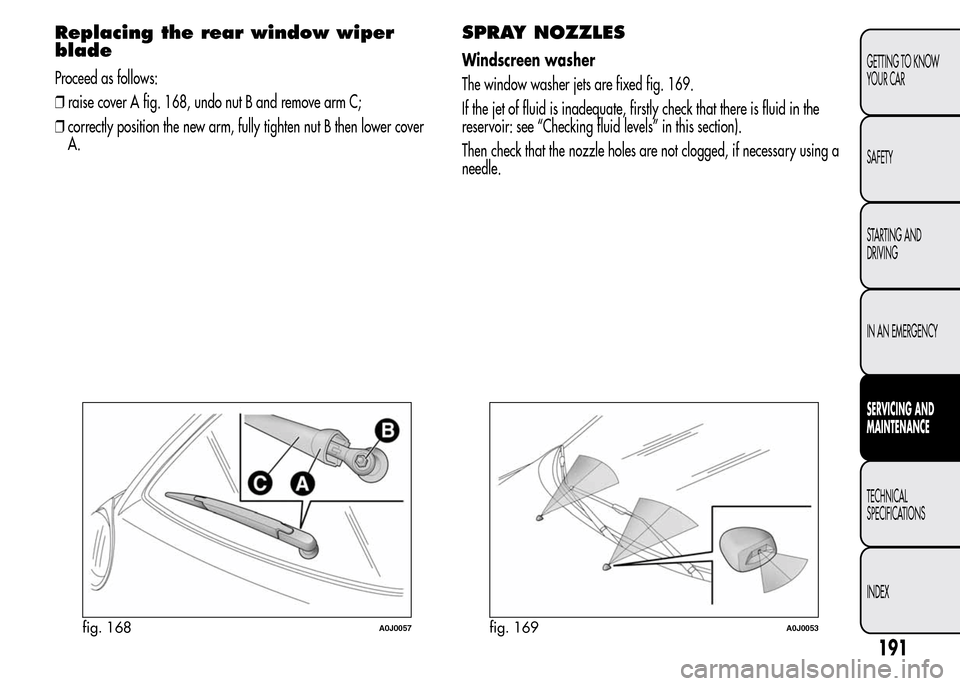
❒raise cover A fig. 168, undo nut B and remove arm C;
❒correctly position the new arm, fully tighten nut B then lower cover
A.
SPRAY NOZZLES
Windscreen washer
The window washer jets are fixed fig. 169.
If the jet of fluid is inadequate, firstly check that there is fluid in the
reservoir: see “Checking fluid levels” in this section).
Then check that the nozzle holes are not clogged, if necessary using a
needle.
fig. 168A0J0057fig. 169A0J0053
191
GETTING TO KNOW
YOUR CAR
SAFETY
STARTING AND
DRIVING
IN AN EMERGENCY
SERVICING AND
MAINTENANCE
TECHNICAL
SPECIFICATIONS
INDEX