2016 Alfa Romeo Giulia warning lights
[x] Cancel search: warning lightsPage 83 of 204

if the seat belt is fastenedthe
corresponding icon will be green;
if the seat belt is unfastenedthe
corresponding icon will be red.
If a rear seat belt is unfastened, an
acoustic warning (3 "beeps") will be
activated along with the relevant icon
lighting up in the display.
Furthermore the icons will light up again
for 30 seconds each time one of the rear
doors is closed.
The visual indication (flashing red) will
start and stop independently for each
warning light if several seat belts are
unfastened.
The icon will turn green after the
corresponding seat belt has been
fastened.
The rear seat icons will go out, regardless
of the state of the belt (red icon or green
icon), approximately 30 seconds after
the last signal.
IMPORTANT NOTES
As far as the rear seats are concerned,
the SBR system will only indicate
whether the seat belts are unfastened
(red icon) or fastened (green icon), not
the presence of any passengers.
The warning lights/icons all stay off if all
seat belts (front and rear) are fastened
when the ignition device is set to ON.
For the rear seats, the icons will activatea few seconds after the ignition device
has been turned to ON, regardless of the
status of the seat belts (even if the seat
belts are all fastened).
All the warning lights/icons will come on
when at least one belt changes from
fastened to unfastened status or vice
versa.
PRETENSIONERS
The vehicle is equipped with front and
rear lateral seat belt pretensioners,
which draw back the seat belts by several
centimetres in the event of a strong
frontal impact. This guarantees the
perfect adherence of the seat belts to
the occupant's bodies before the
retention action begins.
It is evident that the pretensioners have
been activated when the belt withdraws
toward the retractor.
This car is also equipped with a second
pretensioner on the front seat belts
(fitted in the kick plate area). Its
activation is signalled by the shortening
of the metal cable.
A slight discharge of smoke may be
produced during the activation of the
pretensioner which is not harmful and
does not involve any fire hazard.
The pretensioner does not require any
maintenance or lubrication: any changes
to its original conditions will invalidate its
efficiency.
If, due to unusual natural events (floods,
sea storms, etc.), the device has been
affected by water and/or mud, contact an
Alfa Romeo Dealership to have it
replaced.
IMPORTANT To obtain the highest
degree of protection from the action of
81
Page 106 of 204

may be detected when engaging the
electric parking brake with the brake
pedal pressed.
With the electric parking brake engaged,
the warning light
on the instrument
panel and the LED on the switch
fig. 101 turn on.
IMPORTANTWith the Electronic Parking
Brake failure warning light on, some
functions of the electric parking brake are
deactivated. In this case the driver is
responsible for brake activation and vehicle
parking in complete safety conditions.
If, under exceptional circumstances, the
use of the brake is required with the
vehicle in motion, keep the switch on the
central tunnel pulled as long as the brake
action is necessary.
The
warning light may switch on with
the hydraulic system temporarily
unavailable; in this case braking is
controlled by the motors.
The brake lights (stop) will also
automatically switch on in the same way
as for normal braking with the use of the
brake pedal.
Release the switch on the central tunnel
to stop the braking action with the
vehicle in motion.
If, through this procedure, the vehicle is
braked until a speed below 2 mph (3 km/h)is reached and the switch is kept pulled, the
parking brake will definitively engage.
IMPORTANTDriving the vehicle with the
electric parking brake engaged, or using it
several times to slow down the vehicle, may
cause severe damage to the braking system.
Disengaging the electric parking brake
manually
In order to manually release the parking
brake, the ignition device should be at ON
position. Moreover, you need to press the
brake pedal, then press the switch on the
central tunnel briefly.
Noise may be heard from the rear of the
vehicle and a slight movement of the
brake pedal may be detected during
disengagement.
After disengaging the electric parking
brake, the
warning light on the
instrument panel and the LED on the
fig. 101 switch turn off.
If the
warning light on the instrument
panel remains on with the electric parking
brake disengaged, this indicates a fault:
in this case contact an Alfa Romeo
Dealership.
IMPORTANT Never use gear position P
(Park) instead of the electric parking
brake. Always engage the electric
parking brake when parking the vehicle to
prevent injury or damage caused by the
unexpected movement of the vehicle.ELECTRIC PARKING BRAKE OPERATING
MODES
The electric parking brake may operate
as follows:
"Dynamic operating mode": this mode
is activated by pulling the switch
repeatedly whilst driving;
"Static engagement and release
mode": with the vehicle stationary, the
electric parking brake can be activated
by pulling the switch on the central tunnel
once. On the other hand, press the switch
and the brake pedal at the same time to
disengage the brake;
"Drive Away Release": (where
provided) the electric parking brake will
automatically disengage with the driver
side seat belt fastened and the detection
of an action performed by the driver to
move the vehicle (forward gear or
reverse gear);
"Safe Hold": if the vehicle speed is
lower than 2 mph (3 km/h), on vehicles
with automatic transmission, the gear
lever is not in P (Park) position and the
driver's intention of leaving the vehicle is
detected, the electric parking brake will
automatically engage to hold the vehicle
in safety conditions;
"Auto Park Brake": if the vehicle speed
is below 2 mph (3 km/h), the electric
parking break will automatically engage
when the gear lever is in P (Park) position.
The LED on the switch located on the
104
STARTING AND DRIVING
Page 108 of 204
for at least 2 seconds with the clutch
pedal fully pressed before engaging
reverse to prevent damage to the gears
and grating.
IMPORTANT The clutch pedal should be
used only for gear changes. Do not drive
with your foot resting on the clutch pedal,
however lightly. In some circumstances,
the electronic clutch control could cut in
by interpreting the incorrect driving style
as a fault.
WARNING
106)Depress the clutch pedal fully to
change gear correctly. It is therefore
essential that there is nothing under the
pedals: make sure the mats are lying flat and
do not get in the way of the pedals.
IMPORTANT
34)Do not drive with your hand resting on
the gear lever as the force exerted, even if
slight, could lead over time to premature
wear of the gearbox internal components.
AUTOMATIC TRANSMISSION
The vehicle can be equipped with a
8-speed automatic transmission.
The gearbox/transmission can function in
two operating modes: "Automatic" or
"Sequential".
GEAR LEVER
107) 108) 109)
35) 36)
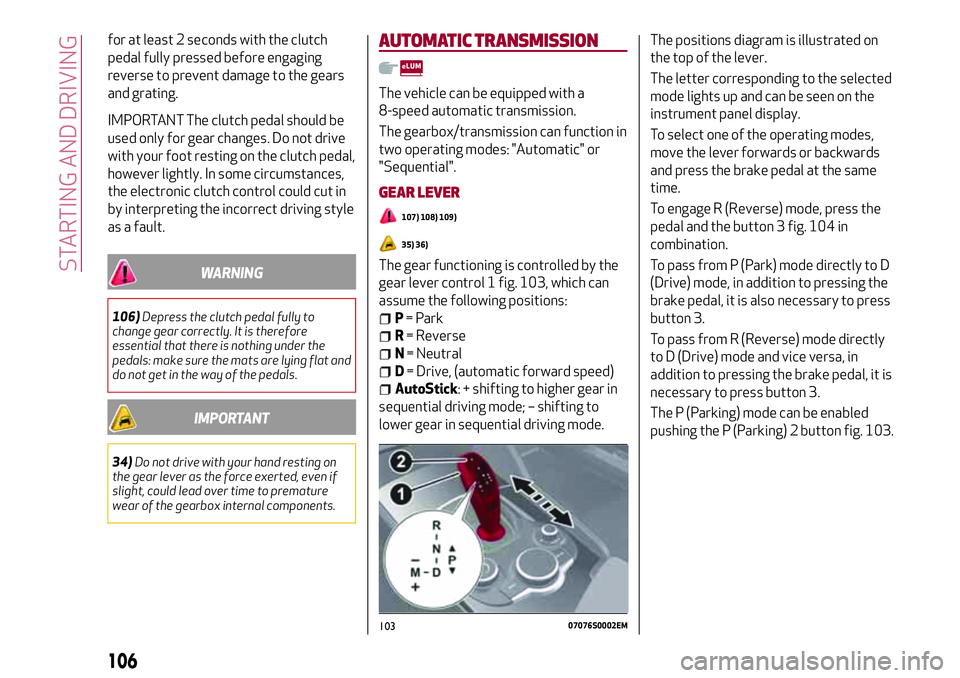
The gear functioning is controlled by the
gear lever control 1 fig. 103, which can
assume the following positions:
P= Park
R= Reverse
N= Neutral
D= Drive, (automatic forward speed)
AutoStick: + shifting to higher gear in
sequential driving mode; – shifting to
lower gear in sequential driving mode.The positions diagram is illustrated on
the top of the lever.
The letter corresponding to the selected
mode lights up and can be seen on the
instrument panel display.
To select one of the operating modes,
move the lever forwards or backwards
and press the brake pedal at the same
time.
To engage R (Reverse) mode, press the
pedal and the button 3 fig. 104 in
combination.
To pass from P (Park) mode directly to D
(Drive) mode, in addition to pressing the
brake pedal, it is also necessary to press
button 3.
To pass from R (Reverse) mode directly
to D (Drive) mode and vice versa, in
addition to pressing the brake pedal, it is
necessary to press button 3.
The P (Parking) mode can be enabled
pushing the P (Parking) 2 button fig. 103.
10307076S0002EM
106
STARTING AND DRIVING
Page 123 of 204

A punctured tyre or a burnt-out bulb?
At times, a problem may interfere with our journey.
The pages on emergencies can help you to deal with critical
situations independently and with calm.
In an emergency we recommend that you call the freephone
number found in the Warranty Booklet.
It is also possible to call the national or international universal
freephone number to search for the nearest Alfa Romeo
Dealership.
IN AN EMERGENCY
HAZARD WARNING LIGHTS.......................122
REPLACING A BULB............................122
REPLACING FUSES . ...........................127
TIRE REPAIR KIT . .............................132
EMERGENCY STARTING.........................134
FUEL CUT-OFF SYSTEM.........................137
BROKEN-DOWN VEHICLE TOWING . . ................138
TOWING THE VEHICLE ..........................138
Page 124 of 204

HAZARD WARNING LIGHTS
CONTROL
48)
Press the fig. 118 button to switch the
hazard warning lights on/off.
When the hazard warning lights are on,
the
andwarning lights flash.
When you need to move away from the
vehicle to look for help, the hazard
warning lights will continue flashing even
if the ignition device is in the STOP
position.
IMPORTANT The use of hazard warning
lights is governed by the highway code of
the country you are driving in: comply
with legal requirements.
Emergency braking
The hazard lights are switched on and
warning lights
andappear on the
instrument panel in case of emergency
braking and according to the mode
selected by the “Alfa DNA™” selector.
When the "Alfa DNA™" selector is in
position "n" or "a", the activation
threshold of the hazard warning lights is
higher; on the other hand, in position "d"
the sensitivity of the activation is lower
than that in the "n" and "a" modes.
The lights switch off automatically when
emergency braking ceases.
IMPORTANT
48)A prolonged use of the hazard warning
lights may discharge the battery.
REPLACING A BULB
119) 120) 121)
49)
GENERAL INSTRUCTIONSBefore replacing a bulb check the
contacts for oxidation;
replace blown bulbs with others of the
same type and power;
after replacing a headlight bulb,
always check its alignment;
when a light is not working, check that
the corresponding fuse is intact before
changing the bulb. For the location of
fuses, refer to the paragraph "If a fuse
blows" in this chapter.
IMPORTANT In some particular climate
conditions such as low temperature,
humidity or after washing the car, a thin
condensation layer may form on the
internal surfaces of the front and rear
headlights. This phenomenon will
disappear after switching on the
headlights
11808016S0001EM
122
IN AN EMERGENCY
Page 129 of 204

pull out the bulb-bulb holder unit from
the headlight body by turning it
anticlockwise fig. 129;
remove the bulb by sliding it off the
bulb holder
install the new bulb, making sure it is
correctly inserted in the bulb holder;
then insert the bulb, bulb holder and
connector assembly in the housing on the
headlight body and turn it clockwise,
making sure that it is locked correctly;
refit the cover by tightening the two
fixing screws.
Front light cluster with main
beam/dipped beam Xenon gas
discharge headlights
To replace the bulbs of the main beam
headlights/dipped headlights contact an
Alfa Romeo Dealership
WARNING
119)Before replacing the bulb, wait for the
exhaust ducts to cool down: DANGER OF
SCALDING!
120)Modifications or repairs to the electric
system that are not carried out properly or
do not take the system technical
specifications into account can cause
malfunctions leading to the risk of fire.
121)Halogen bulbs contain pressurised gas,
in the case of breakage they may burst
causing glass fragments to be projected
outwards.
IMPORTANT
49)Halogen bulbs must be handled holding
the metallic part only. Touching the
transparent part of the bulb with your
fingers may reduce the intensity of the
emitted light and even reduce the lifespan of
the bulb. In the event of accidental contact,
wipe the bulb with a cloth moistened with
alcohol and let the bulb dry.
REPLACING FUSES
INTRODUCTION
122) 123) 124) 125) 126)
50) 51)
Fuses protect the electrical system: they
intervene (blow) in the event of a failure
or improper action on the system.
Fuse extracting pliers
To replace a fuse, use the pliers hooked
to the boot fusebox cover fig. 130.
Grab the pliers from the upper tabs,
press them and extract the pliers pulling
upwards.
The pliers fig. 131 have two different
ends, specifically designed to remove the
different types of fuses present in the
vehicle.
1: MINI fuse;
2: J-CASE fuse.
12808026S0021EM
12908026S0022EM
13008036S0053EM
127
Page 144 of 204

SCHEDULED SERVICING
Correct servicing is crucial for
guaranteeing a long life for the vehicle
under the best conditions.
For this reason, Alfa Romeo has planned
a series of checks and services at fixed
distance intervals and, for
versions/markets, where provided, at
fixed time intervals, as described in the
Scheduled Servicing Plan.
Before each service, it is always
necessary to carefully follow the
instructions in the Scheduled Servicing
Plan (e.g. periodically check level of
fluids, tyre pressure, etc.).
Scheduled Servicing is offered by an Alfa
Romeo Dealership according to a set
time schedule. If, during each operation,
in addition to the ones scheduled, the
need arises for further replacements or
repairs, these may be carried out with the
owner's explicit consent only.
IMPORTANT Scheduled Servicing
Coupons are required by the
Manufacturer. Failure to have them
carried out may invalidate the warranty.
It is advisable to inform the Alfa Romeo
Dealership of any small operating
irregularities without waiting for the next
service.
PERIODIC CHECKS
Every year or every600mi (1,000 km) or
before long trips check and, if necessary,
top up:
engine coolant level;
brake fluid level (if insufficient, see an
Alfa Romeo dealership as soon as
possible);
windscreen washer fluid level;
tyre inflation pressure and condition;
operation of lighting system
(headlights, direction indicators, hazard
warning lights, etc.);
operation of screen washing/wiping
system and positioning/wear of wiper
blades.
Every1,800mi (3,000 km), check and
top up if required: engine oil level.
HEAVY USAGE OF THE CAR
If the vehicle is used under one of the
following conditions:
dusty roads;
short, repeated journeys (less than
4-5 mi (7-8 km)) at sub-zero outside
temperatures;
engine often idling or driving long
distances at low speeds or long periods
of inactivity;
in the event of a long period of
inactivity;
the following checks must be carried outmore often than indicated in the
Scheduled Servicing Plan:
check front and rear disc brake pad
condition and wear;
check cleanliness of bonnet and boot
locks, cleanliness and lubrication of
linkage;
visually inspect conditions of: engine,
gearbox, transmission, pipes and hoses
(exhaust/fuel system/brakes) and rubber
elements (gaiters/sleeves/bushes, etc.);
check battery charge and battery fluid
level (electrolyte);
visually inspect conditions of the
accessory drive belts;
check and, if necessary, change engine
oil and replace oil filter;
check and, if necessary, replace pollen
filter;
check and, if necessary, replace air
cleaner;
check and, if necessary, replace the
Bad Fuel fuel filter (where available).
142
SERVICING AND CARE
Page 145 of 204

SCHEDULED SERVICING PLAN (2.2 JTD diesel engine versions)
The checks listed in the Scheduled Servicing Plan, after reaching 120,000 mi (200,000 km)/10 years, must be cyclically repeated
starting from the first interval, thus following the same intervals as before.
Thousands of miles12 24 36 48 60 72 84 96 108 120
Thousands of kilometres20 40 60 80 100 120 140 160 180 200
Years12345678910
Check battery charge status with the proper instrument●●●●●●●●●●
Check tyre condition/wear and adjust pressure, if necessary.
Check the Tyre Repair Kit recharge condition and expiry date●●●●●●●●●●
Check operation of lighting system (headlights, direction
indicators, hazard warning lights, boot, passenger
compartment, glove compartment, instrument panel warning
lights, etc.)
●●●●●●●●●●
Check and, if necessary, top up fluid levels (1)●●●●●●●●●●
Check exhaust emissions/smokiness●●●●●●●●●●
Use the diagnosis socket to check supply/engine
management systems operation, emissions and, for
versions/markets, where provided, engine oil degradation (2)
●●●●●●●●●●
Visually inspect conditions of: exterior bodywork, underbody
protection, pipes and hoses (exhaust, fuel system, brakes),
rubber elements (gaiters, sleeves, bushes, etc.)
●●●●●
Check position/wear of front windscreen wiper blade●●●●●
(1) Top up using the fluids indicated in the “Fluids and lubricants” paragraph of the “Technical data” chapter and only after checking that the system is
intact.
(2) If the vehicle diagnostics shows the oil to be degraded to less than 20%, replacing the engine oil and filter is advised.
143