2016 Alfa Romeo Giulia key
[x] Cancel search: keyPage 18 of 204

fig. 8, extract the cover pulling
downwards;
remove the key insert from its housing
fig. 9;
insert the metal insert in the driver
side door lock and turn it to unlock the
door.
Do not push the lock/unlock door button
fig. 6 and push the handle simultaneously,
(seefig. 6 ).
POWER LOCK(where provided)
6)
This safety device inhibits the operation
of the interior door handles and the door
locking/unlocking button.
It thereby prevents the opening of the
doors from inside the passenger
compartment, serving as an obstacle to
break-in attempts (e.g. broken window).
We recommend that you activate the
device each time you park your vehicle.
Activating the device
The device is enabled on all the doors by
pressing the
button on the key twice
quickly.
The direction indicators flash 3 times to
let you know that the device is active.
If one or more of the doors are not closed
correctly, the device will not activate,thus preventing a person from getting
stuck inside the passenger compartment
by entering the vehicle through, and then
closing, the open door.
Deactivating the device
The device disengages automatically:
when the doors are unlocked (pressing
button
on the key with remote
control);
when the ignition device is set to ON.
CHILD SAFETY DEVICE
7) 8)
This system prevents the rear doors from
being opened from the inside.
This device fig. 11 can be engaged only
with the doors open.
position: device engaged (door
locked);
position: device not engaged (door
may be opened from the inside).
804016S0002EM
904016S0003EM
1004056S0004EM
1104056S0007EM
16
KNOWING YOUR CAR
Page 19 of 204

The device remains engaged even if the
doors are electrically unlocked.
IMPORTANT The rear doors cannot be
opened from the inside when the child
safety device is engaged.
UNLOCKING THE DOORS WITH A FLAT
BATTERY
Proceed as follows to unlock the doors if
the vehicle battery is flat.
Rear doors and passenger door
Proceed as follows:
insert the metal insert of the
electronic key in the release device
housing fig. 12;
turn the key clockwise for the right
door locks or anticlockwise for the left
door locks;
remove the key from the housing.
Proceed as follows to realign the doorlock device (only when the battery charge
has been restored):
press thebutton on the electronic
key;
press thebutton on the door panel;
open by inserting the key insert in the
driver's door lock;
operate the internal door handle.
IMPORTANT For the rear doors, if the
child lock device was engaged and the
previously described locking procedure
carried out, operating the internal handle
will not open the door but will only realign
the lock release device. To open the door,
the outside handle must be used. The
door central locking/unlocking buttons
are not deactivated when the emergency
lock is engaged.
WARNING
6)Once the Power Lock system is engaged,
it is impossible to open the doors from inside
the vehicle. Before getting out of the car,
please therefore check that there is no-one
left inside.
7)NEVER leave children unattended inside
the car, let alone leave the car with the doors
unlocked in a place that children can access
easily. Children may seriously, or even
fatally, injure themselves. Also ensure that
children do not inadvertently operate the
electric parking brake, the brake pedal or the
transmission lever.8)Always use this device when carrying
children. After engaging the child lock on
both rear doors, check for effective
engagement by trying to open a door with
the internal handle.
IMPORTANT
2)Make sure to take the key with you once a
door or the boot is locked, to prevent
forgetting the key inside the vehicle. If the
key has been locked in, it can only be
recovered using the second provided key.
3)The operation of the recognition system
depends on various factors, such as, for
example, any electromagnetic wave
interference from external sources (e.g.
mobile phones), the charge of the battery in
the electronic key and the presence of metal
objects near the key or the car. In these
cases it is still possible to unlock the doors
by using the metal insert in the electronic key
(see description on the following pages).
1204056S0008EM
17
Page 36 of 204

ANTI-PINCH SAFETY DEVICE
The sun roof has an anti-pinch safety
system capable of detecting the
presence of an obstacle during the
closing movement: if this happens, the
system intervenes and the movement of
the roof is immediately reversed into
opening.
INITIALISATION PROCEDURE
Automatic operation of the sunroof must
be initialised again in case of faulty
sunroof operation.
Proceed as follows:
press button 1 next to thesymbol
to bring the roof into completely closed
position;
bring the ignition device to STOP and
wait at least 10 seconds;
set the ignition device to AVV;
hold button 1 down for at least
10 seconds, then you should hear the
mechanical stop of the roof motor;
within 5 seconds hold button 1 down:
the roof will perform a complete
automatic opening and closing cycle (to
indicate that the initialisation procedure
has been successful). If this does not
occur, the procedure must be restarted
from the beginning.
WARNING
21)When leaving the vehicle, make sure to
take the key with you to avoid the risk of
injury to those still inside the car due to
accidental operation of the sunroof.
Improper use of the roof can be dangerous.
Before and during operation, always check
that no-one is exposed to the risk of being
injured by the moving sunroof or by objects
getting caught or hit by it.
IMPORTANT
11)Do not open the sun roof if a roof rack or
crossbars are fitted. Do not open the sun
roof if there is snow or ice on it: you may
damage it.
BONNET
OPENING
22) 23)
Proceed as follows:
inside the passenger compartment
pull the release lever, fig. 38;
go to the outside of the vehicle and
position yourself in front of the grille;
lift the bonnet slightly from right to
left as indicated on the unhooking
device's arrow, fig. 39;
3804196S0001EM
34
KNOWING YOUR CAR
Page 38 of 204

CLOSING
12)
Grip one of the handles fig. 42 and lower
the boot, pressing next to the lock until it
clicks.
IMPORTANT Before closing the boot
make sure you have the key with you to
prevent locking it in the boot. The boot
will be locked automatically and can only
be opened using another key.BOOT INITIALISATION
IMPORTANT If the battery is
disconnected or the protection fuse
blows, the boot opening/closing
mechanism must be reinitialised as
follows:
close all the doors and the boot;
press thebutton on the remote
control;
press thebutton on the remote
control.
IMPORTANT
12)When you need to disconnect or remove
the battery, do not close the boot. In order to
avoid possible accidental closure, it is
recommended to place an obstacle (e.g. a
cloth) on the lock that would physically avoid
closure.
4104206S0002EM
4204206S0003EM
36
KNOWING YOUR CAR
Page 58 of 204

Symbol What it means
AUTOMATIC TRANSMISSION FAILURE
The symbol switches on, together with a buzzer warning, to indicate that the automatic transmission is faulty.
Contact an Alfa Romeo Dealership as soon as possible.
16)
INSUFFICIENT ENGINE OIL LEVEL
The symbol switches on, along with the related message on the display, to indicate low engine oil level.
On the QV version, the level must also be checked using the dipstick below the boot (see chapter "Servicing and care").
SPEED LIMIT EXCEEDED
(where provided)
The symbol switches on when the speed limit of 75 mph (120 km/h) is exceeded.
IMPORTANT
16)Driving the vehicle with this symbol on may severely damage the gearbox, with resulting breakage. The oil may also overheat: contact with hot
engine or with exhaust components at high temperature could cause fires.
Amber symbols
Symbol What it means
ENGINE IMMOBILIZER FAILURE / BREAK-IN ATTEMPT
Engine Immobilizer system failure
The symbol switches on to report a failure of the Engine Immobilizer system.
Contact an Alfa Romeo Dealership as soon as possible.
Break-in attempt
The symbol switches on when the ignition device is moved to ON position, to indicate a possible break-in attempt detected by the
alarm system.
Electronic key not recognised
The symbol switches on when the engine is started and the electronic key is not recognized by the system.
Alarm system failure
This symbol switches on to report an alarm system failure.
56
KNOWING THE INSTRUMENT PANEL
Page 61 of 204

Symbol What it means
EXTERIOR LIGHTS FAILURE
The symbol switches on to indicate a failure on the following lights: daytime running lights (DRLs) / parking lights / trailer
direction indicators (if present) / trailer lights (if present) / side lights / direction indicators / rear fog light / reversing light / brake
lights / number plate lights.
The failure may be caused by a blown bulb, a blown protection fuse or an interruption of the electrical connection.
Replace the bulb or the relevant fuse. Contact an Alfa Romeo Dealership.
KEYLESS START SYSTEM FAILURE
The symbol switches on in the event of Keyless Start system failure.
Contact an Alfa Romeo Dealership as soon as possible.
FUEL CUT-OFF SYSTEM FAILURE
The symbol switches on in the event of fuel cut-off system failure.
Contact an Alfa Romeo Dealership as soon as possible.
LANE DEPARTURE WARNING (LDW) SYSTEM FAILURE
The symbol comes on also in the case of a fault to the Lane Departure Warning system.
Contact an Alfa Romeo Dealership as soon as possible.
AUTOMATIC HIGH BEAM HEADLIGHTS FAILURE
(where provided)
The symbol switches on to report a failure of the automatic main beam headlights.
Contact an Alfa Romeo Dealership as soon as possible to have the failure eliminated.
59
Page 82 of 204
SBA (Seat Belt Alert)SYSTEM
The SBA system warns the passengers of
the front and rear (where provided) seats
if their seat belt is not fastened.
The system signals unfastened seat belts
with visual warnings (warning lights on in
the instrument panel and icons on the
display) and an acoustic signal (see the
following paragraphs).
NOTE Contact an Alfa Romeo Dealership
to deactivate the acoustic warning. The
acoustic warning can be reactivated at
any time through the Connect system.
FRONT SEAT BELT WARNING LIGHT
BEHAVIOUR
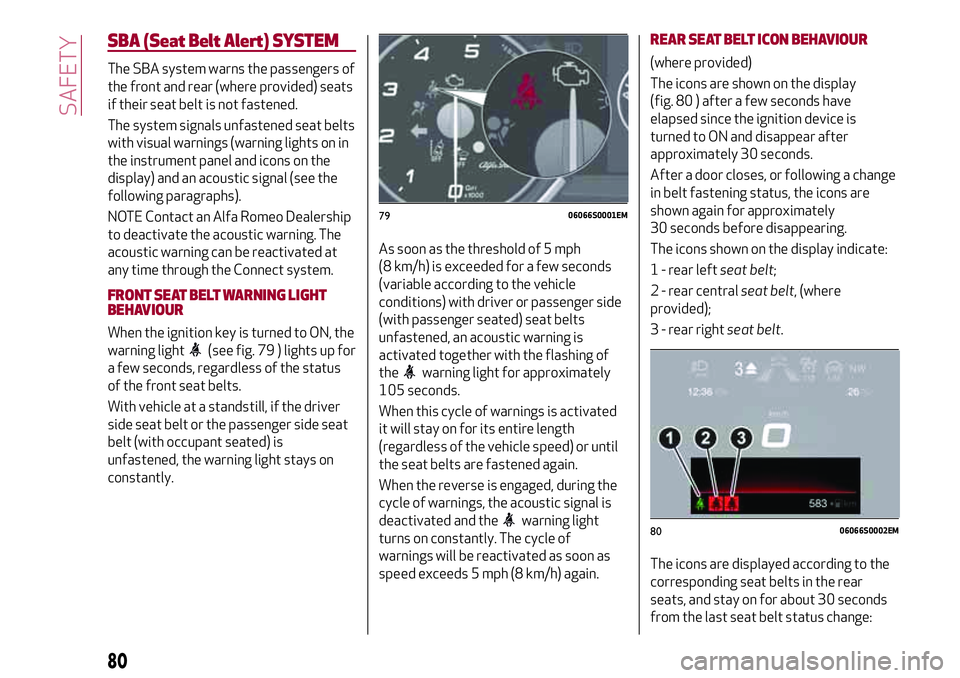
When the ignition key is turned to ON, the
warning light
(see fig. 79 ) lights up for
a few seconds, regardless of the status
of the front seat belts.
With vehicle at a standstill, if the driver
side seat belt or the passenger side seat
belt (with occupant seated) is
unfastened, the warning light stays on
constantly.As soon as the threshold of 5 mph
(8 km/h) is exceeded for a few seconds
(variable according to the vehicle
conditions) with driver or passenger side
(with passenger seated) seat belts
unfastened, an acoustic warning is
activated together with the flashing of
the
warning light for approximately
105 seconds.
When this cycle of warnings is activated
it will stay on for its entire length
(regardless of the vehicle speed) or until
the seat belts are fastened again.
When the reverse is engaged, during the
cycle of warnings, the acoustic signal is
deactivated and the
warning light
turns on constantly. The cycle of
warnings will be reactivated as soon as
speed exceeds 5 mph (8 km/h) again.
REAR SEAT BELT ICON BEHAVIOUR
(where provided)
The icons are shown on the display
(fig. 80 ) after a few seconds have
elapsed since the ignition device is
turned to ON and disappear after
approximately 30 seconds.
After a door closes, or following a change
in belt fastening status, the icons are
shown again for approximately
30 seconds before disappearing.
The icons shown on the display indicate:
1 - rear leftseat belt;
2 - rear centralseat belt, (where
provided);
3 - rear rightseat belt.
The icons are displayed according to the
corresponding seat belts in the rear
seats, and stay on for about 30 seconds
from the last seat belt status change:
7906066S0001EM
8006066S0002EM
80
SAFETY
Page 104 of 204

STARTING THE ENGINE
STARTING THE ENGINE
Before starting the engine, adjust the
seat, the interior rear view mirrors, the
door mirrors and fasten the seat belt
correctly.
Never press the accelerator pedal for
starting the engine.
If necessary, messages indicating the
starting procedure can be shown on the
display.
100) 101) 102)
30) 31) 32)
Versions with manual gearbox
Proceed as follows:
engage the parking brake and set the
gear in neutral, on diesel versions turn the
ignition switch to ON, the
symbol will
appear on the instrument panel: wait until
it goes off;
fully depress the clutch pedal, without
touching the accelerator;
briefly press the ignition button;
if the engine doesn't start within a few
seconds, you need to repeat the procedure.
if the problem persists, contact an Alfa
Romeo Dealership.Versions with automatic transmission
Proceed as follows:
engage the electric parking brake and
set the gear lever to P (Park) or N
(Neutral),
fully depress the brake pedal without
touching the accelerator;
briefly press the ignition button;
if the engine doesn't start within a few
seconds, you need to repeat the procedure.
if the problem persists, contact an Alfa
Romeo Dealership.
ENGINE STARTING FAILURE
Starting the engine with electronic key
battery (Keyless Start) run down or flat
If the ignition device does not respond
when the relevant button is pressed the
electronic key battery might be run down
or flat. Therefore, the system does not
detect the presence of the electronic key
on board the vehicle and displays a
dedicated message.
STOPPING THE ENGINE
33)
To stop the engine, proceed as follows:
park the vehicle in a position that is not
dangerous for oncoming traffic;
engage a gear (versions with manual
gearbox) or select P (Park) mode
(versions with automatic transmission);
with engine idling, press the start
button.Vehicles with electronic key (Keyless
Start)
If the vehicle speed is above 5 mph
(8 km/h), it is still possible to switch off
the engine by selecting an operating
mode other than P (Park). To switch off
the engine in this situation, hold down the
ignition device button for a while or press
it 3 times in a row within a few seconds.
WARNING
100)It is dangerous to run the engine in
enclosed areas. The engine takes in oxygen
and releases carbon dioxide, carbon
monoxide and other toxic gases.
101)The electro-hydraulic braking system
is not active until the engine starts running.
So, the brake pedal travel will be longer than
normal. This does not indicate a fault.
102)Do not start the engine by pushing,
towing or driving downhill. These
manoeuvres may damage the catalytic
converter.
IMPORTANT
30)We recommend that during the initial
period, or during the first 1600 km
(1000 miles), you do not drive to full car
performance (e.g. excessive acceleration,
long journeys at top speed, sharp braking,
etc.).
102
STARTING AND DRIVING