Page 147 of 182
8-37
1
2
3
4
5
6
78
9
10
11
12
13
14
EVU00890Cable inspection and lubrication
WARNING
Damaged cables could restrict operation,
which may cause an accident or injury. In-
spect control cables frequently and re-
place damaged cables. Corrosion can
result when the outer covering of control
cables becomes damaged. Cables can
also become frayed or kinked.Lubricate the cable ends. If the cables do not
operate smoothly, ask a Yamaha dealer to re-
place them.
EVU00900Brake pedal and accelerator pedal
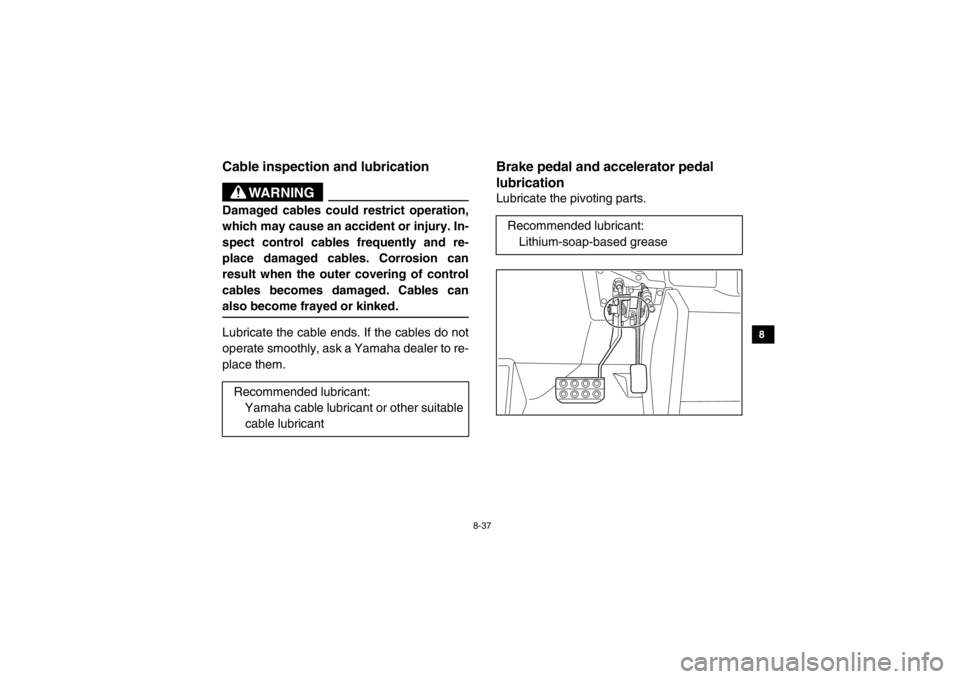
lubricationLubricate the pivoting parts.
Recommended lubricant: Yamaha cable lubricant or other suitable
cable lubricantRecommended lubricant: Lithium-soap-based grease
1XP7C_EE.book Page 37 Monday, June 9, 2014 5:17 PM
Page 150 of 182
8-40
8
9
10
11
12
13
14
Tire replacementAlways use the same size and type of tires
recommended in this owner’s manual. The
tires that came with your Yamaha Viking were
designed to match the performance capabili-
ties and to provide the best combination of
handling, braking, and comfort. It is best to re-
place all four tires at the same time. If that is
not possible, you must replace the tires in
pairs (front or rear) with tires of the same size
and type as the originals. Never replace just
one tire.
WARNING
Installing improper tires on your Yamaha
Viking can affect handling and stability.
This can cause a loss of control.
The tires listed below have been approved by
Yamaha Motor Manufacturing Corporation of America for this model.
Front tire:Size: 25 × 8-12NHS
Manufacturer/model:
MAXXIS/MU09
Rear tire: Size:
25 × 10-12NHS
Manufacturer/model: MAXXIS/MU10
1XP7C_EE.book Page 40 Monday, June 9, 2014 5:17 PM
Page 151 of 182
8-41
1
2
3
4
5
6
78
9
10
11
12
13
14
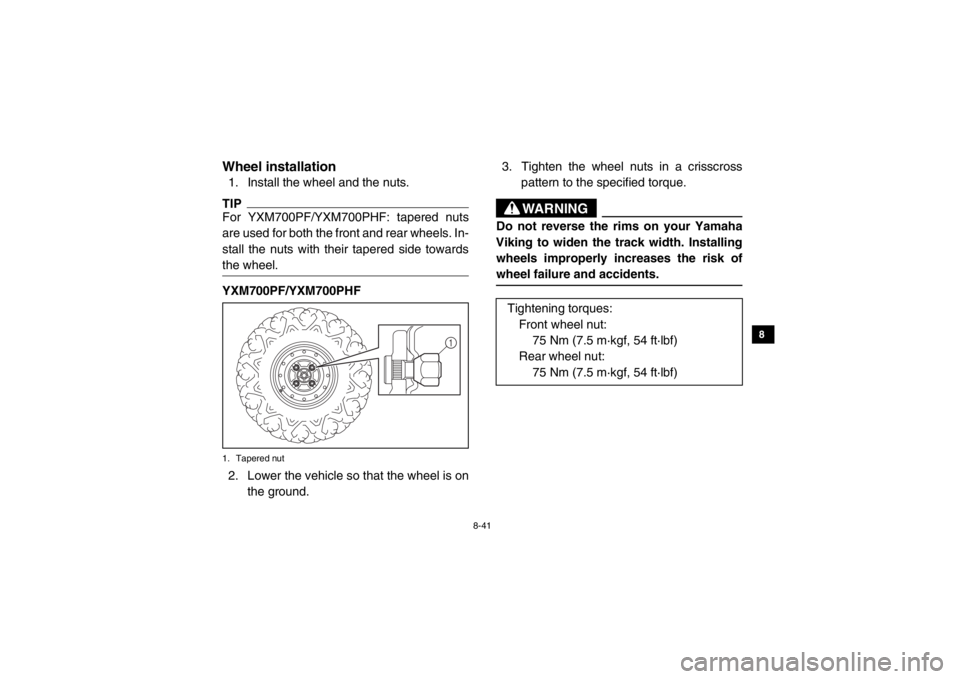
EVU00940Wheel installation1. Install the wheel and the nuts.TIPFor YXM700PF/YXM700PHF: tapered nuts
are used for both the front and rear wheels. In-
stall the nuts with their tapered side towards
the wheel.YXM700PF/YXM700PHF1. Tapered nut2. Lower the vehicle so that the wheel is onthe ground. 3. Tighten the wheel nuts in a crisscross
pattern to the specified torque.
WARNING
Do not reverse the rims on your Yamaha
Viking to widen the track width. Installing wheels improperly increases the risk of
wheel failure and accidents.
1
Tightening torques: Front wheel nut: 75 Nm (7.5 m·kgf, 54 ft·lbf)
Rear wheel nut:
75 Nm (7.5 m·kgf, 54 ft·lbf)
1XP7C_EE.book Page 41 Monday, June 9, 2014 5:17 PM
Page 152 of 182
8-42
8
9
10
11
12
13
14
EVU00950BatteryThe battery is located under the hood. (See
page 8-7 for hood removal and installation
procedures.)
This model is equipped with a VRLA (Valve
Regulated Lead Acid) battery. There is no
need to check the electrolyte or to add distilled
water. However, the battery lead connections
need to be checked and, if necessary, tight-
ened.
WARNING
Avoid battery contact with skin, eyes, or
clothing. Shield eyes when working near
batteries. Keep out of reach of children.
You could be poisoned or severely burned
by the sulfuric acid in battery electrolyte.
In case of accidental contact with battery
electrolyte:
EXTERNAL: Flush with water.
INTERNAL: Drink large quantities of water
or milk. Follow with milk of magnesia,
beaten egg, or vegetable oil. Get prompt
medical attention.
EYES: Flush with water for 15 minutes and
get prompt medical attention.
WARNING
Batteries may produce explosive gases.
Ventilate when charging or using in a
closed space. Keep batteries away from
sparks, flames, cigarettes, or other sourc-
es of ignition.
1XP7C_EE.book Page 42 Monday, June 9, 2014 5:17 PM
Page 156 of 182
8-46
8
9
10
11
12
13
14
5B410022Jump-startingJump-starting the vehicle should be avoided.
The battery should be removed and charged
instead.
WARNING
To avoid battery explosion and/or serious
damage to the electrical system:●
Do not connect the negative lead of
the jumper cable to the negative termi-
nal of the battery.
●
Do not touch the positive lead of the
jumper cable to the negative lead.
●
Do not reverse the polarity of the
jumper cables when connecting to the
batteries.
However, if the vehicle must be jump-started,
proceed as follows. 1. Turn the key to “ ” (off).
2. Remove the hood. (See page 8-7 for
hood removal and installation proce-
dures.)
3. Using a charged 12-volt battery, connect the positive lead of the jumper cable to
the positive terminal of the battery in the
vehicle and the other end of the positive
lead to the positive terminal of the
charged battery.
1XP7C_EE.book Page 46 Monday, June 9, 2014 5:17 PM
Page 159 of 182
8-49
1
2
3
4
5
6
78
9
10
11
12
13
14
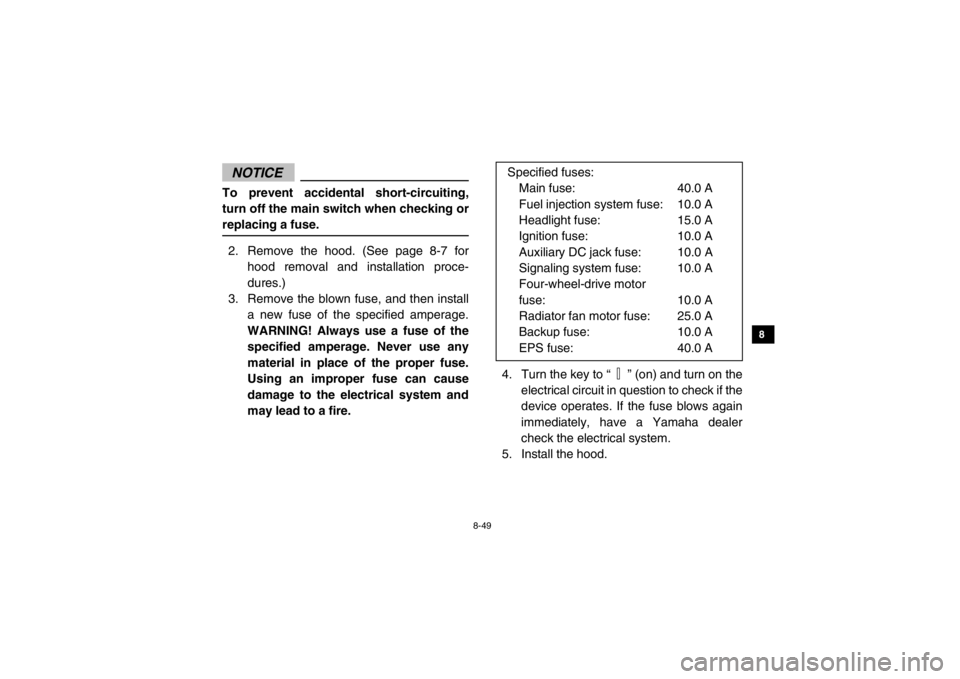
NOTICETo prevent accidental short-circuiting,
turn off the main switch when checking or
replacing a fuse.2. Remove the hood. (See page 8-7 forhood removal and installation proce-
dures.)
3. Remove the blown fuse, and then install a new fuse of the specified amperage.
WARNING! Always use a fuse of the specified amperage. Never use any
material in place of the proper fuse.
Using an improper fuse can cause
damage to the electrical system and
may lead to a fire. 4. Turn the key to “ ” (on) and turn on the
electrical circuit in question to check if the
device operates. If the fuse blows again
immediately, have a Yamaha dealer
check the electrical system.
5. Install the hood. Specified fuses:
Main fuse: 40.0 A
Fuel injection system fuse: 10.0 A
Headlight fuse: 15.0 A
Ignition fuse: 10.0 A
Auxiliary DC jack fuse: 10.0 A
Signaling system fuse: 10.0 A
Four-wheel-drive motor
fuse: 10.0 A
Radiator fan motor fuse: 25.0 A
Backup fuse: 10.0 A
EPS fuse: 40.0 A
1XP7C_EE.book Page 49 Monday, June 9, 2014 5:17 PM
Page 166 of 182
8-56
8
9
10
11
12
13
14
WARNING
When checking the fuel system, do not
smoke and make sure there are no open
flames or sparks in the area, including pi-
lot lights from water heaters or furnaces.
Gasoline or gasoline vapors can ignite or
explode, causing severe injury or property
damage.1XP7C_EE.book Page 56 Monday, June 9, 2014 5:17 PM
Page 168 of 182
8-58
8
9
10
11
12
13
14
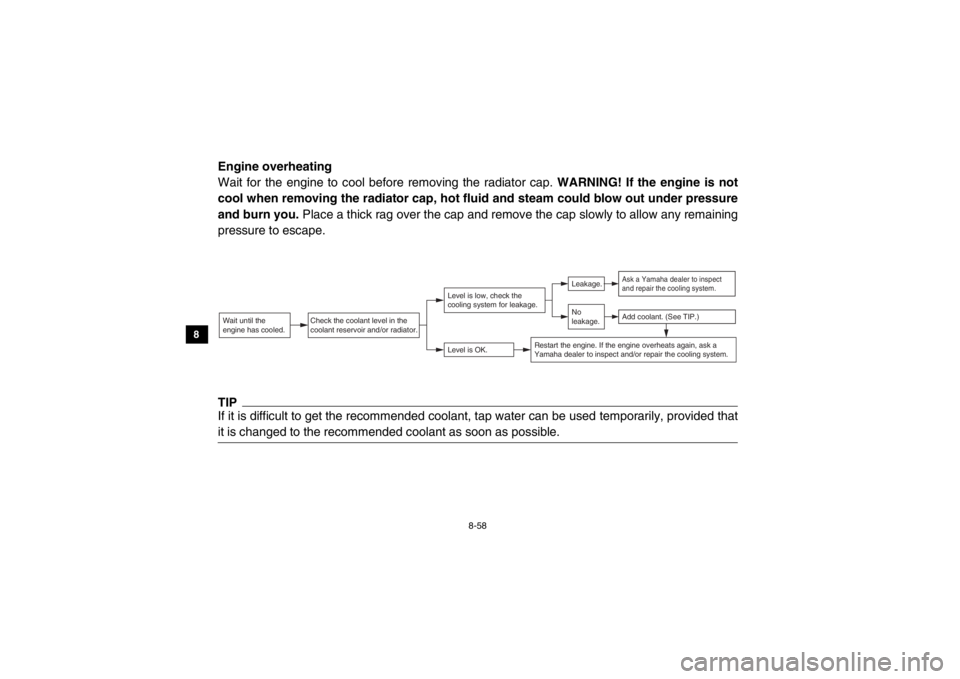
Engine overheating
Wait for the engine to cool before removing the radiator cap. WARNING! If the engine is not
cool when removing the radiator cap, hot fluid and steam could blow out under pressure
and burn you. Place a thick rag over the cap and remove the cap slowly to allow any remaining
pressure to escape.TIPIf it is difficult to get the recommended coolant , tap water can be used temporarily, provided that
it is changed to the recommended coolant as soon as possible.Wait until the
engine has cooled.
Check the coolant level in the
coolant reservoir and/or radiator.
Level is OK.Level is low, check the
cooling system for leakage.
No
leakage.Leakage.
Ask a Yamaha dealer to inspect
and repair the cooling system.Add coolant. (See TIP.)
Restart the engine. If the engine overheats again, ask a
Yamaha dealer to inspect and/or repair the cooling system.
1XP7C_EE.book Page 58 Monday, June 9, 2014 5:17 PM