2015 YAMAHA VIKING main switch
[x] Cancel search: main switchPage 6 of 182
EVU00050
CONTENTS
LOCATION OF THE WARNING
AND SPECIFICATION LABELS ....... 1-1
SAFETY INFORMATION.................. 2-1
DESCRIPTION ................................. 3-1
INSTRUMENT AND CONTROL
FUNCTIONS ..................................... 4-1Main switch ...................................... 4-1
Indicator lights and warning lights ... 4-2
Multi-function meter unit .................. 4-6
Light switch .................................... 4-12
On-Command drive knob
“2WD/4WD/DIFF LOCK” ............. 4-13
Horn switch .................................... 4-14
Accelerator pedal .......................... 4-15
Brake pedal ................................... 4-15
Parking brake lever ....................... 4-16
Drive select lever ........................... 4-16
Fuel tank cap ................................. 4-17
1234
Doors..............................................4-17
Seats ..............................................4-18
Adjusting the driver seat position...4-19
Seat belts .......................................4-20
Glove compartment .......................4-21
Storage compartments ..................4-22
Cup holders....................................4-24
Cargo bed ......................................4-25
The front and rear shock absorber
assemblies ...................................4-28
Trailer hitch bracket and
receiver ........................................4-29
Auxiliary DC jack ............................4-29
FOR YOUR SAFETY –
PRE-OPERATION CHECKS ............5-1 Front and rear brakes ......................5-3
Fuel ..................................................5-4
Engine oil .........................................5-6
Coolant.............................................5-6
Final gear oil ....................................5-7
Differential gear oil ...........................5-7
Accelerator pedal .............................5-7
5
1XP7C_EE.book Page 1 Monday, June 9, 2014 5:17 PM
Page 8 of 182

Uphill.............................................. 7-22
Downhill ......................................... 7-23
Rough terrain................................. 7-24
Pavement ...................................... 7-24
Water ............................................. 7-24
Loose terrain/slippery terrain......... 7-25
Brush or wooded areas ................. 7-26
Encountering obstacles ................. 7-26
PERIODIC MAINTENANCE AND
ADJUSTMENT .................................. 8-1 Owner’s manual and tool kit ............ 8-2
Periodic maintenance chart for the emission control system ................ 8-4
General maintenance and lubrication chart ............................. 8-5
Hood ................................................ 8-7
Engine oil and oil filter cartridge ...... 8-9
Final gear oil .................................. 8-15
Differential gear oil......................... 8-17
Coolant .......................................... 8-20
Axle boots ...................................... 8-21
Spark plug inspection .................... 8-22 Cleaning the air filter element ........8-25
Cleaning the air filter case/duct
check hose ...................................8-29
V-belt case drain plug ....................8-30
Cleaning the spark arrester ...........8-30
Valve clearance .............................8-31
Brakes ............................................8-32
Checking the front and rear brake pads .............................................8-32
Checking the parking brake pads .............................................8-33
Checking the brake fluid level........8-33
Brake fluid replacement .................8-34
Checking the brake pedal ..............8-35
Parking brake lever free play adjustment ...................................8-35
Brake light switch adjustment ........8-36
Cable inspection and lubrication....8-37
Brake pedal and accelerator pedal lubrication.....................................8-37
Checking the stabilizer bushes ......8-38
Rear knuckle upper and lower pivot lubrication (left and right).....8-38
81XP7C_EE.book Page 3 Monday, June 9, 2014 5:17 PM
Page 32 of 182
3-2
3
4
5
6
7
8
9
10
11
12
13
14
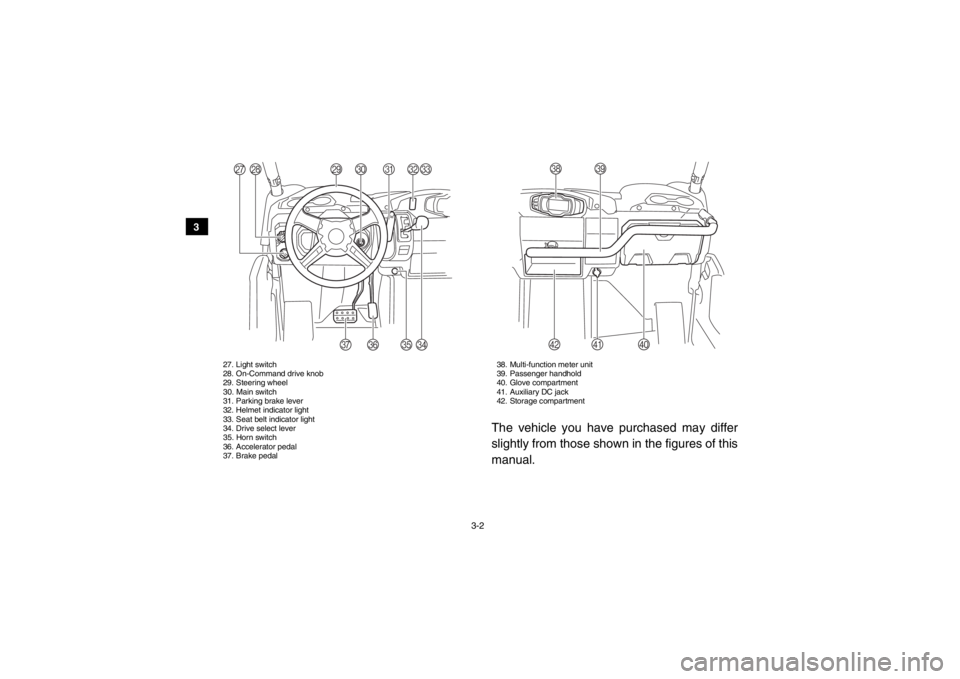
27. Light switch
28. On-Command drive knob
29. Steering wheel
30. Main switch
31. Parking brake lever
32. Helmet indicator light
33. Seat belt indicator light
34. Drive select lever
35. Horn switch
36. Accelerator pedal
37. Brake pedal 38. Multi-function meter unit
39. Passenger handhold
40. Glove compartment
41. Auxiliary DC jack
42. Storage compartment
The vehicle you have purchased may differ
slightly from those shown in the figures of this
manual.
[
Z
R
S
T
U
Y
Q
VWX
b
^
\
]a
1XP7C_EE.book Page 2 Monday, June 9, 2014 5:17 PM
Page 33 of 182

4-1
1
2
34
5
6
7
8
9
10
11
12
13
14
EVU00130
1-INSTRUMENT AND CONTROL FUNCTIONS
EVU00140Main switch1. Main switch 2. “ ” (off)
3. “ ” (on) 4. “ ” (start)
Functions of the respective switch positions
are as follows:
“ ” (on):
All electrical circuits are supplied with power.
The key cannot be removed.TIPThe helmet indicator light comes on and stays
on while the key is turned to “ ” (on).“ ” (off):
All electrical circuits are switched off. The key
can be removed.
“ ” (start):
The electric starter is engaged by turning and
holding the key in this position. Release the
key when the engine starts.
1
2
34
1XP7C_EE.book Page 1 Monday, June 9, 2014 5:17 PM
Page 131 of 182
8-21
1
2
3
4
5
6
78
9
10
11
12
13
14
Changing the coolant
The coolant must be changed by a Yamaha
dealer at the intervals specified in the periodic
maintenance and lubrication chart.
Adding water instead of coolant lowers the
antifreeze content of the coolant. If water is
used instead of coolant, have a Yamaha deal-
er check the antifreeze content of the coolant
as soon as possible.
The radiator fan is automatically switched on
or off according to the coolant temperature in
the radiator.NOTICEMix antifreeze with distilled water only.
However, if distilled water is not available,
soft water may be used for refilling.If your vehicle overheats, see page 8-58 for
instructions.
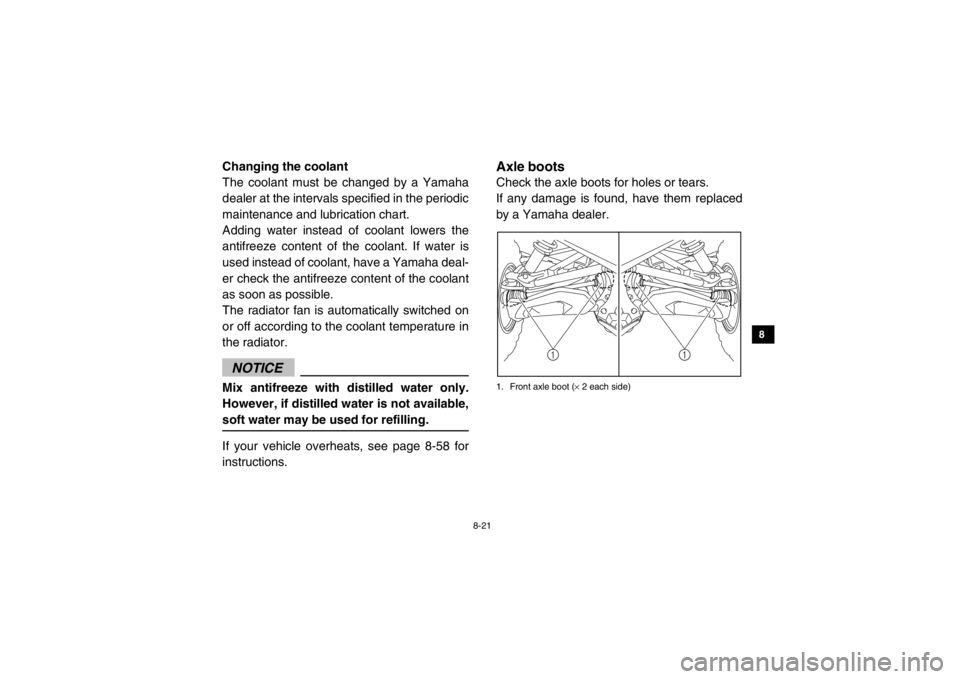
EVU00740Axle bootsCheck the axle boots for holes or tears.
If any damage is found, have them replaced
by a Yamaha dealer.1. Front axle boot (× 2 each side)
1
1
1XP7C_EE.book Page 21 Monday, June 9, 2014 5:17 PM
Page 153 of 182
8-43
1
2
3
4
5
6
78
9
10
11
12
13
14
To remove the battery1. Turn the key to “ ” (off).
2. Remove the hood. (See page 8-7 for hood removal and installation proce-
dures.)
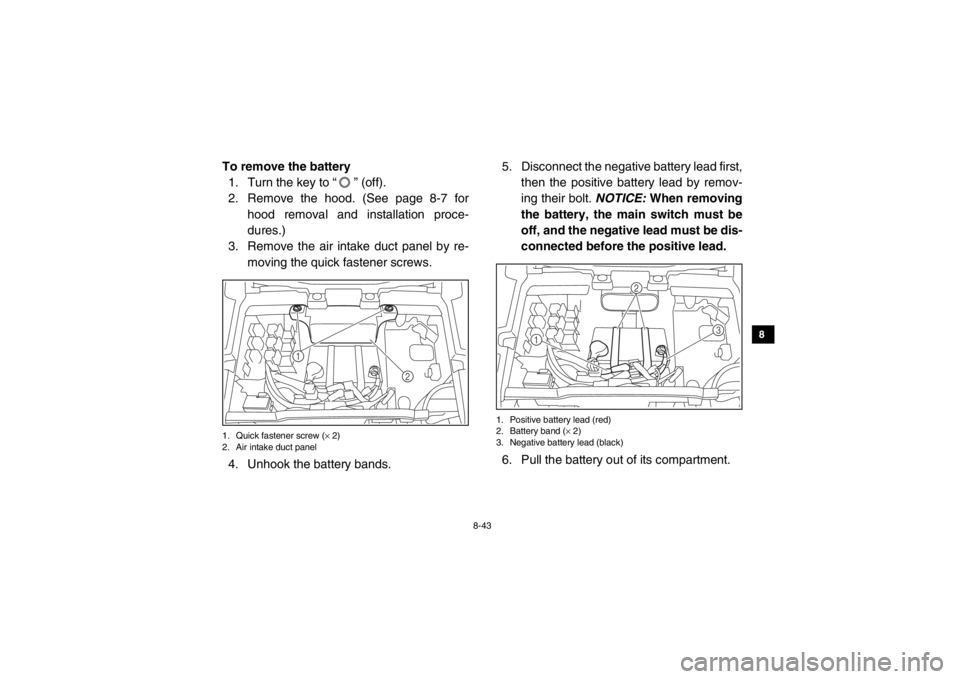
3. Remove the air intake duct panel by re-
moving the quick fastener screws.1. Quick fastener screw ( × 2)
2. Air intake duct panel4. Unhook the battery bands. 5. Disconnect the negative battery lead first,
then the positive battery lead by remov-
ing their bolt. NOTICE: When removing
the battery, the main switch must be
off, and the negative lead must be dis-
connected before the positive lead.
1. Positive battery lead (red)
2. Battery band ( × 2)
3. Negative battery lead (black)6. Pull the battery out of its compartment.
2
1
2
1
3
1XP7C_EE.book Page 43 Monday, June 9, 2014 5:17 PM
Page 155 of 182
8-45
1
2
3
4
5
6
78
9
10
11
12
13
14
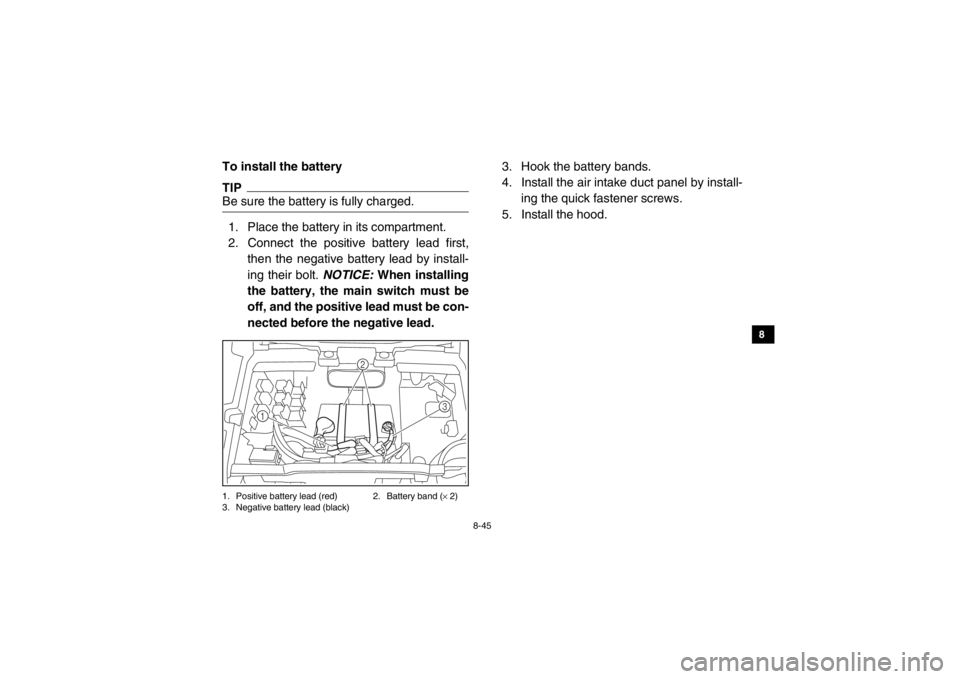
To install the batteryTIPBe sure the battery is fully charged.1. Place the battery in its compartment.
2. Connect the positive battery lead first,then the negative battery lead by install-
ing their bolt. NOTICE: When installing
the battery, the main switch must be
off, and the positive lead must be con-
nected before the negative lead.1. Positive battery lead (red) 2. Battery band ( × 2)
3. Negative battery lead (black)
3. Hook the battery bands.
4. Install the air intake duct panel by install-
ing the quick fastener screws.
5. Install the hood.
2
1
3
1XP7C_EE.book Page 45 Monday, June 9, 2014 5:17 PM
Page 159 of 182
8-49
1
2
3
4
5
6
78
9
10
11
12
13
14
NOTICETo prevent accidental short-circuiting,
turn off the main switch when checking or
replacing a fuse.2. Remove the hood. (See page 8-7 forhood removal and installation proce-
dures.)
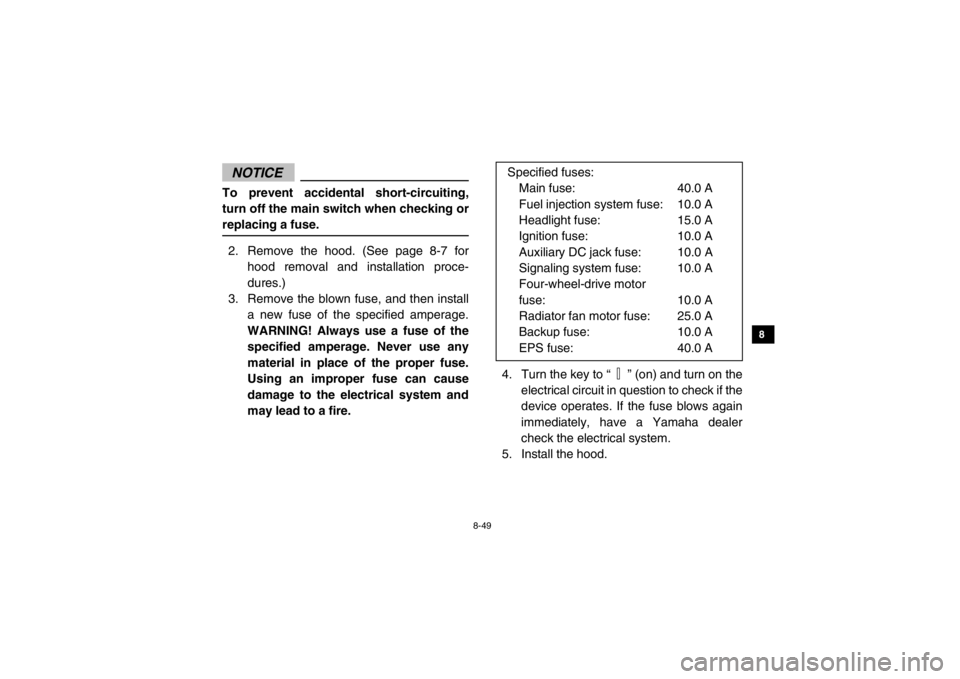
3. Remove the blown fuse, and then install a new fuse of the specified amperage.
WARNING! Always use a fuse of the specified amperage. Never use any
material in place of the proper fuse.
Using an improper fuse can cause
damage to the electrical system and
may lead to a fire. 4. Turn the key to “ ” (on) and turn on the
electrical circuit in question to check if the
device operates. If the fuse blows again
immediately, have a Yamaha dealer
check the electrical system.
5. Install the hood. Specified fuses:
Main fuse: 40.0 A
Fuel injection system fuse: 10.0 A
Headlight fuse: 15.0 A
Ignition fuse: 10.0 A
Auxiliary DC jack fuse: 10.0 A
Signaling system fuse: 10.0 A
Four-wheel-drive motor
fuse: 10.0 A
Radiator fan motor fuse: 25.0 A
Backup fuse: 10.0 A
EPS fuse: 40.0 A
1XP7C_EE.book Page 49 Monday, June 9, 2014 5:17 PM