Page 89 of 182
7-5
1
2
3
4
5
67
8
9
10
11
12
13
14
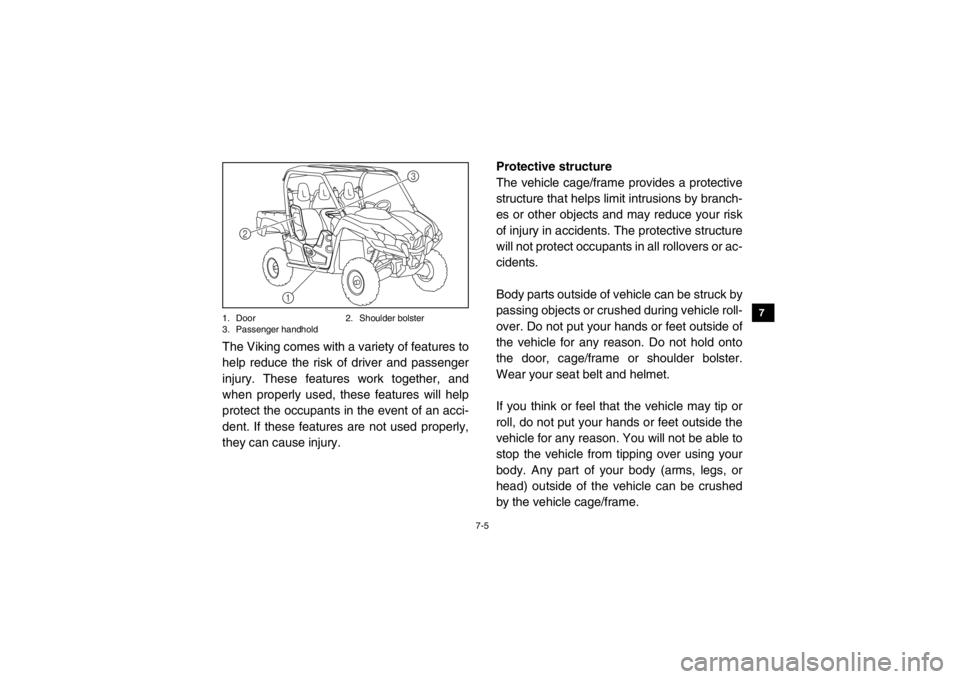
1. Door2. Shoulder bolster
3. Passenger handholdThe Viking comes with a variety of features to
help reduce the risk of driver and passenger
injury. These features work together, and
when properly used, these features will help
protect the occupants in the event of an acci-
dent. If these features are not used properly,
they can cause injury. Protective structure
The vehicle cage/frame provides a protective
structure that helps limit intrusions by branch-
es or other objects and may reduce your risk
of injury in accidents. The protective structure
will not protect occupants in all rollovers or ac-
cidents.
Body parts outside of vehicle can be struck by
passing objects or crushed during vehicle roll-
over. Do not put your hands or feet outside of
the vehicle for any reason. Do not hold onto
the door, cage/frame or shoulder bolster.
Wear your seat belt and helmet.
If you think or feel that the vehicle may tip or
roll, do not put your hands or feet outside the
vehicle for any reason. You will not be able to
stop the vehicle from tipping over using your
body. Any part of your body (arms, legs, or
head) outside of the vehicle can be crushed
by the vehicle cage/frame.
2
1 3
1XP7C_EE.book Page 5 Monday, June 9, 2014 5:17 PM
Page 90 of 182

7-6
7
8
9
10
11
12
13
14
Seat belts
Seat belts should be worn by the driver and
passengers. The driver must be sure that the
passengers are belted before driving.●
Be sure that each occupant’s seat belt
latch plate is inserted into the appropriate
buckle.
●
Be sure the seat belt is not twisted, is
close-fitting across the hips and chest,
and is latched securely.
●
Do not wear the seat belt across the ab-
domen or stomach.
●
Do not put the seat belt behind the back.
Failure to use seat belts properly may lead to
an increased likelihood and severity of injury. An unbelted occupant may strike the interior
of the vehicle, the protective structure, or oth-
er objects in an accident or during operation.
You may also fall completely out or be partial-
ly ejected from the vehicle, which may lead to
being crushed between the ground and the
vehicle. Wearing the seat belt helps you re-
main in the vehicle – the doors and passenger
handhold are not a substitute for using a seat
belt.
A crash can damage the restraint systems in
your vehicle. A damaged restraint system
may not properly protect the person using it,
resulting in serious injury or death in a crash.
To help make sure your restraint systems are
working properly after a crash, have them in-
spected and any necessary replacements
made as soon as possible.
1XP7C_EE.book Page 6 Monday, June 9, 2014 5:17 PM
Page 91 of 182
7-7
1
2
3
4
5
67
8
9
10
11
12
13
14
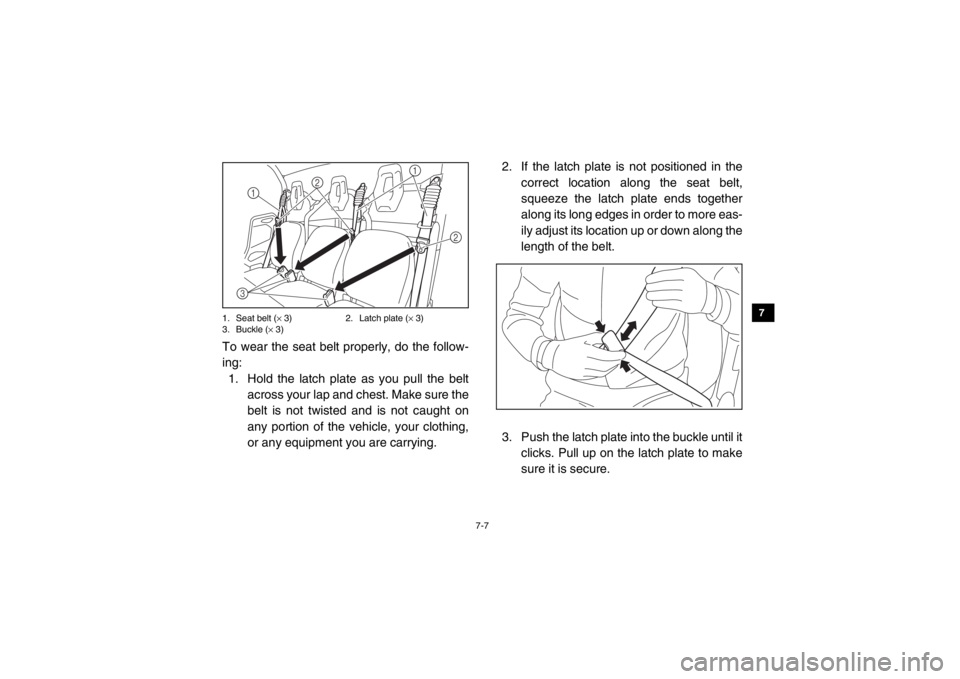
1. Seat belt (× 3) 2. Latch plate ( × 3)
3. Buckle ( × 3)To wear the seat belt properly, do the follow-
ing:
1. Hold the latch plate as you pull the belt across your lap and chest. Make sure the
belt is not twisted and is not caught on
any portion of the vehicle, your clothing,
or any equipment you are carrying. 2. If the latch plate is not positioned in the
correct location along the seat belt,
squeeze the latch plate ends together
along its long edges in order to more eas-
ily adjust its location up or down along the
length of the belt.
3. Push the latch plate into the buckle until it clicks. Pull up on the latch plate to make
sure it is secure.
3 2
1
2
1
1XP7C_EE.book Page 7 Monday, June 9, 2014 5:17 PM
Page 92 of 182
7-8
7
8
9
10
11
12
13
14
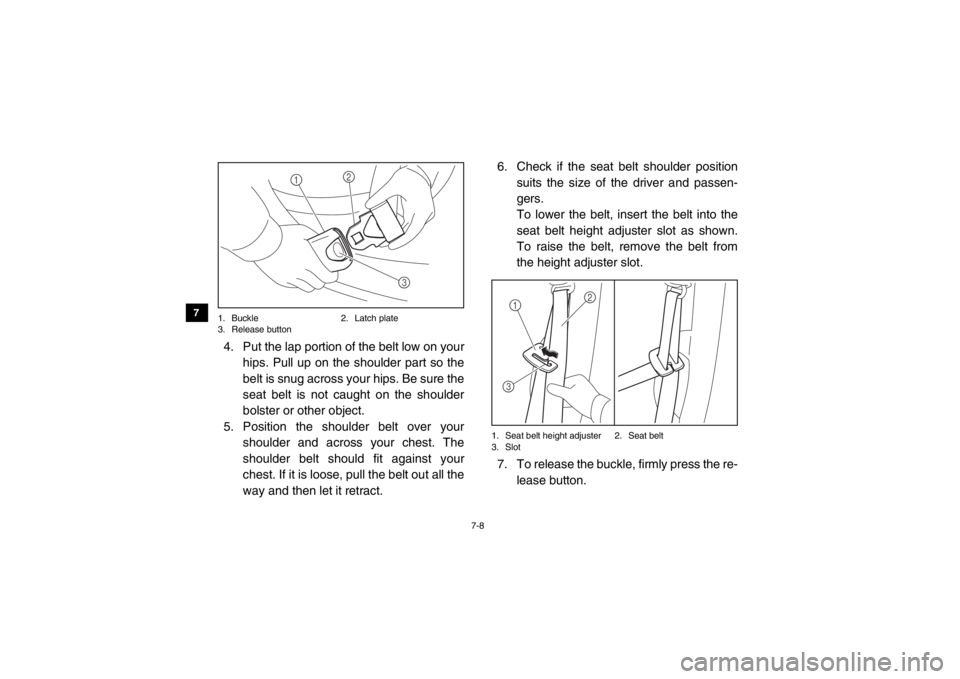
1. Buckle 2. Latch plate
3. Release button4. Put the lap portion of the belt low on your
hips. Pull up on the shoulder part so the
belt is snug across your hips. Be sure the
seat belt is not caught on the shoulder
bolster or other object.
5. Position the shoulder belt over your shoulder and across your chest. The
shoulder belt should fit against your
chest. If it is loose, pull the belt out all the
way and then let it retract. 6. Check if the seat belt shoulder position
suits the size of the driver and passen-
gers.
To lower the belt, insert the belt into the
seat belt height adjuster slot as shown.
To raise the belt, remove the belt from
the height adjuster slot.
1. Seat belt height adjuster 2. Seat belt
3. Slot7. To release the buckle, firmly press the re-lease button.
1
3
2
1
2
3
1XP7C_EE.book Page 8 Monday, June 9, 2014 5:17 PM
Page 109 of 182
7-25
1
2
3
4
5
67
8
9
10
11
12
13
14
NOTICEAfter driving your vehicle in water, be sure
to drain the trapped water by removing the
check hoses at the bottom of the air filter
case and air duct and the V-belt case drain
plug. Wash the vehicle in fresh water if it
has been operated in salt water or muddy
conditions.
Loose terrain/slippery terrain
When driving on slippery terrain, including
wet, muddy, or icy conditions, as well as loose
gravel, be aware that you could begin skid-
ding or sliding. To avoid loss of control, slow
down and put the vehicle in four-wheel drive
before driving on a slippery surface and plan
your path to avoid making abrupt maneuvers.
If you feel the vehicle begin to slide sideways
or the back wheels slide during a turn, steer
into the direction of the slide if possible, to re-
gain directional control. For example, if you
feel the back of the vehicle start to slide to
your right, steer to the right.
1XP7C_EE.book Page 25 Monday, June 9, 2014 5:17 PM
Page 115 of 182
8-5
1
2
3
4
5
6
78
9
10
11
12
13
14
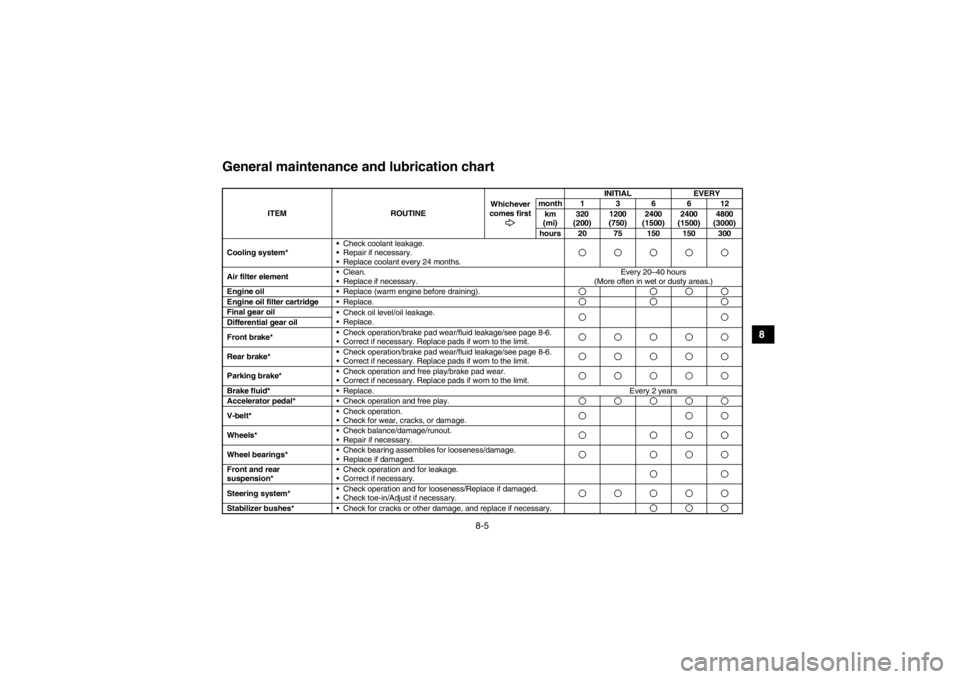
EVU01650General maintenance and lubrication chart
ITEM ROUTINEWhichever
comes first INITIAL
EVERY
month136612 km
(mi) 320
(200) 1200
(750) 2400
(1500) 2400
(1500) 4800
(3000)
hours 20 75 150 150 300
Cooling system* Check coolant leakage.
Repair if necessary.
Replace coolant every 24 months.
Air filter element
Clean.
Replace if necessary. Every 20–40 hours
(More often in wet or dusty areas.)
Engine oil Replace (warm engine before draining).Engine oil filter cartridge Replace.Final gear oil
Check oil level/oil leakage.
Replace.Differential gear oil
Front brake* Check operation/brake pad wear/fluid leakage/see page 8-6.
Correct if necessary. Replace pads if worn to the limit.Rear brake* Check operation/brake pad wear/fluid leakage/see page 8-6.
Correct if necessary. Replace pads if worn to the limit.Parking brake*
Check operation and free play/brake pad wear.
Correct if necessary. Replace pads if worn to the limit.Brake fluid*
Replace. Every 2 years
Accelerator pedal* Check operation and free play.V-belt* Check operation.
Check for wear, cracks, or damage.Wheels* Check balance/damage/runout.
Repair if necessary.Wheel bearings*
Check bearing assemblies for looseness/damage.
Replace if damaged.Front and rear
suspension* Check operation and for leakage.
Correct if necessary.Steering system*
Check operation and for looseness/Replace if damaged.
Check toe-in/Adjust if necessary.Stabilizer bushes*
Check for cracks or other damage, and replace if necessary.
1XP7C_EE.book Page 5 Monday, June 9, 2014 5:17 PM
Page 140 of 182
8-30
8
9
10
11
12
13
14
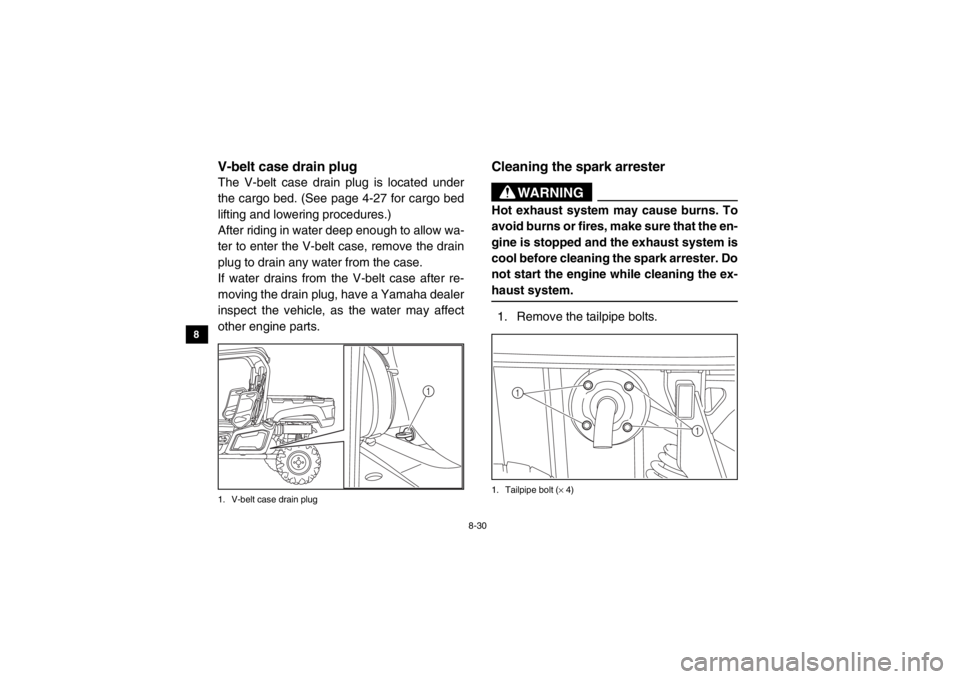
EVU00780V-belt case drain plugThe V-belt case drain plug is located under
the cargo bed. (See page 4-27 for cargo bed
lifting and lowering procedures.)
After riding in water deep enough to allow wa-
ter to enter the V-belt case, remove the drain
plug to drain any water from the case.
If water drains from the V-belt case after re-
moving the drain plug, have a Yamaha dealer
inspect the vehicle, as the water may affect
other engine parts.1. V-belt case drain plug
5B410018Cleaning the spark arrester
WARNING
Hot exhaust system may cause burns. To
avoid burns or fires, make sure that the en-
gine is stopped and the exhaust system is
cool before cleaning the spark arrester. Do
not start the engine while cleaning the ex-
haust system.1. Remove the tailpipe bolts.1. Tailpipe bolt ( × 4)
1
1
1
1XP7C_EE.book Page 30 Monday, June 9, 2014 5:17 PM
Page 175 of 182

10-3
1
2
3
4
5
6
7
8
910
11
12
13
14
Transmission:
Primary reduction system:
V-belt
Secondary reduction system:
Shaft drive
Secondary reduction ratio: 41/21 × 17/12 × 33/9 (10.142)
Transmission type: V-belt automatic
Operation:
Right hand operation
Reverse gear: 23/14 × 28/23 (2.000)
Low range: 31/16 (1.938)
High range:
30/21 (1.429)Chassis:Frame type:Steel tube frame
Caster angle:
3.7 °
Trail: 19.0 mm (0.75 in)Front tire:Type:
Tubeless
Size: 25 × 8-12NHS
Manufacturer/model: MAXXIS/MU09
Rear tire:Type:Tubeless
Size:
25 × 10-12NHS
Manufacturer/model: MAXXIS/MU10Loading:Maximum loading limit:
445 kg (981 lb)
(Total weight of operator, passengers, cargo, accesso-
ries, and tongue)Tire air pressure (measured on cold tires):Recommended:Vehicle load:0 – 300 kg (0 – 661 lb):Front:
75.0 kPa (0.750 kgf/cm
2, 11 psi)
Rear: 90.0 kPa (0.900 kgf/cm2, 13 psi)
Vehicle load: 300 kg – maximum (661 lb – maximum):Front:
75.0 kPa (0.750 kgf/cm2, 11 psi)
Rear: 125.0 kPa (1.250 kgf/cm2, 18 psi)
Minimum: Vehicle load:0 – 300 kg (0 – 661 lb):
Front: 70.0 kPa (0.700 kgf/cm2, 10 psi)
Rear:
85.0 kPa (0.850 kgf/cm2, 12 psi)
1XP7C_EE.book Page 3 Monday, June 9, 2014 5:17 PM