2015 YAMAHA TMAX lights
[x] Cancel search: lightsPage 58 of 112

OPERATION AND IMPORTANT RIDING POINTS
6-4
1
2
3
4
56
7
8
9
10
11
12
EAU16821
Tips for reducing fuel
consumptionFuel consumption depends largely on
your riding style. Consider the following
tips to reduce fuel consumption:
Avoid high engine speeds during
acceleration.
Avoid high engine speeds with no
load on the engine.
Turn the engine off instead of let-
ting it idle for an extended length of
time (e.g., in traffic jams, at traffic
lights or at railroad crossings).
EAU16842
Engine break-inThere is never a more important period
in the life of your engine than the period
between 0 and 1600 km (1000 mi). For
this reason, you should read the follow-
ing material carefully.
Since the engine is brand new, do not
put an excessive load on it for the first
1600 km (1000 mi). The various parts in
the engine wear and polish themselves
to the correct operating clearances.
During this period, prolonged full-throt-
tle operation or any condition that might
result in engine overheating must be
avoided.
EAU36532
0–1000 km (0–600 mi)
Avoid prolonged operation above 4100
r/min. NOTICE: After 1000 km (600
mi) of operation, the engine oil must
be changed, and the oil filter car-
tridge or element replaced.
[ECA11283]
1000–1600 km (600–1000 mi)
Avoid prolonged operation above 5000 r/min.
1600 km (1000 mi) and beyond
The vehicle can now be operated nor-
mally.
NOTICE
ECA10311
Keep the engine speed out of
the tachometer red zone.
If any engine trouble should oc-
cur during the engine break-in
period, immediately have a
Yamaha dealer check the vehi-cle.
2PW-9-E0_1.book 4 ページ 2015年2月19日 木曜日 午後3時30分
Page 65 of 112

PERIODIC MAINTENANCE AND ADJUSTMENT
7-6
1
2
3
4
5
678
9
10
11
12
24 *Cooling system Check coolant level and vehicle
for coolant leakage.
Change coolant. Every 3 years
25 *V- b e l t Replace. When the V-belt replacement indicator flashes [every 20000 km (12500 mi)]
26 *Front and rear brake
switches Check operation.
27 Moving parts and
cables Lubricate.
28 *Throttle grip Check operation.
Check throttle grip free play, and
adjust if necessary.
Lubricate cable and grip housing.
29 *Lights, signals and
switches Check operation.
Adjust headlight beam.
NO. ITEM CHECK OR MAINTENANCE JOB
ODOMETER READING
ANNUAL
CHECK
1000 km
(600 mi) 10000 km
(6000 mi) 20000 km
(12000 mi) 30000 km
(18000 mi) 40000 km
(24000 mi)
2PW-9-E0_1.book 6 ページ 2015年2月19日 木曜日 午後3時30分
Page 90 of 112
PERIODIC MAINTENANCE AND ADJUSTMENT
7-31
1
2
3
4
5
67
8
9
10
11
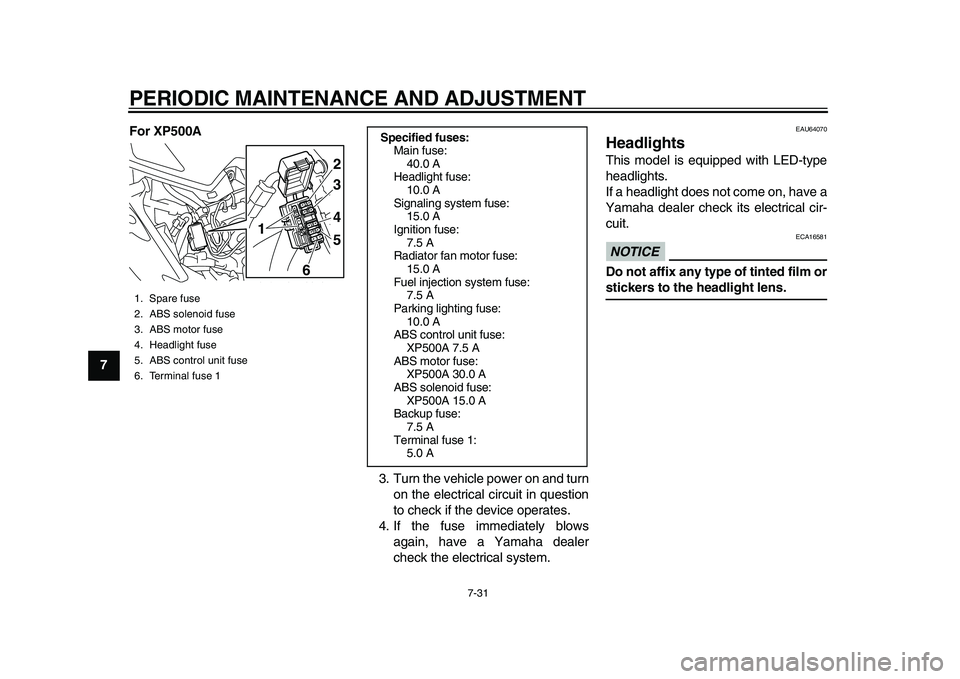
12 For XP500A
3. Turn the vehicle power on and turnon the electrical circuit in question
to check if the device operates.
4. If the fuse immediately blows again, have a Yamaha dealer
check the electrical system.
EAU64070
HeadlightsThis model is equipped with LED-type
headlights.
If a headlight does not come on, have a
Yamaha dealer check its electrical cir-
cuit.NOTICE
ECA16581
Do not affix any type of tinted film orstickers to the headlight lens.
1. Spare fuse
2. ABS solenoid fuse
3. ABS motor fuse
4. Headlight fuse
5. ABS control unit fuse
6. Terminal fuse 1
1
2
4 3
5
6
Specified fuses: Main fuse:40.0 A
Headlight fuse:
10.0 A
Signaling system fuse: 15.0 A
Ignition fuse: 7.5 A
Radiator fan motor fuse:
15.0 A
Fuel injection system fuse: 7.5 A
Parking lighting fuse: 10.0 A
ABS control unit fuse:
XP500A 7.5 A
ABS motor fuse: XP500A 30.0 A
ABS solenoid fuse: XP500A 15.0 A
Backup fuse:
7.5 A
Terminal fuse 1: 5.0 A
2PW-9-E0_1.book 31 ページ 2015年2月19日 木曜日 午後3時30分
Page 91 of 112

PERIODIC MAINTENANCE AND ADJUSTMENT
7-32
1
2
3
4
5
678
9
10
11
12
EAU54501
Auxiliary lightThis model is equipped with LED-type
auxiliary lights.
If an auxiliary light does not come on,
have a Yamaha dealer check it.
EAU24182
Tail/brake lightThis model is equipped with an
LED-type tail/brake light.
If the tail/brake light does not come on,
have a Yamaha dealer check it.
EAU52321
Replacing a front turn signal
light bulb1. Place the scooter on the center- stand.
2. Remove the socket (together with the bulb) by turning it counter-
clockwise.
3. Remove the burnt-out bulb by pushing it in and turning it counter-
clockwise.1. Turn signal light bulb socket
1
2PW-9-E0_1.book 32 ページ 2015年2月19日 木曜日 午後3時30分
Page 93 of 112

PERIODIC MAINTENANCE AND ADJUSTMENT
7-34
1
2
3
4
5
678
9
10
11
12
3. Remove the burnt-out bulb by pull-
ing it out.
4. Insert a new bulb into the socket.
5. Install the socket (together with the bulb) by pushing it in.
6. Install the license plate light unit by installing the screws.
EAU61562
TroubleshootingAlthough Yamaha scooters receive a
thorough inspection before shipment
from the factory, trouble may occur dur-
ing operation. Any problem in the fuel,
compression, or ignition systems, for
example, can cause poor starting and
loss of power.
The following troubleshooting charts
represent quick and easy procedures
for checking these vital systems your-
self. However, should your scooter re-
quire any repair, take it to a Yamaha
dealer, whose skilled technicians have
the necessary tools, experience, and
know-how to service the scooter prop-
erly.
Use only genuine Yamaha replace-
ment parts. Imitation parts may look like
Yamaha parts, but they are often inferi-
or, have a shorter service life and can
lead to expensive repair bills.
WARNING
EWA15142
When checking the fuel system, do
not smoke, and make sure there are
no open flames or sparks in the ar-
ea, including pilot lights from water heaters or furnaces. Gasoline or
gasoline vapors can ignite or ex-
plode, causing severe injury or
property damage.
Smart key system troubleshooting
Please check the following items when
the smart key system does not work.
Is the smart key turned on? (See
page 3-5.)
Is the smart key battery dis-
charged? (See page 3-6.)
Is the smart key battery installed
correctly? (See page 3-6.)
Is the smart key being used in a lo-
cation with strong radio waves or
other electromagnetic noise? (See
page 3-1.)
Are you using the smart key that is
registered to the vehicle?
Is the vehicle battery discharged?
When the vehicle battery is dis-
charged, the smart key system will
not operate. Please have the vehi-
cle battery charged or replaced.
(See page 7-28.)
If the smart key system does not work
after checking the above-mentioned
1. License plate light unit
2. License plate light bulb socket
1 2
2PW-9-E0_1.book 34 ページ 2015年2月19日 木曜日 午後3時30分
Page 100 of 112

SCOOTER CARE AND STORAGE
8-2
1
2
3
4
5
6
78
9
10
11
12 plenty of water, as it is harmful
to plastic parts.
Do not use any harsh chemical
products on plastic parts. Be
sure to avoid using cloths or
sponges which have been in
contact with strong or abrasive
cleaning products, solvent or
thinner, fuel (gasoline), rust re-
movers or inhibitors, brake flu-
id, antifreeze or electrolyte.
Do not use high-pressure wash-
ers or steam-jet cleaners since
they cause water seepage and
deterioration in the following ar-
eas: seals (of wheel and swing-
arm bearings, fork and brakes),
electric components (couplers,
connectors, instruments,
switches and lights), breather
hoses and vents.
For scooters equipped with a
windshield: Do not use strong
cleaners or hard sponges as
they will cause dulling or
scratching. Some cleaning com-
pounds for plastic may leave
scratches on the windshield.
Test the product on a small hid- den part of the windshield to
make sure that it does not leave
any marks. If the windshield is
scratched, use a quality plastic
polishing compound after
washing.
After normal use
Remove dirt with warm water, a mild
detergent, and a soft, clean sponge,
and then rinse thoroughly with clean
water. Use a toothbrush or bottlebrush
for hard-to-reach areas. Stubborn dirt
and insects will come off more easily if
the area is covered with a wet cloth for
a few minutes before cleaning.
After riding in the rain, near the sea oron salt-sprayed roadsSince sea salt or salt sprayed on roads
during winter are extremely corrosive in
combination with water, carry out the
following steps after each ride in the
rain, near the sea or on salt-sprayed
roads.TIPSalt sprayed on roads in the winter may
remain well into spring. 1. Clean the scooter with cold water and a mild detergent after the en-
gine has cooled down. NOTICE:
Do not use warm water since it
increases the corrosive action
of the salt.
[ECA10792]
2. Apply a corrosion protection sprayon all metal, including chrome- and
nickel-plated, surfaces to prevent
corrosion.
Cleaning the windshieldAvoid using any alkaline or strong acid
cleaner, gasoline, brake fluid, or any
other solvent. Clean the windshield with
a cloth or sponge dampened with a mild
detergent, and then wash it off thor-
oughly with water. For additional clean-
ing, use Yamaha Windshield Cleaner
or another high-quality windshield
cleaner. Some cleaning compounds for
plastics may leave scratches on the
windshield. Before using such clean-
ers, test an area of the windshield
which does not affect your visibility and
which cannot be easily recognized.
2PW-9-E0_1.book 2 ページ 2015年2月19日 木曜日 午後3時30分
Page 108 of 112

11-1
1
2
3
4
5
6
7
8
9
1011
12
INDEXAABS (for ABS models) .............................4-13
ABS warning light (for ABS models) ..........4-1
Acceleration and deceleration....................6-3
Air filter element, replacing ......................7-16
Auxiliary DC connector ............................4-25
Auxiliary light ............................................7-32BBattery......................................................7-28
Brake fluid, changing ...............................7-24
Brake fluid level, checking .......................7-23
Brake lever, front......................................4-11
Brake lever, rear ......................................4-11
Brake levers, lubricating...........................7-25
Braking .......................................................6-3CCables, checking and lubricating .............7-25
Care ...........................................................8-1
Catalytic converter ...................................4-16
Centerstand and sidestand, checking and lubricating .......................................7-26
Coolant.....................................................7-14DDimmer switch .........................................4-10
Drive belt slack.........................................7-24EEmergency mode .....................................7-38
Engine break-in ..........................................6-4
Engine idling speed..................................7-16
Engine oil and oil filter cartridge ...............7-11
Engine serial number ...............................10-1
Engine stop switch ...................................4-10
Engine trouble warning light.......................4-1
FFront and rear brak e lever free play,
checking ................................................ 7-20
Front and rear brake pads, checking ....... 7-22
Front fork, checking ................................. 7-27
Fuel.......................................................... 4-15
Fuel consumption, tips for reducing........... 6-4
Fuel tank cap ........................................... 4-14
Fuses, replacing ...................................... 7-29HHandlebar switches ................................... 4-9
Hazard switch .......................................... 4-10
Headlights................................................ 7-31
Helmet holder .......................................... 4-17
High beam indicator light ........................... 4-1
Horn switch .............................................. 4-10
How to lock the steering ............................ 3-9IIdentification numbers ............................. 10-1
Ignition circuit cut-off system ................... 4-23
Indicator lights and warning lights ............. 4-1KKey, handling of smart and mechanical
key........................................................... 3-3LLicense plate light bulb, replacing ........... 7-33MMaintenance and lubrication, periodic ....... 7-4
Maintenance, emission control system...... 7-3
Matte color, caution ................................... 8-1
Model label .............................................. 10-2
Multi-function display ................................. 4-3OON/Start switch........................................ 4-10 Operating range of the smart key
system .................................................... 3-2
PPanels, removing and installing ................ 7-8
Parking ...................................................... 6-5
Parking mode .......................................... 3-10
Part locations ............................................ 2-1
Pass switch ............................................. 4-10
Powering off the vehicle ............................ 3-8RRear brake lock cable, adjusting ............. 7-21
Rear brake lock, checking ....................... 7-22
Rear brake lock lever .............................. 4-12
Rear view mirrors .................................... 4-21
Rider backrest, adjusting......................... 4-17SSafe-riding points ...................................... 1-5
Safety information ..................................... 1-1
Seat opening and closing .......................... 3-9
Shock absorber assembly ....................... 4-22
Sidestand ................................................ 4-22
Smart key .................................................. 3-5
Smart key battery, replacing ..................... 3-6
Smart key system...................................... 3-1
Smart key system indicator light ............... 4-2
Spark plugs, checking ............................. 7-10
Specifications ............................................ 9-1
Speedometer............................................. 4-2
Starting off ................................................. 6-2
Starting the engine .................................... 6-1
Steering, checking................................... 7-27
Storage...................................................... 8-4
Storage compartments ............................ 4-18
2PW-9-E0_1.book 1 ページ 2015年2月19日 木曜日 午後3時30分
Page 109 of 112

INDEX
11-2
1
2
3
4
5
6
7
8
9
101112
TTachometer ............................................... 4-3
Tail/brake light ......................................... 7-32
Throttle grip and cable, checking and lubricating .............................................. 7-25
Throttle grip free play, checking .............. 7-17
Tires......................................................... 7-18
Tool kit ....................................................... 7-2
Troubleshooting ....................................... 7-34
Troubleshooting charts ............................ 7-36
Turn signal indicator lights ......................... 4-1
Turn signal light bulb (front), replacing .... 7-32
Turn signal switch .................................... 4-10VValve clearance ....................................... 7-17
Vehicle identification number................... 10-1
Vehicle power on and steering lock release..................................................... 3-7WWheel bearings, c hecking ....................... 7-28
Wheels..................................................... 7-20
Windshield ............................................... 4-20
2PW-9-E0_1.book 2 ページ 2015年2月19日 木曜日 午後3時30分