2015 VOLKSWAGEN POLO tailgate
[x] Cancel search: tailgatePage 6 of 100
Downloaded from www.Manualslib.com manuals search engine 12/29/2015Bedienungsanleitung < Service & Zubehör < Volkswagen Deutschland
3/32
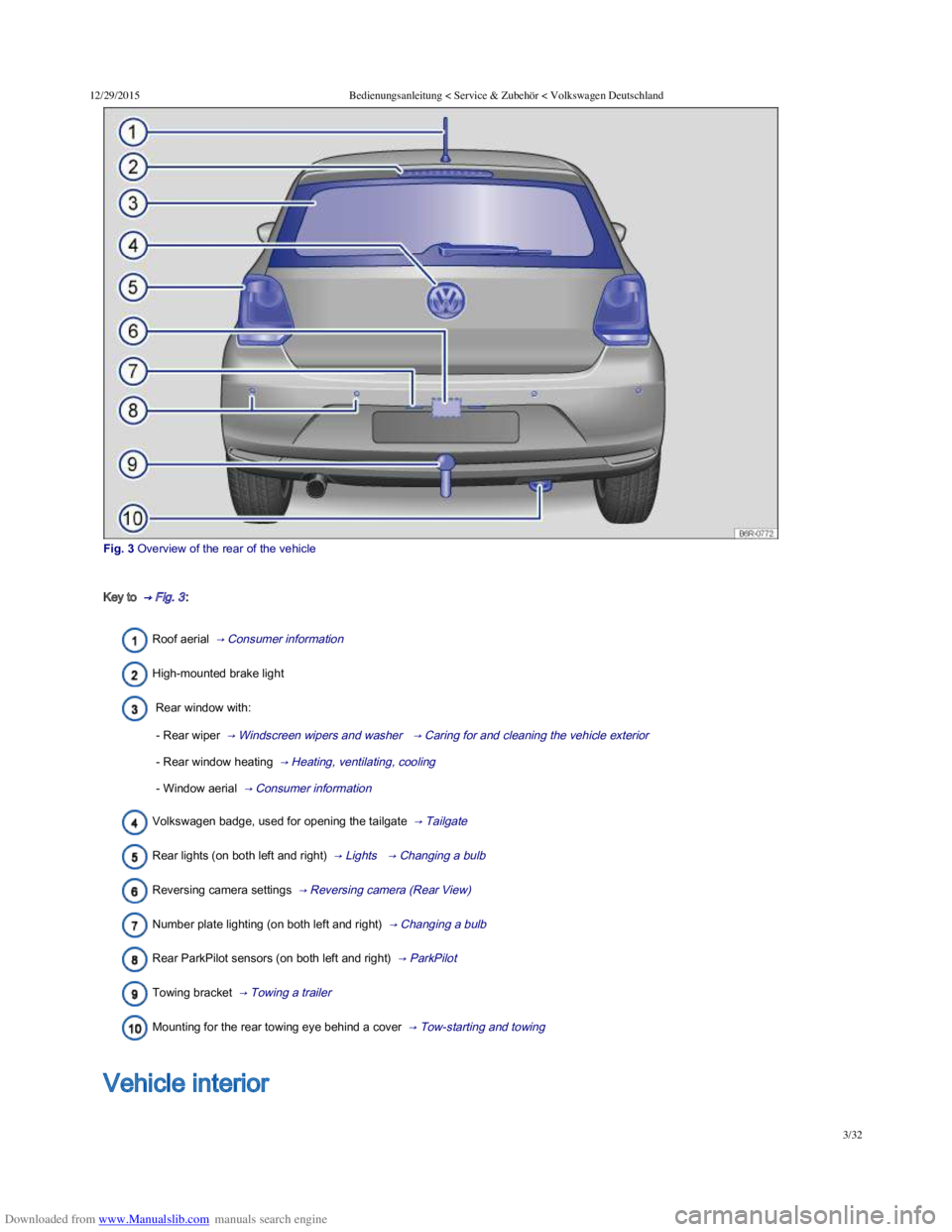
Fig. 3 Overview of the rear of the vehicle
Key to → Fig. 3 :
Roof aerial → Consumer information
High-mounted brake light
Rear window with:
- Rear wiper → Windscreen wipers and washer → Caring for and cleaning the vehicle exterior
- Rear window heating → Heating, ventilating, cooling
- Window aerial → Consumer information
Volkswagen badge, used for opening the tailgate → Tailgate
Rear lights (on both left and right) → Lights → Changing a bulb
Reversing camera settings → Reversing camera (Rear View)
Number plate lighting (on both left and right) → Changing a bulb
Rear ParkPilot sensors (on both left and right) → ParkPilot
Towing bracket → Towing a trailer
Mounting for the rear towing eye behind a cover → Tow-starting and towing
Overview of the driver door
Vehicle interior
Page 14 of 100
Downloaded from www.Manualslib.com manuals search engine 12/29/2015Bedienungsanleitung < Service & Zubehör < Volkswagen Deutschland
11/32
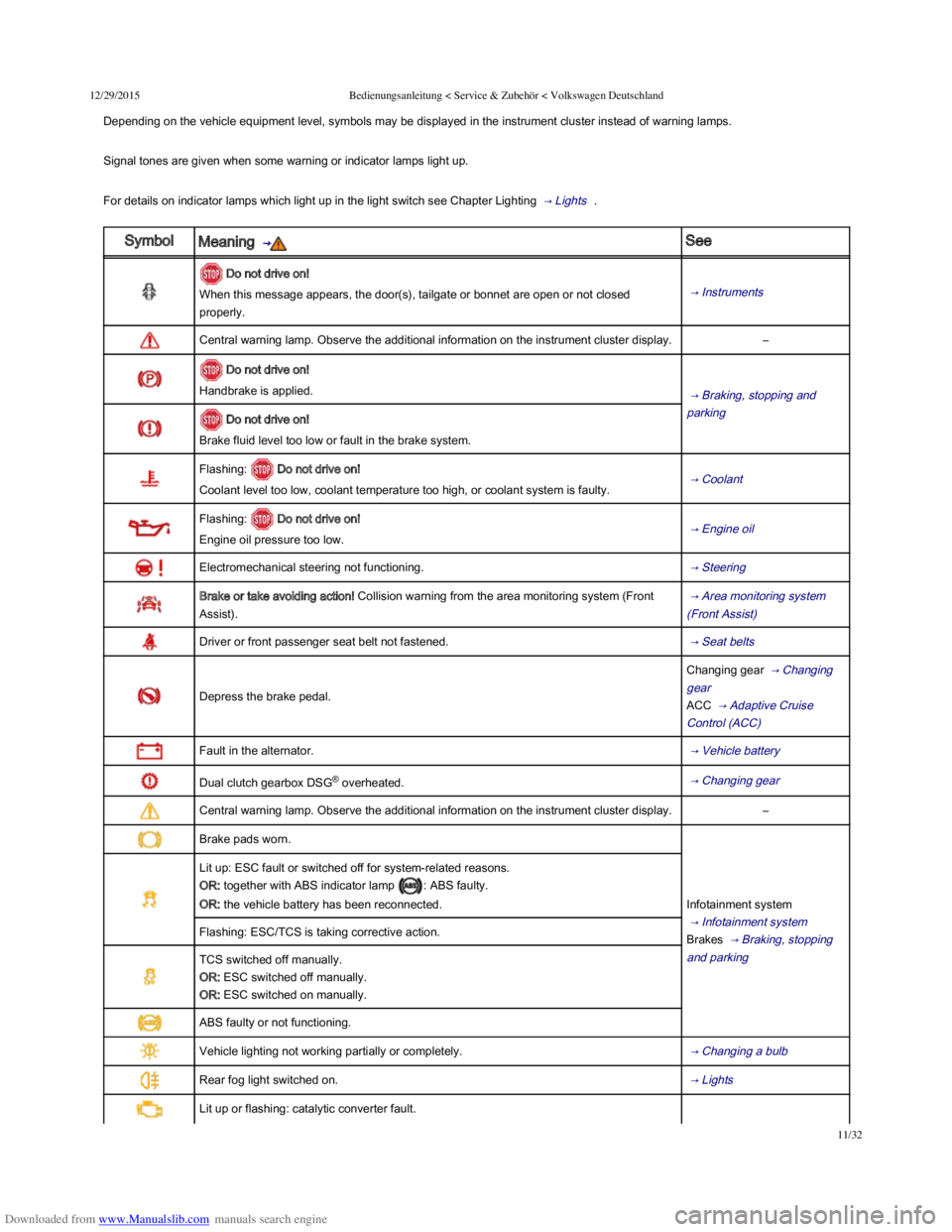
Depending on the vehicle equipment level, symbols may be displayed in the instrument cluster instead of warning lamps.
Signal tones are given when some warning or indicator lamps light up.
For details on indicator lamps which light up in the light switch see Chapter Lighting → Lights .
SymbolMeaning → See
Do not drive on!
When this message appears, the door(s), tailgate or bonnet are open or not closed
properly.
→ Instruments
Central warning lamp. Observe the additional information on the instrument cluster display.–
Do not drive on!
Handbrake is applied. → Braking, stopping and
parking Do not drive on!
Brake fluid level too low or fault in the brake system.
Flashing: Do not drive on!
Coolant level too low, coolant temperature too high, or coolant system is faulty. → Coolant
Flashing: Do not drive on!
Engine oil pressure too low. → Engine oil
Electromechanical steering not functioning. → Steering
Brake or take avoiding action! Collision warning from the area monitoring system (Front
Assist).
→ Area monitoring system
(Front Assist)
Driver or front passenger seat belt not fastened. → Seat belts
Depress the brake pedal.
Changing gear → Changing
gear
ACC → Adaptive Cruise
Control (ACC)
Fault in the alternator. → Vehicle battery
Dual clutch gearbox DSG® overheated. → Changing gear
Central warning lamp. Observe the additional information on the instrument cluster display.–
Brake pads worn.
Infotainment system
→ Infotainment system
Brakes → Braking, stopping
and parking
Lit up: ESC fault or switched off for system-related reasons.
OR: together with ABS indicator lamp : ABS faulty.
OR: the vehicle battery has been reconnected.
Flashing: ESC/TCS is taking corrective action.
TCS switched off manually.
OR: ESC switched off manually.
OR: ESC switched on manually.
ABS faulty or not functioning.
Vehicle lighting not working partially or completely. → Changing a bulb
Rear fog light switched on. → Lights
Lit up or flashing: catalytic converter fault.
Starting the engine → Starting
Page 18 of 100
Downloaded from www.Manualslib.com manuals search engine 12/29/2015Bedienungsanleitung < Service & Zubehör < Volkswagen Deutschland
15/32
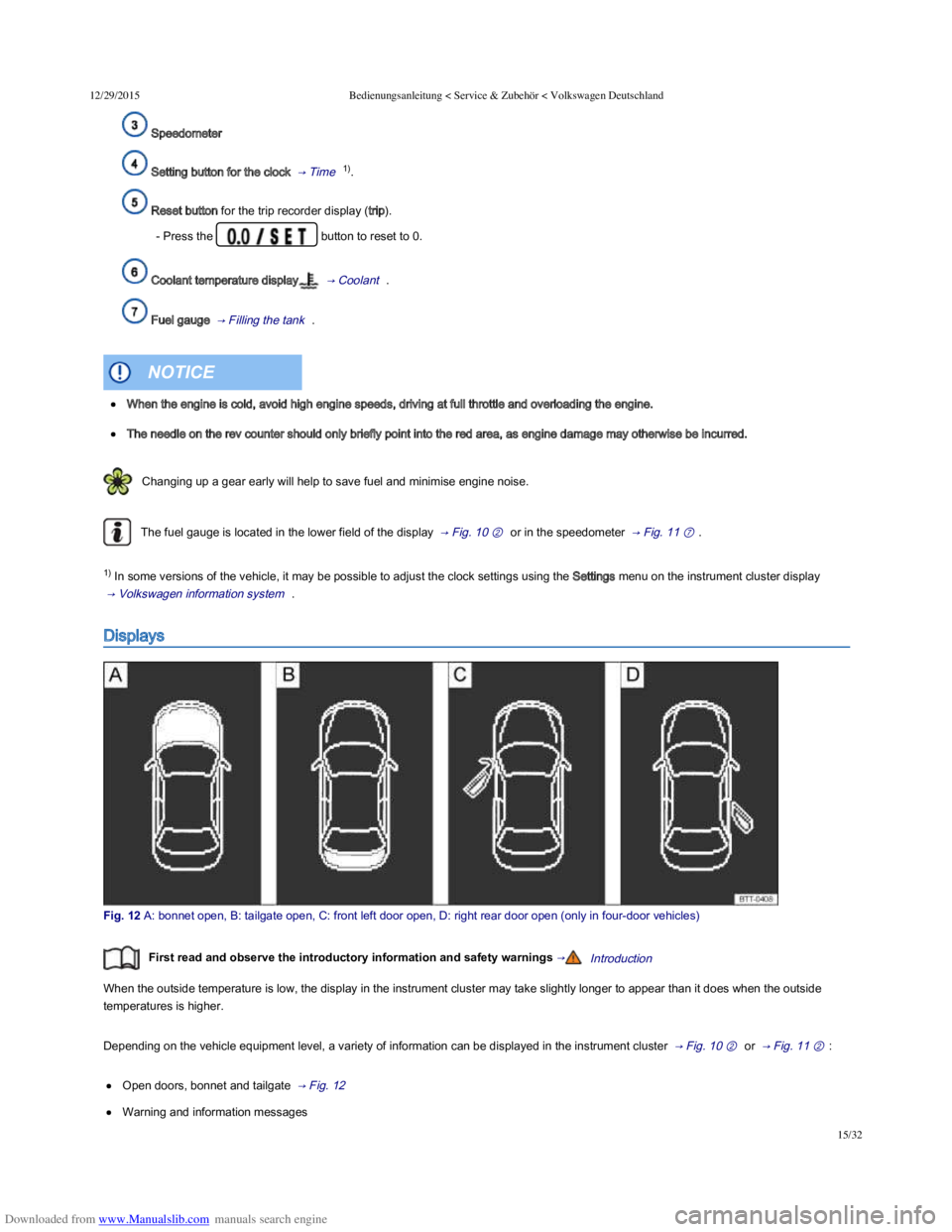
Speedometer
Setting button for the clock → Time 1).
Reset button for the trip recorder display (trip).
- Press the button to reset to 0.
Coolant temperature display → Coolant .
Fuel gauge → Filling the tank .
Changing up a gear early will help to save fuel and minimise engine noise.
The fuel gauge is located in the lower field of the display → Fig. 10 ② or in the speedometer → Fig. 11 ⑦ .
1) In some versions of the vehicle, it may be possible to adjust the clock settings using the Settings menu on the instrument cluster display
→ Volkswagen information system .
Displays
Fig. 12 A: bonnet open, B: tailgate open, C: front left door open, D: right rear door open (only in fourdoor vehicles)
First read and observe the introductory information and safety warnings →Introduction
When the outside temperature is low, the display in the instrument cluster may take slightly longer to appear than it does when the outside
temperatures is higher.
Depending on the vehicle equipment level, a variety of information can be displayed in the instrument cluster → Fig. 10 ② or → Fig. 11 ② :
Open doors, bonnet and tailgate → Fig. 12
Warning and information messages
When the engine is cold, avoid high engine speeds, driving at full throttle and overloading the engine.
The needle on the rev counter should only briefly point into the red area, as engine damage may otherwise be incurred.
NOTICE
Page 19 of 100
Downloaded from www.Manualslib.com manuals search engine 12/29/2015Bedienungsanleitung < Service & Zubehör < Volkswagen Deutschland
16/32
Mileage displays
Time
Radio and navigation information ⇒ BookletRadio, or ⇒ BookletNavigation system,
Telephone information ⇒ BookletNavigation system, or ⇒ BookletRadio/navigation system,
Outside temperature
Compass display
Selector lever positions → Changing gear
Gear change indicator → Changing gear
Driving data display (multifunction display (MFD)) and menus for various settings → Volkswagen information system
Service interval display → Service interval display
Speed warning for winter tyres
Start/stop system status display → Pull-away assist systems
Status display for active cylinder management (ACT®) → Driving with respect for the environment
Engine code
Fuel gauge → Filling the tank
Open doors, bonnet and tailgate
The instrument cluster display indicates if any doors, or the bonnet or tailgate, are open once the vehicle has been unlocked, and while the
vehicle is in motion. In some cases, a signal tone is also given. Different instrument cluster designs will have different displays.
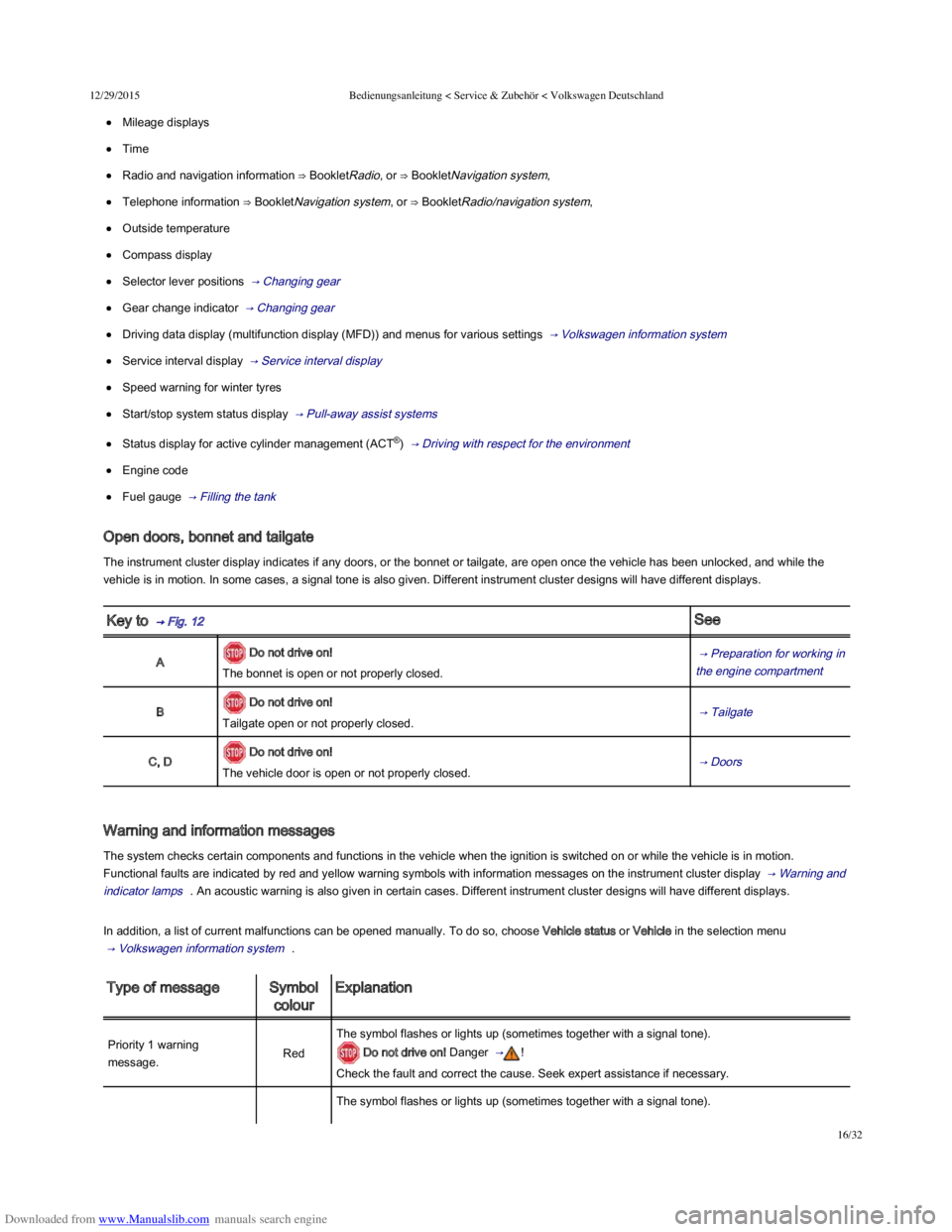
Key to → Fig. 12 See
A Do not drive on!
The bonnet is open or not properly closed.
→ Preparation for working in
the engine compartment
B Do not drive on!
Tailgate open or not properly closed. → Tailgate
C, D Do not drive on!
The vehicle door is open or not properly closed. → Doors
Warning and information messages
The system checks certain components and functions in the vehicle when the ignition is switched on or while the vehicle is in motion.
Functional faults are indicated by red and yellow warning symbols with information messages on the instrument cluster display → Warning and
indicator lamps . An acoustic warning is also given in certain cases. Different instrument cluster designs will have different displays.
In addition, a list of current malfunctions can be opened manually. To do so, choose Vehicle status or Vehicle in the selection menu
→ Volkswagen information system .
Type of messageSymbol
colour
Explanation
Priority 1 warning
message.Red
The symbol flashes or lights up (sometimes together with a signal tone).
Do not drive on! Danger → !
Check the fault and correct the cause. Seek expert assistance if necessary.
The symbol flashes or lights up (sometimes together with a signal tone).
Page 42 of 100
Downloaded from www.Manualslib.com manuals search engine 12/29/2015Bedienungsanleitung < Service & Zubehör < Volkswagen Deutschland
7/136
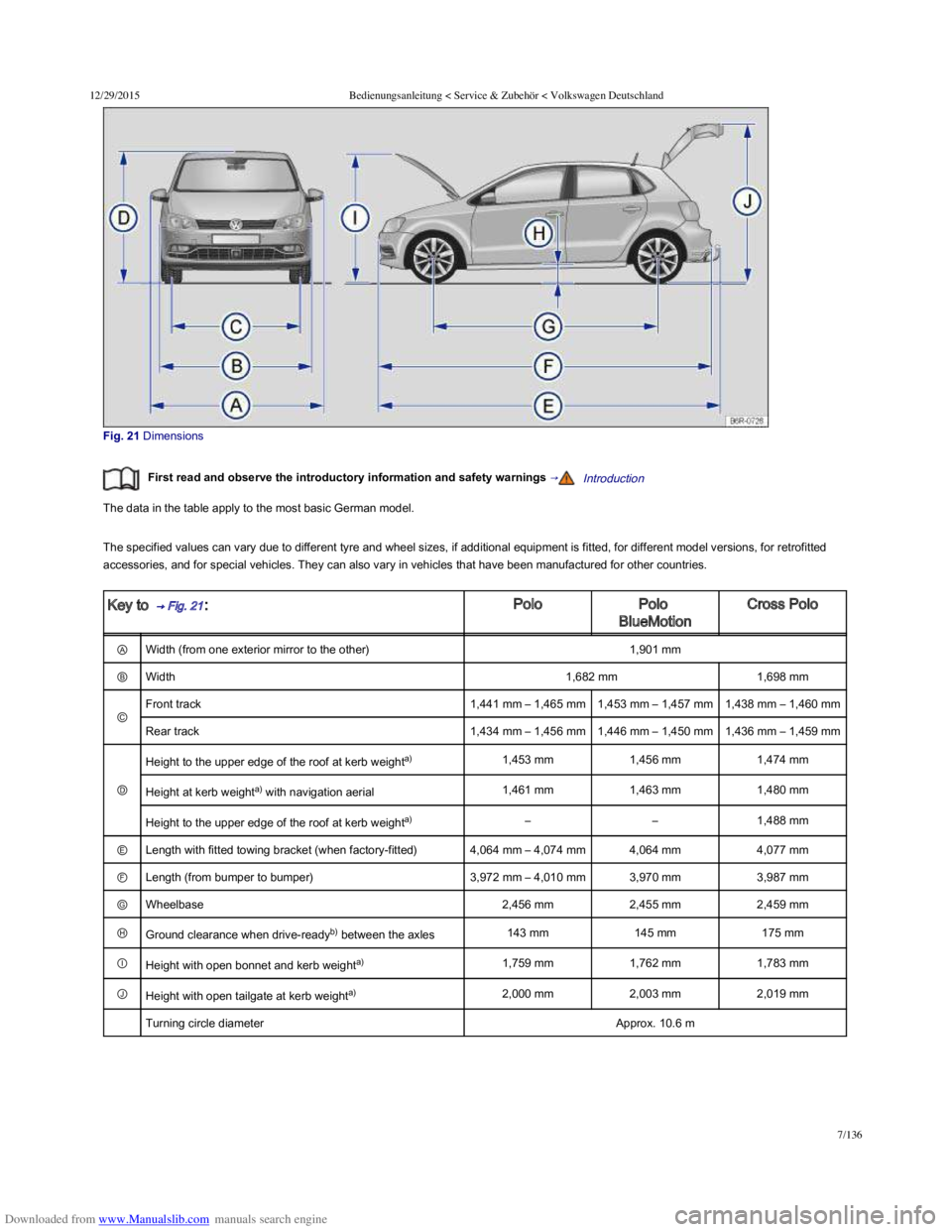
Fig. 21 Dimensions
First read and observe the introductory information and safety warnings →Introduction
The data in the table apply to the most basic German model.
The specified values can vary due to different tyre and wheel sizes, if additional equipment is fitted, for different model versions, for retrofitted
accessories, and for special vehicles. They can also vary in vehicles that have been manufactured for other countries.
Key to → Fig. 21 :PoloPolo
BlueMotion
Cross Polo
ⒶWidth (from one exterior mirror to the other)1,901 mm
ⒷWidth1,682 mm1,698 mm
Ⓒ
Front track1,441 mm – 1,465 mm1,453 mm – 1,457 mm1,438 mm – 1,460 mm
Rear track1,434 mm – 1,456 mm1,446 mm – 1,450 mm1,436 mm – 1,459 mm
Ⓓ
Height to the upper edge of the roof at kerb weighta)1,453 mm1,456 mm1,474 mm
Height at kerb weighta) with navigation aerial1,461 mm1,463 mm1,480 mm
Height to the upper edge of the roof at kerb weighta)––1,488 mm
ⒺLength with fitted towing bracket (when factory-fitted)4,064 mm – 4,074 mm4,064 mm4,077 mm
ⒻLength (from bumper to bumper)3,972 mm – 4,010 mm3,970 mm3,987 mm
ⒼWheelbase2,456 mm2,455 mm2,459 mm
ⒽGround clearance when drive-readyb) between the axles143 mm145 mm175 mm
ⒾHeight with open bonnet and kerb weighta)1,759 mm1,762 mm1,783 mm
ⒿHeight with open tailgate at kerb weighta)2,000 mm2,003 mm2,019 mm
Turning circle diameterApprox. 10.6 m
Page 44 of 100
Downloaded from www.Manualslib.com manuals search engine 12/29/2015Bedienungsanleitung < Service & Zubehör < Volkswagen Deutschland
9/136
Introduction
This chapter contains information on the following subjects:
→ Vehicle key
→ Indicator lamp in the vehicle key
→ Replacing the battery
→ Synchronising the vehicle key
Additional information and warnings:
Settings in the Volkswagen information system → Volkswagen information system
Central locking system → Central locking system
Starting and stopping the engine → Starting and stopping the engine
Consumer information → Consumer information
Manual opening and closing → Manual opening and closing
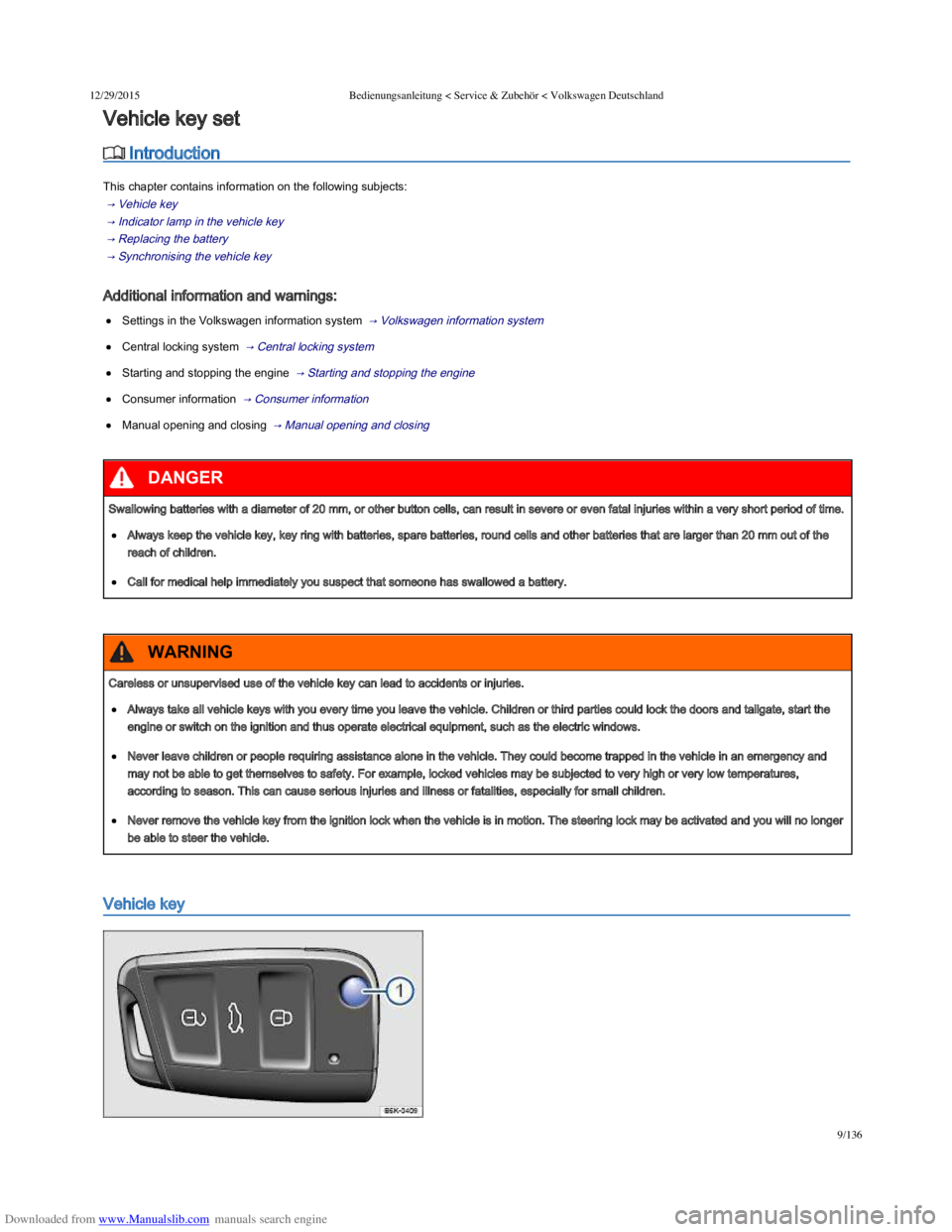
Vehicle key
Vehicle key set
Swallowing batteries with a diameter of 20 mm, or other button cells, can result in severe or even fatal injuries within a very short period of time.
Always keep the vehicle key, key ring with batteries, spare batteries, round cells and other batteries that are larger than 20 mm out of the
reach of children.
Call for medical help immediately you suspect that someone has swallowed a battery.
DANGER
Careless or unsupervised use of the vehicle key can lead to accidents or injuries.
Always take all vehicle keys with you every time you leave the vehicle. Children or third parties could lock the doors and tailgate, start the
engine or switch on the ignition and thus operate electrical equipment, such as the electric windows.
Never leave children or people requiring assistance alone in the vehicle. They could become trapped in the vehicle in an emergency and
may not be able to get themselves to safety. For example, locked vehicles may be subjected to very high or very low temperatures,
according to season. This can cause serious injuries and illness or fatalities, especially for small children.
Never remove the vehicle key from the ignition lock when the vehicle is in motion. The steering lock may be activated and you will no longer
be able to steer the vehicle.
WARNING
Page 47 of 100
Downloaded from www.Manualslib.com manuals search engine 12/29/2015Bedienungsanleitung < Service & Zubehör < Volkswagen Deutschland
12/136
Replacing the battery
Fold out the key bit of the vehicle key → Opening and closing the key bit .
Pull up the cover on the rear side of the vehicle key → Fig. 24 in the direction of the arrow → .
Using a suitable thin object, lever the battery out of the battery compartment → Fig. 25 .
Insert the new battery as shown → Fig. 25 and push it into the battery compartment against the direction of the arrow → .
Fit the cover as shown → Fig. 24 and push it onto the vehicle key housing against the direction shown by the arrow until it engages.
Dispose of discharged batteries in accordance with regulations governing the protection of the environment.
The battery in the vehicle key may contain perchlorate. Please comply with any legal requirements and regulations when handling and
disposing of these batteries.
Synchronising the vehicle key
First read and observe the introductory information and safety warnings →Introduction
It may no longer be possible to lock or unlock the vehicle with the remote control if the button is pressed repeatedly outside of the
effective range of the vehicle key. If this is the case, the vehicle key should be re-synchronised as follows:
Fold out the key bit of the vehicle key → Opening and closing the key bit .
Press the button on the vehicle key. Remain standing close to the vehicle.
Unlock the vehicle with the key bit within one minute. The synchronisation process is complete.
Fold in the key bit of the vehicle key.
Introduction
This chapter contains information on the following subjects:
→ Indicator lamp
→ Description of the central locking system
→ Locking and unlocking the vehicle from the outside
→ Locking and unlocking the vehicle from the inside
→ SAFELOCK mechanism
→ Anti-theft alarm
→ Interior monitoring system and anti-tow alarm
The central locking system will only work correctly when all doors and the tailgate are properly closed. The vehicle cannot be locked with the key
if the driver door is open.
If the vehicle is unlocked and not used for a long time (e.g. in your own garage) the vehicle battery could discharge or the engine may not start.
The vehicle key can be damaged if the battery is not changed properly.
Unsuitable batteries can damage the vehicle key. Replace discharged batteries only with new batteries of the same voltage rating, size and
specification.
Make sure that the battery is fitted the right way round.
NOTICE
Central locking system
Page 48 of 100
Downloaded from www.Manualslib.com manuals search engine 12/29/2015Bedienungsanleitung < Service & Zubehör < Volkswagen Deutschland
13/136
Additional information and warnings:
Exterior views → Exterior views
Infotainment system → Infotainment system
Vehicle key set → Vehicle key set
Doors → Doors
Tailgate → Tailgate
Electric windows → Electric windows
Electric panorama sliding/tilting roof → Electric panorama sliding/tilting glass roof
Mirrors → Mirrors
Towing a trailer → Towing a trailer
Cleaning and caring for the vehicle exterior → Caring for and cleaning the vehicle exterior
Manual opening and closing → Manual opening and closing
Indicator lamp
First read and observe the introductory information and safety warnings →Introduction
The central locking system indicator lamp is located in the driver door → Vehicle interior .
Depending on the vehicle equipment level, the vehicle may have an anti-theft alarm and a SAFELOCK mechanism → SAFELOCK mechanism .
After locking the vehicleMeaning
Without anti-theft alarmWith anti-theft alarm and
SAFELOCK mechanism
A red LED flashes for approximately 2 seconds, firstly at short
intervals and then more slowly.Vehicle is locked.Vehicle is locked and SAFELOCK is
activated.
A red LED flashes for approximately 2 seconds and then goes
out. The light starts to flash again after approximately 30
seconds.
–Vehicle is locked and SAFELOCK is
deactivated.
A red LED flashes for approximately 2 seconds in short
Improper use of the central locking system could lead to serious injury.
The central locking system locks all doors. Locking the vehicle from the inside can prevent accidental opening of the doors and unauthorised
persons from entering the vehicle. However, locked doors can delay assistance to passengers inside the vehicle in the event of an accident
or emergency.
Never leave children or people requiring assistance alone in the vehicle. All doors can be locked from the inside using the central locking
button. This may mean that people lock themselves in the vehicle. People locked in the vehicle may be subjected to very high or very low
temperatures.
Temperatures inside a locked vehicle may reach extremes of heat or cold, according to season. This can cause serious injuries and illness
or fatalities, especially to small children.
Never leave anyone inside a locked vehicle. People in the vehicle could become trapped in an emergency and may not be able to get
themselves to safety.
WARNING