Page 254 of 578
Install summer tires promptly in the spring. Summer tires offer
better handling characteristics for temperatures above +45 °F (+7 °C).
They are quieter, do not wear as quickly, and reduce fuel consump-
tion.
If factory-installed wheels and/or tires are replaced when in-
stalling winter tires, make sure that the wheels are equipped with
sensors that are compatible with the factory-installed Tire Pressure
Monitoring System and that the tires are also compatible with the sys-
tem. If new tires are not identical to those that were removed and re-
quire different cold tire inflation pressure, the tire inflation pressure
values must be reprogrammed for the TPMS. Please see your author-
ized Volkswagen dealer or authorized Volkswagen Service Facility ⇒
The Tire Pressure Monitoring System must be recalibrated whenever
you remove and remount or change any wheel or tire on the vehicle,
even if the reinstalled or replacement wheels and tires are identical to
those that were removed and even if the tire pressure does not
change.
If necessary, ask your authorized Volkswagen dealer or author-
ized Volkswagen Service Facility about permissible winter tire dimen-
sions.
Snow chains
Page 260 of 578
Speed rating (letter code)
A standardized letter code indicating the maximum speed at which a
tire is designed to be driven for extended periods of time. The ratings
range from 93 mph or 150 km/h (“P”) to 186 mph or (300 km/h) “Y”.
The speed rating letter code, where applicable, is molded on the tire
sidewall. You may not find this information on all tires because it is
not required by law.
Tire Pressure Monitoring System
A system that detects when at least one of a vehicle's tires is underin-
flated and illuminates a low tire-pressure warning light.
Tread
The portion of a tire that normally touches the road.
Tread rib
A tread section running circumferentially around a tire.
Tread separation
Tire failure caused by the tread pulling away from the tire carcass.
Tread wear indicators (TWI)
Raised areas within the main tread grooves that show, visually, when
tires are worn and near the end of their useful life ⇒ page 261.
Uniform Tire Quality Grading (UTQG)
A tire information system developed by the U.S. National Highway
Traffic Safety Administration (NHTSA) that is designed to help buyers
compare tires. UTQG is not a safety rating, nor is it a guarantee that a
tire will last for a certain number of miles or perform a certain way. It
gives tire buyers more information to compare with factors such as
price, brand loyalty and dealer recommendations. Under UTQG, tires
are graded by the tire manufacturers in 3 areas: tread wear, traction
and temperature resistance. UTQG information is molded into the tire
sidewalls.
U.S. DOT Tire Identification Number (TIN)
A tire's serial number. It begins with the letters “DOT” (“Department of
Transportation”) and indicates that the tire meets all federal stand-
ards. The next 2 numbers or letters indicate the plant where the tire
Page 267 of 578
Tire Pressure Monitoring System (TPMS)
Page 270 of 578
Do not rely only on the Tire Pressure Monitoring System. Check
your tires regularly to make sure they are properly inflated and have
no signs of damage, such as punctures, cuts, cracks, and blisters.
Remove any objects that become embedded in the tire tread but have
not penetrated into the body of tire itself.
The Tire Pressure Monitoring System checks for the factory-
recommended inflation pressure, as shown on the label inside the
driver door ⇒ Tire inflation pressure.
For replacement tires that require a different inflation pressure, the
TPMS must be adjusted to the new pressure specification by an au-
thorized Volkswagen dealer or an authorized Volkswagen Service
Facility. Only one value can be entered for each tire; see the tire infla-
tion pressure label on the driver door pillar ⇒ Tire inflation pressure.
To help prevent damage to the sensor and valve, do not put exces-
sive force on the valve when checking the tire pressure. Do not try to
bend the valve.
If sensors have to be replaced, have the valves changed at the
same time.
The tire valve gaskets must be replaced whenever a tire is mount-
ed on the rim. Your authorized Volkswagen dealer or authorized
Volkswagen Service Facility has a valve seal and gasket kit for this
purpose. Always make sure that a valve seal and gasket kit is also
used whenever a sensor is replaced.
If you have to adjust the tire pressure on a “warm” tire, fill the tire
with 2.0 - 4.35 psi (20 - 30 kPa) more than the pressure specified on
the tire pressure label.
When the TPMS determines that the air pressure in at least one
tire is too low, carefully check the pressure in all 4 tires with an accu-
rate tire pressure gauge. Low tire pressure usually cannot be deter-
mined by looking at the tire. This is especially true of low-profile tires.
A Declaration of Compliance with the United States FCC and
Industry Canada regulations is found in the Consumer Information
section of this Manual ⇒ Declaration of Compliance, Telecommunica-
tions and Electronic Systems.
Page 271 of 578
There may be differences between the pressure readings from a
tire pressure gauge and the pressures registered by the Tire Pressure
Monitoring System. The electronic TPMS is more accurate.
If you have work done on your wheels or tires, inform the work-
shop that the vehicle is equipped with a Tire Pressure Monitoring
System that has sensors in the wheels.
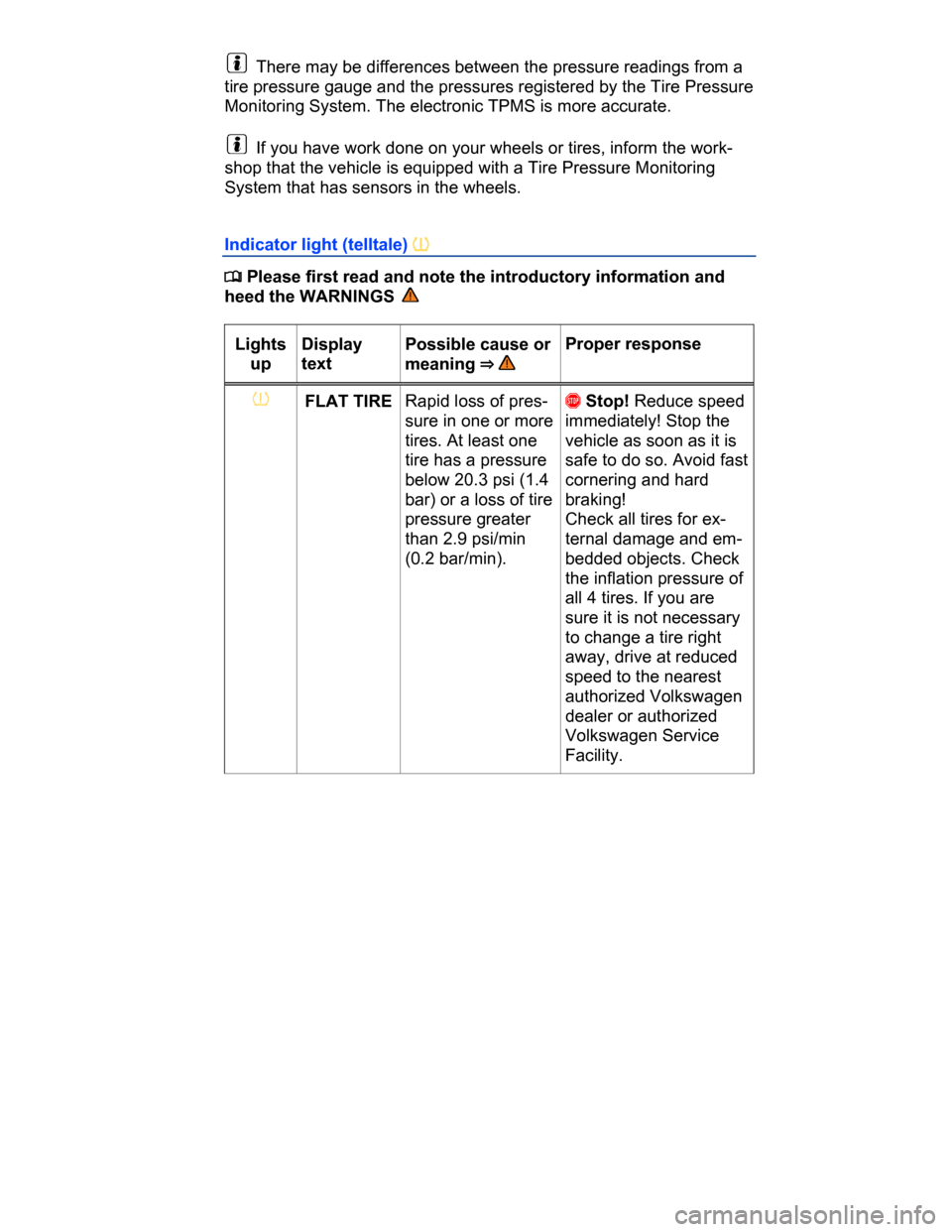
Indicator light (telltale)
Page 275 of 578
If the tire is not “flat” and you do not have to change the tire
or wheel immediately, drive at reduced speed to the nearest
service station to check the tire pressure and add air as re-
quired.
When replacing tires or wheel rims on vehicles equipped with
TPMS, always read and heed the information and all WARN-
INGS in the section ⇒ Tires and wheels.
WARNING
Failure to heed warning lights and instrument cluster text mes-
sages can cause the vehicle to break down in traffic and result
in a collision and serious personal injury.
Never ignore warning lights or text WARNINGS.
Always stop the vehicle as soon as it is safe to do so.
NOTICE
Failure to heed warning lights or text WARNINGS can result in
vehicle damage.
Tire Pressure Monitoring System (TPMS)
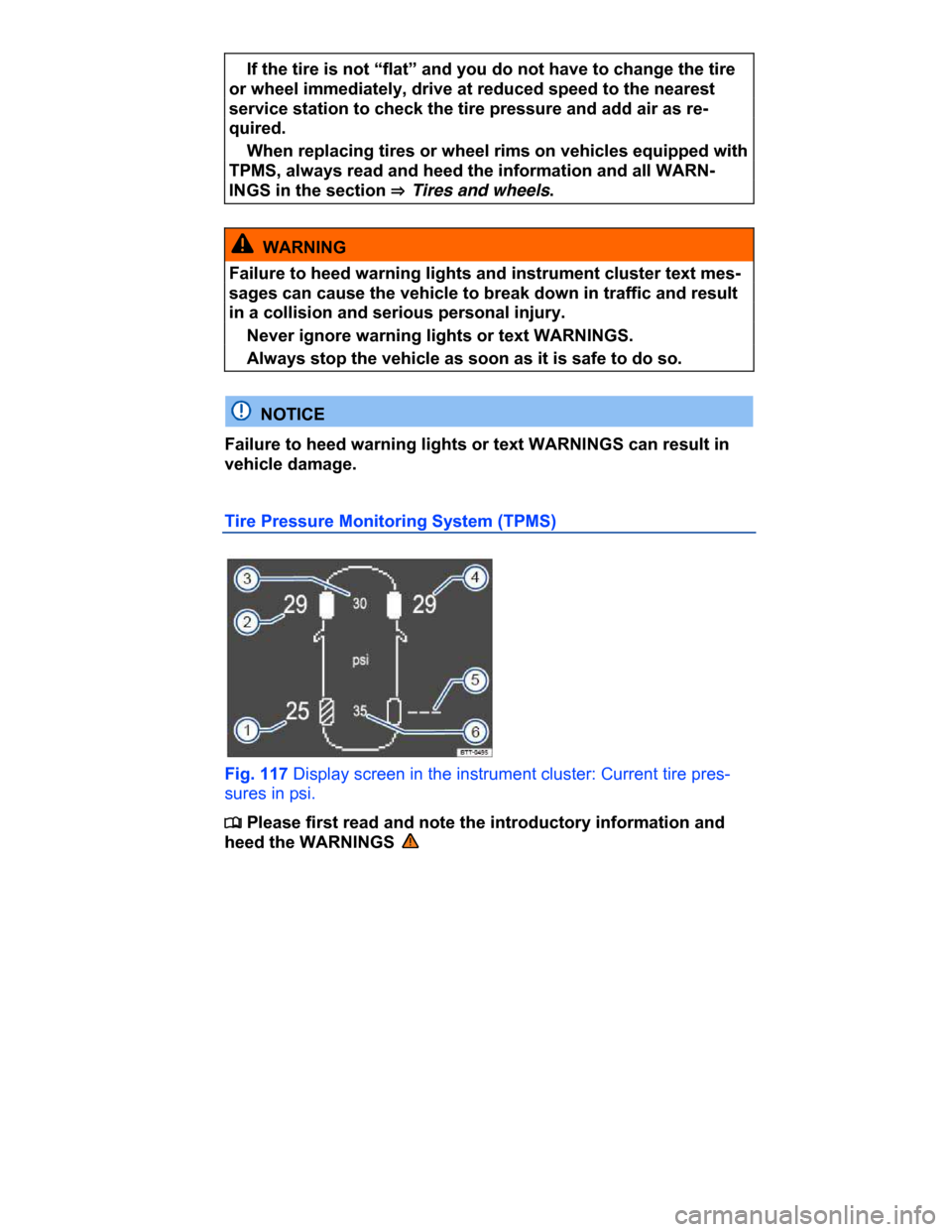
Fig. 117 Display screen in the instrument cluster: Current tire pres-
sures in psi.
Page 276 of 578

The Tire Pressure Monitoring System uses a pressure sensor in each
wheel. Signals from the sensors are transmitted to the TPMS.
The TPMS checks the tire pressure of all 4 tires while you are driving
and warns if there is a loss of pressure while the vehicle is moving.
Pressure loss that is 25% or more of the benchmark value pro-
grammed into the system is signaled by the indicator light (telltale)
described above, by acoustic warnings, and by text messages in the
instrument cluster display.
If you mount tires of a different size than the factory installed tires, an
authorized Volkswagen dealer or an authorized Volkswagen Service
Facility can adjust the benchmark TPMS tire pressure to match the
new tires. Without this adjustment, TPMS may not work correctly or at
all.
The tire pressure recommended for the tires originally installed on the
vehicle is on a sticker on the driver door jamb ⇒ Tire inflation pres-
sure.
Display in the instrument cluster
The display in the instrument cluster shows the vehicle with the actual
and benchmark tire pressures of all 4 road wheels ⇒ fig. 117
Tire pressure display screen
⇒ fig. 117 Meaning
(1) Tire pressure warning, left rear
tire.
(2) Current tire pressure, front left
tire.
(3) Benchmark pressure, front tires
(4) Current tire pressure, front right
tire.
(5) No data received, right rear tire.
(6) Benchmark pressure, rear tires
Page 277 of 578
If the tire pressure is too low, the relevant tires and the respective
readings are highlighted in yellow.
Each tire, including the spare (if provided), should be checked month-
ly when cold and inflated to the inflation pressure recommended by
the vehicle manufacturer on the vehicle placard or tire inflation pres-
sure label. (If your vehicle has tires of a different size than the size
indicated on the vehicle placard or tire inflation pressure label, you
should determine the proper tire inflation pressure for those tires.)
As an added safety feature, your vehicle has been equipped with a
Tire Pressure Monitoring System (TPMS) that illuminates a low tire
pressure telltale when one or more of your tires is significantly under-
inflated. Accordingly, when the low tire pressure telltale illuminates,
you should stop and check your tires as soon as possible, and inflate
them to the proper pressure. Driving on a significantly underinflated
tire causes the tire to overheat and can lead to tire failure. Under-
inflation also reduces fuel efficiency and tire tread life, and may affect
the vehicle's handling and stopping ability.
Please note that the TPMS is not a substitute for proper tire mainte-
nance, and it is the driver's responsibility to maintain correct tire pres-
sure, even if under-inflation has not reached the level to trigger illumi-
nation of the TPMS low tire pressure telltale.
Your vehicle has also been equipped with a TPMS malfunction indi-
cator to indicate when the system is not operating properly. The
TPMS malfunction indicator is combined with the low tire pressure
telltale. When the system detects a malfunction, the telltale will flash
for approximately one minute and then remain continuously illuminat-
ed. This sequence will continue upon subsequent vehicle start-ups as
long as the malfunction exists.
When the malfunction indicator is illuminated, the system may not be
able to detect or signal low tire pressure as intended. TPMS malfunc-
tions may occur for a variety of reasons, including the installation of
replacement or alternate tires or wheels on the vehicle that prevent
the TPMS from functioning properly. Always check the TPMS mal-
function telltale after replacing one or more tires or wheels on your
vehicle to ensure that the replacement or alternate tires and wheels
allow the TPMS to continue to function properly.