2015 VOLKSWAGEN GOLF SPORTWAGEN start stop button
[x] Cancel search: start stop buttonPage 7 of 439

As an added safety feature, your vehicle has been equipped with a Tire Pressure Monitoring System (TPMS) that illuminates a low tire pressure telltale when one or more of your tires is significantly underinflated. Accordingly, when the low tire pressure telltale illuminates, you should stop and check your tires as soon as possible, and inflate them to the proper pressure. Driving on a significantly underinflated tire causes the tire to overheat and can lead to tire failure. Underinflation also reduces fuel efficiency and tire tread life, and may affect the vehicle’s handling and stopping ability.
Please note that the TPMS is not a substitute for proper tire maintenance, and it is the driver’s respon-sibility to maintain correct tire pressure, even if underinflation has not reached the level to trigger illumination of the TPMS low tire pressure telltale.
Your vehicle has also been equipped with a TPMS malfunction indicator to indicate when the system is not operating properly. The TPMS malfunction indicator is combined with the low tire pressure telltale. When the system detects a malfunction, the telltale will flash for approximately 1 minute and then remain continuously illuminated. This sequence will continue upon subsequent vehicle start-ups as long as the malfunction exists.
When the malfunction indicator is illuminated, the system may not be able to detect or signal low tire pressure as intended. TPMS malfunctions may occur for a variety of reasons, including the installation of replacement or alternate tires or wheels on the vehicle that prevent the TPMS from functioning properly. Always check the TPMS malfunction telltale after replacing one or more tires or wheels on your vehicle to ensure that the replacement or alternate tires and wheels allow the TPMS to continue to function properly.
Resetting and recalibrating the benchmark tire pressure
Resetting the tire pressures in the Infotainment system resets the benchmark tire pressure used by the TPMS to the current tire pressure in the tires based on the circumference of the tires.
x Switch on the ignition.
x Press the #!2 Infotainment button ⇒ Menu and system settings (SETUP).
x Tap the
Page 73 of 439

alarm system can be retrofitted by an authorized Volkswagen dealer or an authorized Volkswagen Service Facility.
The anti-theft alarm system makes it more difficult for someone to break into or steal the vehicle.
The anti-theft alarm system is automatically activated when the vehicle is locked by pressing the lock button on the remote control vehicle key.
When is the alarm triggered?
The anti-theft alarm system sounds and the turn signals flash for up to 5 minutes if the following oc-curs with respect to the locked vehicle:
x In vehicles with an open lock cylinder: A door unlocked mechanically with the vehicle key bit is opened and the ignition is not switched on within about 15 seconds.
x In vehicles with a covered lock cylinder: A door unlocked mechanically with the vehicle key bit is opened.
x Forcibly opening a door.
x Forcibly opening the engine hood.
x Forcibly opening the rear hatch.
x Switching on the ignition with an invalid key.
x Disconnecting the vehicle battery.
Deactivating the alarm
Unlock the vehicle with the unlock button on the remote control vehicle key or switch on the ignition with a valid remote control vehicle key.
For vehicles with Keyless Access, the alarm can be deactivated by grasping one of the front door handles when a valid vehicle key is in range or by holding the remote control vehicle key to the right of
the steering column trim and pressing the starter button ⇒ Starter button.
After the alarm has stopped and the vehicle is opened again in the same or a different area that is protected by the alarm, the alarm is triggered again. For example, the alarm will sound again if the rear hatch is opened after one of the doors has been opened.
The anti-theft alarm system is not activated when the vehicle is locked with the power lock switch
Page 181 of 439
x Unlock the parking brake and gently release it while holding the unlock button. At the same time, release the brake pedal and gradually depress the accelerator and, for a manual transmission, let out the clutch until you can feel the car moving forward. If applicable, follow the instructions for the Hill
Hold feature ⇒ Starting assistance systems.
x Do not release the parking brake lever until the engine starts to move the vehicle forward. If your vehicle has an automatic transmission, you can also depress and hold the brake pedal for added braking and then let up on the brake pedal when you feel that the vehicle “wants” to move forward.
x Drive ahead slowly.
WARNING
Improper trailer towing can cause loss of vehicle control and serious personal injury.
x Driving with a trailer and carrying heavy or bulky items changes the way the vehicle han-dles and increases the distance it needs to stop safely.
x Always watch what is happening up ahead and around you. Brake earlier than you would if you were not towing a trailer.
x Always adapt your speed and driving to the heavier load and the weight distribution in the vehicle. Take road, weather, traffic, and visibility conditions into account as well.
x Reduce your speed even more than you otherwise would when going downhill and under unfavorable load, weather, or wind conditions.
x Drive especially carefully and accelerate gently. Always avoid sudden maneuvers and hard braking.
x Be especially careful when passing other vehicles.
x Reduce speed immediately if the trailer shows even the slightest sign of swaying.
x Never try to stop the swaying by accelerating.
x Always obey speed limits. In some areas speed limits for vehicles towing trailers are lower than for vehicles without trailers.
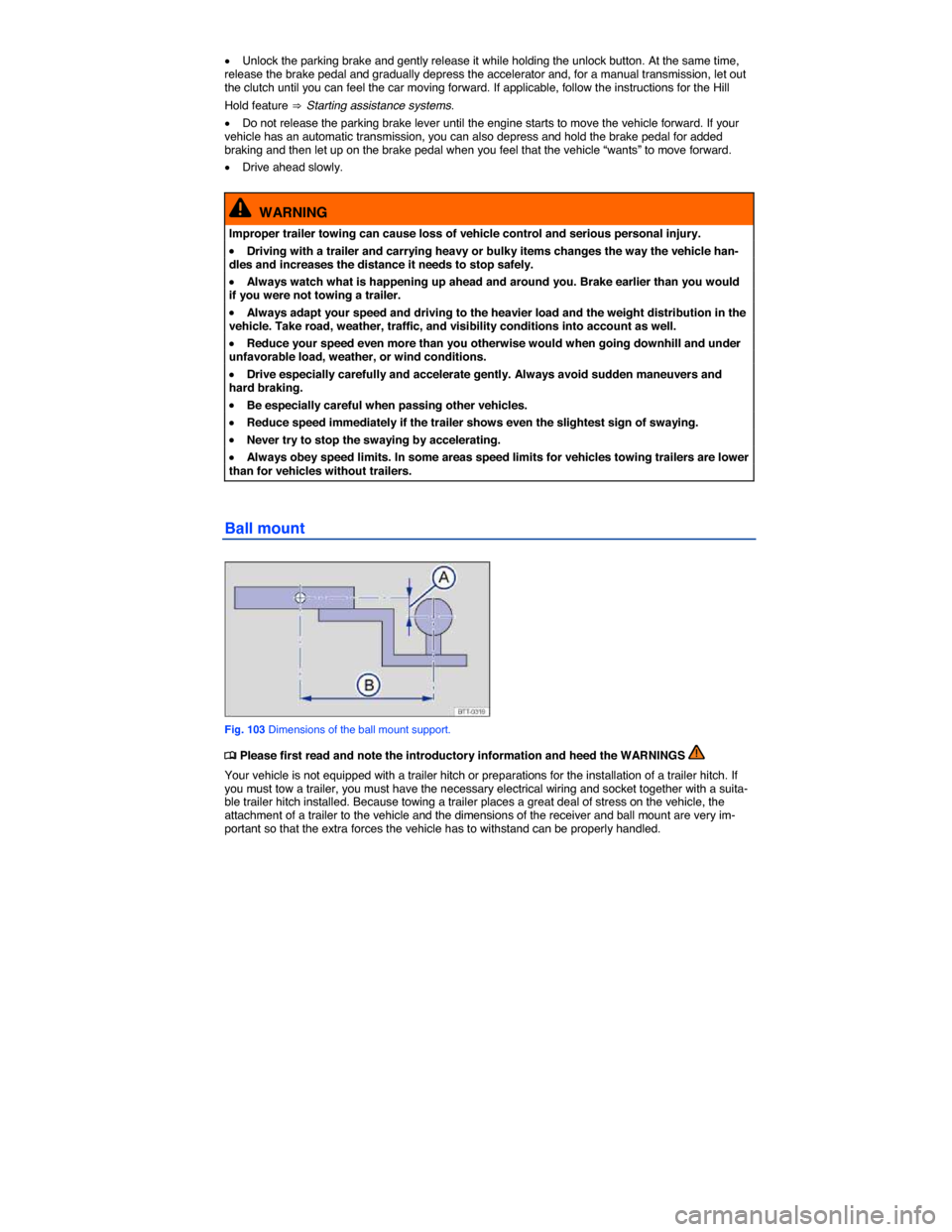
Ball mount
Fig. 103 Dimensions of the ball mount support.
Page 234 of 439

WARNING
Improper use of vehicle keys can result in serious personal injury.
x Always take the key with you when you leave the vehicle. The engine can be started and vehicle systems such as the power windows can be operated, leading to serious personal injury.
x Never leave children, disabled persons, or anyone who cannot help themselves in the vehicle. The doors can be locked with the remote control vehicle key. This could result in people being trapped in the vehicle in an emergency. For example, depending on the time of year, people trapped in the vehicle can be exposed to very high or very low temperatures.
x Heat buildup in the passenger and luggage compartment of a parked vehicle can result in temperatures in the vehicle that are much higher than the outside temperatures, particularly in summer. Temperatures can quickly reach levels that can cause unconsciousness and death, particularly to small children.
x Never remove the key from the ignition switch while the vehicle is moving or rolling to a stop. The steering wheel will lock and you will not be able to steer or control the vehicle.
Leaving the key in the ignition for a long time when the engine is not running will drain the vehicle battery.
Leaving the selector lever for a long period of time in any position other than Park (P) when the ignition is switched off can drain the vehicle battery.
On automatic transmission vehicles, the vehicle key can be removed from the ignition switch only when the transmission is in Park (P). You may have to press the release button on the transmis-sion selector lever to put the lever into Park (P).
Starter button
Fig. 128 In the lower center console: Starter button for the Keyless Access system.