Page 264 of 540

2644-6. Using the driving support systems
YARIS_F_WE_52G04E
WARNING
■When the VSC is activated
The slip indicator flashes. Always drive carefully. Reckless driving may
cause an accident. Exercise particular care when the indicator light flashes.
■ When the TRC/VSC systems are turned off
Be especially careful and drive at a speed appropriate to the road condi-
tions. As these are the systems to help ensure vehicle stability and driving
force, do not turn the TRC/VSC systems off unless unnecessary.
■ Replacing tires
Make sure that all tires are of the specified size, brand, tread pattern and
total load capacity. In addition, make sure that the tires are inflated to the
recommended tire inflation pressure level.
The ABS, TRC and VSC systems will not function correctly if different tires
are installed on the vehicle.
Contact any authorized Toyota dealer or repairer, or another duly qualified
and equipped professional for further in formation when replacing tires or
wheels.
■ Handling of tires and the suspension
Using tires with any kind of problem or modifying the suspension will affect
the driving assist systems, and may cause a system to malfunction.
Page 269 of 540

2694-7. Driving tips
4
Driving
YARIS_F_WE_52G04E
■Tire chain installation
Observe the following precautions when installing and removing chains:
● Install and remove tire chains in a safe location.
● Install tire chains on the front tires only. Do not install tire chains on the rear
tires.
● Install tire chains on front tires as tightly as possible. Retighten chains after
driving 0.5 1.0 km (1/4 1/2 mile).
● Install tire chains following the instructions provided with the tire chains.
● If wheel ornaments are used, they will be scratched by the chain band, so
remove the ornaments before putting on the chains. ( P. 450)
WARNING
■Driving with snow tires
Observe the following precautions to reduce the risk of accidents.
Failure to do so may result in a loss of vehicle control and cause death or
serious injury.
● Use tires of the specified size.
● Maintain the recommended level of air pressure.
● Do not drive at speeds in excess of the speed limit or the speed limit spec-
ified for the snow tires being used.
● Use snow tires on all, not just some wheels.
● Do not use tires of noticeably different wear level.
■ Driving with tire chains
Observe the following precautions to reduce the risk of accidents.
Failure to do so may result in the vehicle being unable to be driven safely,
and may cause death or serious injury.
● Do not drive in excess of the speed limit specified for the tire chains being
used, or 50 km/h (30 mph), whichever is lower.
● Avoid driving on bumpy road surfaces or over potholes.
● Avoid sudden acceleration, abrupt steering, sudden braking and shifting
operations that cause sudden engine braking.
● Slow down sufficiently before entering a curve to ensure that vehicle con-
trol is maintained.
● Do not use LDA (Lane Departure Alert) (if equipped).
Page 341 of 540
341
7Maintenance and care
YARIS_F_WE_52G04E
7-1. Maintenance and care
Cleaning and protecting
the vehicle exterior .......... 342
Cleaning and protecting
the vehicle interior ........... 345
7-2. Maintenance
Maintenance
requirements.................... 348
7-3. Do-it-yourself maintenance
Do-it-yourself service
precautions ...................... 351
Hood .................................. 354
Positioning a floor jack ....... 356
Engine compartment.......... 358
Tires ................................... 373
Tire inflation pressure ........ 387
Wheels ............................... 389
Air conditioning filter .......... 392
Wireless remote control/
electronic key battery....... 394
Checking and replacing
fuses ................................ 397
Light bulbs ......................... 403
Page 351 of 540

3517-3. Do-it-yourself maintenance
7
Maintenance and care
YARIS_F_WE_52G04E
Do-it-yourself ser vice precautions
If you perform maintenance by yourself, be sure to follow the
correct procedure as given in these sections.
ItemsParts and tools
Battery condition
( P. 368)
•Warm water• Baking soda•Grease
• Conventional wrench (for terminal clamp bolts)
• Distilled water
Engine coolant
level ( P. 366)
• “Toyota Super Long Life Coolant” or a similar high
quality ethylene glycol-based non-silicate, non-
amine, non-nitrite and non-borate coolant with long-
life hybrid organic acid technology
“Toyota Super Long Life Coolant” is pre-mixed with
50% coolant and 50% deionized water.
• Funnel (used only for adding coolant)
Engine oil level
( P. 361)
• “Toyota Genuine Motor Oil” or equivalent
• Rag or paper towel
• Funnel (used only for adding engine oil)
Fuses
( P. 397)• Fuse with same amperage rating as original
Light bulbs
( P. 403)
• Bulb with same number and wattage rating as origi-
nal
• Phillips-head screwdriver
• Flathead screwdriver•Wrench
Radiator, condenser
and intercooler
( P. 367)
Tire inflation
pressure
( P. 387)
• Tire pressure gauge
• Compressed air source
Washer fluid
( P. 371)
• Water or washer fluid containing antifreeze (for win-
ter use)
• Funnel (used only for adding water or washer fluid)
Page 373 of 540
3737-3. Do-it-yourself maintenance
7
Maintenance and care
YARIS_F_WE_52G04E
Tires
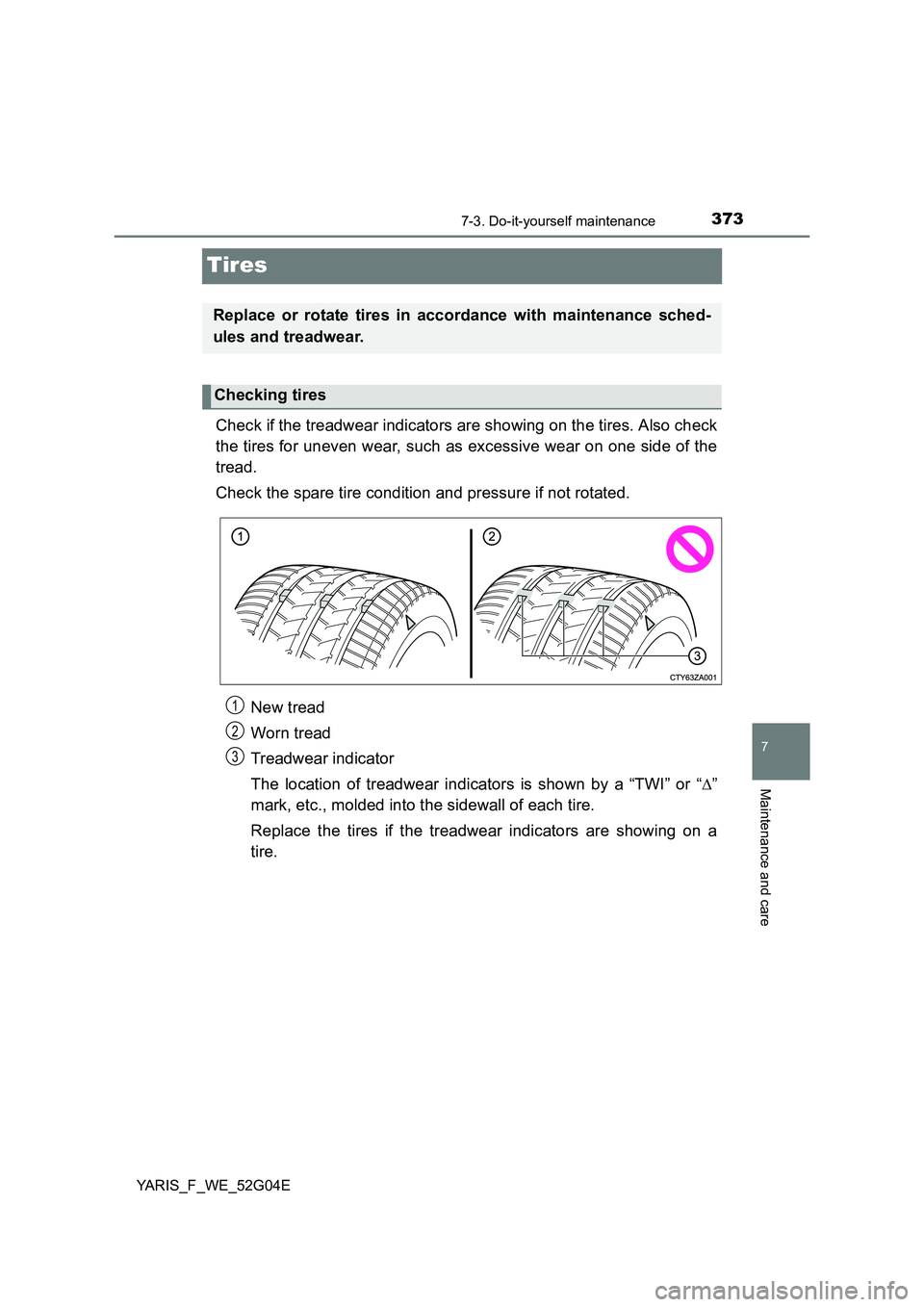
Check if the treadwear indicators are showing on the tires. Also check
the tires for uneven wear, such as excessive wear on one side of the
tread.
Check the spare tire condition and pressure if not rotated.
New tread
Worn tread
Treadwear indicator
The location of treadwear indicators is shown by a “TWI” or “ ”
mark, etc., molded into the sidewall of each tire.
Replace the tires if the treadwear indicators are showing on a
tire.
Replace or rotate tires in accordance with maintenance sched-
ules and treadwear.
Checking tires
1
2
3
Page 374 of 540
3747-3. Do-it-yourself maintenance
YARIS_F_WE_52G04E
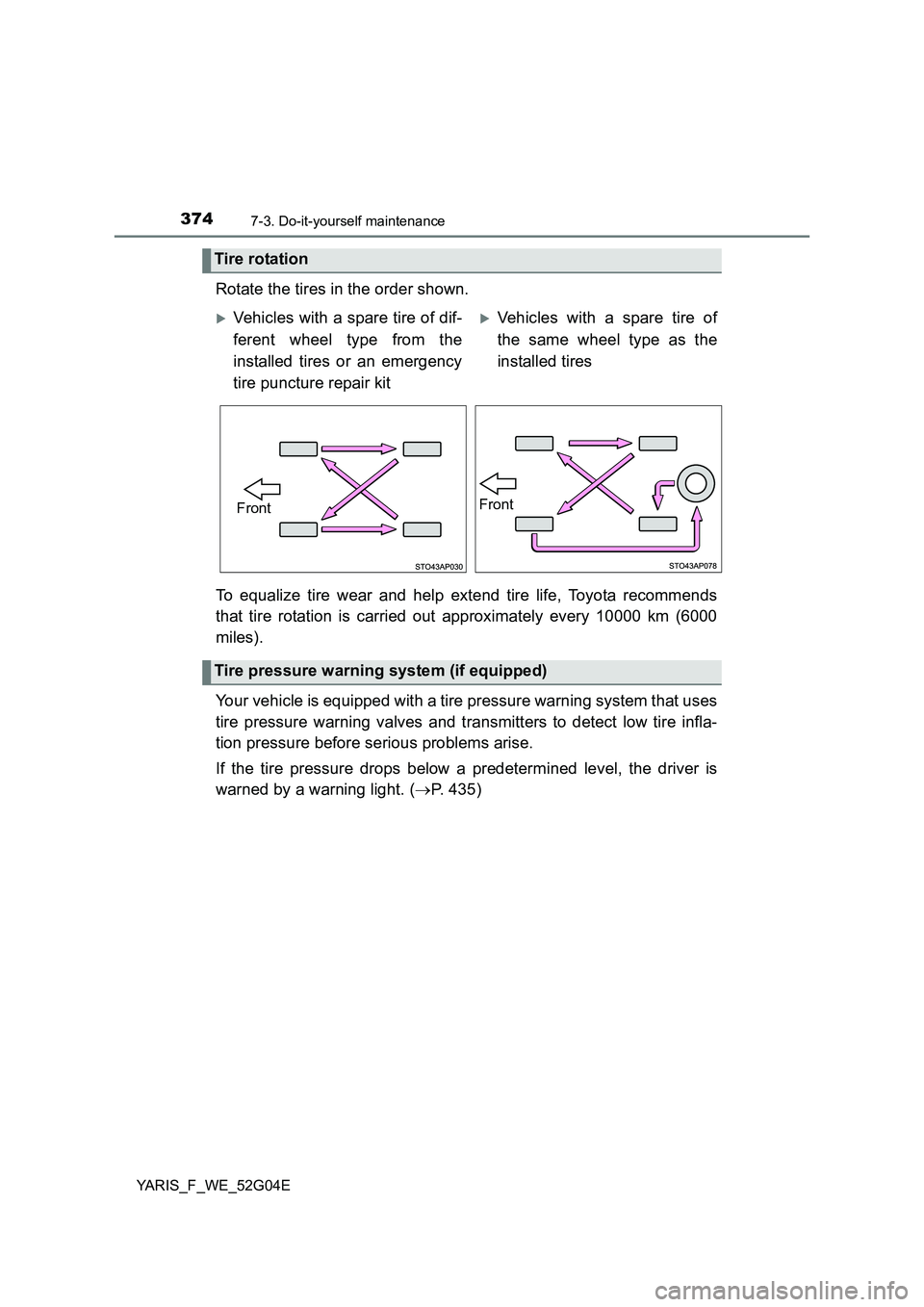
Rotate the tires in the order shown.
To equalize tire wear and help extend tire life, Toyota recommends
that tire rotation is carried out approximately every 10000 km (6000
miles).
Your vehicle is equipped with a tire pressure warning system that uses
tire pressure warning valves and transmitters to detect low tire infla-
tion pressure before serious problems arise.
If the tire pressure drops below a predetermined level, the driver is
warned by a warning light. ( P. 435)
Tire rotation
Vehicles with a spare tire of dif-
ferent wheel type from the
installed tires or an emergency
tire puncture repair kit
Vehicles with a spare tire of
the same wheel type as the
installed tires
FrontFront
Tire pressure warning system (if equipped)
Page 375 of 540

3757-3. Do-it-yourself maintenance
7
Maintenance and care
YARIS_F_WE_52G04E
When replacing tires or wheels, tire pressure warning valves and
transmitters must also be installed.
When new tire pressure warning valves and transmitters are installed,
new ID codes must be registered in the tire pressure warning com-
puter and the tire pressure warning system must be initialized. Have
tire pressure warning valve and transmitter ID codes registered by
any authorized Toyota dealer or repairer, or another duly qualified and
equipped professional. ( P. 377)
■The tire pressure warning system must be initialized in the fol-
lowing circumstances:
● When rotating front and rear tires which have different tire infla-
tion pressures
● When the tire inflation pressure is changed such as when chang-
ing traveling speed
● When changing the tire size
When the tire pressure warning system is initialized, the current tire
inflation pressure is set as the benchmark pressure.
Installing tire pressure warning valves and transmitters (vehicles
with a tire pressure warning system)
Initializing the tire pressure warning system (vehicles with a tire
pressure warning system)
Page 376 of 540
3767-3. Do-it-yourself maintenance
YARIS_F_WE_52G04E
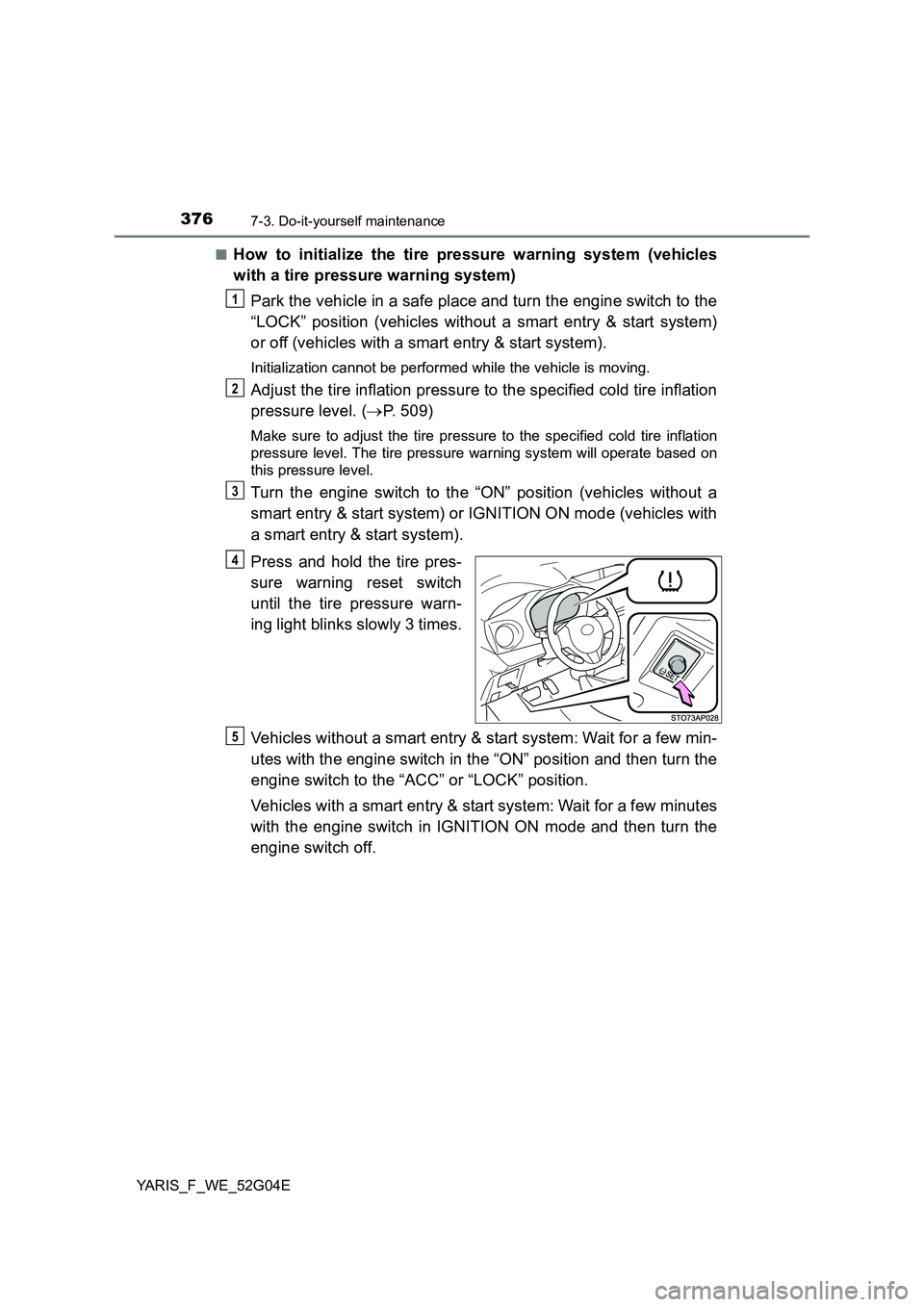
■How to initialize the tire pressure warning system (vehicles
with a tire pressure warning system)
Park the vehicle in a safe place and turn the engine switch to the
“LOCK” position (vehicles without a smart entry & start system)
or off (vehicles with a smart entry & start system).
Initialization cannot be performed while the vehicle is moving.
Adjust the tire inflation pressure to the specified cold tire inflation
pressure level. ( P. 509)
Make sure to adjust the tire pressure to the specified cold tire inflation
pressure level. The tire pressure warning system will operate based on
this pressure level.
Turn the engine switch to the “ON” position (vehicles without a
smart entry & start system) or IGNITION ON mode (vehicles with
a smart entry & start system).
Press and hold the tire pres-
sure warning reset switch
until the tire pressure warn-
ing light blinks slowly 3 times.
Vehicles without a smart entry & start system: Wait for a few min-
utes with the engine switch in the “ON” position and then turn the
engine switch to the “ACC” or “LOCK” position.
Vehicles with a smart entry & start system: Wait for a few minutes
with the engine switch in IGNITION ON mode and then turn the
engine switch off.
1
2
3
4
5