Page 399 of 564
399 4-3. Do-it-yourself maintenance
4
Maintenance and care
NOTICE
Replacing tire pressure warning valves and transmitters
Because tire repair or replacement may affect the tire pressure warning
valves and transmitters, make sure to have tires serviced by any autho-
rized Toyota dealer or repairer, or another duly qualified and equipped pro-
fessional or other qualified service shop. In addition, make sure to
purchase your tire pressure warning valves and transmitters at any autho-
rized Toyota dealer or repairer, or another duly qualified and equipped pro-
fessional.
Ensure that only genuine Toyota wheels are used on your vehicle.
Tire pressure warning valves and transmitters may not work properly with
non-genuine wheels.
Page 401 of 564
401 4-3. Do-it-yourself maintenance
4
Maintenance and care
Checking interval
Replace the air conditioning filter according to the maintenance schedule. In
dusty areas or areas with heavy traffic flow, early replacement may be
required. (For scheduled maintenance information, please refer to the
“Toyota Service Booklet” or “Toyota Warranty Booklet”.)
If air flow from the vents decreases dramatically
The filter may be clogged. Check the filter and replace if necessary.
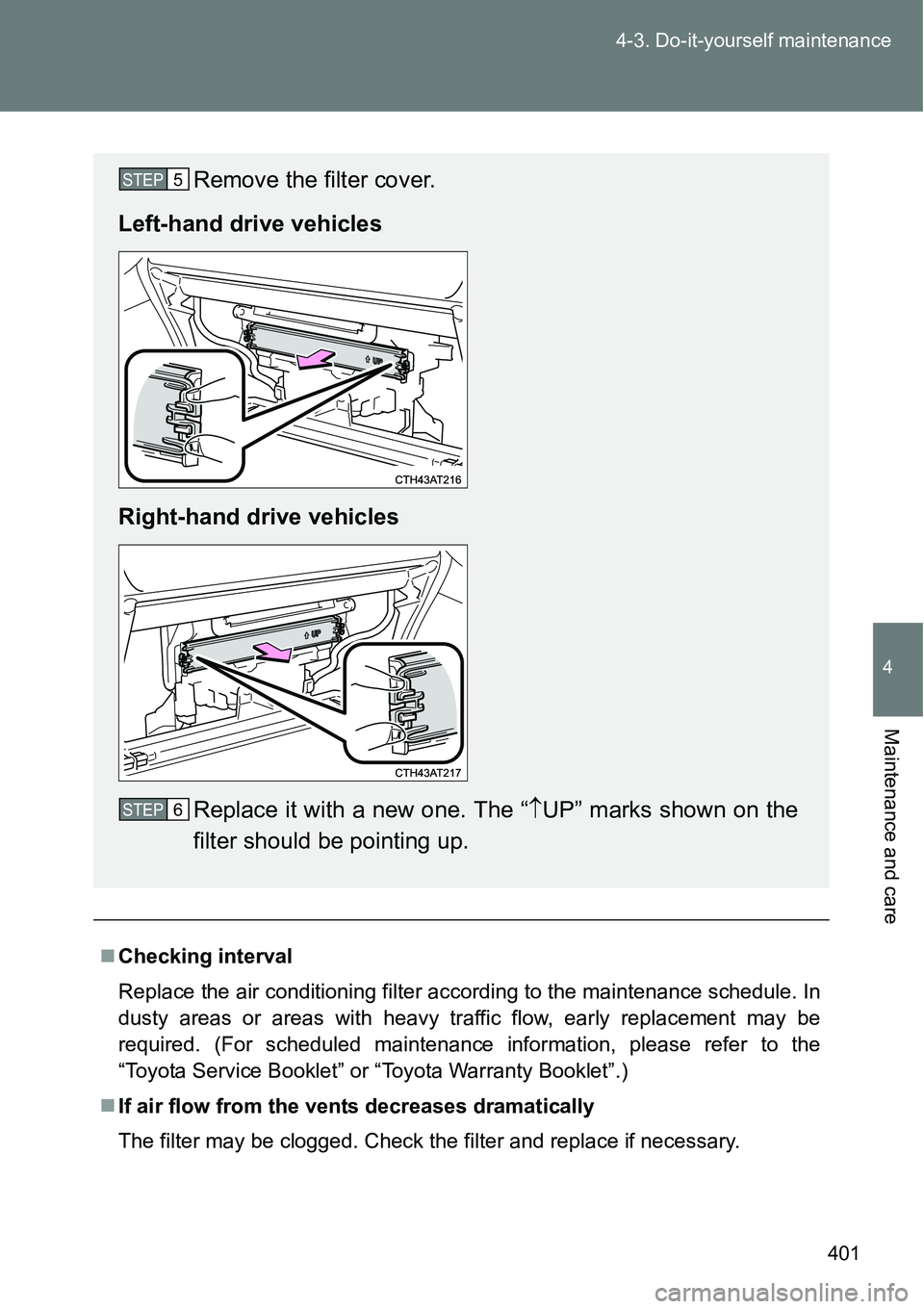
Remove the filter cover.
Left-hand drive vehicles
Right-hand drive vehicles
Replace it with a new one. The “UP” marks shown on the
filter should be pointing up.STEP5
STEP6
Page 437 of 564

5
437
5-1. Essential information
When trouble arises
If your vehicle needs to be towed
Situations needs to contact dealers before towing
The following may indicate a problem with your transmission. Contact
any authorized Toyota dealer or repairer, or another duly qualified
and equipped professional or commercial towing service before tow-
ing.
The engine is running but the vehicle will not move.
The vehicle makes an abnormal sound.
Towing with a sling-type truck
Do not tow with a sling-type truck
to prevent body damage.
If towing is necessary, we recommend having your vehicle towed by
any authorized Toyota dealer or repairer, or another duly qualified
and equipped professional or commercial towing service, using a
lift-type truck or flatbed truck.
Use a safety chain system for all towing, and abide by all state/pro-
vincial and local laws.
If towing your vehicle with a wheel-lift type truck from the front, the
vehicle's rear wheels and axles must be in good conditions.
(P. 438, 443)
If they are damaged, use a towing dolly or flatbed truck.
Page 474 of 564
474 5-2. Steps to take in an emergency
CAUTION
When installing the wheel nuts
Be sure to install the wheel nuts with the tapered end facing inward.
(P. 398)
Failure to follow these precautions could cause the wheel nuts to loosen and
the tire to fall off, resulting in death or serious injury.
NOTICE
Do not drive the vehicle with a flat tire.
Do not continue driving with a flat tire.
Driving even a short distance with a flat tire can damage the tire and the
wheel beyond repair.
Be careful when driving over bumps with the compact spare tire
installed on the vehicle.
The vehicle becomes lower when driving with the compact spare tire com-
pared to when driving with standard tires. Be careful when driving over
uneven road surfaces.
Driving with tire chains and the compact spare tire
Do not fit tire chains to the compact spare tire.
Tire chains may damage the vehicle body and adversely affect driving per-
formance.
When replacing the tires
When removing or fitting the wheels, tires or the tire pressure warning valve
and transmitter, contact any authorized Toyota dealer or repairer, or another
duly qualified and equipped professional as the tire pressure warning valve
and transmitter may be damaged if not handled correctly.
To avoid damage to the tire pressure warning valves and transmitters
When a tire is repaired with liquid sealants, the tire pressure warning valve
and transmitter may not operate properly. If a liquid sealant is used, contact
any authorized Toyota dealer or repairer, or another duly qualified and
equipped professional or other qualified service shop as soon as possible.
Make sure to replace the tire pressure warning valve and transmitter when
replacing the tire. (P. 385)
Page 491 of 564

5
491 5-2. Steps to take in an emergency
When trouble arises
NOTICE
When performing an emergency repair
A tire should only be repaired with the emergency tire puncture repair kit if
the damage is caused by a sharp object such as nail or screw passing
through the tire tread.
Do not remove the sharp object from the tire. Removing the object may
widen the opening and disenable emergency repair with the repair kit.
The repair kit is not waterproof. Make sure that the repair kit is not
exposed to water, such as when it is being used in the rain.
Do not put the repair kit directly onto dusty ground such as sand at the
side of the road. If the repair kit vacuums up dust etc., a malfunction may
occur.
Precautions for the emergency tire puncture repair kit
The repair kit power source should be 12 V DC suitable for vehicle use. Do
not connect the repair kit to any other source.
If gasoline splatters on the repair kit, the repair kit may deteriorate. Take
care not to allow gasoline to contact it.
Place the repair kit in a storage to prevent it from being exposed to dirt or
water.
Store the repair kit under the front right seat out of reach of children.
Do not disassemble or modify the repair kit. Do not subject parts such as
the air pressure indicator to impacts. This may cause a malfunction.
To avoid damage to the tire pressure warning valves and transmitters
When a tire is repaired with liquid sealants, the tire pressure warning valve
and transmitter may not operate properly. If a liquid sealant is used, contact
any authorized Toyota dealer or repairer, or another duly qualified and
equipped professional or other qualified service shop as soon as possible.
Make sure to replace the tire pressure warning valve and transmitter when
replacing the tire. (P. 385)
Page 529 of 564
529 6-1. Specifications
6
Vehicle specifications
Oil viscosity (0W-20 is explained here as an example):
• The 0W in 0W-20 indicates the characteristic of the oil which
allows cold startability. Oils with a lower value before the W allow
for easier starting of the engine in cold weather.
• The 20 in 0W-20 indicates the viscosity characteristic of the oil
when the oil is at high temperature. An oil with a higher viscosity
(one with a higher value) may be better suited if the vehicle is oper-
ated at high speeds, or under extreme load conditions.
How to read oil container labels:
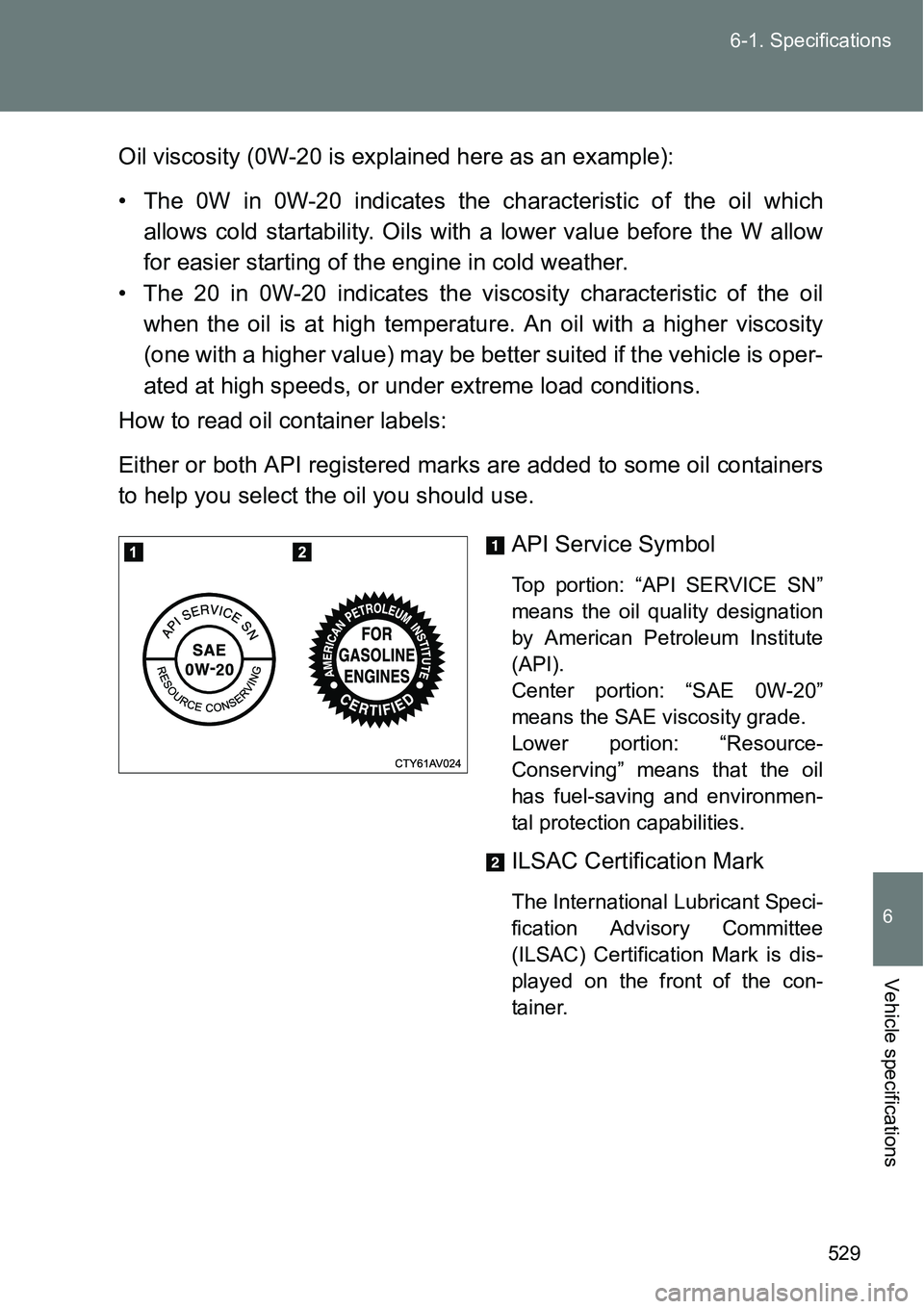
Either or both API registered marks are added to some oil containers
to help you select the oil you should use.
API Service Symbol
Top portion: “API SERVICE SN”
means the oil quality designation
by American Petroleum Institute
(API).
Center portion: “SAE 0W-20”
means the SAE viscosity grade.
Lower portion: “Resource-
Conserving” means that the oil
has fuel-saving and environmen-
tal protection capabilities.
ILSAC Certification Mark
The International Lubricant Speci-
fication Advisory Committee
(ILSAC) Certification Mark is dis-
played on the front of the con-
tainer.
Page 557 of 564

557 Alphabetical index
Seats
Adjustment .............................. 77
Adjustment precautions .......... 77
Child seats/child restraint
system installation .............. 145
Cleaning ................................ 358
Head restraint ......................... 83
Properly sitting in the seat..... 120
Rear seat adjustment .............. 78
Rear seat adjustment
precautions ........................... 81
Seat heaters.......................... 338
Service reminder
indicators .............................. 204
Shift lever
Manual transmission ............. 192
Multidrive............................... 186
Shift lock system ..................... 495
Side airbags ............................. 122
Side mirror
Adjusting and folding............... 96
Smart entry & start system
Entry function .......................... 33
Starting the engine ................ 173
Spare tire
Inflation pressure .................. 535
Storage location .................... 462Spark plug ................................ 531
Specifications .......................... 522
Speedometer ............................ 198
Steering
Column lock release ..... 179, 184
Steering wheel
Adjustment .............................. 92
Audio switches ...................... 320
Stop & Start cancel switch ..... 231
Stop & Start system ................ 229
Stop & Start system
operation time ....................... 199
Stop & Start system total
operation time ....................... 200
Storage feature ........................ 326
Storage precautions ................ 248
Stuck
If your vehicle becomes
stuck ................................... 516
Sun visors ................................ 332
*: Refer to “Navigation and multimedia system Owner’s manual”.