Page 547 of 692

5
When trouble arises
547
5-2. Steps to take in an emergency
PRIUS PHV_OM_OM47A11U_(U)
CAUTION
■If the tire pressure warning light comes on
Be sure to observe the following precautions. Failure to do so could
cause a loss of vehicle control and result in death or serious injury.
●Stop your vehicle in a safe place as
soon as possible. Adjust the tire
inflation pressure immediately.
●If the tire pressure warning light comes on even after tire inflation pres-
sure adjustment, it is pr obable that you have a flat tire. Check the tires.
If a tire is flat, repair the flat ti re by using emergency tire puncture
repair kit.
●Avoid abrupt maneuvering and braking. If the vehicle tires deteriorate,
you could lose control of the steering wheel or the brakes.
■If a blowout or sudden air leakage should occur
The tire pressure warning syste m may not activate immediately.
■Maintenance of the tires
Each tire, including the spare (if provided), should be checked monthly
when cold and inflated to the inflation pressure recommended by the
vehicle manufacturer on the vehicle placard or tire inflation pressure
label (tire and load information label). (If your vehicle has tires of a differ-
ent size than the size indicated on the vehicle placard or tire inflation
pressure label [tire and load information label], you should determine the
proper tire inflation pr essure for those tires.)
Page 548 of 692

548 5-2. Steps to take in an emergency
PRIUS PHV_OM_OM47A11U_(U)
CAUTION
As an added safety feature, your vehicle has been equipped with a tire
pressure monitoring system (TPMS-ti re pressure warning system) that
illuminates a low tire pressure telltal e (tire pressure warning light) when
one or more of your tires is significantly under-inflated. Accordingly,
when the low tire pressu re telltale (tire pressure warning light) illumi-
nates, you should stop and check your tires as soon as possible, and
inflate them to the proper pressure. Driving on a significantly under-
inflated tire causes the tire to overheat and can lead to tire failure.
Under-inflation also reduces fuel effi ciency and tire tread life, and may
affect the vehicle’s handling and stopping ability.
Please note that the TPMS (tire pressure warning system) is not a sub-
stitute for proper tire main tenance, and it is the driver’s responsibility to
maintain correct tire pressure, even if under-inflation has not reached the
level to trigger illu mination of the TPMS low tire pressure telltale (tire
pressure warning light).
Your vehicle has also been equipped with a TPMS (tire pressure warning
system) malfunction indicator to indi cate when the system is not operat-
ing properly. The TPMS (tire pressure warning system) malfunction indi-
cator is combined with the low tire pressure telltale (tire pressure
warning light). When the system det ects a malfunction, the telltale will
flash for approximately one minute an d then remain continuously illumi-
nated. This sequence will continue upon subsequent vehicle start-ups as
long as the malfunction exists. When the malfunction indi cator is illumi-
nated, the system may not be able to detect or signal low tire pressure
as intended.
Page 549 of 692
5
When trouble arises
549
5-2. Steps to take in an emergency
PRIUS PHV_OM_OM47A11U_(U)
CAUTION
TPMS (tire pressure warning system) malfunctions may occur for a vari-
ety of reasons, including the installati
on of replacement or alternate tires
or wheels on the vehicle that prevent the TPMS (tire pressure warning
system) from functioning properly. Always check the TPMS (tire pres-
sure warning system) malfunction te lltale after replacing one or more
tires or wheels on your vehicle to ensure that the replacement or alter-
nate tires and wheels allow the TPMS (tire pressure warning system) to
continue to function properly.
NOTICE
■To ensure the tire pressure warning system operates properly
Do not install tires with different s pecifications or makers, as the tire
pressure warning system may not operate properly.
Page 584 of 692
584 5-2. Steps to take in an emergency
PRIUS PHV_OM_OM47A11U_(U)
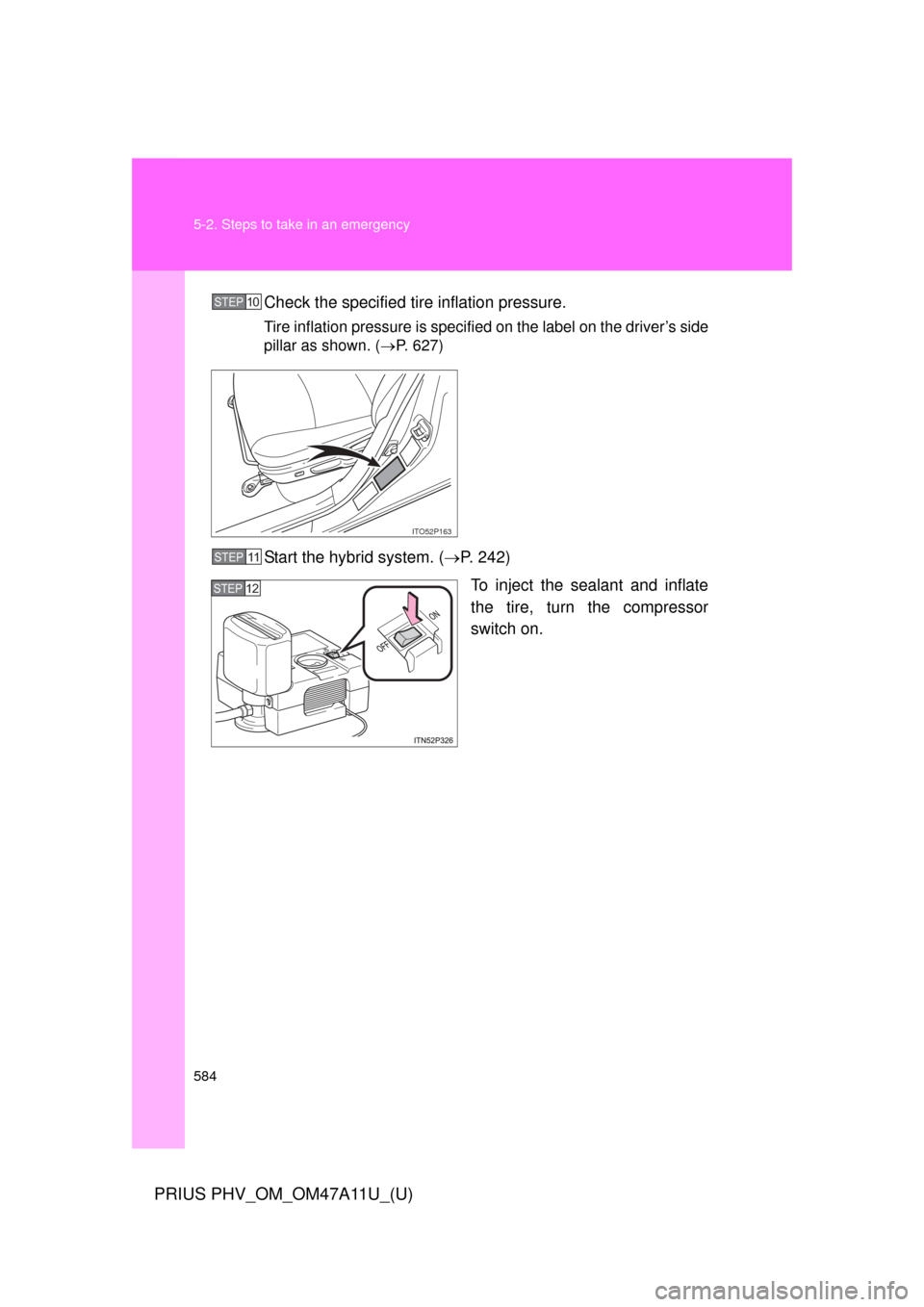
Check the specified tire inflation pressure.
Tire inflation pressure is specified on the label on the driver’s side
pillar as shown. ( P. 627)
Start the hybrid system. ( P. 242)
To inject the sealant and inflate
the tire, turn the compressor
switch on.
STEP10
ITO52P163
STEP11
STEP12
Page 585 of 692
5
When trouble arises
585
5-2. Steps to take in an emergency
PRIUS PHV_OM_OM47A11U_(U)
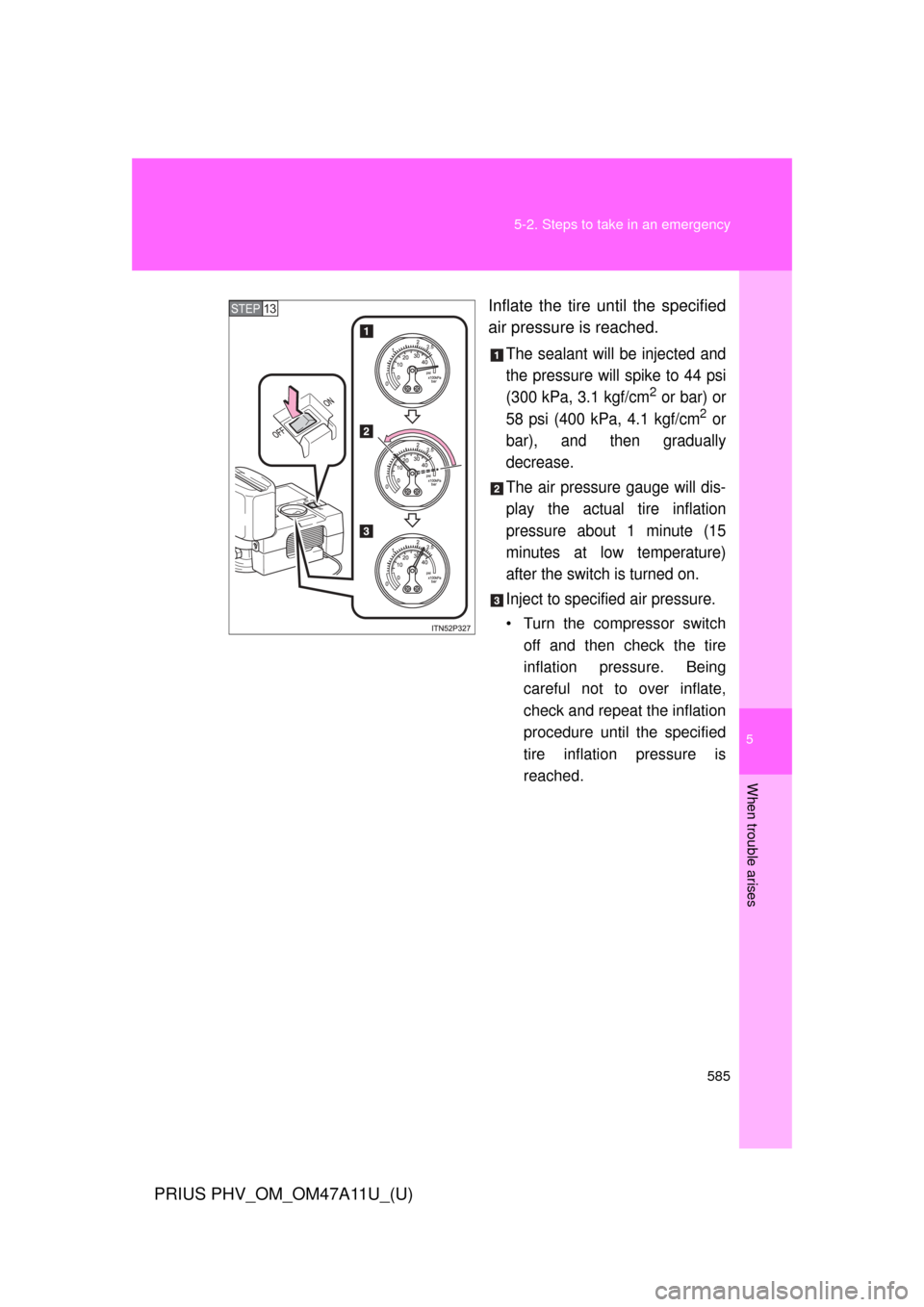
Inflate the tire until the specified
air pressure is reached.
The sealant will be injected and
the pressure will spike to 44 psi
(300 kPa, 3.1 kgf/cm
2 or bar) or
58 psi (400 kPa, 4.1 kgf/cm2 or
bar), and then gradually
decrease.
The air pressure gauge will dis-
play the actual tire inflation
pressure about 1 minute (15
minutes at low temperature)
after the switch is turned on.
Inject to specified air pressure.
• Turn the compressor switch
off and then check the tire
inflation pressure. Being
careful not to over inflate,
check and repeat the inflation
procedure until the specified
tire inflation pressure is
reached.
STEP13
Page 586 of 692
586 5-2. Steps to take in an emergency
PRIUS PHV_OM_OM47A11U_(U)
• If the tire inflation pressure isstill lower than the specified
point after inflation for 10
minutes (40 minutes at low
temperature) with the switch
on, the tire is too damaged to
be repaired. Turn the com-
pressor switch off and con-
tact your Toyota dealer.
• If the tire inflation pressure exceeds the specified air
pressure, let out some air to
adjust the tire inflation pres-
sure. ( P. 590, 627)
With the compressor switch off, disconnect the hose from the
valve on the tire and then pull out the power plug from the
power outlet socket.
Some sealant may leak when the hose is removed.
Install the valve cap onto the valve of the emergency repaired
tire.
STEP14
STEP15
Page 588 of 692
588 5-2. Steps to take in an emergency
PRIUS PHV_OM_OM47A11U_(U)
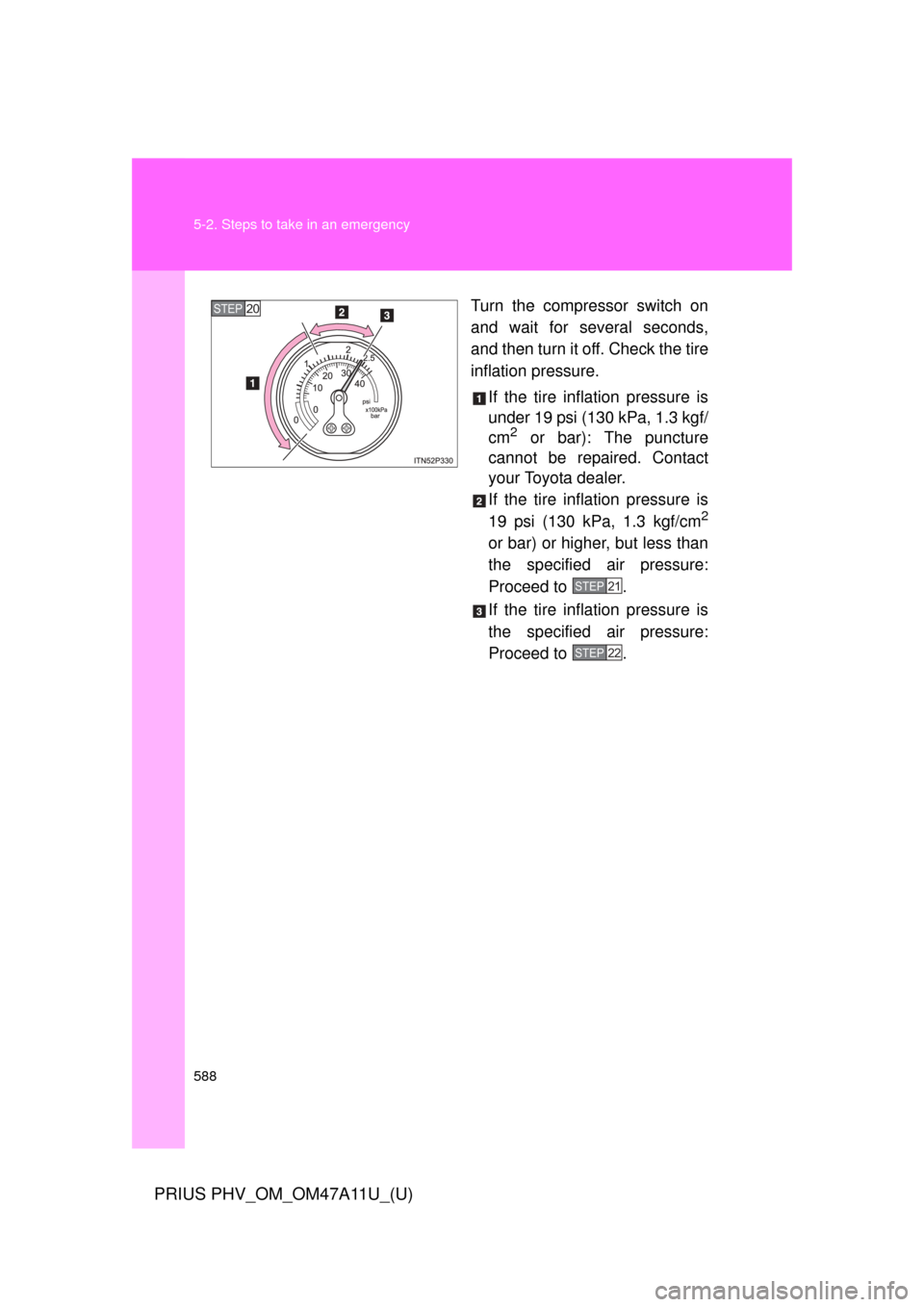
Turn the compressor switch on
and wait for several seconds,
and then turn it off. Check the tire
inflation pressure.If the tire inflation pressure is
under 19 psi (130 kPa, 1.3 kgf/
cm
2 or bar): The puncture
cannot be repaired. Contact
your Toyota dealer.
If the tire inflation pressure is
19 psi (130 kPa, 1.3 kgf/cm
2
or bar) or higher, but less than
the specified air pressure:
Proceed to .
If the tire inflation pressure is
the specified air pressure:
Proceed to .
STEP20
STEP21
STEP22
Page 589 of 692
5
When trouble arises
589
5-2. Steps to take in an emergency
PRIUS PHV_OM_OM47A11U_(U)
Turn the compressor switch on to inflate the tire until the spec-
ified air pressure is reached. Drive for about 3 miles (5 km)
and then perform .
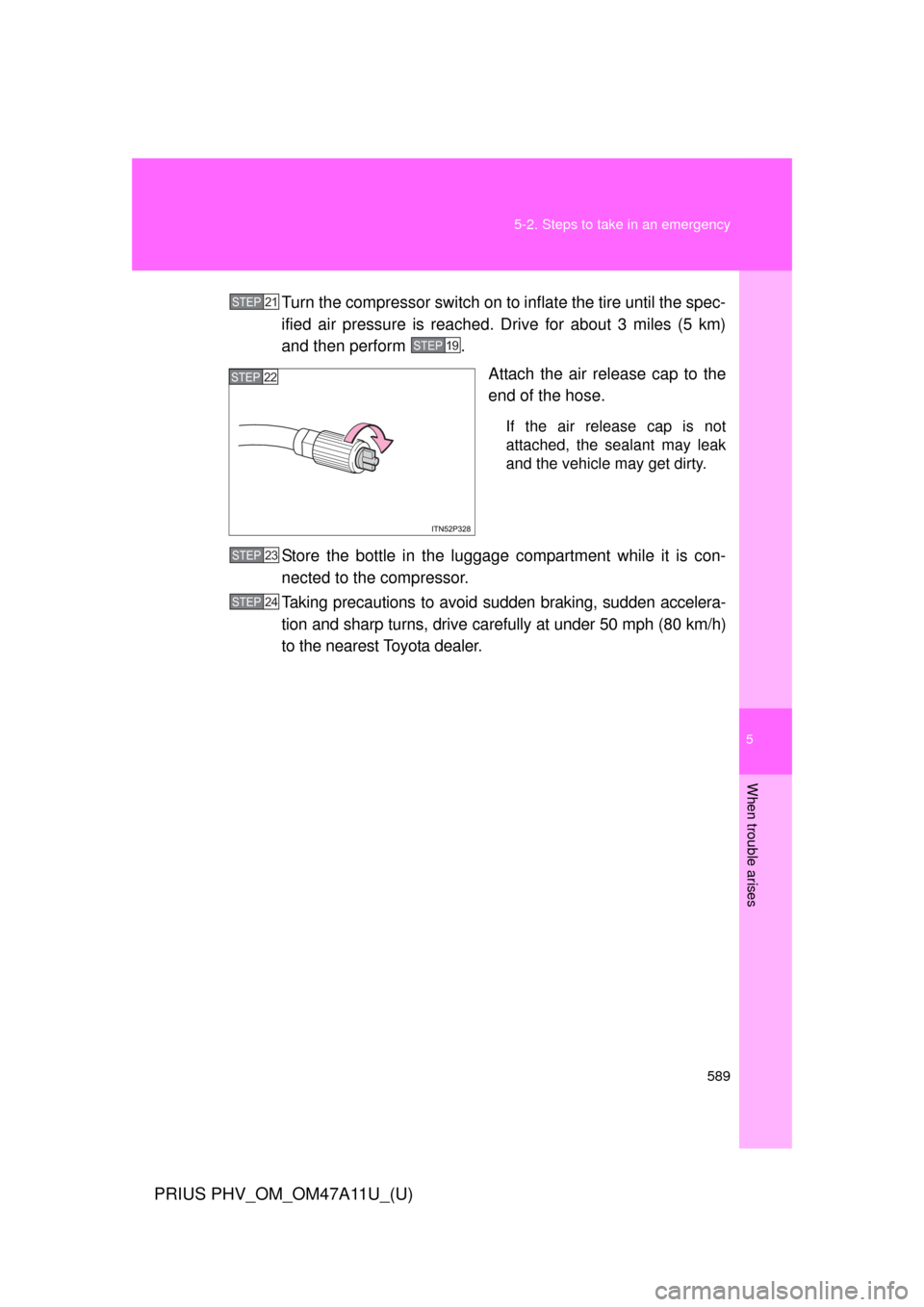
Attach the air release cap to the
end of the hose.
If the air release cap is not
attached, the sealant may leak
and the vehicle may get dirty.
Store the bottle in the luggage compartment while it is con-
nected to the compressor.
Taking precautions to avoid sudden braking, sudden accelera-
tion and sharp turns, drive carefully at under 50 mph (80 km/h)
to the nearest Toyota dealer.
STEP21
STEP19
STEP22
STEP23
STEP24