Page 394 of 500
3947-2. Steps to take in an emergency
AVALON (U)_(OM41456U)
■SRS warning light
This warning light system monitors the airbag sensor assembly, front impact
sensors, side impact sensors (front), side impact sensors (rear), driver’s seat
belt buckle switch, front passenger occupant classification system, “AIR BAG
ON” indicator light, “AIR BAG OFF” indicator light, front passenger’s seat belt
buckle switch, seat belt pretensioners, airbags, interconnecting wiring and
power sources. ( P. 3 5 )
■ Front passenger detection sensor, seat belt reminder and warning
buzzer
If luggage is placed on the front passenger seat, the front passenger detec-
tion sensor may cause the warning light to flash and the warning buzzer to
sound even if a passenger is not sitting in the seat.
■ If the malfunction indicator la mp comes on while driving
First check the following:
● Is the fuel tank empty?
If it is, fill the fuel tank immediately.
● Is the fuel tank cap loose?
If it is, tighten it securely.
The light will go off after several driving trips.
If the light does not go off even after several trips, contact your Toyota dealer
as soon as possible.
■ Electric power steering system warning light (warning buzzer)
When the battery charge becomes insufficient or the voltage temporarily
drops, the electric power steering system warning light may come on and the
warning buzzer may sound.
■
When the tire pressure warning light comes on
Check the tire inflation pressure and adjust to the appropriate level. Push-
ing the tire pressure warning reset switch will not turn off the tire pressure
warning light.
■The tire pressure warning light may come on due to natural causes
The tire pressure warning light may come on due to natural causes such
as natural air leaks and tire inflation pressure changes caused by temper-
ature. In this case, adjusting the ti re inflation pressure will turn off the
warning light (after a few minutes).
Page 404 of 500
4047-2. Steps to take in an emergency
AVALON (U)_(OM41456U)
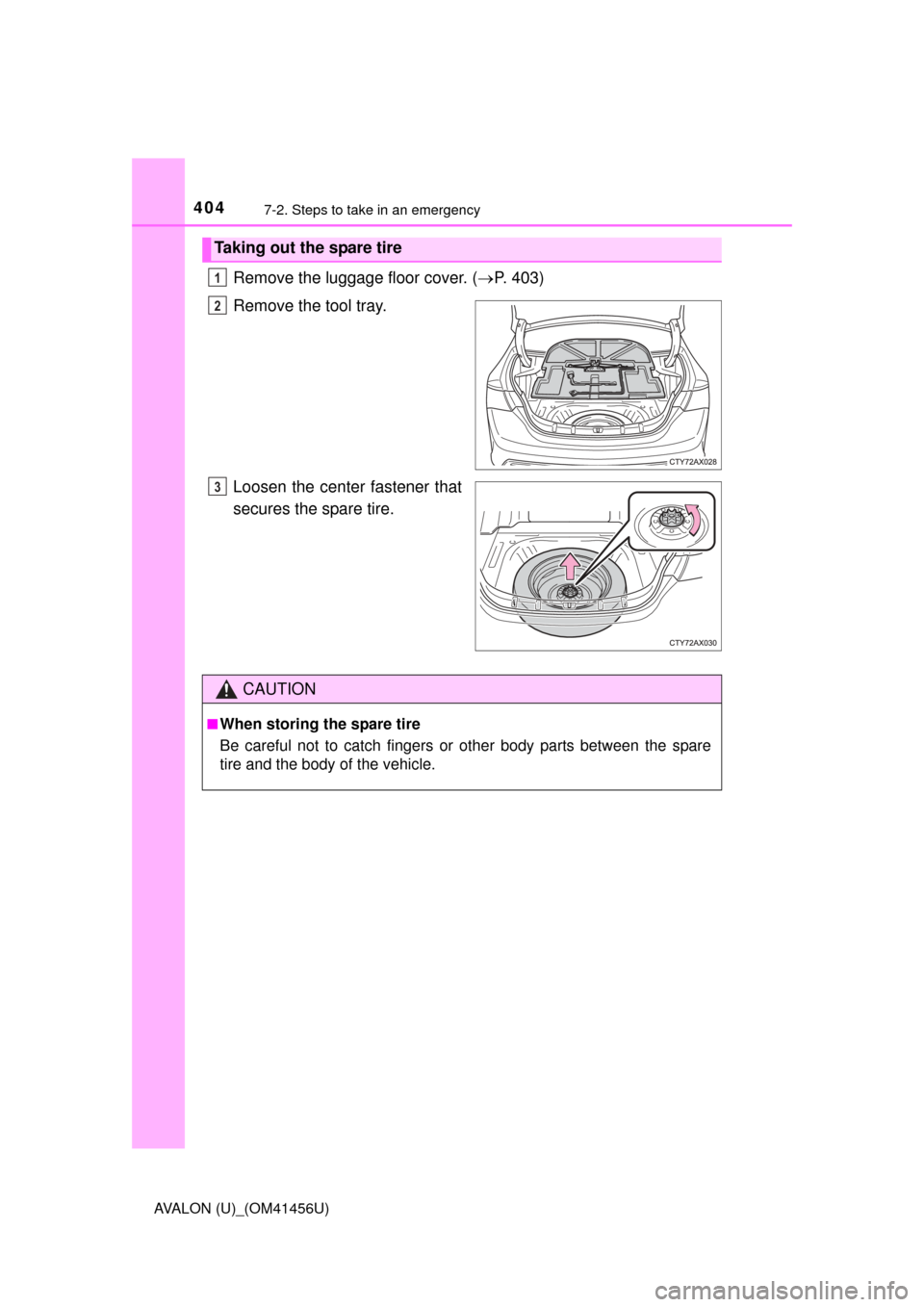
Remove the luggage floor cover. (P. 403)
Remove the tool tray.
Loosen the center fastener that
secures the spare tire.
Taking out the spare tire
1
2
3
CAUTION
■When storing the spare tire
Be careful not to catch fingers or other body parts between the spare
tire and the body of the vehicle.
Page 412 of 500

4127-2. Steps to take in an emergency
AVALON (U)_(OM41456U)
CAUTION
■Speed limit when using the compact spare tire
Do not drive at speeds in excess of 50 mph (80 km/h) when a compact
spare tire is installed on the vehicle.
The compact spare tire is not designed for driving at high speeds. Fail-
ure to observe this precaution may lead to an accident causing death or
serious injury.
■After using the tools and jack
Before driving, make sure all the tools and jack are securely in place in
their storage location to reduce the possibility of personal injury during a
collision or sudden braking.
NOTICE
■Driving with tire chains and the compact spare tire
Do not fit tire chains to the compact spare tire.
Tire chains may damage the vehicle body and adversely affect driving
performance.
■When replacing the tires
When removing or fitting the wheels, tires or the tire pressure warning
valve and transmitter, contact your Toyota dealer as the tire pressure
warning valve and transmitter may be damaged if not handled correctly.
Page 453 of 500
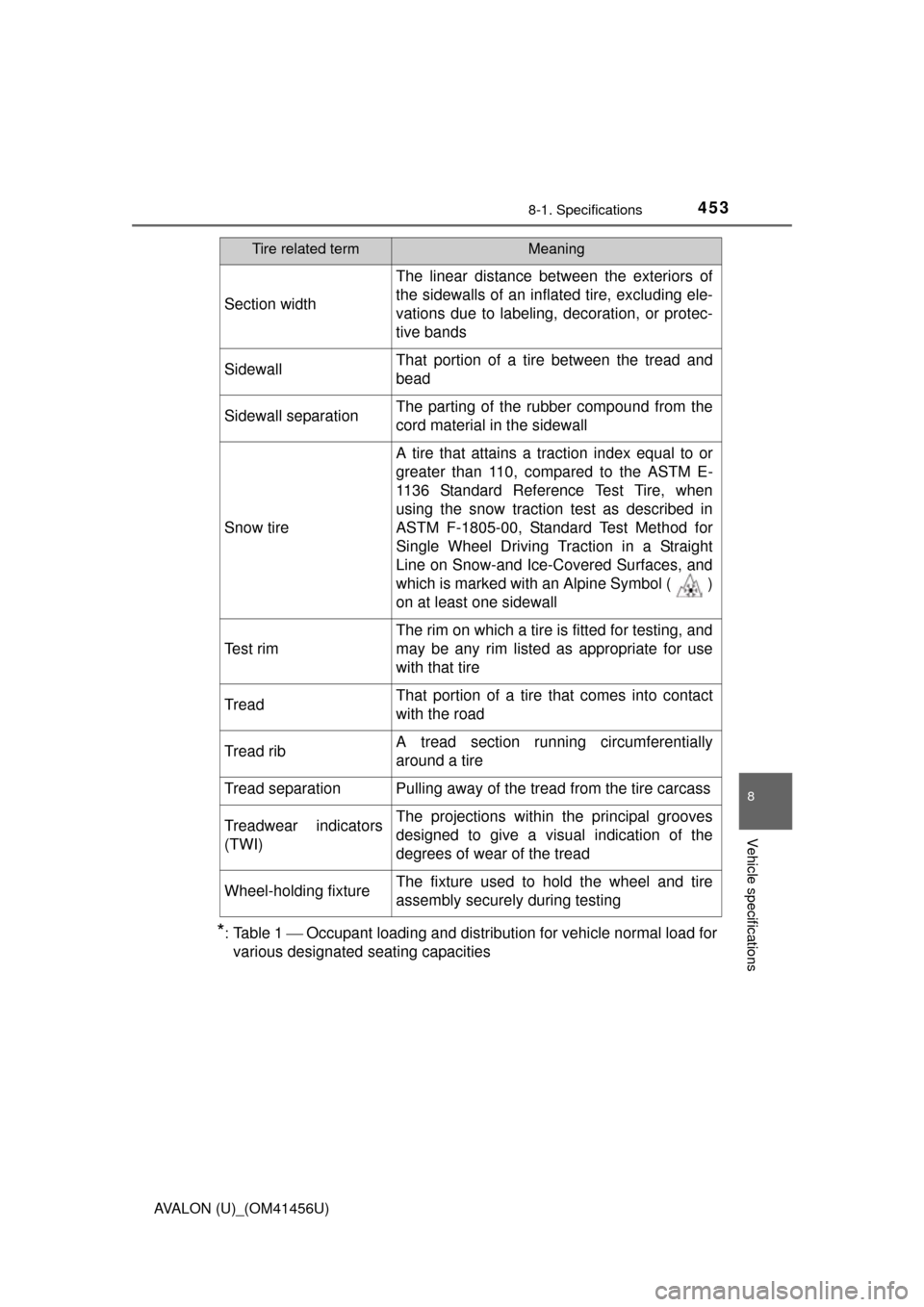
4538-1. Specifications
8
Vehicle specifications
AVALON (U)_(OM41456U)
*:Table 1 Occupant loading and distribution for vehicle normal load for
various designated seating capacities
Section width
The linear distance between the exteriors of
the sidewalls of an inflated tire, excluding ele-
vations due to labeling, decoration, or protec-
tive bands
SidewallThat portion of a tire between the tread and
bead
Sidewall separationThe parting of the rubber compound from the
cord material in the sidewall
Snow tire
A tire that attains a traction index equal to or
greater than 110, compared to the ASTM E-
1136 Standard Reference Test Tire, when
using the snow traction test as described in
ASTM F-1805-00, Standard Test Method for
Single Wheel Driving Traction in a Straight
Line on Snow-and Ice-Covered Surfaces, and
which is marked with an Alpine Symbol ( )
on at least one sidewall
Test rim
The rim on which a tire is fitted for testing, and
may be any rim listed as appropriate for use
with that tire
TreadThat portion of a tire that comes into contact
with the road
Tread ribA tread section running circumferentially
around a tire
Tread separationPulling away of the tread from the tire carcass
Treadwear indicators
(TWI)The projections within the principal grooves
designed to give a visual indication of the
degrees of wear of the tread
Wheel-holding fixtureThe fixture used to hold the wheel and tire
assembly securely during testing
Tire related termMeaning
Page 465 of 500
465
9
For owners
AVALON (U)_(OM41456U)
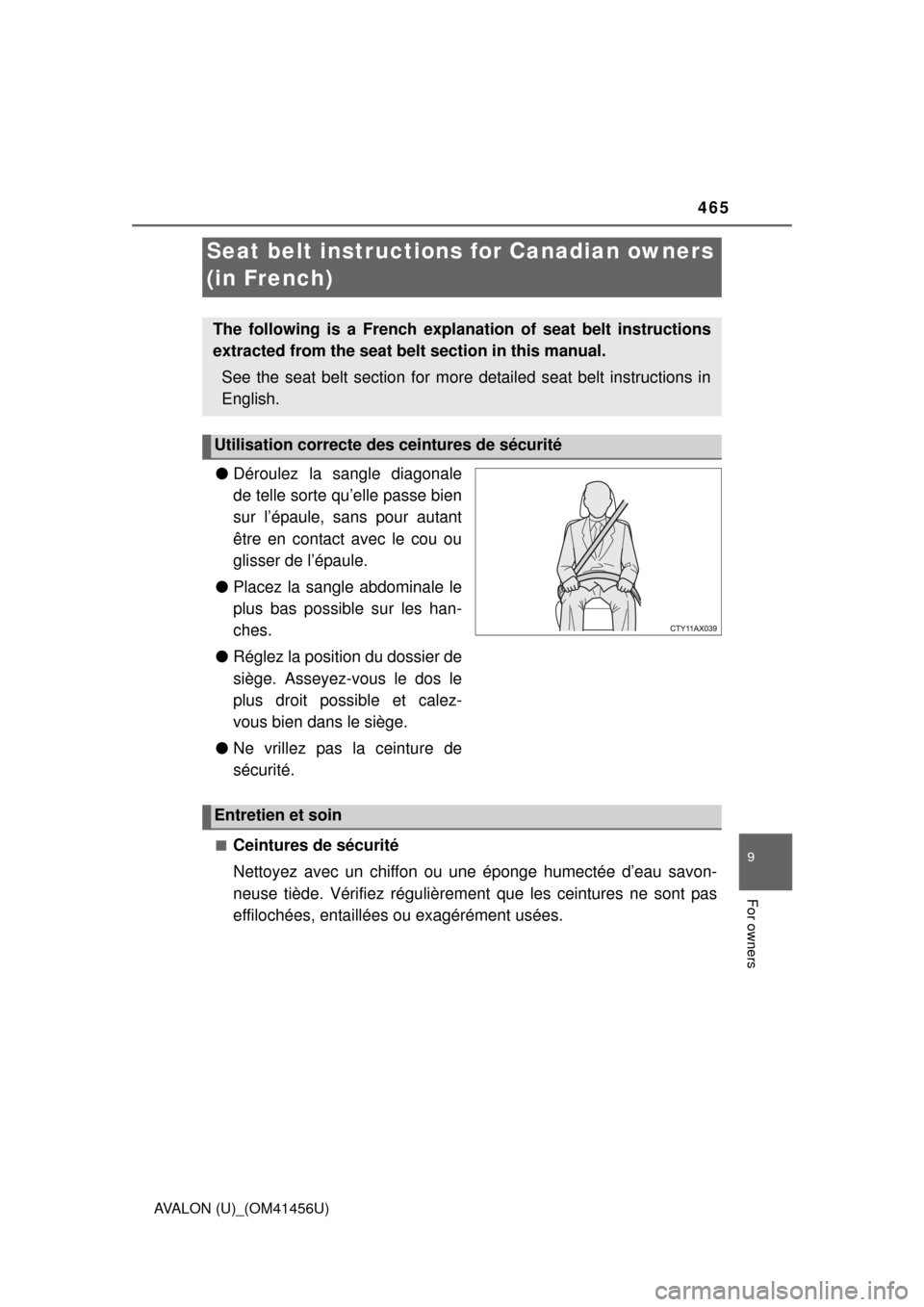
●Déroulez la sangle diagonale
de telle sorte qu’elle passe bien
sur l’épaule, sans pour autant
être en contact avec le cou ou
glisser de l’épaule.
● Placez la sangle abdominale le
plus bas possible sur les han-
ches.
● Réglez la position du dossier de
siège. Asseyez-vous le dos le
plus droit possible et calez-
vous bien dans le siège.
● Ne vrillez pas la ceinture de
sécurité.
■Ceintures de sécurité
Nettoyez avec un chiffon ou une éponge humectée d’eau savon-
neuse tiède. Vérifiez régulièrem ent que les ceintures ne sont pas
effilochées, entaillées ou exagérément usées.
Seat belt instructions for Canadian owners
(in French)
The following is a French explan ation of seat belt instructions
extracted from the seat be lt section in this manual.
See the seat belt section for more detailed seat belt instructions in
English.
Utilisation correcte des ceintures de sécurité
Entretien et soin
Page 466 of 500
466
AVALON (U)_(OM41456U)
AT T E N T I O N
■Détérioration et usure des ceintures de sécurité
Inspectez les ceintures de sécurité périodiquement. Contrôlez qu’elles ne
sont pas entaillées, effilochées et que leurs ancrages ne sont pas desser-
rés. N’utilisez pas une ceinture de sécurité défectueuse avant qu’elle ne soit
remplacée. Une ceinture de sécurité défectueuse n’apporte aucune garan-
tie de protection de l’occupant en cas d’accident.
Page 469 of 500
469
9
For owners
AVALON (U)_(OM41456U)
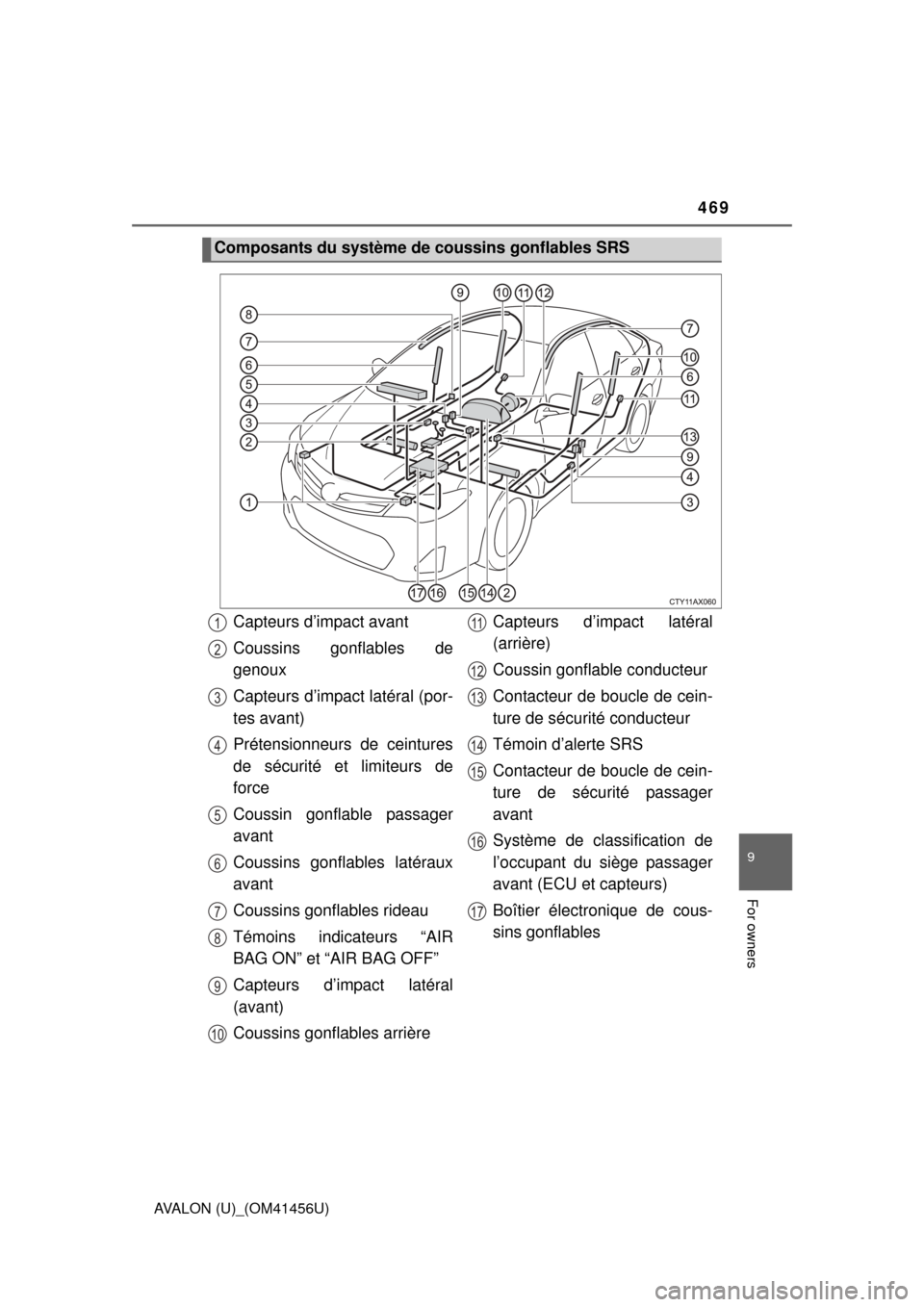
Composants du système de coussins gonflables SRS
Capteurs d’impact avant
Coussins gonflables de
genoux
Capteurs d’impact latéral (por-
tes avant)
Prétensionneurs de ceintures
de sécurité et limiteurs de
force
Coussin gonflable passager
avant
Coussins gonflables latéraux
avant
Coussins gonflables rideau
Témoins indicateurs “AIR
BAG ON” et “AIR BAG OFF”
Capteurs d’impact latéral
(avant)
Coussins gonflables arrière Capteurs d’impact latéral
(arrière)
Coussin gonflable conducteur
Contacteur de boucle de cein-
ture de sécurité conducteur
Témoin d’alerte SRS
Contacteur de boucle de cein-
ture de sécurité passager
avant
Système de classification de
l’occupant du siège passager
avant (ECU et capteurs)
Boîtier électronique de cous-
sins gonflables1
2
3
4
5
6
7
8
9
10
11
12
13
14
15
16
17
Page 470 of 500
470
AVALON (U)_(OM41456U)
Votre véhicule est équipé de COUSSINS GONFLABLES INTELLI-
GENTS conçus selon les normes de sécurité américaines applicables
aux véhicules à moteur (FMVSS208). Le boîtier électronique (ECU)
des coussins gonflables régule le déploiement de ces derniers sur la
base des informations qu’il reçoit des capteurs, etc., indiqués ci-des-
sus dans le schéma illustrant les composants du système. Parmi ces
informations figurent la gravité du choc et l’occupation du véhicule par
les passagers. Le déploiement rapi de des coussins gonflables est
obtenu au moyen d’une réaction chimique dans les dispositifs pyro-
techniques, qui produit un gaz inoffe nsif permettant d’amortir le mou-
vement des occupants.