Page 364 of 492
364
5-1. Essential information
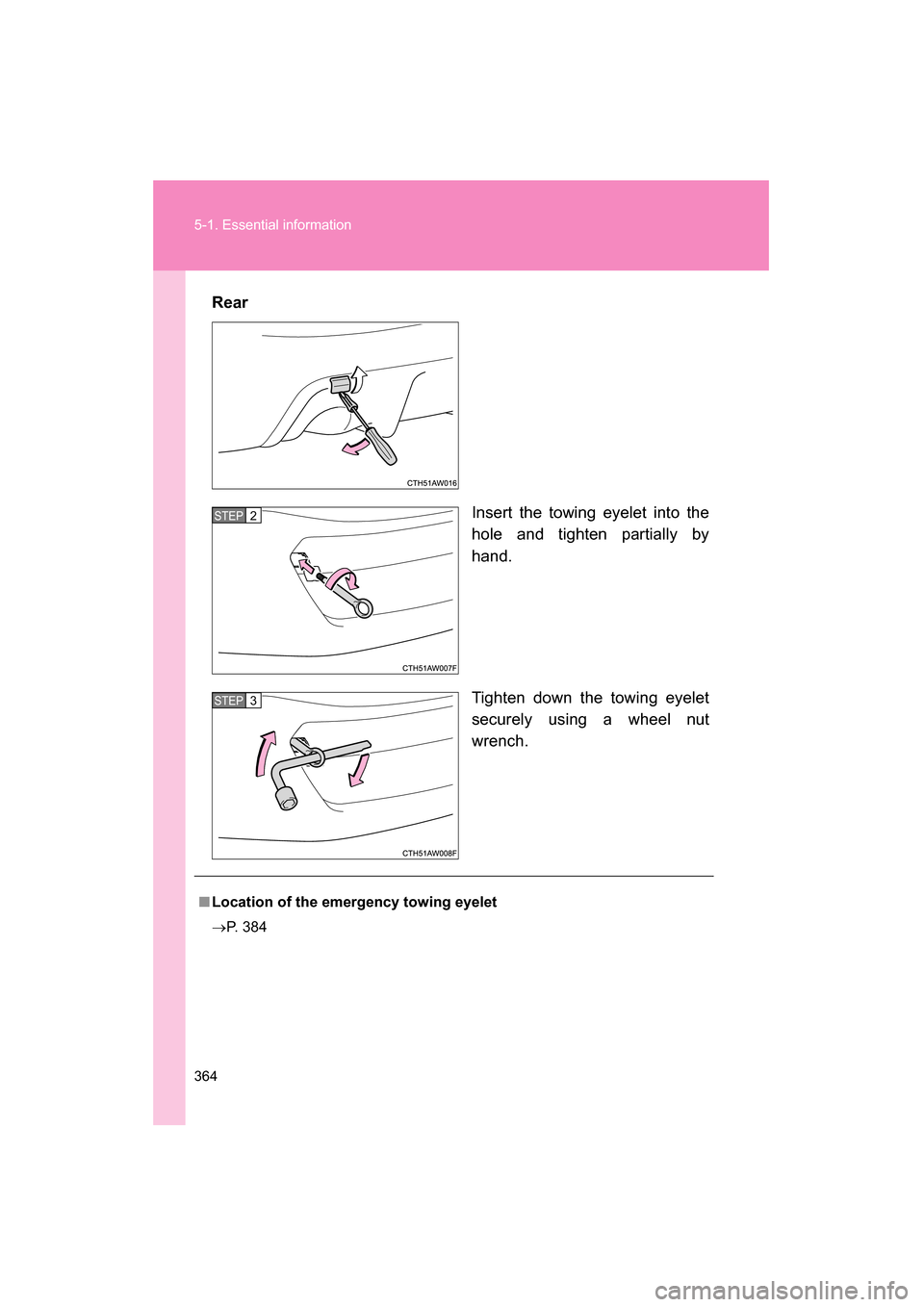
RearInsert the towing eyelet into the
hole and tighten partially by
hand.
Tighten down the towing eyelet
securely using a wheel nut
wrench.
STEP 2
STEP 3
■Location of the emergency towing eyelet
→P. 384
Page 365 of 492
5
When trouble arises
365
5-1. Essential information
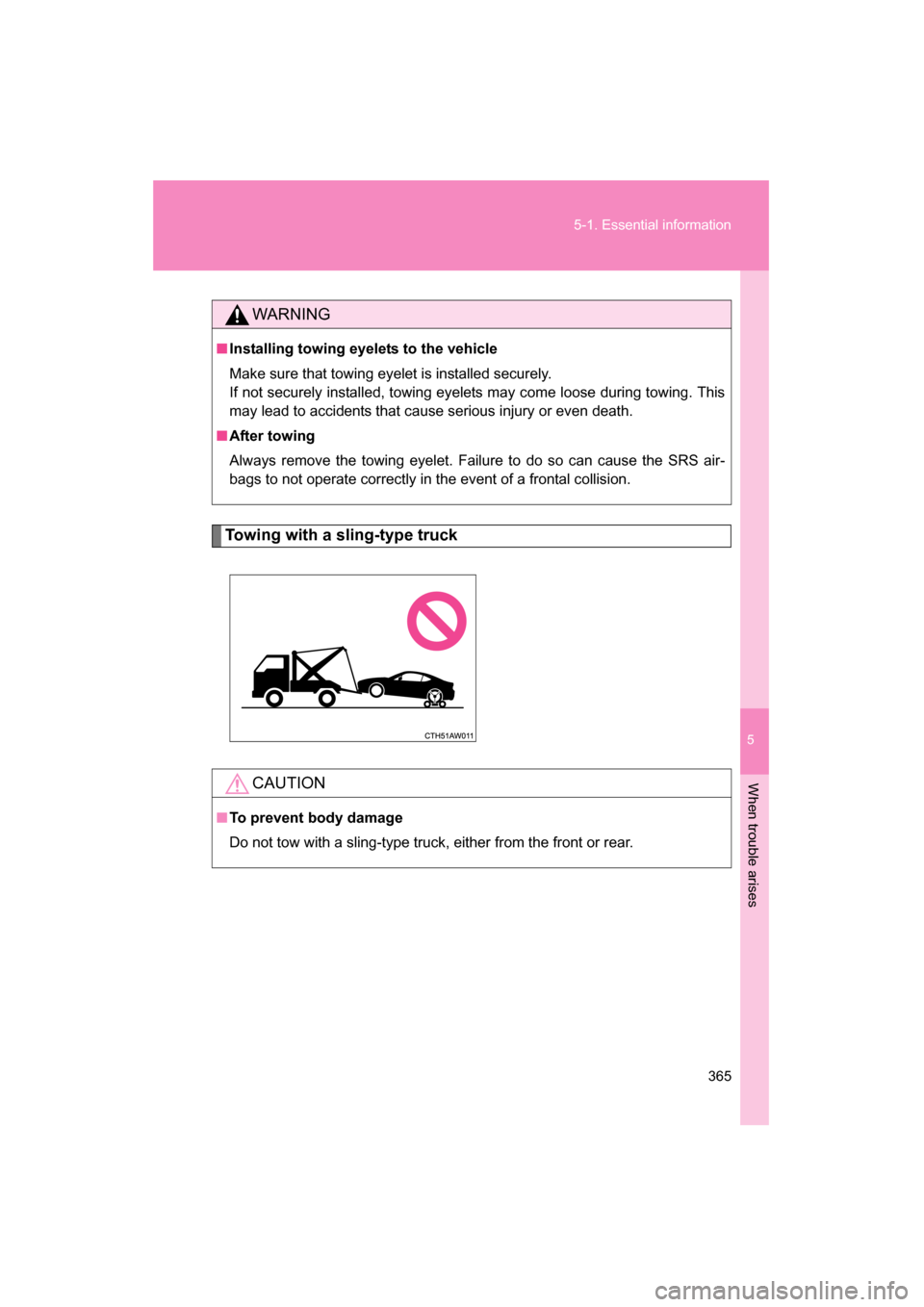
Towing with a sling-type truck
WARNING
■Installing towing eyelets to the vehicle
Make sure that towing eyelet is installed securely.
If not securely installed, towing eyelets may come loose during towing. This
may lead to accidents that cause serious injury or even death.
■After towing
Always remove the towing eyelet. Failure to do so can cause the SRS air-
bags to not operate correctly in the event of a frontal collision.
CAUTION
■To prevent body damage
Do not tow with a sling-type truck, either from the front or rear.
Page 372 of 492
372
5-2. Steps to take in an emergency
(Comes on in yellow) Cruise control indicator light
Indicates a malfunction in the cruise control system.
■If the malfunction indicator lamp comes on while driving
First check the following:
●Is the fuel tank empty?
If it is, fill the fuel tank immediately.
●Is the fuel tank cap loose?
If it is, tighten it securely.
The malfunction indicator lamp will go off after several driving trips.
If the malfunction indicator lamp does not go off even after several trips, con-
tact your SUBARU dealer as soon as possible.
■SRS airbag system warning light
→ P. 121
■Electric power steering warning light (warning buzzer)
The electric power steering warning light may come on and the warning
buzzer may sound when the voltage is low or the voltage drops.
WARNING
■When the electric power steering warning light comes on
The steering wheel may become extremely heavy.
If the steering wheel becomes heavier than usual when operating, hold
firmly and operate using more force than usual.
Warning lightWarning light/Details
Page 385 of 492
5
When trouble arises
385
5-2. Steps to take in an emergency
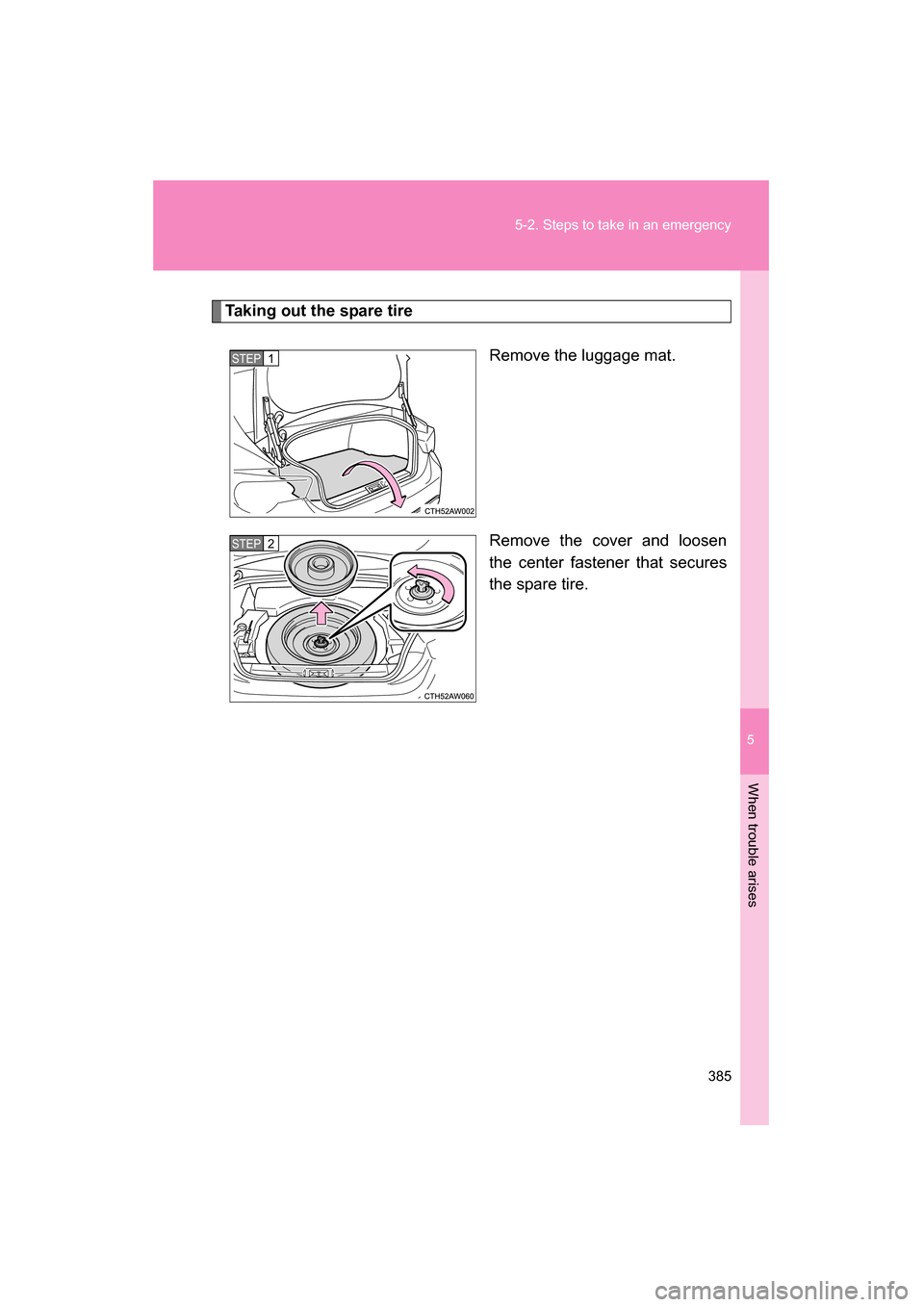
Taking out the spare tireRemove the luggage mat.
Remove the cover and loosen
the center fastener that secures
the spare tire.
STEP 1
STEP 2
Page 391 of 492
5
When trouble arises
391
5-2. Steps to take in an emergency
WARNING
■Using the tire jack
Improper use of the tire jack may lead to death or serious injuries due to
the vehicle suddenly falling off the jack.
●Do not use the tire jack for any purpose other than replacing tires or
installing and removing tire chains.
●Only use the tire jack that comes with this vehicle for replacing a flat
tire.
Do not use it on other vehicles, and do not use other tire jacks for
replacing tires on this vehicle.
●Always check that the tire jack is securely set to the jack point.
●Do not put any part of your body under the vehicle supported by a jack.
●Do not start or run the engine while your vehicle is supported by the
jack.
●Do not raise the vehicle while someone is in it.
●When raising the vehicle, do not put an object on or under the jack.
●Do not raise the vehicle to a height greater than that required to
replace the tire.
●Use a jack stand if it is necessary to get under the vehicle.
Take particular care when lowering the vehicle to ensure that no one
working on or near the vehicle may be injured.
Page 443 of 492
443
6-1. Specifications
6
Vehicle specifications
*:Table 1 Occupant loading and distribution for vehicle normal load
for various designated seating capacities
Tire related termMeaning
Snow tire A tire that attains a traction index equal to or
greater than 110, compared to the ASTM E-
1136 Standard Reference Test Tire, when
using the snow traction test as described in
ASTM F-1805-00, Standard Test Method for
Single Wheel Driving Traction in a Straight Line
on Snow-and Ice-Covered Surfaces, and which
is marked with an Alpine Symbol ( ) on at
least one sidewall
Te s t r i m The rim on which a tire is fitted for testing, and
may be any rim listed as appropriate for use
with that tire
Tread That portion of a tire that comes into contact
with the road
Tread rib A tread section running circumferentially
around a tire
Tread separation Pulling away of the tread from the tire carcass
Treadwear indicators
(TWI) The projections within the principal grooves
designed to give a visual indication of the
degrees of wear of the tread
Wheel-holding fixture The fixture used to hold the wheel and tire
assembly securely during testing
Page 451 of 492
451
7
For owners
Seatbelt instructions for Canadian owners (in French)
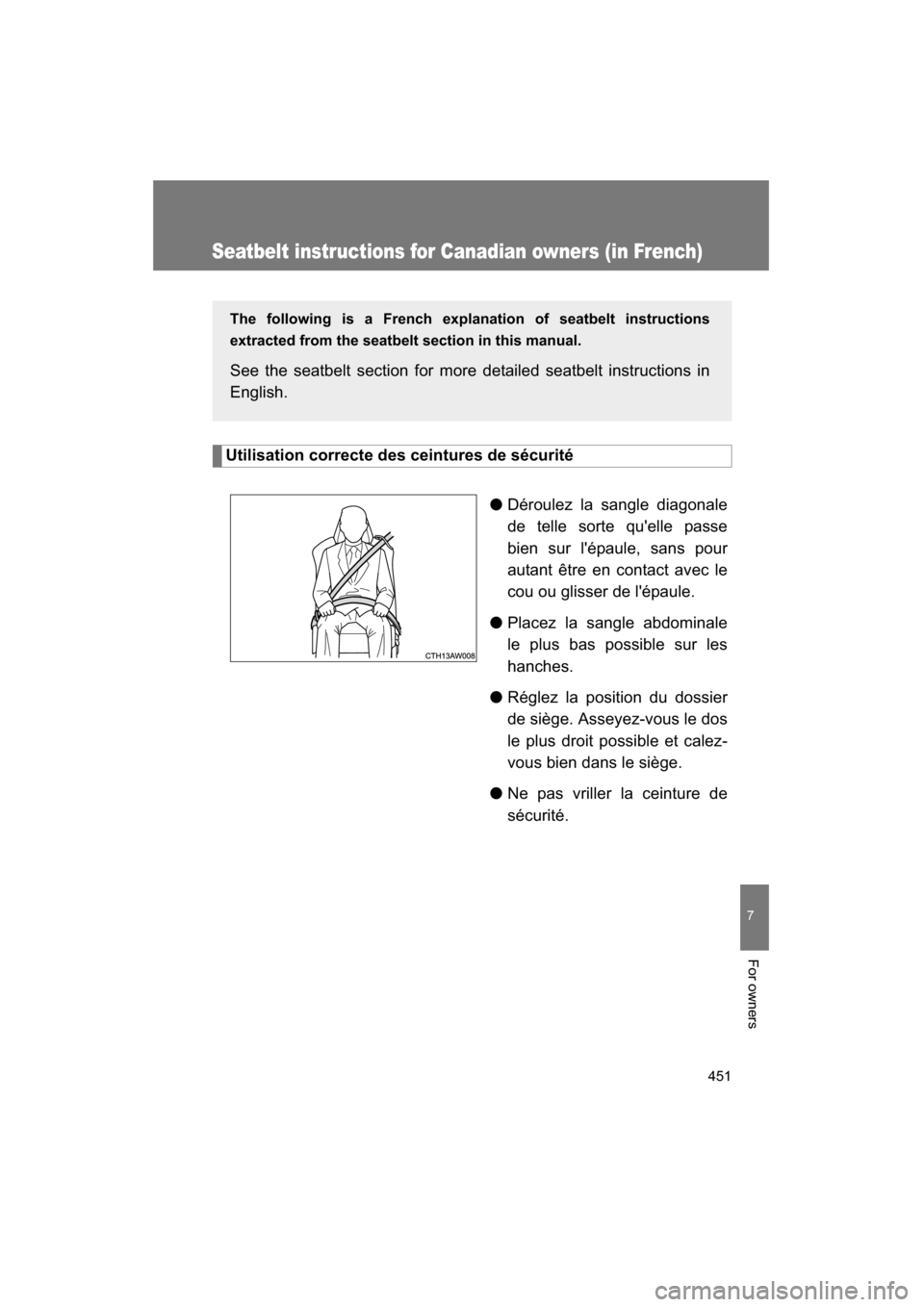
Utilisation correcte des ceintures de sécurité●Déroulez la sangle diagonale
de telle sorte qu'elle passe
bien sur l'épaule, sans pour
autant être en contact avec le
cou ou glisser de l'épaule.
● Placez la sangle abdominale
le plus bas possible sur les
hanches.
● Réglez la position du dossier
de siège. Asseyez-vous le dos
le plus droit possible et calez-
vous bien dans le siège.
● Ne pas vriller la ceinture de
sécurité.
The following is a French explanation of seatbelt instructions
extracted from the seatbelt section in this manual.
See the seatbelt section for more detailed seatbelt instructions in
English.
Page 452 of 492
452
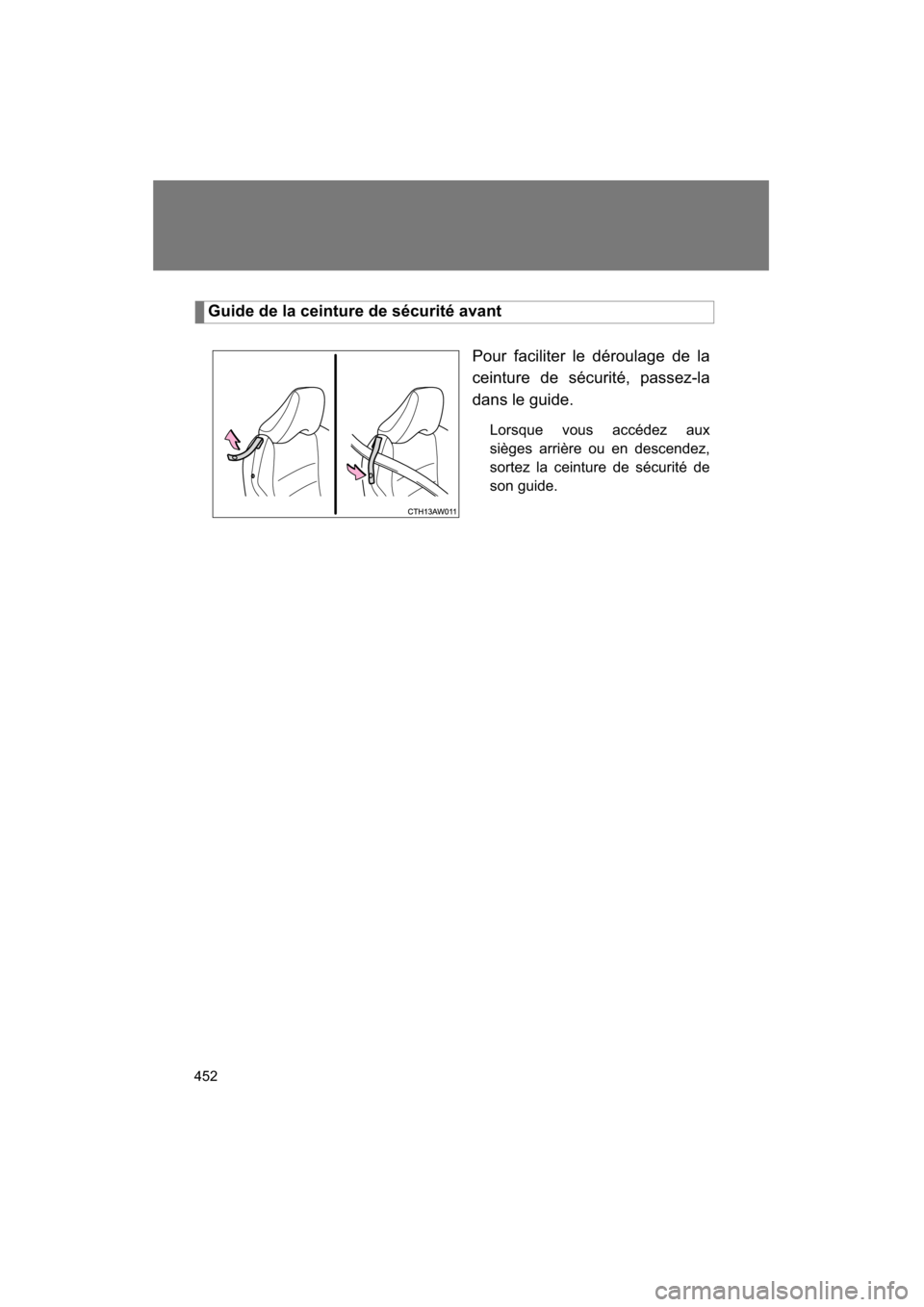
Guide de la ceinture de sécurité avantPour faciliter le déroulage de la
ceinture de sécurité, passez-la
dans le guide.
Lorsque vous accédez aux
sièges arrière ou en descendez,
sortez la ceinture de sécurité de
son guide.