2015 SMART FORTWO COUPE service
[x] Cancel search: servicePage 129 of 222

X
Push cap :onto the windshield washer
reservoir.
X Remount the service flap and close it
(Y page 123). Brake fluid
G
WARNING
During vehicle operation, the boiling
point of the brake fluid is continuously
reduced through the absorption of moisture from the atmosphere. Under extremely
strenuous operating conditions, this mois-
ture content can lead to the formation of
bubbles in the system, thus reducing the
system’s efficiency.
Therefore, the brake fluid must be replaced regularly. Refer to your vehicle’s Mainte-
nance Booklet for replacement interval.
The brake fluid level in the brake fluid
reservoir may be too low if the brake warn- ing lamp in the instrument cluster comes on(Y page 23) although the parking brake is
released.
! If you find that the brake fluid in the
brake fluid reservoir has fallen to the
minimum mark or below, have the brake
system checked for brake pad thickness
and leaks immediately. Contact an
authorized electric drive smart center
immediately. Do not add brake fluid as
this will not solve the problem.
X Remove the service flap and insert it on
the front of the vehicle (Y page 123).
The brake fluid reservoir is located in the
front compartment on the passenger side. Checking brake fluid level
X
Perform a visual check of the brake fluid
reservoir :.
The brake fluid level is correct when it
is between the minimum mark and the
maximum mark. R If the brake fluid level has fallen
slightly below the minimum mark,
drive to an authorized electric drive
smart center.
R If the brake fluid level has fallen sig-
nificantly below the minimum mark,
call Roadside Assistance or an author- ized electric drive smart center.
X Remount the service flap and close it
(Y page 123). Tires and wheels
Safety notes
Contact an authorized electric drive smart
center for information on tested and rec-
ommended rims and tires for summer and
winter operation. They can also offer
advice concerning tire service and pur-
chase. G
WARNING
Replace rims or tires with the same desig- nation, manufacturer and type as shown on
the original part. For further information
contact an authorized electric drive smart
center. If incorrectly sized rims and tires are mounted, the wheel brakes or suspen- Tires and wheels
127>> Operation.
Z
Page 139 of 222

For more information on tire load rating
(Y page 140).
For information on calculating total and
cargo load capacities (Y page 134).Direction of rotation
Unidirectional tires offer added advan-
tages, such as better hydroplaning per-
formance. To benefit, however, you must
make sure the tires rotate in the direction
specified.
An arrow on the sidewall indicates the
intended direction of rotation (spinning)
of the tire. Tire care and maintenance
G
WARNING
Regularly check the tires for damage. Dam- aged tires can cause tire inflation pres-
sure loss. As a result, you could lose control
of your vehicle.
Worn, old tires can cause accidents. If the
tire tread is badly worn, or if the tires have
sustained damage, replace them.
Check the tire inflation pressure at least
once a month. For more information on
checking tire inflation pressure, see
“Recommended tire inflation pressure”
(Y page 128).
Tire inspection Every time you check the tire inflation
pressure, you should also inspect your
tires for the following
R excessive treadwear (Y page 137)
R cord or fabric showing through the tire’s
rubber
R bumps, bulges, cuts, cracks or splits in
the tread or side of the tire
Replace the tire if you find any of the above conditions. Life of tire G
WARNING
Tires should be replaced after 6 years,
regardless of the remaining tread.
The service life of a tire is dependent upon varying factors including but not limited
to
R driving style
R tire inflation pressure
R distance driven
Tread depth G
WARNING
Although the applicable federal motor
vehicle safety laws consider a tire to be
worn when the treadwear indicators (TWI)
become visible at approximately 1
/ 16 in
(1.6 mm), we recommend that you do not allow your tires to wear down to that level. As
tread depth approaches 1
/ 8 in (3 mm), the
adhesion properties on a wet road are
sharply reduced.
Depending upon the weather and/or road
surface (conditions), the tire traction var- ies widely.
Do not allow your tires to wear down too far. Adhesion properties on wet roads are
sharply reduced at tread depths of less than
1 / 8 in (3 mm).
Treadwear indicators (TWI) are required by law. These indicators are located in six
places on the tread circumference and
become visible at a tread depth of approx-
imately 1
/ 16 in (1.6 mm), at which point the
tire is considered worn and should be
replaced.
Recommended minimum tire tread depth:
Summer tires 1
/ 8 in (3 mm)
Winter tires 1
/ 6 in (4 mm) Tires and wheels
137>> Operation. Z
Page 140 of 222

Treadwear indicator
:appears as a solid
band across the tread.
Storing tires !
Keep unmounted tires in a cool, dry
place with as little exposure to light as
possible. Protect tires from contact with oil, grease and fuels.
Cleaning tires !
Never use a round nozzle to power wash
tires. The intense jet of water can result in damage to the tire.
Always replace a damaged tire. Uniform Tire Quality Grading Stand-
ards
The Uniform Tire Quality Grading is a U.S.
Government requirement designed to give
drivers consistent and reliable informa-
tion regarding tire performance. Tire
manufacturers are required to grade tires
based on three performance factors: tread- wear
:, traction ;, and temperature
resistance =. Although not a Government
of Canada requirement, all tires made for
sale in North America have these grades
branded on the sidewall.
i For illustration purposes only. Actual
data on tires are specific to each vehicle and may vary from data shown in above
illustration.
Quality grades can be found, where appli-
cable, on the tire sidewall between tread
shoulder and maximum section width. For
example: Treadwear Traction Temperature
200 AA A
All passenger car tires must conform to
federal safety requirements in addition to
these grades.
Treadwear The treadwear grade is a comparative rat-
ing based on the wear rate of the tire when
tested under controlled conditions on a
specified U.S. government test course. For example, a tire graded 150 would wear one
and one-half (1 1
/ 2 ) times as well on the
government course as a tire graded 100.
The relative performance of tires depends
upon the actual conditions of their use,
however, and may depart significantly from
the norm due to variations in driving hab-
its, service practices and differences in
road characteristics and climate.
Traction G
WARNING
The traction grade assigned to this tire is based on straight-ahead braking traction
tests, and does not include acceleration,
cornering, hydroplaning, or peak traction
characteristics. 138
Tires and wheels>> Operation.
Page 143 of 222

Always replace rims and tires with the same
designation, manufacturer and type as
shown on the original part. G
WARNING
Do not overload the tires by exceeding the
specified load limit as indicated on the
Tire and Loading Information placard on
the driver’s door B‑pillar. Overloading the tires can overheat them, possibly causing a
blowout. Overloading the tires can also
result in handling or steering problems, or brake failure.
Tire load rating Ais a numerical code
associated with the maximum load a tire
can support.
For example, a load rating of 91 corre-
sponds to a maximum load of 1356 lbs
(615 kg) the tire is designed to support.
See also “Maximum tire load” (Y page 136)
where the maximum load associated with
the load index is indicated in kilograms
and lbs.
For additional information on tire load
rating, see “Load identification”
(Y page 142).
Tire speed rating G
WARNING
Even when permitted by law, never operate a
vehicle at speeds greater than the maximum speed rating of the tires.
Exceeding the maximum speed for which
tires are rated can lead to sudden tire fail-
ure, causing loss of vehicle control and
possibly resulting in an accident and/or
personal injury and possible death, for you and for others.
Regardless of the tire speed rating, local
speed limits should be obeyed. Use prudent driving speeds appropriate to prevailing
conditions.
Tire speed rating Bindicates the
approved maximum speed for the tire. Summer tires Index Speed rating
Q up to 100 mph (160 km/h)
R up to 106 mph (170 km/h)
S up to 112 mph (180 km/h)
T up to 118 mph (190 km/h)
H up to 130 mph (210 km/h)
V up to 149 mph (240 km/h)
W up to 168 mph (270 km/h)
Y up to 186 mph (300 km/h)
ZR...Y above 186 mph (300 km/h)
ZR...(Y) above 186 mph (300 km/h)
ZR above 149 mph (240 km/h)
R
At the tire manufacturer’s option, any
tire with a speed capability above
149 mph (240 km/h) can include a “ZR” in
the size designation (for example:
245/40 ZR18). To determine the maximum
speed capability of the tire, the service description for the tire must be referred to.
The service description is comprised of
tire load rating Aand tire speed rating
B.
If your tire includes “ZR” in the size
designation and no service description
is given, the tire manufacturer must be
consulted for the maximum speed capa-
bility.
If a service description is given, the
speed capability is limited by the speed
symbol in the service description.
Example: 245/40 ZR18 97Y.
In this example, “97Y” is the service
description. The letter “Y” designates
the speed rating and the speed capabil- Tires and wheels
141>> Operation. Z
Page 144 of 222
ity of the tire is limited to 186 mph
(300 km/h).
R Any tire with a speed capability above
186 mph (300 km/h) must include a “ZR” in
the size designation AND the service
description must be placed in parenthe- sis. Example: 275/40 ZR 18 (99Y). The “(Y)”speed rating in parenthesis designates
the maximum speed capability of the tire
as being above 186 mph (300 km/h). Con-
sult the tire manufacturer for the actual
maximum permissible speed of the tire.
All-season and winter tires Index Speed rating
Q M+S
7 up to 100 mph (160 km/h)
T M+S
7 up to 118 mph (190 km/h)
H M+S
7 up to 130 mph (210 km/h)
V M+S
7 up to 149 mph (240 km/h)
i
Not all M+S rated tires provide special
winter performance. Make sure the tires
you use show M+S and the mountain/snow-
flake marking ion the tire sidewall.
These tires meet specific snow traction
performance requirements of the Rubber
Manufacturers Association (RMA) and the Rubber Association of Canada (RAC) and
have been designed specifically for use
in snow conditions. Load identification
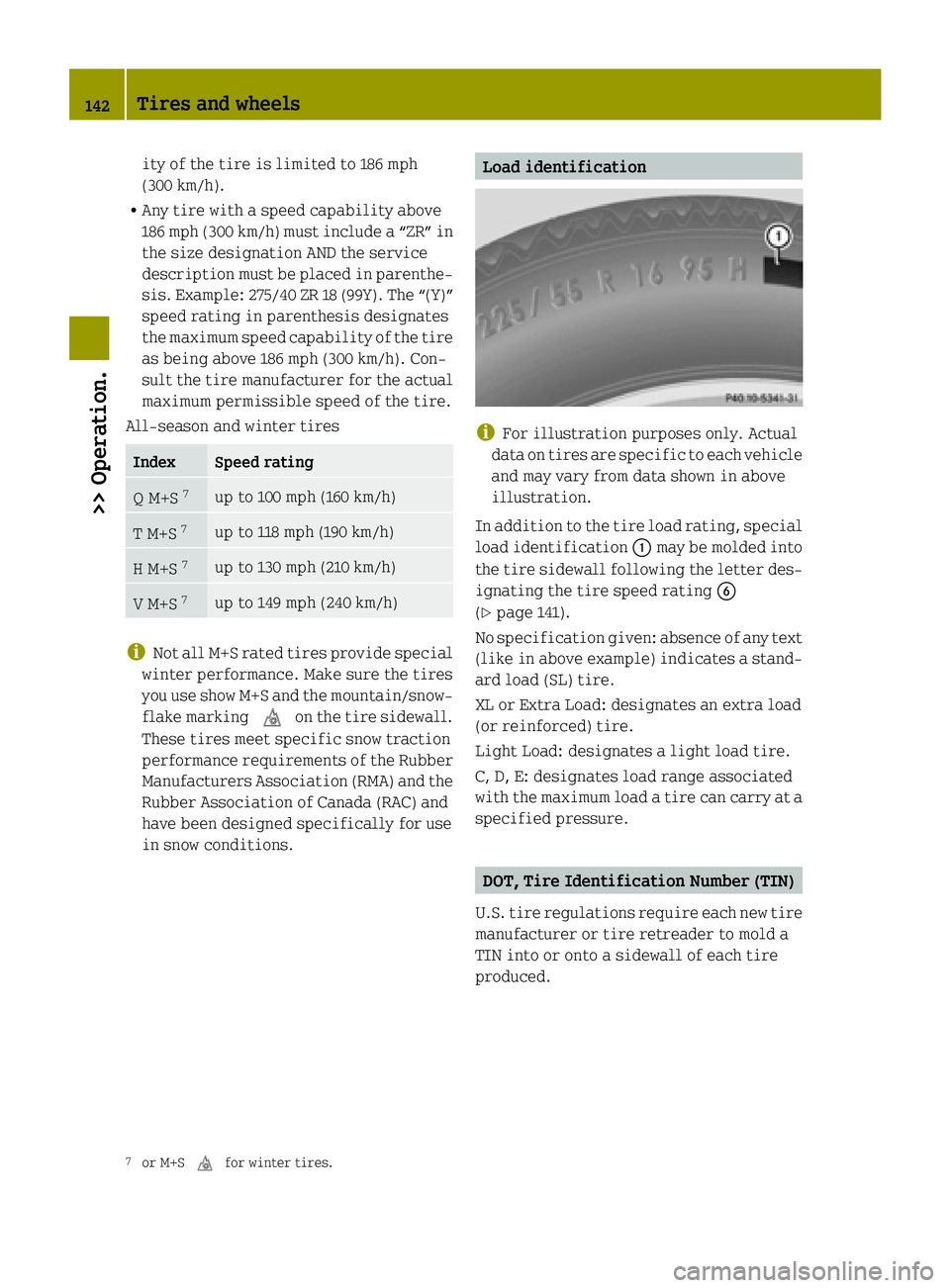
i
For illustration purposes only. Actual
data on tires are specific to each vehicle and may vary from data shown in above
illustration.
In addition to the tire load rating, special
load identification :may be molded into
the tire sidewall following the letter des-
ignating the tire speed rating B
(Y page 141).
No specification given: absence of any text (like in above example) indicates a stand-
ard load (SL) tire.
XL or Extra Load: designates an extra load
(or reinforced) tire.
Light Load: designates a light load tire.
C, D, E: designates load range associated
with the maximum load a tire can carry at a
specified pressure. DOT, Tire Identification Number (TIN)
U.S. tire regulations require each new tire
manufacturer or tire retreader to mold a
TIN into or onto a sidewall of each tire
produced.
7 or M+S ifor winter tires. 142
Tires and wheels>> Operation.
Page 148 of 222

Treadwear indicators
Narrow bands, sometimes called “wear
bars” that show across the tread of a tire
when only 1
/ 16 in (1.6 mm) of tread remains.
Uniform Tire Quality Grading Standards A tire information system that provides
consumers with ratings for a tire’s trac-
tion, temperature and treadwear. Ratings
are determined by tire manufacturers
using U.S. government testing procedures.
The ratings are molded into the sidewall of the tire.
Vehicle maximum load on the tire Load on an individual tire that is deter-
mined by distributing to each axle its
share of the maximum loaded vehicle
weight and dividing it by two. Winter driving
Before the onset of winter, have your vehi- cle winterized at an authorized electric
drive smart center.
This service includes:
R Check of anticorrosion and antifreeze
concentration.
R Addition of washer concentrate to the
water of the windshield/rear window.
Use a windshield washer concentrate
labeled for winter which is formulated
for temperatures below freezing point
(Y page 218).
R 12 V battery test. The capacity of the
12 V battery test drops with decreasing
ambient temperature.
R Tire change. Winter tires
G
WARNING
Winter tires with a tread depth of less than 1 / 6 in (4 mm) must be replaced. They are no
longer suitable for winter operation.
Always use winter tires at temperatures
below 45 ¦(7¥) and whenever wintry road
conditions prevail. Not all M+S rated tires provide special winter performance. Make
sure the tires you use show the mountain/
snowflake marking ion the tire side-
wall. These tires meet specific snow trac-
tion performance requirements of the Rub- ber Manufacturers Association (RMA) and
the Rubber Association of Canada (RAC) and
have been designed specifically for use in
snow conditions. Use of winter tires is the only way to achieve the maximum effective-
ness of the ABS and ESP ®
in winter opera-
tion.
For safe handling, make sure all mounted
winter tires are of the same make and have
the same tread design.
For information on winter tires for your
vehicle model, see the "Technical data"
section (Y page 216).
Always observe the speed rating of the win-
ter tires installed on your vehicle. If the
maximum speed for which your tires are
rated is below the speed rating of your
vehicle, you must place a notice to this
effect where it will be seen by the driver.
Such notices are available at your tire
dealer or any authorized electric drive
smart center. Snow chains*
! Remember that snow chains must always
be compatible with the tire sizes of a
vehicle. Snow chains that are approved
by smart are only permitted for the fol-
lowing tire size:
175/55 R15 on the rear axle. 146
Winter driving>> Operation.
* optional
Page 150 of 222

keep in mind that a considerably higher
degree of effort is necessary to brake and
steer the vehicle. Adapt your driving
accordingly. Brakes
G
WARNING
Make sure not to endanger any other road
users when carrying out braking maneu-
vers.
Refer to the description of the hydraulic
brake assistant (Y page 47).
! Because the ESP ®
operates automati-
cally, the ignition must be switched off
when the parking brake is being tested
on a brake test dynamometer. Active
braking action through the ESP ®
may oth-
erwise seriously damage the brake sys-
tem which is not covered by the smart
Limited Warranty.
Brake pad wear or a leak in the brake system may be the reason for low brake fluid level
in the brake fluid reservoir.
The brake fluid level in the brake fluid
reservoir may be too low if the brake warn- ing lamp in the instrument cluster comes on
(Y page 23) although the parking brake is
released.
Have the brake system inspected immedi-
ately. Contact an authorized electric drive
smart center.
All checks and service work on the brake
system should be carried out by qualified
technicians only. Contact an authorized
electric drive smart center.
Only install brake pads and use brake fluid
recommended by smart. Inclines G
WARNING
Resting your foot on the brake pedal will
cause excessive and premature wear of the
brake pads.
It can also result in the brakes overheat-
ing, thereby significantly reducing their
effectiveness and your ability to stop the
vehicle in sufficient time to avoid an acci- dent.
Please observe the following guidelines to
avoid that the permitted maximum speed is
exceeded when driving on downhill grades:
R Do not move the gear selector lever to N.
R Recuperation is limited, if:
- the high-voltage battery is fully
charged or too cold
- the power electronics or the electric
motor is overheated.
When driving down long and steep grades, do not depress the brake pedal perma-
nently. Depress it in intervals instead to
reduce the vehicle speed.
High and low stresses After hard braking, it is advisable to drive
on for some time, rather than immediately
park, so that the air stream will cool down
the brakes faster.
If your brake system is normally only sub-
jected to moderate loads, you should occa- sionally test the effectiveness of the
brakes by applying above-normal braking
pressure at higher speeds. This will also
enhance the grip of the brake pads. G
WARNING
Make sure not to endanger any other road
users when carrying out these braking
maneuvers. 148
Driving instructions>> Operation.
Page 155 of 222

For more information on coolant tempera-
ture warning lamp (Y page 172).Driving abroad
Abroad, there is an extensive smart service network at your disposal. If you plan to
drive into areas which are not listed in the
index of your smart center directory, you
should request pertinent information from an authorized electric drive smart center.
Keep in mind, however, that due to the tech-
nical requirements of the smart fortwo
electric drive and its high-voltage power
systems, the vehicle should be serviced
only at an authorized electric drive smart
center.
If you plan to operate your vehicle in for-
eign countries, please be aware that:
R Service facilities or replacement parts
may not be readily available.
R The AC power sockets in some countries,
especially overseas, require different
plugs on the charging cable.
R Charging stations may not be available. Symmetrical low beams
i If you drive in countries where vehi-
cles drive on the other side of the road
than the country in which the vehicle is
registered, you must have the headlamps
modified for symmetrical low beams.
Relevant information can be obtained at
any authorized electric drive smart cen- ter. Vehicle care
Care tips
Regular and proper care will help to main-
tain the value of your vehicle. The best way to protect your vehicle from harmful envi- ronmental influences is to wash it and use
protective treatments regularly.
smart recommends that you care for the
paintwork at least twice a year (e.g. in the
spring and autumn). G
WARNING
Many cleaning products can be hazardous.
Some are poisonous, others are flammable.
Always follow the instructions on the par-
ticular container. Always open your vehi-
cle’s doors or windows when cleaning the
inside.
Never use fluids or solvents that are not
designed for cleaning your vehicle.
Always lock away cleaning products and
keep them out of reach of children.
! Follow the care tips. Wash your vehicle
preferably by hand.
While in operation or even while parked,
your vehicle is subjected to varying exter-
nal influences, which left unchecked can
attack the paint as well as the vehicle
underbody and lead to permanent damage.
Such damage is caused not only by extreme
and varying climatic conditions, but also
by:
R Air pollution
R Road salt
R Tar
R Gravel and stone chipping
To avoid paint damage, you should imme-
diately remove:
R Insects
R Bird droppings
R Tree sap, etc.
R Grease and oil
R Brake fluid
R Coolant
R Fuel
R Tar spots
! Failure to remove such dirt immedi-
ately can cause damage to the paint or the Vehicle care
153>> Operation. Z