2015 SKODA SUPERB seats
[x] Cancel search: seatsPage 87 of 276

Armrest settingFig. 77
Raise armrest
Read and observe on page 81 first.
The armrest is adjustable in height.
Raise
›
Lift the armrest in the direction of arrow into one of the six locking positions
» Fig. 77 .
Folding down
›
Raise the armrest in the direction of the arrow until it stops.
›
Fold down the rear armrest.
Rear seats
Introduction
This chapter contains information on the following subjects:
Seat backrests
85
Armrest adjustment
86
Long cargo channel in the backrest
86Seat backrestsFig. 78
Fold the backrest forward from the interior
Fig. 79
Fold the backrest forward from
the luggage compartment
The luggage compartment can be increased by folding back the seat. This can
be done either from the interior or of from the luggage compartment.
Before folding the seat backrests forwards, adapt the position of the front
seats in such a way that they are not damaged by the folded seat backrests.
If the front seats are too far back, we recommend that you have the rear head
restraints removed before the seat backrests are folded forward » page 87.
Fold forward from the interior
›
Place the outer seat belt behind the raised edge
A
» Fig. 78 .
›
Press the release lever
B
in the direction of arrow
1
.
›
Remove the cover in the direction of the arrow
2
.
Fold forward from the luggage compartment
There is a lever on the left side of the luggage compartment for unlocking the
left rear seat backrest.
85Seats and head restraints
Page 88 of 276

There is a lever on the right side of the luggage compartment for unlocking
the right and the middle rear seat backrests.
Before folding the seat backrest forward, check that there are no objects on
the rear seat.
On vehicles with a net partition, the left and then the right and middle rear
seat backrest must first be unlocked. The net partition must be rolled up in the
housing.›
Pull the lever in the direction of the arrow » Fig. 79.
The respective seat rest is unlocked and folded forward if applicable.
Folding backwards
›
Place the outer seat belt behind the raised edge
A
» Fig. 78 .
›
Subsequently, fold back the backrest in the opposite direction of the arrow
2
until the release handle
B
clicks into place - by pulling on the seat back-
rest.
›
Make sure that the red pin
C
is hidden.
WARNING■ In occupied rear seats make sure that the respective seat backrests are
properly engaged.■
After folding back the seat back, the seat belts must be ready for use.
■
The seat backrests must be securely latched in position so that no ob-
jects from the luggage compartment can slip into the passenger compart-
ment under sudden braking – risk of injury.
■
When transporting objects in the luggage compartment that has been en-
larged by folding the backrest forward, ensure the safety of the passengers
transported on the other rear seats.
CAUTION
■ Ensure that the seat belts are not damaged when operating the seat backr-
ests. Under no circumstances must the rear seat belts be jammed by the fol-
ded back seat backrests.■
Before folding the seat back forward, check there are no objects on the rear
seat - there is a danger of damage to/from these items or to/from the seat
back and the seat.
Armrest adjustmentFig. 80
Fold down armrest
The armrest can be folded down to increase comfort.
Lowering / raising
›
Fold down the armrest in the direction of the arrow » Fig. 80.
Raising takes place in reverse order.
Long cargo channel in the backrest
Fig. 81
Opening the cover: from inside the vehicle / from the luggage
compartment
After folding-up the rear armrest and cover, an opening in the seat backrest
becomes visible through which the through-loading bag with skis can be push-
ed.
Opening from the interior
›
Fold the rear armrest down (not as far as the stop) » Fig. 80 on page 86 .
›
Pull the handle
A
in the direction of the arrow » Fig. 81 and fold the cover
forwards.
86Using the system
Page 89 of 276

Opening from the boot›Push the unlock button B in the direction of the arrow » Fig. 81 and fold the
cover including the armrest forwards.
Closing›
Fold the cover and rear armrest upwards to the stop - the cover must click
into place.
Ensure that the armrest is always locked into place after closing the cover.
This is apparent as the red field above the unlocking button
B
» Fig. 81 is not
visible from the boot.
WARNINGThe through-loading channel is only intended for transporting skis that are
placed in a properly secured, through-loading bag.
Head restraints
Introduction
This chapter contains information on the following subjects:
Height adjustment
87
removing and installing
87WARNINGPlease note the following points about the head restraint settings
» page 8 , Correct and safe seated position .
Height adjustment
Fig. 82
Front head restraint: moving it
up and down
Fig. 83
Rear head restraint: moving it up / down
Read and observe
on page 87 first.
Adjust front support
›
Press and hold the safety button
A
» Fig. 82 .
›
Move the supports into the required position.
Adjust rear support
›
Grasp the restraint and move upwards in the direction of
1
» Fig. 83 .
›
In order to push the supports downward, press the safety button
B
in the
direction of arrow
2
and hold down.
›
Press in the support in the direction of arrow
3
.
removing and installing
Fig. 84
Rear head restraint: removing / fitting
Read and observe
on page 87 first.
Only the real head restraints may be removed or installed.
87Seats and head restraints
Page 90 of 276

Removing›Pull the head restraint out of the seat backrest as far as the stop.›
Press down the locking button
A
in the direction of arrow
1
» Fig. 84 , while
at the same time using a flat screwdriver with a max. width of 5 mm to press
the locking button in opening
B
in the direction of arrow
2
.
›
Remove the restraint in the direction of arrow
3
.
Fitting
›
Slide the restraint into the seat backrest in the direction of arrow
4
until the
locking button clicks into place.
CAUTION
Store the head restraints that were removed in such a way that they are not
damaged or soiled.
Seat heating and ventilation
Introduction
Fig. 85
Button arrangement: Heated front seats (and ventilation) / rear
seat heating
Fig. 86
Display of the front seat heating (and ventilation) with control
lamps
This chapter contains information on the following subjects:
Front seats with heating
89
Front seats with heating and ventilation
89
Rear seats with seat heating
90
The front seats can be heated depending on the equipment or heated and
ventilated.
Only the outboard rear seats can be heated.
Buttons for the heating and ventilation » Fig. 85
Left seat heating
Right seat heating
Seat heating and ventilation left
Seat heating and ventilation right
Indicator lamp display » Fig. 86
Vehicles with seat heating - seat heating is switched on at maximum heat
Vehicles fitted with seat heating and ventilation - seat heating is switched
on with maximum heating capacity
Vehicles fitted with seat heating and ventilation - seat ventilation is
switched on with maximum ventilation capacity
Vehicles with seat heating and ventilation - seat heating and ventilation is
switched on
The seat heater and seat ventilation can already be set with the ignition on,
however it only comes on after starting the engine.
88Using the system
Page 91 of 276

When the ignition is switched off, the seat heating and seat ventilation is also
switched off. If the engine is started again within 10 minutes, the driver's seat
heating and seat ventilation is automatically turned on again at the last set-
ting.WARNINGIf you have a subdued pain and/or temperature sensitivity, e.g. through
medication, paralysis or because of chronic illness (e.g. diabetes), we rec-
ommend not to use the seat heating. There may be difficult to heal burns. If
the seat heating is used, we recommend to make regular breaks in your
journey when driving long distances, so that the body can recuperate from
the stress of the journey. Please consult your doctor, who can evaluate
your specific condition.
CAUTION
The following instructions must be observed to avoid damage to the seats.■Do not kneel on the seats or otherwise apply concentrated pressure to them.■
Do not turn on any of the seat heaters if seats are not occupied.
■
Do not switch on the relevant seat heating if the seats have objects attached
to or placed on them, for example a child seat, a bag, etc.
■
When there are additional protective covers or protective covers mounted on
each of the seats, do not turn the seat heating on.
Note
If the on-board voltage decreases, the seat heating and ventilation switches
off automatically » page 216, Automatic load deactivation .
Front seats with heating
Read and observe
and on page 89 first.
The level of the seat heating is indicated by the number of illuminated warning
lights below the switch.
Seat heating operation
›
Press button or
.
The seat heating is switched on at maximum heat » Fig. 86 on page 88 -
.
With repeated pressing of the switch, the level is down-regulated up to the
switch-off.
Front seats with heating and ventilationFig. 87
Infotainment display: Front seat
heating and ventilation with
maximum heating / ventilation
level switched on
Read and observe and on page 89 first.
The heating / ventilation level is indicated by the number of illuminated func-
tion keys in Infotainment, if necessary, by the number of illuminated warning
lights below the button.
The heating / ventilation setting can also be adjusted in the Infotainment us-
ing function keys
A
and
B
» Fig. 87 and with the respective function key
turned off.
Seat heating operation only
›
Press button or
.
The seat heating is switched on at maximum heat » Fig. 86 on page 88 -
.
With repeated pressing of the switch, the level is down-regulated up to the
switch-off.
The heat output can be set in the Infotainment.
Only use seat ventilation
›
Press button or
.
›
Turn off the seat heating.
›
Set the ventilation level in the Infotainment with the function keys
A
» Fig. 87
.
Another setting of the ventilation level up to turn off can also take place by
pressing the buttons and
again.
Operating the seat heating and ventilation simultaneously
›
Press button or
.
›
Adjust the heating / ventilation level in the Infotainment.
Below the button the control lamps » Fig. 86 on page 88 -
illuminate.
89Seats and head restraints
Page 92 of 276

The setting of the heating / ventilation level by pressing the keys and is
not possible .
Rear seats with seat heating
Fig. 88
The seat heating is switched on
at maximum heat
Read and observe and on page 89 first.
The level of the seat heating is indicated by the number of illuminated warning
lights in the switch.
Seat heating operation
›
Press button or
.
The seat heating is switched on at maximum heat » Fig. 88.
With repeated pressing of the switch, the level is down-regulated up to the
switch-off.
The adjustment of the heating power can be locked and unlocked in the Info-
tainment with the function key
» Owner´s Manual Infotainment , chap-
ter Adjustment of the heating and cooling system . In the locked setting the
heating power can only be adjusted down to turn off.
Transporting and practical equipment
Useful equipment
Introduction
This chapter contains information on the following subjects:
Car park ticket holder
91
Storage compartment on the driver's side
91
stowage compartments in the doors
91
Storage compartment in the front centre console
92
Cup holders
92
Waste container
93
Storage compartment under the front arm rest
94
Glasses compartment
95
Storage compartment on the front passenger side
95
Storage compartment under passenger seat
96
Clothes hook
96
Storage pockets on the backs of the front seats
97
Storage pockets on the inner sides of the front seats
97
Storage compartments for umbrella
97
Storage compartment in the rear centre console
98
Storage compartment in the rear armrest
98
Removable through-loading bag
98
AUX and USB inputs
99WARNING■ Do not place anything on the dash panel. These objects might slide or fall
down when driving (when accelerating, cornering or with an incorrect driv-
ing action) and may distract you from concentrating on the traffic – there is
the risk of an accident.■
When driving, ensure that no objects from the centre console or from oth-
er storage compartments can get into the driver's footwell. You would not
be able to brake, operate the clutch pedal or accelerate - danger of causing
an accident!
■
No objects should be placed in the storage compartments nor in the
drinks holders; the vehicle occupants could be endangered if there is sud-
den braking or the vehicle collides with something.
■
Ash, cigarettes, cigars and the like. may only be placed in the ashtray!
90Using the system
Page 99 of 276
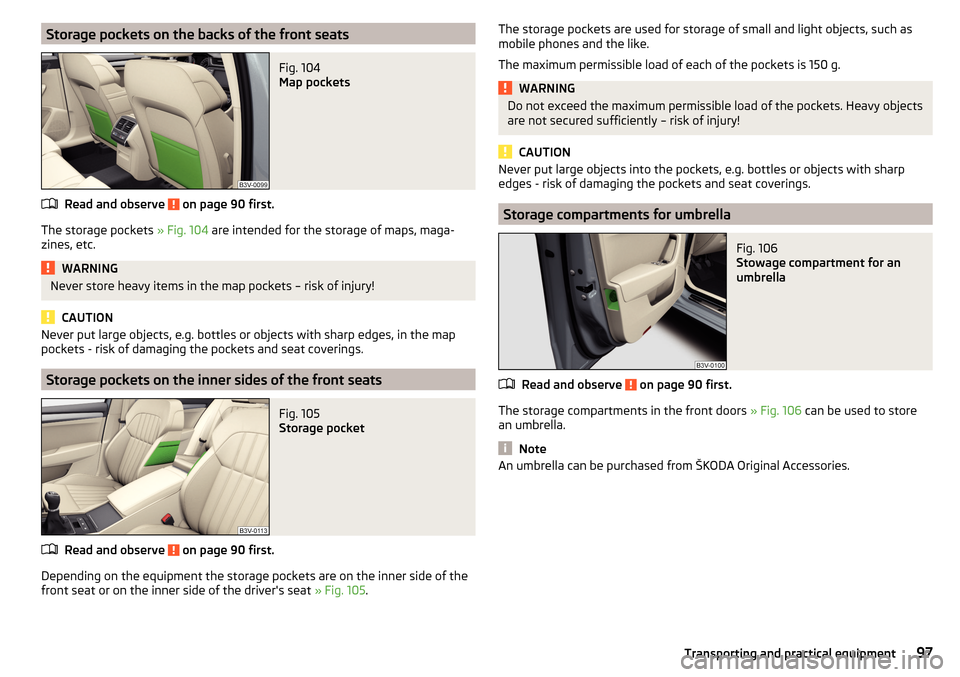
Storage pockets on the backs of the front seatsFig. 104
Map pockets
Read and observe on page 90 first.
The storage pockets » Fig. 104 are intended for the storage of maps, maga-
zines, etc.
WARNINGNever store heavy items in the map pockets – risk of injury!
CAUTION
Never put large objects, e.g. bottles or objects with sharp edges, in the map
pockets - risk of damaging the pockets and seat coverings.
Storage pockets on the inner sides of the front seats
Fig. 105
Storage pocket
Read and observe on page 90 first.
Depending on the equipment the storage pockets are on the inner side of the
front seat or on the inner side of the driver's seat » Fig. 105.
The storage pockets are used for storage of small and light objects, such as
mobile phones and the like.
The maximum permissible load of each of the pockets is 150 g.WARNINGDo not exceed the maximum permissible load of the pockets. Heavy objects
are not secured sufficiently – risk of injury!
CAUTION
Never put large objects into the pockets, e.g. bottles or objects with sharp
edges - risk of damaging the pockets and seat coverings.
Storage compartments for umbrella
Fig. 106
Stowage compartment for an
umbrella
Read and observe on page 90 first.
The storage compartments in the front doors » Fig. 106 can be used to store
an umbrella.
Note
An umbrella can be purchased from ŠKODA Original Accessories.97Transporting and practical equipment
Page 108 of 276
When transporting cargo the following the instructions must be adhered to
▶ When transporting heavy objects, the driving characteristics change due to
the shift in centre-of-gravity. The speed and style of driving must be adjus-
ted accordingly.
▶ The cargo is stowed in the luggage compartment. To prevent this from mov-
ing it should be secured with suitable lashing straps to the lashing eyes or
secured with fixing nets.
▶ Distribute loads as evenly as possible.
▶ Place heavy objects as far forward as possible.
▶ The transported items must be stowed in such a way that no objects are able
to slip forward on sudden driving or braking manoeuvres – risk of injury!
▶ Tyre pressure is to match the load.
▶ When transporting loads in the luggage compartment that has been en-
larged by folding the rear seats forward, ensure the safety of the passengers
transported on the other rear seats .
In the event of an accident, even small and light objects gain so much kinetic energy that they can cause severe injuries.
The magnitude of the kinetic energy is dependent on the speed at which the
vehicle is travelling and the weight of the object.
Example: In the event of a frontal collision at a speed of 50 km/h, an object
with a weight of 4.5 kg produces an energy, which corresponds to 20 times its
own weight. This means that it results in a weight of approx. 90 kg “ ”.
Luggage compartment light
The warning light turns on when tailgate is opened.
The warning light turns off when the tailgate is closed.
If the boot lid is open and the ignition switched off, the light will extinguish
automatically after around 10 minutes.
The luggage compartment illumination using the removable lamp » page 114.WARNING■
Never exceed the maximum permissible load of the respective fasteners,
nets, hooks etc. Heavy objects were not secured sufficiently – risk of injury!■
If the cargo is tied down with unsuitable or damaged lashing straps, inju-
ries can occur in the event of braking manoeuvres or accidents.
■
Loose cargo can be thrown forward during a sudden manoeuvre or in case
of an accident and can injure the occupants or other road users.
■
Loose cargo could hit a deployed airbag and injure occupants – danger of
death!
CAUTION■ Never exceed the maximum permissible load of the respective fasteners,
nets, hooks etc. - these could be damaged.■
Make sure that transported objects with sharp edges do not damage the
threads of the following devices. ■Rear window heater.
■ Rear window with an integrated antenna.
■ Integrated antenna in the rear side windows.
Fastening elements
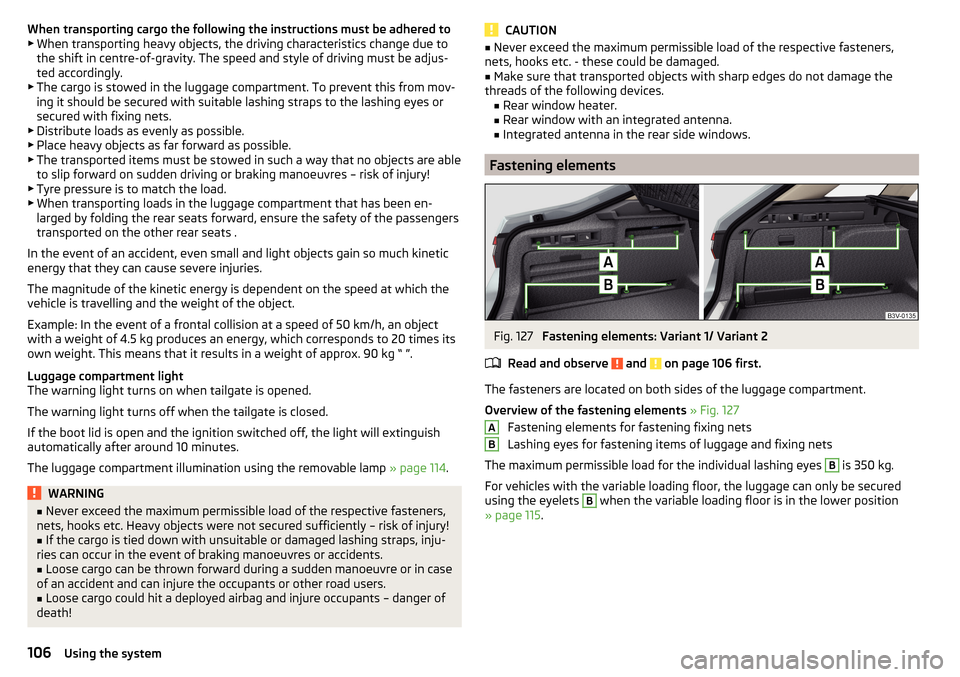
Fig. 127
Fastening elements: Variant 1/ Variant 2
Read and observe
and on page 106 first.
The fasteners are located on both sides of the luggage compartment.
Overview of the fastening elements » Fig. 127
Fastening elements for fastening fixing nets
Lashing eyes for fastening items of luggage and fixing nets
The maximum permissible load for the individual lashing eyes
B
is 350 kg.
For vehicles with the variable loading floor, the luggage can only be secured
using the eyelets
B
when the variable loading floor is in the lower position
» page 115 .
AB106Using the system