2015 SKODA OCTAVIA tow
[x] Cancel search: towPage 100 of 268

CAUTION■The power socket can only be used for connecting approved electrical acces-
sories with a two-pin 230V plug, with a total power uptake of up to 150 watt.■
Place the connector on the electrical device into the power socket as far as it
can go to create a connection between the contacts.
■
If the connector of the electrical device is not inserted fully into the power
socket, the child safety lock might release, and the power socket be activated.
The electrical device is still not supplied with power.
■
The socket is temporarily disabled at engine start-up and the indicator light
flashes red. After starting the engine, the power socket is re-activated auto-
matically.
■
Do not connect any lamps with neon filaments to the power socket - risk of
damaging the lamp.
■
A larger current surge may arise in some power supplies (e.g. for notebooks)
when connecting them to the power socket- this will automatically deactivate
the power socket. In this case, disconnect the power supply from the consum-
er and connect the power supply to the power socket first, followed by the
consumer.
■
The connected appliances may behave differently to when connected to the
mains.
Removable through-loading bag
Fig. 103
Tighten ribbon / secure through-loading bag
Read and observe
on page 89 first.
The removable through-loading bag (hereinafter referred to as a through-load-
ing bag) is used exclusively for transporting skis.
Stowing the through-loading bag and skis
›
Open the boot lid.
› Fold the rear armrest and the cover in the seat backrest downwards
» page 88 .›
Place the empty, through-loading bag in the opening in such a way that the
end of the bag with the zip is in the boot.
›
Push the skis into the through-loading bag from the boot » .
›
Close the through-loading bag.
Securing the through-loading bag and skis
›
Tighten the strap
A
on the free end around the skis in front of the bindings
» Fig. 103 .
›
Fold the seat backrest a little forward.
›
Guide the securing strap
B
through the opening in the seat backrest around
the upper part of the seat backrest.
›
Then push the seat backrest back into the upright position until the unlock-
ing button clicks into place - check by pulling on the seat backrest.
›
Insert the securing strap
B
into the lock
C
until it clicks into place.
WARNING■ After placing skis into the through-loading bag, you must secure the bag
with the securing strap B » Fig. 103 .■
The strap
A
must hold the skis tight.
■
Make sure that the strap
A
holds all skis in front of the binding (see also
the text on the through-loading bag).
■
The total weight of the skis which are transported must not exceed
24 kg.
CAUTION
■ Never fold and stow the through-loading bag when it is wet - risk of damag-
ing the through-loading bag.■
The through-loading bag is designed for the transportation of up to four
pairs of skis.
■
Place the skis with the tips facing to the front and the sticks with the tips
facing to the rear. into the through-loading bag.
98Using the system
Page 102 of 268

Handle holderFig. 107
Tilt and rotate holder
Fig. 108
Adjust holder size
Read and observe on page 99 first.
Tilt and rotate holder
The holder may be tilted 30° in the direction of arrow
1
and rotated through
360° in the direction of arrow
2
» Fig. 107 .
Adjust holder size
›
Pull out the securing tab
A
in the direction of arrow
3
and move part
B
in
direction of arrow
4
to the desired position » Fig. 108.
Luggage compartment and transport of cargo
Introduction
This chapter contains information on the following subjects:
Fastening elements
101
Fixing nets
102Multifunction pocket102Folding double hooks103
Foldable hook
103
Floor covering
103
Floor covering on both sides
103
Luggage net
104
Luggage compartment cover
104
Roll-up cover
105
Storage compartment with cargo element
106
Storage compartments under the floor covering
106
Multi-function pocket
107
Class N1 vehicles
107
When transporting cargo the following the instructions must be adhered to
▶ When transporting heavy objects, the driving characteristics change due to
the shift in centre-of-gravity. The speed and style of driving must be adjus-
ted accordingly.
▶ The cargo is stowed in the luggage compartment. To prevent this from mov-
ing it should be secured with suitable lashing straps to the lashing eyes or
secured with fixing nets.
▶ Distribute loads as evenly as possible.
▶ Place heavy objects as far forward as possible.
▶ The items carried in the luggage compartment must be stored in such a way
that no objects are able to slip forward if any sudden driving or braking ma-
noeuvres are undertaken – risk of injury!
▶ Tyre pressure is to match the load.
▶ When transporting loads in the luggage compartment that has been en-
larged by folding the rear seats forward, ensure the safety of the passengers
transported on the other rear seats .
In the event of an accident, even small and light objects gain so much kinetic
energy that they can cause severe injuries.
The magnitude of the kinetic energy is dependent on the speed at which the
vehicle is travelling and the weight of the object.
Example: In the event of a frontal collision at a speed of 50 km/h, an object
with a weight of 4.5 kg produces an energy, which corresponds to 20 times its
own weight. This means that it results in a weight of approx. 90 kg “ ”.
Luggage compartment light
The warning light turns on when tailgate is opened.
100Using the system
Page 106 of 268

NoteFor easier turning of the covering, use the loop attached.
Luggage net
Fig. 117
Luggage net
Read and observe and on page 101 first.
The net at the bottom of the luggage compartment cover » Fig. 117 is provided
for transporting light and soft items.
The maximum permissible load of the net is 1.5 kg.
CAUTION
Do not place any sharp objects into the net – risk of net damage.
Luggage compartment cover
Fig. 118
Remove the luggage compartment cover
Fig. 119
Luggage compartment cover
stowed behind the rear seats
Read and observe and on page 101 first.
If the support straps
A
» Fig. 118 are attached to the boot lid, then opening
the lid will raise the boot lid cover (hereafter referred to as cover).
If you want to carry bulky goods, the cover can be removed from the vehicle, and may be stowed behind the rear seat backrests » Fig. 119.
Removing
›
On both sides of the boot lid unhook the straps
A
in direction of arrow
1
» Fig. 118 .
›
Hold the raised cover.
›
Press on the two sides to the underside of the cover in the region of the
mounts
C
.
›
Remove the cover in the direction of the arrow
2
.
Installing
›
Place the cover on the contact surfaces of the side trim panel.
›
Place the fixtures
B
on the cover above the brackets
C
on the side trim
» Fig. 118 .
›
Press on the two sides to the upper side of the cover in the region of the
mounts
C
.
The fixtures
B
must completely lock into place in the mounts
C
on both sides
of the luggage compartment.
›
On both sides of the boot lid hook the straps
A
in the opposite direction of
arrow
1
.
WARNINGNo objects should be placed on the cover. This could endanger the vehicle
occupants during sudden braking or vehicle impact. 104Using the system
Page 107 of 268

CAUTION■When closing the boot lid, jamming and damage to the cover or the side trim
panel can occur if handled incorrectly. The following guidelines must be ob-
served. ■ The recesses in the cover B
» Fig. 118 must lock in the holders in the side
trim panel
C
.
■ The items which are transported must not exceed the height of the cover.
■ The cover must not be jammed in the surrounding seal of the luggage com-
partment lid when it is in the raised position. ■ There must be no object in the gap between the cover in the raise position
and the rear backrest.
Roll-up cover
Fig. 120
Roll-up cover: pull out/roll/remove
Fig. 121
Remove the side panels of the luggage compartment/stow the
roll-up luggage compartment cover
Read and observe and on page 101 first.
Extending
›
Grasp the cover on the handle
A
and pull it out in the direction of the arrow
1
until it clicks » Fig. 120.
Retracting
›
Push the cover in the area of handle
A
in the direction of the arrow
2
» Fig. 120 .
The cover rolls up automatically.
Removing/inserting
The fully rolled luggage compartment cover can be removed.
›
Press on the side of the cross bar in the direction of arrow
3
and remove
the cover in the arrow direction
4
» Fig. 120 .
Insertion takes place in reverse order.
Stowage
If the vehicle is equipped with the variable loading floor, then the removable
roll-up luggage compartment cover can be stowed in the recesses of the lug-
gage compartment side trim.
›
Fold the variable loading floor into the upper position » page 108.
›
Remove the side covers of the luggage compartment in the direction of the
arrow
1
» Fig. 121 .
›
Remove the roll-up luggage compartment cover » Fig. 120.
›
Insert the front part of the roll-up luggage compartment cover under a por-
tion of the side trim
D
» Fig. 121 on the left.
›
Fold the rear part of the roll-up luggage compartment cover in the direction
of arrow
2
» .
›
Replace the side trims of the luggage compartment in the opposite direction
of the arrow
1
.
›
Fold out the variable loading floor to the upper position » page 108.
WARNINGNo objects should be placed on the foldable boot cover. This could endan-
ger the vehicle occupants during sudden braking or vehicle impact.
CAUTION
If you want to stow the roll-up luggage compartment cover and the roof rack
at the same time , then it is necessary that the rear part of the roll-up luggage
compartment is covering the rear roof rack.105Transporting and practical equipment
Page 110 of 268
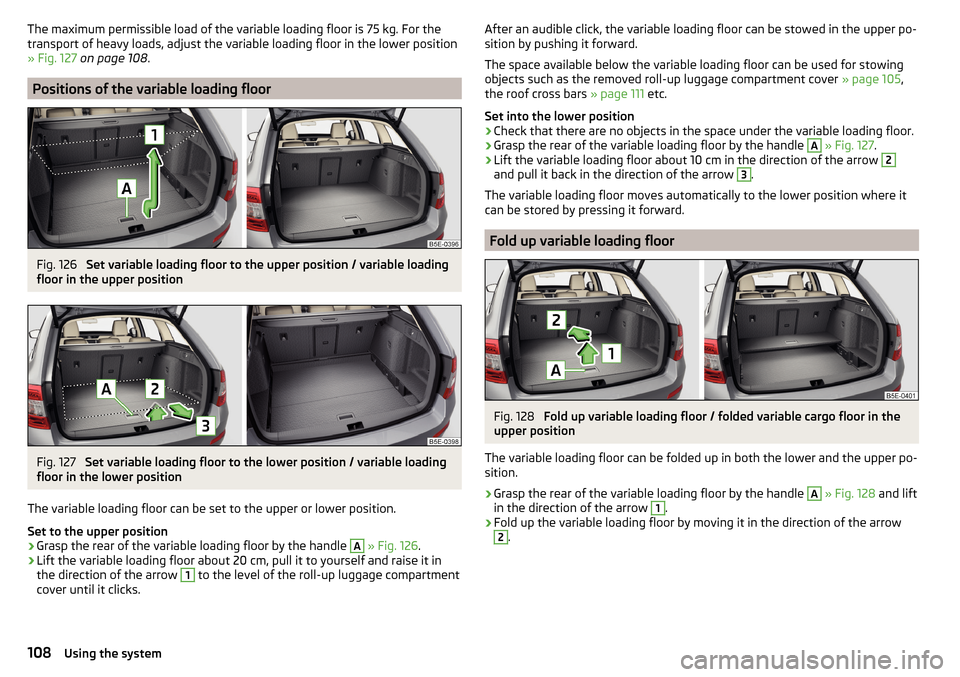
The maximum permissible load of the variable loading floor is 75 kg. For the
transport of heavy loads, adjust the variable loading floor in the lower position
» Fig. 127 on page 108 .
Positions of the variable loading floor
Fig. 126
Set variable loading floor to the upper position / variable loading
floor in the upper position
Fig. 127
Set variable loading floor to the lower position / variable loading
floor in the lower position
The variable loading floor can be set to the upper or lower position.
Set to the upper position
›
Grasp the rear of the variable loading floor by the handle
A
» Fig. 126 .
›
Lift the variable loading floor about 20 cm, pull it to yourself and raise it in
the direction of the arrow
1
to the level of the roll-up luggage compartment
cover until it clicks.
After an audible click, the variable loading floor can be stowed in the upper po-
sition by pushing it forward.
The space available below the variable loading floor can be used for stowing
objects such as the removed roll-up luggage compartment cover » page 105,
the roof cross bars » page 111 etc.
Set into the lower position›
Check that there are no objects in the space under the variable loading floor.
›
Grasp the rear of the variable loading floor by the handle
A
» Fig. 127 .
›
Lift the variable loading floor about 10 cm in the direction of the arrow
2
and pull it back in the direction of the arrow
3
.
The variable loading floor moves automatically to the lower position where it
can be stored by pressing it forward.
Fold up variable loading floor
Fig. 128
Fold up variable loading floor / folded variable cargo floor in the
upper position
The variable loading floor can be folded up in both the lower and the upper po-
sition.
›
Grasp the rear of the variable loading floor by the handle
A
» Fig. 128 and lift
in the direction of the arrow
1
.
›
Fold up the variable loading floor by moving it in the direction of the arrow
2
.
108Using the system
Page 112 of 268

If the crossbar is hooked into the receptacle E to the left for example, then
press on the crossbar in the direction of the arrow 1 and insert into the re-
ceptacle E
to the right.
›
Make sure that the crossbar is firmly seated in the fittings
E
.
›
Fold back part of the roll-up luggage compartment cover
A
in the opposite
direction of the arrow » Fig. 130.
Using the net partition behind the rear seats
›
Fold out part of the roll-up luggage compartment cover
A
in the direction of
the arrow » Fig. 130.
›
Press on the crossbar and remove it from the receptacles
E
, first on one
side, then on the other side » Fig. 131.
›
Hold the crossbar
C
in such a way that the net partition can slowly roll up
into the housing
D
without being damaged.
›
Fold back part of the roll-up luggage compartment cover
A
in the opposite
direction of the arrow » Fig. 130.
CAUTION
If the net partition blocks when pulling it out of the housing, push the release
lever B in the direction of the arrow » Fig. 130.
Removing and refitting the net partition housing
Fig. 132
Removing the net partition
housing
Removing
›
Fold the rear seat backrests forward » page 87.
›
Open the rear right door » page 57.
›
Push the net partition housing
A
in the direction of the arrow
1
and re-
move it from the mounts on the right seat backrests in the direction of the
arrow
2
» Fig. 132 .
Fitting›Insert the recesses on the net partition housing into the mounts on the rear
seat backrests.›
Push the net partition housing in the opposite direction of the arrow
1
» Fig. 132 as far as the stop.
›
Fold the rear seats backs into their original position » page 87.
Roof rack
Introduction
This chapter contains information on the following subjects:
fixing points for base support
111
Stowing the roof rack
111
Roof load
112WARNINGWhen transporting cargo the following the instructions must be adhered
to.■
The transported items on the roof rack must always be securely attached
– risk of accident!
■
Always secure the load with appropriate and undamaged lashing straps
or tensioning straps.
■
Distribute the load evenly over the roof rack system.
■
When transporting heavy objects or objects which take up a large area on
the roof rack system, the handling of the car may change as a result of the
displacement of the centre of gravity. The style of driving and speed must
therefore be adapted to the current circumstances.
■
Avoid abrupt and sudden driving/braking manoeuvres.
■
The permissible roof load, permissible axle loads and gross permissible
weight of the vehicle must not be exceeded under any circumstances – risk
of accident!
CAUTION
■ On models fitted with a sliding/tilting roof, ensure that the sliding/tilting roof
does not strike any items of luggage transported on the roof when tilting.■
Ensure that the luggage compartment lid does not hit the roof load when
opened.
110Using the system
Page 113 of 268

■The height of the vehicle changes after mounting a roof luggage rack system
including the load that is being transported. Compare the vehicle height with
available clearances, such as underpasses and garage doors.■
Ensure the roof aerial is not impaired by the load being transported.
Note
We recommend that you use a roof rack from ŠKODA Original Accessories.
fixing points for base support
Fig. 133
Attachment points
Read and observe
and on page 110 first.
The mounting points are located on both sides of the vehicle.
Arrangement of the mounting points » Fig. 133
Front attachment points
Rear attachment points
The mounting and dismounting of the basic carrier is carried out according to
the instructions provided.
ABStowing the roof rackFig. 134
Remove the side panels of the luggage compartment/stow the
roof rack
Read and observe
and on page 110 first.
With vehicles have the variable loading floor, then the roof racks can be stow-ed in the recesses of the luggage compartment side trim.
›
Fold the variable loading floor into the upper position » page 108.
›
Remove the side covers of the luggage compartment in the direction of the
arrow
1
» Fig. 134 .
›
Remove the key from the roof rack » .
The removed key can be stowed in recess
C
.
›
Insert the front roof rack
A
into the front recesses of the side trim.
›
Insert the rear roof rack
B
into the rear recesses of the side trim.
›
Replace the side trims of the luggage compartment in the opposite direction
of the arrow
1
.
›
Fold out the variable loading floor to the upper position » page 108.
CAUTION
■
Before stowing the roof rack, pull out the key from the carrier, otherwise it
could be damaged.■
If you want to stow the roof rack and the roll-up luggage compartment cover
at the same time , then it is necessary that the rear part of the roll-up luggage
compartment is covering the rear roof rack.
111Transporting and practical equipment
Page 126 of 268

Problems starting the engineFig. 144
Starting the engine - press the
button with the key
Read and observe and on page 122 first.
The key in the vehicle cannot be verified
If the key in the vehicle cannot be verified, then engine cannot be started by pressing a button.
One of the following message is shown in the information cluster display.
Key not detected. Owner's Manual!Key not found.NO KEY
The reasons for this may be:
▶ The battery in the key is almost out of charge.
▶ The key is malfunctioning
▶ There is interference in the signal between the system and the key (strong
electromagnetic field).
Try to start the engine by pressing the button with the key » Fig. 144.
System fault
If the following message appears on the display of the instrument cluster,
there is a system malfunction.
Keyless access system faulty.KEYLESS ACCESS SYSTEM FAULTY
Try to start the engine by pressing the button with the key » Fig. 144.
CAUTION
The key can only be verified if it is in the vehicle. It is therefore not always nec-
essary to know where the key is.Note■ When attempting to start, the key bit must be pointed towards the button
» Fig. 144 .■
If the engine fails to start after pressing the button with the key, seek spe-
cialist help.
START-STOPsystem
Introduction
This chapter contains information on the following subjects:
Operation
125
Manually deactivating/activating the system
126
Information messages
126
The START STOP system (hereinafter referred to as the system) reduces CO 2
emissions and harmful emissions, and saves fuel.
If the system determine that the engine is not needed when the vehicle stops
or is at a standstill (e.g. at the traffic lights), it turns off the engine and starts it
again when moving off.
The system function depends on many factors. Some of them are down to the
driver, the others are systemic and can neither be influenced nor identified.
Therefore the system may react differently in situations which seem identi-
cal from the driver's perspective.
The system is automatically activated every time the ignition is switched on
(even where this has previously been manually deactivated with the button ).
Note
If the engine has stopped due to the system, the ignition remains on.124Driving