2015 Seat Mii wheel
[x] Cancel search: wheelPage 206 of 232

Advice
Spare wheel or temporary spare
wheel* Fig. 176
In the luggage compartment: hand
c ontr
o
lled wheel for securing the spare wheel Removing the spare wheel
● Open the rear lid and lift the luggage com-
p ar
tment
shelf ››› page 118.
● If necessary, remove the boot variable floor
›››
page 118.
● Lift up the carpet from the recess and re-
move it
from the luggage compartment.
● If necessary, take out the vehicle tool kit
with the cont
ainer.
● Completely remove the hand controlled
wheel from the c
entre of the spare wheel
››› Fig. 176 by turning it in an anticlockwise
direction, and take out the spare wheel. Storing the replaced wheel
● Pull back the carpet.
● With the wheel rim facing downwards, sit-
uate the rep
laced wheel in the spare wheel
well so that the wheel rim central hole coin-
cides with the opening.
● Turn the hand controlled wheel with the
shank s
crewed clockwise until the replaced
wheel is secured.
● If necessary, store the vehicle tool in the
container
, inside the boot.
● Replace the carpet on the boot floor.
● Lower the rear shelf.
● Close the rear lid.
If the sp
are wheel is different to the rest of
the vehicle tyres
If the spare tyre is not the same as the tyres
that are mounted on the vehicle - for example
with winter tyres or the temporary spare
wheel - you should only use the spare tyre for
a short period of time and drive with extra
care ››› .
R efit
the norm
al road wheel as soon as possi-
ble.
Please observe driving advice:
● Do not drive faster than 80 km/h (50 mph).
● Avoid heavy acceleration, hard braking and
fas
t cornering. ●
Snow ch
ains on the temporary spare wheel
are not permitted ›››
page 40.
● After mounting the spare wheel or the tem-
porary
spare wheel, check the tyre pressure
as soon as possible ››› page 200.
It is advisable to check the spare wheel or
temporary spare wheel tyre pressure when
checking the rest of the vehicle wheels at
least once a month. The spare wheel should
have the highest pressure allowed for the ve-
hicle ››› page 200. The sticker situated on the
temporary spare wheel shows the tyre pres-
sure. WARNING
Incorrect handling of the spare wheel or the
tempor ar
y spare wheel can cause loss of ve-
hicle control, producing collisions or other
serious accidents and injury.
● Never use the spare wheel or the temporary
spar
e wheel if it is damaged or worn to the
wear indicator.
● In some vehicles the spare wheel is smaller
than the origina
l tyres. This can be seen on a
sticker showing the text “80 km/h” and
“50 mph”. This text indicates the maximum
velocity permitted for this type of tyre.
● Never drive faster than 80 km/h (50 mph).
Avoid po
werful acceleration, hard braking
and taking corners at high speed.
● Never drive more than 200 km with a tem-
porary
spare wheel fitted to the drive axle.204
Page 207 of 232

Wheels and tyres
●
Rep l
ace the temporary spare wheel for a
normal wheel as soon as possible. The com-
pact temporary spare wheel is only intended
for temporary use over short distances.
● The temporary spare wheel must always be
secured w
ith the factory supplied wheel
bolts.
● You should never use more than one tem-
porary
spare wheel. ●
Aft er mou
nting the temporary spare wheel,
check the tyre pressure as soon as possible
››› page 200.
● Snow chains on the temporary spare wheel
are not permitt
ed. Note
Wherever possible, secure the spare wheel,
t empor ar
y spare wheel or the replaced wheel
safely in the luggage compartment. In vehi- cles with anti-puncture kit, it is not possible
to sec
ur
e the defective wheel. Tyre code
Fig. 177
Universal code on tyres Radial
Rim di
amet
er c
ode
Load index & speed rating
DOT tyre identification number
Severe snow conditions
Tyre ply composition and materials used
Max. load rating
Treadwear, traction and temperature
grades
Max. permissible inflation pressure
Passenger car tyre
Nominal width of tyre in millimetres
Ratio of height to width (aspect ratio) »
1 2
3
4
5
6
7
8
9
10
11
12
205
Technical data
Advice
Operation
Emergencies
Safety
Page 208 of 232

AdviceTyre code (example)Meaning
Make, logotypeManufacturer
Product nameName of tyre assigned by manufacturer.
P255 / 55 R 18Size:
PPassenger vehicle code.
255Nominal width between walls, in mm.
55Height/width ratio in %
RTyre type (R indicates "radial").
18Rim diameter in inches
109 HLoad index
››› page 207 and speed rating ››› page 207.
XLReinforced tyres (“Reinforced”).
M+S or M/S or Winter tyres code (mud and snow tyres).
RADIAL TUBELESSRadial tyre without inner tube.
E4 ...E-mark certifying tyre complies with international legislation followed by a number denoting the country granting the au-
thorisation. The authorisation number ( several digits) is shown below.
DOT BT RA TY5 1709Tyre identification number (TIN a)
, may be only on interior wall of wheel) and date of manufacture:
DOTThe tyre complies with the legal requirements of the US Department of Transport, responsible for tyre
safety regulations.
BTPlace of manufacture code.
RAInformation about manufacturer and tyre size.
TY5Manufacturer's tyre specifications.
1709Date of manufacture: Week 17 of 2009.
TWIThis identifies the position of the Tread Wear Indicator ››› page 201. 206
Page 209 of 232

Wheels and tyresTyre code (example)Meaning
Made in GermanyCountry of manufacture.
MAX LOAD 615 KGUS load rating, indicating maximum permitted load per tyre.
MAX INFLATION 350 KPA (51 PSI)US limit, indicating maximum permitted tyre pressure.
SIDEWALL 1 PLY RAYONInformation about tyre wall components:
1 layer of rayon (artificial silk).
TREAD 4 PLIES
1 RAYON + 2 STEEL + 1 NYLONInformation about tread components:
In the example, there are 4 layers below the tread: 1 layer of rayon (artificial silk), 2 layers of steel reinforcement and 1
layer of nylon.
Information for the end consumer concerning the comparative values of the established base tyres (standardised test procedures)
››› page 175:
TREADWEAR 220Relative service life of the tyre, with respect to specific US standard test.
TRACTION ABraking capacity of tyre on wet surface (AA, A, B or C).
TEMPERATURE ATyre temperature resistance at higher test speeds (A, B or C).
If the tyre has other markings, these are specific tyre manufacturer codes or specific national codes, e.g. for Brazil or China.
a)
The letters TIN refer to the tyre serial number.
Tyres with directional tread pattern
Tyres with directional tread pattern have
been designed to operate best when rotating
in only one direction. An arrow on the tyre
sidewall indicates the direction of rotation on
tyres with directional tread. Always observe
the direction of rotation indicated when
mounting the wheel. This guarantees opti-
mum grip and helps to avoid aquaplaning,
grip, noise and wear. If the tyre is mounted in the opposite direc-
tion of rot
ation, drive with extreme caution,
as the tyre is no longer being used correctly.
This is of particular importance when the
road surface is wet. Change the tyre as soon
as possible or remount it with the correct di-
rection of rotation.
Tyre load rating
The load rating code indicates the maximum
load in kilogrammes each wheel can carry
(load capacity). 425 kg
462 kg
487 kg
515 k
g
545 kg
615 kg
Speed rating
The speed rating indicates the maximum
speed permitted for the tyres. »
78
81
83
85
87
91
207
Technical data
Advice
Operation
Emergencies
Safety
Page 212 of 232

Technical data
part of the windscreen. The vehicle identifica-
tion number (c h
a
ssis number) is also stam-
ped on the right water drain channel. The wa-
ter drain channel is located between the sus-
pension tower and the wing. Open the bon-
net to read the vehicle identification number
.
Vehicle data plate
The vehicle data label ››› Fig. 178 is at the
front of the spare wheel well. It contains the
following data:
Vehicle identification number (chassis
number).
Vehicle type, engine power, gearbox type.
Engine and gearbox code, paint number,
interior equipment.
Optional extras, PR numbers.
These data are also provided in the Mainte-
nance Programme.
Specific vehicle weight information The instructions in the official vehicle docu-
ments
t
ak
e precedence. All the technical data
provided in this documentation is applicable
to the basic model. The vehicle data label in
the Maintenance Programme or the vehicle
documentation shows which engine is instal-
led in your vehicle. 1 2
3
4 The figures may be different depending
whether a
d
dition
al equipment is fitted, for
different models and for special vehicles.
Kerb weight values shown in the following ta-
ble apply to a vehicle with driver (75 kg), liq-
uids including a fuel tank 90% full, in addi-
tion to tools and a spare wheel ››› . The
k erb w
eight
indicated increases with optional
equipment and retrofitting of accessories,
while proportionally reducing carrying ca-
pacity.
The load is equivalent to the following
weights:
● Passengers.
● Total equipment.
● Roof load, included in the carrier. WARNING
Exceeding the maximum authorised weight
and the loa d on the ax
les could cause dam-
age to the vehicle, accidents and serious in-
juries.
● The real load on the axles should never ex-
ceed the max
imum permitted.
● The load and its distribution in the vehicle
have eff
ects on the vehicle handling and the
braking ability. Always drive at a suitable
speed. CAUTION
Distribute the load as uniformly and as low
down on the v
ehicle as possible. When trans-
porting heavy objects in the luggage com-
partment, these should be placed as far for-
ward as possible or over the rear axle to have
as little influence on handling as possible. Information on fuel consumption
The consumption and emission values indi-
cat
ed do not
refer to one specific vehicle.
They are only to be used to compare the val-
ues of the different vehicle versions. The fuel
consumption and CO 2 emissions of a vehicle
not only depend on the effective use of fuel.
They also depend on your driving style and
other non-technical factors.
Calculation of fuel consumption
Fuel consumption and emission values are
determined according to the current version
of the 715/2007/EC or 80/1268/EEC regula-
tion and are valid for the vehicle kerb weight.
The specifications do not refer to an individu-
al vehicle. To measure the fuel consumption,
two measuring cycles are carried out on a
rolling road test bed. The test criteria are as
follows:
210
Page 213 of 232

Technical featuresUrban cycle
Measurement of the urban cycle starts
with an engine cold start. City driving is
then simulated at between 0 and
50 km/h (0 and 31 mph).
Road cycle
In the road cycle simulation, the car un-
dergoes frequent acceleration and
braking in all gears, as in normal every-
day driving. The road speed ranges
from 0 to 120 km/h (0 and 75 mph).
Combined
The average combined consumption is
calculated with a weighting of around
37 % for the urban cycle and 63 % for
the road cycle.
CO
2 emis-
sions of the
combination
The exhaust gases are collected during
both driving cycles to calculate carbon
dioxide emissions (urban and road).
The gas composition is analysed below
to evaluate the CO 2 content and other
emissions. Note
● The kerb w eight
may vary according to the
vehicle equipment. This could raise consump-
tion and the CO 2 emissions slightly.
● In practice, consumption values could be
different
to the values calculated based on
the 715/2007/EC or 80/1268/EEC regula-
tions. Wheels
Ty
r
e pressure, snow chains, wheel
bolts Tyre pressures
The stic
k
er with the tyre pressure values can
be found on the inside of the fuel tank flap.
The tyre pressure values are given for cold
tyres ››› page 200. The slightly raised pres-
sures of warm tyres must not be reduced.
››› Snow chains
Sno
w c
h
ains may be fitted only to the front
wheels.
Consult the section “wheels” of this manual.
Wheel bolts
After the wheels have been changed, the
tightening torque of the wheel bolts should
be checked as soon as possible with a torque
wrench ››› . The tightening torque for steel
and al lo
y
wheels is 140 Nm. WARNING
● Check the ty
re pressure at least once per
month. Checking the tyre pressure is very im-
portant. If the tyre pressure is too high or too
low, there is an increased danger of accidents
- particularly at high speeds. ●
If the tight enin
g torque of the wheel bolts
is too low, they could loosen while the vehi-
cle is in motion. Risk of accident! If the tight-
ening torque is too high, the wheel bolts and
threads can be damaged. Note
We recommend that you ask your Technical
Ser vic
e for information about appropriate
wheel, tyre and snow chain size. 211
Technical data
Advice
Operation
Emergencies
Safety
Page 217 of 232
Technical features
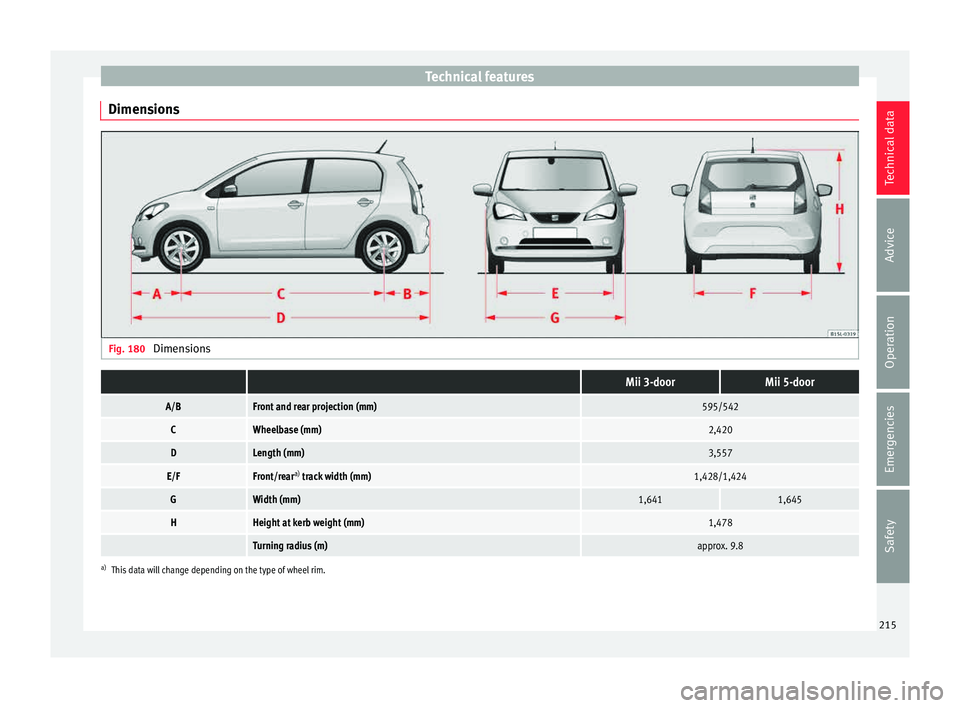
Dimensions Fig. 180
Dimensions Mii 3-doorMii 5-door
A/BFront and rear projection (mm)595/542
CWheelbase (mm)2,420
DLength (mm)3,557
E/FFront/rear a)
track width (mm)1,428/1,424
GWidth (mm)1,6411,645
HHeight at kerb weight (mm)1,478
Turning radius (m)approx. 9.8
a) This data will change depending on the type of wheel rim.
215
Technical data
Advice
Operation
Emergencies
Safety
Page 219 of 232

Index
Index
A
Abr o
a
d
extended stay abroad with your vehicle . . . . . 176
sale of vehicle . . . . . . . . . . . . . . . . . . . . . . . . . . 176
ABS see Anti-lock brake system . . . . . . . . . . . . . . . 147
Accessories . . . . . . . . . . . . . . . . . . . . . . . . . . . . . . 159
Acoustic alarm seatbelt unfastened . . . . . . . . . . . . . . . . . . . . . . 53
Adjusting front seat . . . . . . . . . . . . . . . . . . . . . . . . . . . . . . 108
lights . . . . . . . . . . . . . . . . . . . . . . . . . . . . . . . . . 104
rear head restraints . . . . . . . . . . . . . . . . . . . . . 108
Rear head restraints . . . . . . . . . . . . . . . . . . . . . . 50
seats . . . . . . . . . . . . . . . . . . . . . . . . . . . . . . . . . . 47
Adjusting the head restraints rear head restraints . . . . . . . . . . . . . . . . . . . . . 108
Advice for driving spare wheel or temporary spare wheel . . . . . . 204
Airbag covers . . . . . . . . . . . . . . . . . . . . . . . . . . . . . 14
Airbags . . . . . . . . . . . . . . . . . . . . . . . . . . . . . . . . . . 58
Airbag system . . . . . . . . . . . . . . . . . . . . . . . . . . 14, 58 activation . . . . . . . . . . . . . . . . . . . . . . . . . . . . . . 60
cleaning dash panel . . . . . . . . . . . . . . . . . . . . . 174
control lamp . . . . . . . . . . . . . . . . . . . . . . . . . . . . 62
description . . . . . . . . . . . . . . . . . . . . . . . . . . . . . 59
front airbags . . . . . . . . . . . . . . . . . . . . . . . . . 14, 61
functioning . . . . . . . . . . . . . . . . . . . . . . . . . . . . . 60
locking the vehicle after deployment . . . . . . . . 93
repairs . . . . . . . . . . . . . . . . . . . . . . . . . . . . . . . . 161
Side airbags . . . . . . . . . . . . . . . . . . . . . . . . . . . . 16
use of child seats . . . . . . . . . . . . . . . . . . . . . . . . 15
vehicle care . . . . . . . . . . . . . . . . . . . . . . . . . . . . 174 Air conditioning . . . . . . . . . . . . . . . . . . . . . . . . . . 124
climatr onic . . . . . . . . . . . . . . . . . . . . . . . . 28, 124
controls . . . . . . . . . . . . . . . . . . . . . . . . . . . . . . . . 28
special features . . . . . . . . . . . . . . . . . . . . . . . . 127
user instructions . . . . . . . . . . . . . . . . . . . . . . . . 126
Air outlets . . . . . . . . . . . . . . . . . . . . . . . . . . . . . . . 127
Air recirculation . . . . . . . . . . . . . . . . . . . . . . . . . . 128
Antenna . . . . . . . . . . . . . . . . . . . . . . . . . . . 161, 176
Anti-freeze . . . . . . . . . . . . . . . . . . . . . . . . . . . . . . . 31
Anti-lock brake system . . . . . . . . . . . . . . . . . . . . . 147
Anti-lock system . . . . . . . . . . . . . . . . . . . . . . . . . . 147
Anti-puncture kit . . . . . . . . . . . . . . . . . . . . . . . . 34, 71 Check after 10 minutes . . . . . . . . . . . . . . . . . . . 73
Anti-theft security system . . . . . . . . . . . . . . . . . . . 95
Ashtray . . . . . . . . . . . . . . . . . . . . . . . . . . . . . . . . . 116
Aspects to take into account before starting the vehicle . . . . . . . . . . . . . . . . . . . . . . . . . . . . . . . . . 46
ASR see Traction control system . . . . . . . . . . . . . . . 147
Assistance systems brake assist system (BAS) . . . . . . . . . . . . . . . . 147
cruise control . . . . . . . . . . . . . . . . . . . . . . . . . . 151
electronic differential lock (EDS) . . . . . . . . . . . 148
optical parking system (OPS) . . . . . . . . . . . . . 150
parking aid . . . . . . . . . . . . . . . . . . . . . . . . . . . . 149
parking distance warning system . . . . . . . . . . 149
safety Assist . . . . . . . . . . . . . . . . . . . . . . . . . . . 152
Assisted starting . . . . . . . . . . . . . . . . . . . . . . . . . . 42
Assist systems traction control (ASR) . . . . . . . . . . . . . . . . . . . . 148
traction control (TC) . . . . . . . . . . . . . . . . . . . . . 148
Audible warnings Control and warning lamps . . . . . . . . . . . . . . . . 25
lights . . . . . . . . . . . . . . . . . . . . . . . . . . . . . . . . . 102
speed . . . . . . . . . . . . . . . . . . . . . . . . . . . . . . . . . 24
Automatic belt retractor . . . . . . . . . . . . . . . . . . . . . 57
Automatic device disconnection battery . . . . . . . . . . . . . . . . . . . . . . . . . . . . . . . . 196 Automatic gearbox
driving tip s . . . . . . . . . . . . . . . . . . . . . . . . . . . . 140
ignition key removal lock . . . . . . . . . . . . . . . . . 131
kick-down . . . . . . . . . . . . . . . . . . . . . . . . . . . . . 140
malfunction . . . . . . . . . . . . . . . . . . . . . . . . . . . . 141
starting on a slope . . . . . . . . . . . . . . . . . . . . . . 140
stopping on a slope . . . . . . . . . . . . . . . . . . . . . 140
Automatic gear change . . . . . . . . . . . . . . . . . . . . 139
Axle loads . . . . . . . . . . . . . . . . . . . . . . . . . . . . . . . 210
B Bag support . . . . . . . . . . . . . . . . . . . . . . . . . . . . . 114
BAS see Brake assist systems . . . . . . . . . . . . . . . . . 147
Battery changing in the vehicle key . . . . . . . . . . . . . . . . 91
Battery acid . . . . . . . . . . . . . . . . . . . . . . . . . . . . . . 195
Before starting the vehicle . . . . . . . . . . . . . . . . . . 46
Belt tension device service and disposal . . . . . . . . . . . . . . . . . . . . . 57
Belt tensioner . . . . . . . . . . . . . . . . . . . . . . . . . . . . . 57
Belt tension limiter . . . . . . . . . . . . . . . . . . . . . . . . . 57
Belt tightening . . . . . . . . . . . . . . . . . . . . . . . . . . . . 57
Bonnet . . . . . . . . . . . . . . . . . . . . . . . . . . . . . 10, 184
Boot hatch emergency locking and unlocking . . . . . . . . . . . 10
Brake assist system . . . . . . . . . . . . . . . . . . . . . . . 147
Brake fluid . . . . . . . . . . . . . . . . . . . . . . . . . . . . . . . 32 specification . . . . . . . . . . . . . . . . . . . . . . . . . . . 192
Brakes . . . . . . . . . . . . . . . . . . . . . . . . . . . . . . . . . . 132 brake assist systems . . . . . . . . . . . . . . . . . . . . 147
brake fluid . . . . . . . . . . . . . . . . . . . . . . . . . . . . . 191
brake fluid level . . . . . . . . . . . . . . . . . . . . . . . . 192
brake pads . . . . . . . . . . . . . . . . . . . . . . . . . . . . 135
brake servo . . . . . . . . . . . . . . . . . . . . . . . . . . . . 136
changing the brake fluid . . . . . . . . . . . . . . . . . 192
217