2015 Seat Mii park assist
[x] Cancel search: park assistPage 135 of 232

Driving
CAUTION
● Spec i
al care should be taken when parking
in areas with high kerbs or fixed barriers.
Objects protruding from the ground may
damage the bumper or other parts of the ve-
hicle during manoeuvres. To avoid damage,
stop before the wheels touch the barrier or
kerb.
● Special attention is required when driving
through entranc
es, over ramps, kerbs or oth-
er objects. The vehicle underbody, bumpers,
mudguards and running gear, and the engine
and exhaust system could be damaged as
you drive over these objects. Control and warning lamps
It lights up
›››
Handbrake applied.››› page 134.
It lights up
›››
Fault in the brake
system Do not drive on!
Seek professional advice
››› page 135.
Brake fluid level in-
adequate. Do not drive on!
Check brake fluid level
››› page 192.
Together with the
ABS control lamp
: ABS and EBV do
not function.
Do not drive on!
Seek professional advice
››› page 135.
It lights up
›››
ESC* disconnected
by system.Switching the ignition on and off
If necessary, drive for a short dis-
tance.
Fault in ESC*.Contact a specialised workshop.
Together with the
ABS control lamp
: Fault in the ABS.
Contact a specialised workshop.
The vehicle can be braked with-
out ABS.
The battery has
been reconnected.››› page 193.
It lights up
›››
Traction Control*
faulty or switched
off by the system.Contact a specialised workshop.
It lights up
›››
Together with the
ESC* control lamp
: Fault in the ABS.
Contact a specialised workshop.
The vehicle can be braked with-
out ABS.
Together with the
warning lamp :
ABS and EBV do not
function. Do not drive on!
Seek professional advice
››› page 135.
Flashes
ESC* or ASR regulat-
ing.Take your foot off the accelera-
tor. Adjust your driving style to
the road conditions.
Flashes
Traction Control*
regulator operating.Take your foot off the accelera-
tor. Adjust your driving style to
the road conditions. Several warning and indication lamps light
up for a f
ew sec
onds when the ignition is
switched on, signalling that the function is
being verified. They will switch off after a few
seconds. WARNING
If the warning lamps are ignored, the vehicle
ma y
stall in traffic, or may cause accidents
and severe injuries.
● Never ignore the warning lamps.
● Stop the vehicle safely as soon as possible. WARNING
Driving with brakes in bad condition could re-
su lt
in a serious accident.
● If the brake warning lamp does not
go
out, or if it lights up when driving, the brake
fluid level in the reservoir is too low or there
is a fault in the brake system. Obtain profes-
sional assistance immediately ››› page 191,
Checking the brake fluid level.
● If the brake warning lamp lights up t
o-
gether with the ABS warning lamp , the
regulation function of the ABS could be mal-
functioning. As a result, the rear wheels can
lock relatively easily when braking. If the rear » 133
Technical data
Advice
Operation
Emergencies
Safety
Page 143 of 232

Driving
Automatic gearbox malfunction Back-up programme
When autom
atic
gearbox warning and indica-
tion lamps light up on the instrument panel,
there may be a system malfunction
››› page 137. In the event of some faults the
automatic gearbox functions using a backup
programme. When the programme is activa-
ted, it is possible to drive the vehicle, howev-
er, at low speeds and within a selected range
of gears.
With the manual gearbox, in some cases it is
not possible to drive with all the gears .
In all cases the automatic gearbox must be
checked at a specialised workshop.
Automatic gearbox overheating
The automatic gearbox can overheat with a
prolonged start up, or when stopping and
starting continuously. This overheating is dis-
played with a warning lamp in the instru-
ment panel. Additionally, an audible warning
can be heard. Stop and let the gearbox cool
››› .
The v
ehic
le moves forward or back despite
having selected a gear range
When the vehicle does not move in the re-
quired direction, the system may not have
the gear range correctly engaged. Press the
brake pedal and engage the gear range again. If the vehicle still does not move in the
required dir
ection, there is a system malfunc-
tion. Seek specialist assistance and have the
system checked. CAUTION
● When the ge arbo
x is displayed as overheat-
ing for the first time, the vehicle must be
parked safely or must be driven at a speed of
more than 20 km/h (12 mph).
● When the warning lamp lights up and the
audible w
arning is heard, the vehicle must be
parked safely and the engine switched off.
Let the gearbox cool down.
● To prevent damage to the gearbox, driving
must
only be continued when the warning
lamps are no longer lit up. While the gearbox
is overheated, starting up and driving, even
at a slow speed should be avoided. Recommended gear display
In some vehicles, the recommended gear for
r
educ
in
g fuel consumption is displayed on
the instrument panel:
DisplayMeaning
Optimum gear.
Recommendation to change up a gear.
Recommendation to change down a
gear. WARNING
The recommended gear display is intended as
a guideline only; it shou
ld never replace the
driver's attention to driving carefully.
● Responsibility for selecting the correct gear
for eac
h situation continues to lie with the
driver, for example when overtaking or climb-
ing a hill. For the sake of the environment
Selecting the most appropriate gear for the
sit uation w
ill help you to save fuel. Note
● The rec ommended g
ear display is switched
off when the clutch pedal is pressed.
● On the display of the Portable Navigation
Sys
tem (supplied by SEAT) ››› page 164 the
recommended gear can also be seen. Run-in and economical driving
R u
nnin
g in Please observe the instructions for running-in
new c
omponents.
R u
nning-in the engine
The engine needs to be run in over the first
1,500 km. During its first few hours of »
141
Technical data
Advice
Operation
Emergencies
Safety
Page 151 of 232
Driver assistance systems
Parking distance warning sys-
t em*
Intr oduction The parking distance warning system assists
the driver when p
ark
ing. If the rear of the ve-
hicle is approaching an obstacle, an intermit-
tent audible warning is emitted. The shorter
the distance, the shorter the intervals be-
tween tones. If the vehicle is too close to the
obstacle, the audible warning becomes con-
stant.
If you continue to approach an obstacle when
the sound is continuous, this means the sys-
tem can no longer measure the distance.
Sensors situated on the rear bumper transmit
and receive ultrasound. Using the ultrasound
signal (transmission, reflection from the ob-
stacles and reception), this system continu-
ously calculates the distance between the
bumper and the obstacle. WARNING
The parking distance warning system cannot
rep l
ace the driver's assessment of the situa-
tion.
● The sensors have blind spots in which ob-
stac
les and people are not registered.
● Always observe the area around the vehi-
cle, a
s the sensors do not always detect
small children, animals or objects. ●
The sur f
ace of certain objects and some
clothing do not reflect the ultrasound signals
from the parking distance system. The sys-
tem cannot detect or incorrectly detects
these objects and people wearing these
types of clothes.
● External sound sources can affect the park-
ing dis
tance aid signals. In this case, under
certain circumstances, people and objects
will not be detected. CAUTION
● The sen sors
may not always be able to de-
tect objects such as trailer draw bars, thin
rails, fences, posts, trees and open boots,
etc. This could result in damage to your car.
● Although the parking distance warning sys-
tem detect
s and warns of the presence of an
obstacle, the obstacle could disappear from
the angle of measurement of the sensors if it
is too high or low and the system would no
longer show it. Therefore, it will not warn you
of these objects. Ignoring the warnings of the
parking sensor system could cause consider-
able damage to the vehicle.
● The bumper sensors may become damaged
or misa
ligned, for example, when parking.
● To ensure that the system works properly,
the bumper sensor
s must be kept clean, free
of ice and snow and uncovered.
● When cleaning the sensors with high-pres-
sure or s
team cleaning equipment, spray the sensors briefly at a distance of no less than
10 cm.
● Diff er
ent sources of noise can produce er-
rors
in the parking distance warning system,
e.g. parking distance warning systems from
other vehicles, inductive loops or construc-
tion works machines.
● Retrofitting of components to the vehicle,
such a
s a bicycle carrier, may interfere with
the function of the parking distance warning
system. Parking distance warning system
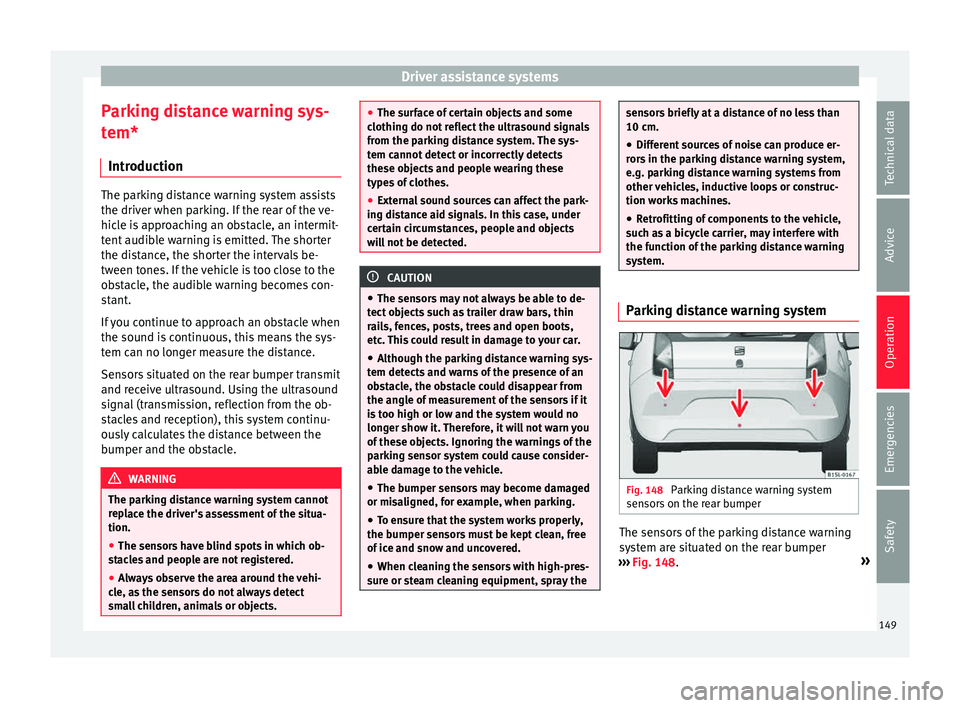
Fig. 148
Parking distance warning system
sen sor
s
on the rear bumper The sensors of the parking distance warning
sy
s
t
em are situated on the rear bumper
››› Fig. 148. »
149
Technical data
Advice
Operation
Emergencies
Safety
Page 153 of 232

Driver assistance systems
WARNING
Do not be distracted from traffic to look at the
sc r
een. Note
● SEA T r
ecommends practising using the
parking distance warning system in a traffic-
free zone or in a car park to familiarise your-
self with the system and its operation.
● Representation of the registered area on
the scr
een of the portable navigation system
may take up to 5 seconds.
● Note the Instruction Manual provided for
the device of
the additional information relat-
ing to the Portable Navigation System (sup-
plied by SEAT) ››› page 164. Cruise control* (Cruise control
sy
s
t
em - CCS)
Control lamp
It lights upPossible cause
This cruise control system maintains the
set speed of the vehicle.
Several warning and indication lamps light
up f
or a f
ew sec
onds when the ignition is
switched on, signalling that the function is being verified. They will switch off after a few
seconds. WARNING
If the warning lamps are ignored, the vehicle
ma y
stall in traffic, or may cause accidents
and severe injuries.
● Never ignore the warning lamps. CAUTION
Failure to heed the warning lamps when they
appe ar m
ay result in faults in the vehicle. Cruise control operation
Read the additional information carefully
› ›
›
page 25
The cruise control system (CCS) is able to in-
dividually maintain the set speed when driv-
ing forwards from approx. 20 km/h (15 mph).
The CCS only slows down by reducing the ac-
celerator but not by braking ››› .
T r
av
elling down hills with the CCS
When travelling down hills the CCS cannot
maintain a constant speed. Slow the vehicle
down using the brake pedal and reduce
gears if required. Automatic off
The cruise c
ontrol system (CCS) is switched
off automatically or temporarily:
● If the system detects a fault that could af-
fect the w
orking order of the CCS.
● If you increase the stored speed by press-
ing the acc
elerator pedal for a certain time.
● if the brake or clutch pedal is depressed.
● If the gear is changed with the manual
gearbo
x.
● If the airbag is triggered. WARNING
Use of the cruise control could cause acci-
dents and sev
ere injuries if it is not possible
to drive at a constant speed maintaining the
safety distance.
● Do not use the cruise control in heavy traf-
fic, if the dis
tance from the vehicle in front is
insufficient, on steep roads, with several
bends or in slippery circumstances (snow,
ice, rain or loose gravel), or on flooded roads.
● Never use the CCS when driving off-road or
on unpav
ed roads.
● Always adapt your speed and the distance
to the v
ehicles ahead in line with visibility,
weather conditions, the condition of the road
and the traffic situation.
● To avoid unexpected operation of the cruise
contro
l system, turn it off every time you fin-
ish using it. » 151
Technical data
Advice
Operation
Emergencies
Safety
Page 181 of 232

Checking and refilling levels
metal additives. Using them may damage the
engine!
● On ly
use fuel with an octane rating that is
in line with the norm EN 228, otherw
ise sig-
nificant damage could be caused to the en-
gine and fuel system. Furthermore, it could
lead to a loss of performance with the conse-
quent engine fault.
● The use of unsuitable petrol additives could
seriously
damage the engine and the catalyt-
ic converter.
● If, in exceptional circumstances, petrol with
a lower oct
ane rating to that recommended is
used, only use moderate engine speeds and a
light throttle. Avoid using full throttle and
overloading the engine. Otherwise engine
damage may occur. Fill up with fuel of a suita-
ble octane rating as soon as possible.
● Just filling one full tank of leaded fuel or
with other meta
l additives would seriously
impair the efficiency of the catalytic convert-
er and could damage it. Natural gas
Natural gas, in addition to others, can be in
li
quid f
orm.
Li
quefied natural gas (LNG) is the result of
heavy cooling of natural gas. Therefore its
volume is considerably reduced compared
with compressed natural gas (CNG). In vehi-
cles with a natural gas engine, liquefied nat-
ural gas cannot be directly refilled, as the gas would expand excessively in the vehicle gas
tank.
Theref
ore, vehicles with a natural gas engine
must only be refuelled using compressed
natural gas ››› .
Nat ur
a
l gas quality and consumption
Natural gas is divided into the groups H and
L depending on its quality.
Gas type H has a superior heating power and
inferior nitrogen and carbon dioxide content
than type L. The higher the heating power of
the natural gas, the lower the consumption
will be.
However, the heating power and the propor-
tion of nitrogen and carbon dioxide can fluc-
tuate within the quality groups. Therefore, ve-
hicle consumption can also vary when using
one type of gas only.
The engine management automatically
adapts to the natural gas used according to
its quality. Therefore, different quality gases
can be mixed in the tank, without the need
for comprehensive draining before applying a
different quality gas.
Natural gas and safety
If you can smell gas or suspect that there is a
leak ››› :
● Stop the vehicle immediately. ●
Sw it
c
h the ignition off.
● Open the doors to appropriately ventilate
the vehic
le.
● Immediately extinguish cigarettes.
● Move away from the vehicle or switch off
obj
ects that may cause sparks or a fire.
● If you continue to smell gas, do not contin-
ue driving!
● Seek
specialist assistance. Have the fault
repair
ed. WARNING
Failure to act when you can smell gas in the
vehic l
e or when refuelling can cause serious
injuries.
● Carry out the necessary operations.
● Leave the danger zone.
● If necessary, warn the emergency services. WARNING
The vehicle is not prepared to use liquefied
nat ur
al gas (LNG) and this fuel must not be
added under any circumstances. Liquefied
natural gas can cause the natural gas tank to
explode, resulting in serious injury. Note
The natural gas system must be subject to
re gu
lar inspections at a specialised work-
shop in accordance with the Maintenance
Programme. 179
Technical data
Advice
Operation
Emergencies
Safety
Page 182 of 232

Advice
Filling the tank Intr oduction The fuel tank flap is on the rear right of the
vehic
l
e. WARNING
Refuelling or handling fuel carelessly can
cau se an e
xplosion or fire resulting in serious
burns and injuries.
● Always make sure that you correctly close
the fuel c
ap to avoid evaporation and fuel
spillage.
● Fuels are highly explosive and inflammable
subs
tances that can cause serious burns and
injuries.
● Fuel could leak out or be spilt if the engine
is not
switched off or if the filler fuel nozzle is
not fully inserted into the tank filler neck
when refuelling. This could lead to a fire, ex-
plosion and severe injuries.
● When refuelling, turn off the engine and
turn off the ignition f
or safety reasons.
● Always turn off mobile telephones, radio
appar
atus and other radio wave emitting
equipment before refuelling. Electromagnetic
waves could cause sparks and lead to a fire.
● Never enter the vehicle while refuelling. If it
is ab
solutely necessary to enter, close the
door and touch a metal surface before touch- ing the filler nozzle again. This will prevent
the gener
ation of
static electricity. Sparks
could cause a fire when refuelling.
● Never handle fuel close to flames, sparks or
obj
ects with slow combustion (e.g. ciga-
rettes).
● Avoid static electricity and electro-magnet-
ic ra
diation when refuelling.
● Observe the safety regulations of the serv-
ice st
ation.
● Never spill fuel on the vehicle or in the lug-
gage c
ompartment. WARNING
For safety reasons, SEAT does not recommend
carr y
ing a spare fuel canister in the vehicle.
Fuel could be spilled and catch fire, above all
in case of an accident and this applies to a
full container as well as empty containers.
This could lead to explosions, fires and inju-
ries.
● Observe the following if you exceptionally
have t
o carry fuel in a canister:
– Never place a fuel container, to fill it, in-
side the vehicle or on the vehicle, for ex-
ample, in the luggage compartment. Fill-
ing in these circumstances could create
an electrostatic charge and spark that
could ignite fuel fumes.
– Always place the canister on the ground
to fill it. –
Inser t
the fuel nozzle into the neck of the
canister as far as possible.
– If you are using a metal fuel canister, the
nozzle must always touch the canister
while it is being filled to avoid static elec-
tricity.
– Follow the legal requirements for the use,
storage and transport of spare fuel canis- ters.
– Insure that the fuel container complies
with manufacturing standards, for exam-
ple, ANSI or ASTM F852-86. CAUTION
● Alw a
ys remove any fuel spilled anywhere
on the vehicle to avoid damage to the wheel
housing, the tyre and vehicle paintwork.
● Refuelling a petrol engine with diesel can
cause seriou
s engine and fuel system dam-
age; the resulting malfunctions are not cov-
ered by the SEAT warranty. If you refuel with
the wrong type of fuel, never start the engine.
This applies to even the smallest amount of
the wrong fuel. Seek specialist assistance.
With the engine running, the composition of
the wrong fuel could significantly damage the
fuel system and the engine itself. For the sake of the environment
Fuels can contaminate the environment. Col-
lect an
y spilt service fluids and allow a pro-
fessional to dispose of them. 180
Page 190 of 232

Advice
Preparations
● Park the vehicle on flat ground so that the
en gine oi
l
reading is correct.
● The engine must be hot to be able to check
the engine oil
level. Stop the engine and wait
a few minutes for the oil to drain back into
the sump.
● Open the bonnet ›››
page 184.
● The engine oil filler neck can be recognised
by the symbo
l on the cap ››› Fig. 168 and
the dipstick by its coloured handle.
Check the engine oil level
● Pull out the dipstick and wipe it on a clean
cloth.
● Rep
lace the dipstick, pushing it in as far as
it wi
ll go. If the dipstick to measure engine oil
has a mark, when you reintroduce it this
mark should slot into the corresponding
groove located on the upper end of the tube.
● Remove the oil dipstick again and check
the engine oil
level.
● After reading the oil level, replace the dip-
stick
in the tube completely. WARNING
Oil could catch fire if it comes into contact
with hot en
gine components. This could lead
to a fire, explosion and severe injuries.
● Always ensure that after topping of oil, the
engine oil
filler cap is correctly tightened. This will avoid engine oil spilling onto hot en-
gine par
t
s when the engine is running. CAUTION
● If the en gine oi
l level is above the area
››› Fig. 167 A do not start the engine. Seek
spec i
alist assistance. Otherwise catalytic
converter and engine damage may occur.
● When refilling or changing service liquids,
ensur
e that you put the liquids into the right
tank. Making a mistake when refilling could
cause serious malfunctions and damage the
engine! For the sake of the environment
The oil level must never be above area A .
Otherw i
se oil can be drawn in through the
crankcase breather and escape into the at-
mosphere via the exhaust system. Engine oil consumption
The consumption of engine oil can be differ-
ent
fr
om one en
gine to another and can vary
during the useful life of the engine.
Depending on how you drive and the condi-
tions in which the vehicle is used, oil con-
sumption can be up to 1 ltr./2000 km. In the
case of new vehicles, the consumption can
exceed this figure over 5,000 kilometres. For
this reason the engine oil level must be checked at regular intervals, preferably when
fillin
g the tank and before a journey.
When the engine is working hard, for in-
stance during sustained high-speed motor-
way cruising in summer or when climbing
mountain passes, the oil level should pref-
erably be kept within area ››› Fig. 167 A .
Topping up engine oil Read the additional information carefully
›› ›
page 30.
The engine oil must be changed regularly ac-
cording to the specifications of the Mainte-
nance Programme.
Due to the problems linked with disposing of
used oil and the need for suitable tools and
special knowledge, always visit a specialised
workshop to have the engine oil and filter
changed. SEAT recommends taking your car
in for technical service.
Detailed information on the service intervals
is shown in the Maintenance Programme.
Engine oil additives make new oil darker after
the engine has been running for a short peri-
od. This is normal and does not mean more
frequent oil changes are required.
188
Page 219 of 232

Index
Index
A
Abr o
a
d
extended stay abroad with your vehicle . . . . . 176
sale of vehicle . . . . . . . . . . . . . . . . . . . . . . . . . . 176
ABS see Anti-lock brake system . . . . . . . . . . . . . . . 147
Accessories . . . . . . . . . . . . . . . . . . . . . . . . . . . . . . 159
Acoustic alarm seatbelt unfastened . . . . . . . . . . . . . . . . . . . . . . 53
Adjusting front seat . . . . . . . . . . . . . . . . . . . . . . . . . . . . . . 108
lights . . . . . . . . . . . . . . . . . . . . . . . . . . . . . . . . . 104
rear head restraints . . . . . . . . . . . . . . . . . . . . . 108
Rear head restraints . . . . . . . . . . . . . . . . . . . . . . 50
seats . . . . . . . . . . . . . . . . . . . . . . . . . . . . . . . . . . 47
Adjusting the head restraints rear head restraints . . . . . . . . . . . . . . . . . . . . . 108
Advice for driving spare wheel or temporary spare wheel . . . . . . 204
Airbag covers . . . . . . . . . . . . . . . . . . . . . . . . . . . . . 14
Airbags . . . . . . . . . . . . . . . . . . . . . . . . . . . . . . . . . . 58
Airbag system . . . . . . . . . . . . . . . . . . . . . . . . . . 14, 58 activation . . . . . . . . . . . . . . . . . . . . . . . . . . . . . . 60
cleaning dash panel . . . . . . . . . . . . . . . . . . . . . 174
control lamp . . . . . . . . . . . . . . . . . . . . . . . . . . . . 62
description . . . . . . . . . . . . . . . . . . . . . . . . . . . . . 59
front airbags . . . . . . . . . . . . . . . . . . . . . . . . . 14, 61
functioning . . . . . . . . . . . . . . . . . . . . . . . . . . . . . 60
locking the vehicle after deployment . . . . . . . . 93
repairs . . . . . . . . . . . . . . . . . . . . . . . . . . . . . . . . 161
Side airbags . . . . . . . . . . . . . . . . . . . . . . . . . . . . 16
use of child seats . . . . . . . . . . . . . . . . . . . . . . . . 15
vehicle care . . . . . . . . . . . . . . . . . . . . . . . . . . . . 174 Air conditioning . . . . . . . . . . . . . . . . . . . . . . . . . . 124
climatr onic . . . . . . . . . . . . . . . . . . . . . . . . 28, 124
controls . . . . . . . . . . . . . . . . . . . . . . . . . . . . . . . . 28
special features . . . . . . . . . . . . . . . . . . . . . . . . 127
user instructions . . . . . . . . . . . . . . . . . . . . . . . . 126
Air outlets . . . . . . . . . . . . . . . . . . . . . . . . . . . . . . . 127
Air recirculation . . . . . . . . . . . . . . . . . . . . . . . . . . 128
Antenna . . . . . . . . . . . . . . . . . . . . . . . . . . . 161, 176
Anti-freeze . . . . . . . . . . . . . . . . . . . . . . . . . . . . . . . 31
Anti-lock brake system . . . . . . . . . . . . . . . . . . . . . 147
Anti-lock system . . . . . . . . . . . . . . . . . . . . . . . . . . 147
Anti-puncture kit . . . . . . . . . . . . . . . . . . . . . . . . 34, 71 Check after 10 minutes . . . . . . . . . . . . . . . . . . . 73
Anti-theft security system . . . . . . . . . . . . . . . . . . . 95
Ashtray . . . . . . . . . . . . . . . . . . . . . . . . . . . . . . . . . 116
Aspects to take into account before starting the vehicle . . . . . . . . . . . . . . . . . . . . . . . . . . . . . . . . . 46
ASR see Traction control system . . . . . . . . . . . . . . . 147
Assistance systems brake assist system (BAS) . . . . . . . . . . . . . . . . 147
cruise control . . . . . . . . . . . . . . . . . . . . . . . . . . 151
electronic differential lock (EDS) . . . . . . . . . . . 148
optical parking system (OPS) . . . . . . . . . . . . . 150
parking aid . . . . . . . . . . . . . . . . . . . . . . . . . . . . 149
parking distance warning system . . . . . . . . . . 149
safety Assist . . . . . . . . . . . . . . . . . . . . . . . . . . . 152
Assisted starting . . . . . . . . . . . . . . . . . . . . . . . . . . 42
Assist systems traction control (ASR) . . . . . . . . . . . . . . . . . . . . 148
traction control (TC) . . . . . . . . . . . . . . . . . . . . . 148
Audible warnings Control and warning lamps . . . . . . . . . . . . . . . . 25
lights . . . . . . . . . . . . . . . . . . . . . . . . . . . . . . . . . 102
speed . . . . . . . . . . . . . . . . . . . . . . . . . . . . . . . . . 24
Automatic belt retractor . . . . . . . . . . . . . . . . . . . . . 57
Automatic device disconnection battery . . . . . . . . . . . . . . . . . . . . . . . . . . . . . . . . 196 Automatic gearbox
driving tip s . . . . . . . . . . . . . . . . . . . . . . . . . . . . 140
ignition key removal lock . . . . . . . . . . . . . . . . . 131
kick-down . . . . . . . . . . . . . . . . . . . . . . . . . . . . . 140
malfunction . . . . . . . . . . . . . . . . . . . . . . . . . . . . 141
starting on a slope . . . . . . . . . . . . . . . . . . . . . . 140
stopping on a slope . . . . . . . . . . . . . . . . . . . . . 140
Automatic gear change . . . . . . . . . . . . . . . . . . . . 139
Axle loads . . . . . . . . . . . . . . . . . . . . . . . . . . . . . . . 210
B Bag support . . . . . . . . . . . . . . . . . . . . . . . . . . . . . 114
BAS see Brake assist systems . . . . . . . . . . . . . . . . . 147
Battery changing in the vehicle key . . . . . . . . . . . . . . . . 91
Battery acid . . . . . . . . . . . . . . . . . . . . . . . . . . . . . . 195
Before starting the vehicle . . . . . . . . . . . . . . . . . . 46
Belt tension device service and disposal . . . . . . . . . . . . . . . . . . . . . 57
Belt tensioner . . . . . . . . . . . . . . . . . . . . . . . . . . . . . 57
Belt tension limiter . . . . . . . . . . . . . . . . . . . . . . . . . 57
Belt tightening . . . . . . . . . . . . . . . . . . . . . . . . . . . . 57
Bonnet . . . . . . . . . . . . . . . . . . . . . . . . . . . . . 10, 184
Boot hatch emergency locking and unlocking . . . . . . . . . . . 10
Brake assist system . . . . . . . . . . . . . . . . . . . . . . . 147
Brake fluid . . . . . . . . . . . . . . . . . . . . . . . . . . . . . . . 32 specification . . . . . . . . . . . . . . . . . . . . . . . . . . . 192
Brakes . . . . . . . . . . . . . . . . . . . . . . . . . . . . . . . . . . 132 brake assist systems . . . . . . . . . . . . . . . . . . . . 147
brake fluid . . . . . . . . . . . . . . . . . . . . . . . . . . . . . 191
brake fluid level . . . . . . . . . . . . . . . . . . . . . . . . 192
brake pads . . . . . . . . . . . . . . . . . . . . . . . . . . . . 135
brake servo . . . . . . . . . . . . . . . . . . . . . . . . . . . . 136
changing the brake fluid . . . . . . . . . . . . . . . . . 192
217