2015 Seat Altea seats
[x] Cancel search: seatsPage 29 of 236

Transporting children safetyWeight
group
Seating position
Front
passen-
ger seatRear side seatRear cen-tral seat
Group 0
to 10 kgU*UU
Group 0+ to 13 kgU*UU
Group I
9 to 18 kgU*UU
Group II
15 to 25 kgU*UU
Group III
22 to 36 kgU*UU Suitable for universal restraint systems
for use in this weight group.
Move the front passenger seat as far
back as possible, as high as possible
and always disable the airbag.
WARNING
● When travelling, children must be secured
in the vehicle with a restraint system suitable
for age, weight and size.
● Read and always observe information and
warnings concerning the use of child seats
››› page 25. U:
*:
Child seats fastened with the “ISOFIX” and Top Tether* system Fig. 23
ISOFIX securing rings. Fig. 24
Top Tether* securing ring.
» 27
Technical specifications
Advice
Operation
Safety
Page 30 of 236

Safety
Child seats with the “ISOFIX” or Top Tether*
system can be secured quickly, easily and
safely on the rear outer seats.
When removing or fitting the child seat,
please be sure to follow the manufacturer's
instructions. – Move the rear seat as far to the rear as it
will go.
– Press the child seat onto the “ISOFIX” re-
taining rings until the child seat can be heard to engage securely. If the child seat
is equipped with Top Tether* anchor points,
secure it to the correspondent ring
››› Fig. 24 . Follow the manufacturer's in-
s truction
s.
– Pull on both sides of the child seat to en-
sure that it is secure.
Two “ISOFIX” retaining rings are fitted on
eac
h rear seat. In some vehicles, the rings
are secured to the seat frame and in others they are secured to the rear floor. Access to
the “ISOFIX” rings is between the rear seat
backrest and the seat cushioning. The Top
Tether* rings are located at the rear of the
backrests of the rear seats (behind the seat
backrest or in the boot).
Child seats with the “ISOFIX” and Top Tether*
attachment system are available from Techni-
cal Services.
Weight groupSize classElectrical equipmentMounting directionVehicle Isofix positions
Rear side seats
Baby carrierFISO/L1Backward-facingX
GISO/L2Backward-facingX
Group 0 to 10 kgEISO/R1Backward-facingIU
Group 0+ to 13 kg
EISO/R1Backward-facingIU
DISO/R2Backward-facingIU
CISO/R3Backward-facingIU
Group I 9 to 18 kg
DISO/R2Backward-facingIU
CISO/R3Backward-facingIU
BISO/F2Forward-facingIU
B1ISO/F2XForward-facingIU
AISO/F3Forward-facingIU
Group II 15 to 25 kg------Forward-facing---
28
Page 31 of 236

Transporting children safetyWeight groupSize classElectrical equipmentMounting directionVehicle Isofix positions
Rear side seats
Group III 22 to 36 kg------Forward-facing---
Suitable for ISOFIX universal child re-
straint systems approved for use in this
weight group
ISOFIX position not suitable for ISOFIX
child restraint systems for this weight
group or size class.
WARNING
● The retaining rings are designed only for
use with “ISOFIX” and Top Tether* child
seats.
● Never secure other child seats without the
“ISOFIX”, Top Tether* system, nor retaining
belts or objects to the fastening rings; other-
wise this can result in potentially fatal inju-
ries to the child.
● Ensure that the child seat is secured cor-
rectly using the “ISOFIX” and Top Tether* se-
curing rings. IU:
X:
29
Technical specifications
Advice
Operation
Safety
Page 90 of 236
Operation
the rear of the vehicle. The right exterior
mirror will be adjusted at the same time
(sy nc
hronised). WARNING
● Convex or spherical mirrors increase the
field of vision however the objects appear
smaller and further away. If you use these
mirrors to estimate the distance to vehicles
behind you when changing lane, you could
make a mistake. Risk of accident.
● If possible, use the rear vision mirror to es-
timate distances to vehicles behind you.
● Make sure that you do not get your finger
trapped between the mirror and the mirror
base when folding back the mirrors. Risk of
injury! For the sake of the environment
The exterior mirror heating should be switch-
ed off when it is no longer needed. Other-
wise, it is an unnecessary fuel waste. Note
● If the electrical adjustment ever fails to op-
erate, the mirrors can be adjusted by hand by
lightly pressing the edge of the mirror glass.
● In vehicles with electric exterior mirrors,
the following points should be observed: if, due to an external force (e.g. being knocked
while manoeuvring), the adjustment of the
mirror housing is altered, the mirror will have
to be fully folded electrically. Do not readjust the rear vision mirror housing by hand, as
this will interfere with the mirror adjuster
function.
● The rear vision mirrors can be adjusted sep-
arately or simultaneously, as described
above.
● The folding function on the exterior mirrors
is not active at speeds over 40 km/h
(25 mph). Seats and head restraints
Adjusting the seat and head
restraints
The importance of correct seat
adjustment Proper seat adjustment optimises the level of
protection offered by seat belts and airbags.
Your vehicle has
five
seats, two in the front
and thr ee in the r
ear. Each seat is equipped
with a three-point seat belt.
The driver seat and the front passenger seat
can be adjusted in many ways to suit the
physical requirements of the vehicle occu-
pants. The correct seat position is very impor-
tant for:
● a fast and easy operation of all controls on
the instrument panel,
● a relaxed posture which does not cause
drowsiness,
● a safe driving ›››
page 5,
● ensuring that the seat belts and airbag sys-
tem provide maximum protection ›››
page 11. WARNING
● If the driver and passengers assume im-
proper sitting positions, they may sustain
critical injuries. 88
Page 91 of 236
Seats and head restraints
●
Never transport more than the permitted
amount of people in your vehicle.
● Every vehicle occupant must properly fas-
ten and wear the seat belt belonging to his or
her seat. Children must be protected with an
appropriate child restraint system ››› page 24,
Transporting children safety.
● The front seats and all head restraints must
always be adjusted to body size and the seat
belt must always be properly adjusted to pro-
vide you and your passengers with optimum
protection.
● Always keep your feet on the footwell when
the vehicle is moving; never rest them on the
dash panel, out of the window or on the seat.
This is also applied to passengers. An incor-
rect sitting position exposes you to an in-
creased risk of injury in case of a sudden
braking or an accident. If the airbag is trig-
gered, you could sustain severe injuries due
to an incorrect sitting position.
● It is important for the driver and front pas-
senger to keep a distance of at least 25 cm
from the steering wheel and dash panel. Fail-
ure to respect the minimum distance means
that the airbag will not protect you. Risk of
fatal injury. The distance between the driver
and the steering wheel or between the front
passenger and the dash panel should always
be as great as possible.
● Adjust the driver or front passenger seat
only when the vehicle is stationary. This also
applies to the forwards/backwards adjust-
ment of the rear seats. Otherwise, your seat
could move unexpectedly while the vehicle is moving. This could increase the risk of an ac-
cident and therefore, injury. In addition,
while adjusting your seat, you will assume an
incorrect sitting position. Risk of fatal acci-
dents.
●
Special guidelines apply to installing a
child seat on the front passenger seat. When
installing a child seat, please observe the
warnings described in ››› page 24, Transport-
ing children safety. Adjustment of the front seats
Fig. 74
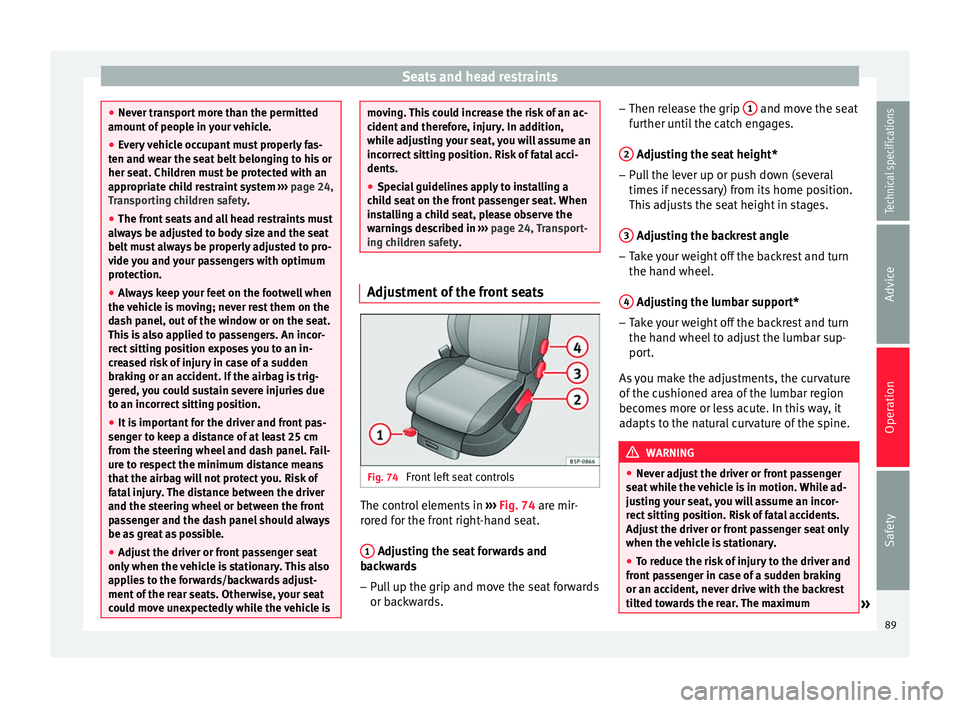
Front left seat controls The control elements in
››› Fig. 74 are mir-
r or
ed for the front right-hand seat.
1 Adjusting the seat forwards and
backwards
– Pull up the grip and move the seat forwards
or backwards. –
Then release the grip 1 and move the seat
further until the catch engages.
2 Adjusting the seat height*
– Pull the lever up or push down (several
times if necessary) from its home position.
This adjusts the seat height in stages.
3 Adjusting the backrest angle
– Take your weight off the backrest and turn
the hand wheel.
4 Adjusting the lumbar support*
– Take your weight off the backrest and turn
the hand wheel to adjust the lumbar sup-
port.
As you make the adjustments, the curvature
of the cushioned area of the lumbar region
becomes more or less acute. In this way, it
adapts to the natural curvature of the spine. WARNING
● Never adjust the driver or front passenger
seat while the vehicle is in motion. While ad-
justing your seat, you will assume an incor-
rect sitting position. Risk of fatal accidents.
Adjust the driver or front passenger seat only
when the vehicle is stationary.
● To reduce the risk of injury to the driver and
front passenger in case of a sudden braking
or an accident, never drive with the backrest
tilted towards the rear. The maximum » 89
Technical specifications
Advice
Operation
Safety
Page 92 of 236
Operation
protection of the seat belt can be achieved
only when the backrests are in an upright po-
sition and the driver and front passenger
have properly adjusted their seat belts. The
further the backrests are tilted to the rear,
the greater the risk of injury due to improper
positioning of the belt web!
●
Exercise caution when securing the seat
height into forwards/backwards position. In-
juries can be caused if the seat height is ad-
justed without due care and attention. Correct adjustment of head restraints
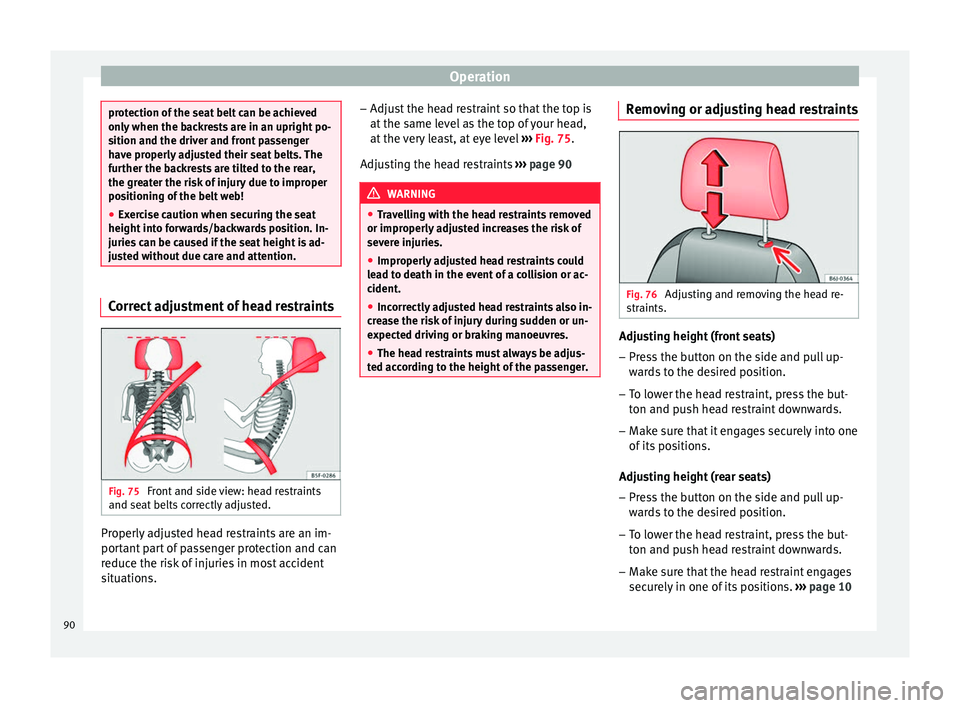
Fig. 75
Front and side view: head restraints
and seat belts correctly adjusted. Properly adjusted head restraints are an im-
portant part of passenger protection and can
reduce the risk of injuries in most accident
situations. –
Adjust the head restraint so that the top is
at the same level as the top of your head,
at the very least, at eye level ››› Fig. 75 .
Adju s
ting the head restraints ››› page 90 WARNING
● Travelling with the head restraints removed
or improperly adjusted increases the risk of
severe injuries.
● Improperly adjusted head restraints could
lead to death in the event of a collision or ac-
cident.
● Incorrectly adjusted head restraints also in-
crease the risk of injury during sudden or un-
expected driving or braking manoeuvres.
● The head restraints must always be adjus-
ted according to the height of the passenger. Removing or adjusting head restraints
Fig. 76
Adjusting and removing the head re-
straints. Adjusting height (front seats)
– Press the button on the side and pull up-
wards to the desired position.
– To lower the head restraint, press the but-
ton and push head restraint downwards.
– Make sure that it engages securely into one
of its positions.
Adjusting height (rear seats) – Press the button on the side and pull up-
wards to the desired position.
– To lower the head restraint, press the but-
ton and push head restraint downwards.
– Make sure that the head restraint engages
securely in one of its positions. ››› page 10
90
Page 93 of 236

Seats and head restraints
Angle adjustment (front seats) – Press the head restraint forward or back to
the required position.
Removing the head restraint – Push the head restraint up as far as it will
go.
– Press the button ››› Fig. 76 (arrow).
– Pull head restraint out of fitting without re-
leasing the button.
Fitting the head restraint
– Insert the head restraint into the guides on
the backrest.
– Push head restraint down.
– Adjust the head restraint to suit body size
››› page 10 and
›
›› page 9. WARNING
● Never drive if the head restraints have been
removed. Risk of injury.
● Never drive if the head restraints are in an
unsuitable position, there is a risk of serious
injury.
● After refitting the head restraint, you must
always adjust it properly for height to achieve
optimal protection.
● Please observe the safety warnings in
››› page 90, Correct adjustment of head re-
straints. Seat functions
Heated seats* Fig. 77
Thumb wheel for front seat heating. Fig. 78
Front seat heating with Climatronic. The front seat cushions and backrests can be
heated electrically.Front seat heating for vehicles without
Climatronic
– Turn the appropriate thumb wheel
››› Fig. 77 to switch on the seat heating. The
se at
heating is switched off in the 0 posi-
tion.
Front seat heating for vehicles with
Climatronic – Press the button to switch on seat heating.
– Press once to set seat heating at maximum
level (level 3).
– Press twice to set seat heating at medium
level (level 2).
– Press three times to set seat heating at
minimum level (level 1).
– When the button is pressed four times, the
heating goes off and the LED goes out (lev-
el 0).
The seat heating only works when the igni-
tion is switched on. The left thumb wheel
controls the left seat and the right thumb
wheel the right seat. CAUTION
To avoid damaging the heating elements,
please do not kneel on the seat or apply
sharp pressure at a single point to the seat
cushion and backrest. 91
Technical specifications
Advice
Operation
Safety
Page 94 of 236

Operation
Rear seats Seat adjustment Fig. 79
Unlock bar on rear seat Fig. 80
Rear seat backrest angle adjustment. The seats may be moved forwards or back-
wards independently. This movement range
can be 1/3 or 2/3 of the seat. There are vari-
ous possible positions. Adjusting reach
– In the seated position, unlock the lever in
the direction of the arrow ››› Fig. 79 .
– Mo v
e the seat cushion forwards or back-
wards to the desired position.
Adjusting the backrest angle
– Hold the backrest at the top. Pull the loop
on the side of the seat ››› Fig. 80 1 in the
direction of the arrow and hold it in this po-
sition. Push the backrest to the required
position and release the loop. WARNING
● Adjust the seat only when the vehicle is
stationary. Otherwise, your seat could move
unexpectedly while the vehicle is moving.
This could increase the risk of an accident
and therefore, injury.
● Do not push the backrests down when the
seat is moved to prevent damage to the cen-
tre console.
● Ensure that the seat, once moved, is fixed
in position. Note
● In order to maintain the maximum luggage
compartment space, put the backrests in po-
sition normal, without moving.
● In order to maintain the maximum space
without putting the backrests down, move
the seats forward to the desired position. Folding and lifting the seat backrest
Fig. 81
Folding the rear seat backrests down. Fig. 82
Lifting the rear seat backrests. Folding the backrest forwards
– Pull the loop on the side of the seat
››› Fig. 81 1 .
In this position the backrest is locked.
92