2015 Seat Altea height
[x] Cancel search: heightPage 27 of 236

Transporting children safety
Follow the manufacturer's instructions and
observe any statutory requirements when in-
stalling and using child seats. Always read
and note ››› page 25 .
W e r
ecommend you always carry the manu-
facturer's Child Seat Instruction Manual to-
gether with the on-board documentation.
Important information regarding the
front passenger's airbag Fig. 21
Passenger's side sun visor: airbag
sticker. Fig. 22
On the rear frame of the passenger
side door: airbag sticker. A sticker with important information about
the passenger airbag is located on the pas-
senger's sun visor and/or on the passenger
side door frame. Read and always observe
the safety information included in the follow-
ing chapters:
● Safety distance with respect to the passen-
ger airbag ››› page 17 .
● Ob
jects between the passenger and the
passenger side airbag ››› in Front airbags
on page 20 .
The p a
ssenger side front airbag, when activa-
ted, is a serious risk for a child who is facing
backward since the airbag can strike the seat
with such force that it can cause serious or
fatal injuries. Children up to 12 years old
should always travel on the rear seat.
Therefore we strongly recommend you to
transport children on the rear seats. This is the safest location in the vehicle. Alternative-
ly, the front passenger airbag can be disa-
bled with a key-operated switch
››› page 23.
When transporting children, use a child seat
suitable for the age and size of each child
››› page 24. WARNING
● If a child seat is secured to the front pas-
senger seat, the risk to the child of sustain-
ing critical or fatal injuries in the event of an
accident increases.
● An inflating front passenger airbag can
strike the rear-facing child seat and project it
with great force against the door, the roof or
the backrest.
● Never install a child seat facing backwards
on the front passenger seat unless the front
passenger front airbag has been disabled.
Risk of potentially fatal injuries to the child!
However, if it is necessary, in exceptional ca-
ses, to transport a child in the front passen-
ger seat, the front passenger front airbag
must always be disabled ››› page 23, Front
passenger front airbag deactivation . If the
front passenger seat has a height adjustment
option, move it to the highest position.
● For those vehicles that do not include a key
lock switch to deactivate the airbag, the vehi-
cle must be taken to a Technical Service.
● All vehicle occupants, especially children,
must assume the proper sitting position and
be properly belted in while travelling. » 25
Technical specifications
Advice
Operation
Safety
Page 91 of 236
Seats and head restraints
●
Never transport more than the permitted
amount of people in your vehicle.
● Every vehicle occupant must properly fas-
ten and wear the seat belt belonging to his or
her seat. Children must be protected with an
appropriate child restraint system ››› page 24,
Transporting children safety.
● The front seats and all head restraints must
always be adjusted to body size and the seat
belt must always be properly adjusted to pro-
vide you and your passengers with optimum
protection.
● Always keep your feet on the footwell when
the vehicle is moving; never rest them on the
dash panel, out of the window or on the seat.
This is also applied to passengers. An incor-
rect sitting position exposes you to an in-
creased risk of injury in case of a sudden
braking or an accident. If the airbag is trig-
gered, you could sustain severe injuries due
to an incorrect sitting position.
● It is important for the driver and front pas-
senger to keep a distance of at least 25 cm
from the steering wheel and dash panel. Fail-
ure to respect the minimum distance means
that the airbag will not protect you. Risk of
fatal injury. The distance between the driver
and the steering wheel or between the front
passenger and the dash panel should always
be as great as possible.
● Adjust the driver or front passenger seat
only when the vehicle is stationary. This also
applies to the forwards/backwards adjust-
ment of the rear seats. Otherwise, your seat
could move unexpectedly while the vehicle is moving. This could increase the risk of an ac-
cident and therefore, injury. In addition,
while adjusting your seat, you will assume an
incorrect sitting position. Risk of fatal acci-
dents.
●
Special guidelines apply to installing a
child seat on the front passenger seat. When
installing a child seat, please observe the
warnings described in ››› page 24, Transport-
ing children safety. Adjustment of the front seats
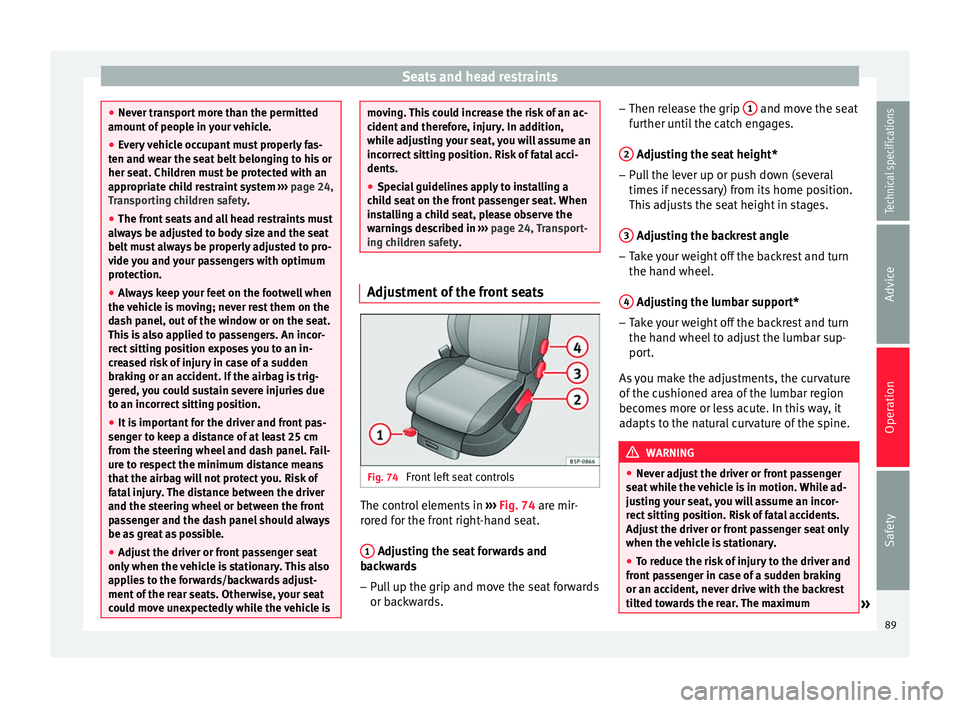
Fig. 74
Front left seat controls The control elements in
››› Fig. 74 are mir-
r or
ed for the front right-hand seat.
1 Adjusting the seat forwards and
backwards
– Pull up the grip and move the seat forwards
or backwards. –
Then release the grip 1 and move the seat
further until the catch engages.
2 Adjusting the seat height*
– Pull the lever up or push down (several
times if necessary) from its home position.
This adjusts the seat height in stages.
3 Adjusting the backrest angle
– Take your weight off the backrest and turn
the hand wheel.
4 Adjusting the lumbar support*
– Take your weight off the backrest and turn
the hand wheel to adjust the lumbar sup-
port.
As you make the adjustments, the curvature
of the cushioned area of the lumbar region
becomes more or less acute. In this way, it
adapts to the natural curvature of the spine. WARNING
● Never adjust the driver or front passenger
seat while the vehicle is in motion. While ad-
justing your seat, you will assume an incor-
rect sitting position. Risk of fatal accidents.
Adjust the driver or front passenger seat only
when the vehicle is stationary.
● To reduce the risk of injury to the driver and
front passenger in case of a sudden braking
or an accident, never drive with the backrest
tilted towards the rear. The maximum » 89
Technical specifications
Advice
Operation
Safety
Page 92 of 236
Operation
protection of the seat belt can be achieved
only when the backrests are in an upright po-
sition and the driver and front passenger
have properly adjusted their seat belts. The
further the backrests are tilted to the rear,
the greater the risk of injury due to improper
positioning of the belt web!
●
Exercise caution when securing the seat
height into forwards/backwards position. In-
juries can be caused if the seat height is ad-
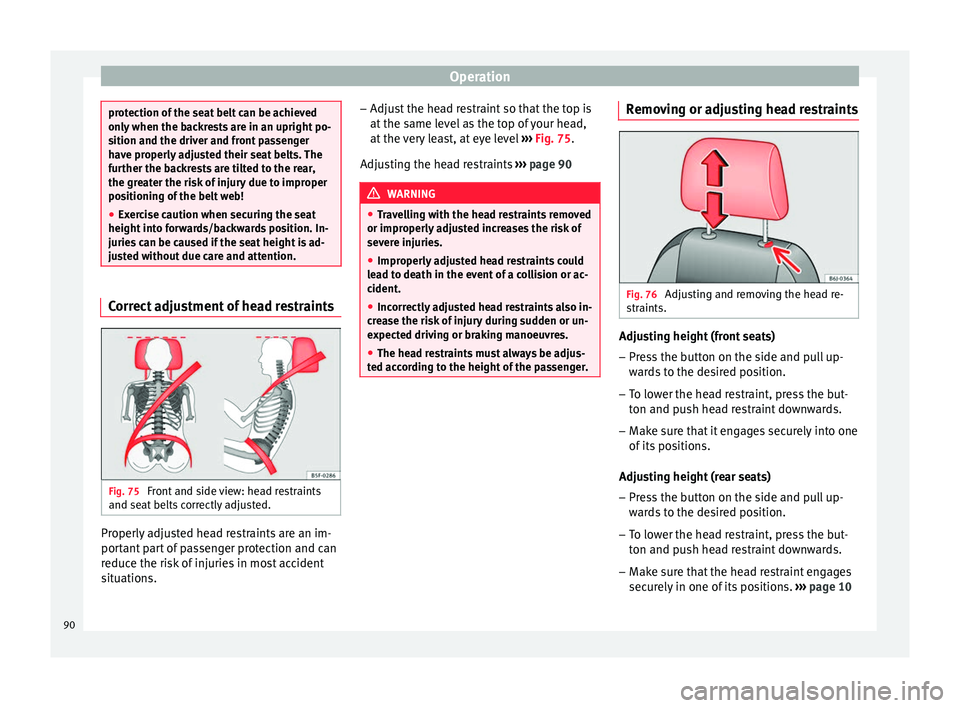
justed without due care and attention. Correct adjustment of head restraints
Fig. 75
Front and side view: head restraints
and seat belts correctly adjusted. Properly adjusted head restraints are an im-
portant part of passenger protection and can
reduce the risk of injuries in most accident
situations. –
Adjust the head restraint so that the top is
at the same level as the top of your head,
at the very least, at eye level ››› Fig. 75 .
Adju s
ting the head restraints ››› page 90 WARNING
● Travelling with the head restraints removed
or improperly adjusted increases the risk of
severe injuries.
● Improperly adjusted head restraints could
lead to death in the event of a collision or ac-
cident.
● Incorrectly adjusted head restraints also in-
crease the risk of injury during sudden or un-
expected driving or braking manoeuvres.
● The head restraints must always be adjus-
ted according to the height of the passenger. Removing or adjusting head restraints
Fig. 76
Adjusting and removing the head re-
straints. Adjusting height (front seats)
– Press the button on the side and pull up-
wards to the desired position.
– To lower the head restraint, press the but-
ton and push head restraint downwards.
– Make sure that it engages securely into one
of its positions.
Adjusting height (rear seats) – Press the button on the side and pull up-
wards to the desired position.
– To lower the head restraint, press the but-
ton and push head restraint downwards.
– Make sure that the head restraint engages
securely in one of its positions. ››› page 10
90
Page 93 of 236

Seats and head restraints
Angle adjustment (front seats) – Press the head restraint forward or back to
the required position.
Removing the head restraint – Push the head restraint up as far as it will
go.
– Press the button ››› Fig. 76 (arrow).
– Pull head restraint out of fitting without re-
leasing the button.
Fitting the head restraint
– Insert the head restraint into the guides on
the backrest.
– Push head restraint down.
– Adjust the head restraint to suit body size
››› page 10 and
›
›› page 9. WARNING
● Never drive if the head restraints have been
removed. Risk of injury.
● Never drive if the head restraints are in an
unsuitable position, there is a risk of serious
injury.
● After refitting the head restraint, you must
always adjust it properly for height to achieve
optimal protection.
● Please observe the safety warnings in
››› page 90, Correct adjustment of head re-
straints. Seat functions
Heated seats* Fig. 77
Thumb wheel for front seat heating. Fig. 78
Front seat heating with Climatronic. The front seat cushions and backrests can be
heated electrically.Front seat heating for vehicles without
Climatronic
– Turn the appropriate thumb wheel
››› Fig. 77 to switch on the seat heating. The
se at
heating is switched off in the 0 posi-
tion.
Front seat heating for vehicles with
Climatronic – Press the button to switch on seat heating.
– Press once to set seat heating at maximum
level (level 3).
– Press twice to set seat heating at medium
level (level 2).
– Press three times to set seat heating at
minimum level (level 1).
– When the button is pressed four times, the
heating goes off and the LED goes out (lev-
el 0).
The seat heating only works when the igni-
tion is switched on. The left thumb wheel
controls the left seat and the right thumb
wheel the right seat. CAUTION
To avoid damaging the heating elements,
please do not kneel on the seat or apply
sharp pressure at a single point to the seat
cushion and backrest. 91
Technical specifications
Advice
Operation
Safety
Page 167 of 236

Checking and refilling levels
For the sake of the environment
Service fluids leaks are harmful to the envi-
ronment. For this reason you should make
regular checks on the ground underneath
your vehicle. If you find spots of oil or other
fluids, have your vehicle inspected in a speci-
alised workshop. Opening the bonnet
Fig. 144
Detail of footwell area on driver side:
lever for unlocking the bonnet Fig. 145
Handle for releasing the bonnet. The bonnet is released from inside the vehi-
cle.
Before opening the bonnet ensure that the
windscreen wipers are in rest position.
– To release the bonnet, pull the lever under
the dash panel ››› Fig. 144 in the direction
indic at
ed (arrow). The bonnet will be re-
leased by a spring action ››› .
– Lift the bonnet using the release lever (ar-
row) and open the bonnet.
– Release the bonnet stay and secure it in
the fixture designed for this in the bonnet. WARNING
Hot coolant can scald!
● Never open the bonnet if you see steam,
smoke or coolant escaping from the engine
compartment. ●
Wait until no more steam, smoke or coolant
is emitted from the bonnet, then carefully
open the bonnet.
● When working in the engine compartment,
always observe the safety warnings
››› page 163. Closing the bonnet
–
Slightly lift the bonnet.
– Release the bonnet stay and replace it in its
support.
– At a height of approximately 30 cm let it fall
so it locks.
If the bonnet does not close, do not press
downwards. Open it once more and let it fall
as before. WARNING
If the bonnet is not closed properly, it could
open while you are driving and completely
obscure your view of the road. Risk of acci-
dent.
● After closing the bonnet, always check that
it is properly secured. The bonnet must be
flush with the surrounding body panels.
● If you notice that the bonnet latch is not se-
cured when the vehicle is moving, stop the
vehicle immediately and close the bonnet
properly. Risk of accident. 165
Technical specifications
Advice
Operation
Safety
Page 181 of 236

Wheels
the vehicle is impaired and there is a risk of
accident.
Note
● The run-flat tyres do not “deflate” on losing
pressure because they are supported on the
reinforced sides. Therefore defects in the tyre
cannot be detected with a visual inspection.
● Snow chains must not be used on front
tyres used in emergency conditions. New tyres and wheels
New tyres and wheels have to be run in.
The tyres and wheel rims are an essential
part of the vehicle's design. Those approved
by SEAT are specially matched to the charac-
teristics of the vehicle and make a major con-
tribution to good road-holding and safe han-
dling
››› .
Note for Italy: A SEAT Service Centre should
be c on
sulted whether different sized wheels
or tyres to those originally fitted by SEAT may
be fitted, as well as the combinations al-
lowed between the front axle (axle 1) and
back axle (axle 2).
Tyres should be replaced at least in pairs and
not individually (i.e. both front tyres or both
rear tyres together). A knowledge of tyre des-
ignations makes it easier to choose the cor- rect tyres. Radial tyres have the tyre designa-
tions marked on the sidewall, for example:
195/65 R15 91T
This contains the following information:
Tyre width in mm
Height/width ratio in %
Tyre construction: Radial
Rim di
ameter in inches
Load rating code
Speed rating
The tyres could also have the following infor-
mation:
● A direction of rotation symbol
● “Reinforced” denotes heavy-duty tyres.
The manufacturing date is also indicated on
the tyre sidewall (possibly only on the inner
side of the wheel).
“DOT... 1103...” means, for example, that the
tyre was produced in the 11th week of 2003.
We recommend that work on tyres and
wheels be carried out by a Technical Service.
They are familiar with the procedure and
have the necessary special tools and spare
parts as well as the proper facilities for dis-
posing of the old tyres. 195
65
R
15
91
T Any technical service has full information on
the technical requirements when installing or
changing tyres, wheels or wheel trims.
On vehicles with
all-wheel drive, all four tyres
must always be fitted with tyres of the same
type, make and tread pattern, as otherwise
the driveline can be damaged by continuous
differences in the wheel speeds. For this rea-
son, the spare wheel should have the same
wheel dimensions as the normal wheels so
that it will fit if there is a puncture. You may
also use the factory-supplied compact tem-
porary spare wheel. WARNING
● We recommend that you use only wheels
and tyres which have been approved by SEAT
for your model. Failure to do so could impair
vehicle handling. Risk of accident.
● Avoid running the vehicle on tyres that are
more than 6 years old. If you have no alterna-
tive, you should drive slowly and with extra
care at all times.
● Never use old tyres or those with an un-
known “history of use”.
● If wheel trims are retrofitted, you must en-
sure that the flow of air to the brakes is not
restricted. This could cause the brake system
to overheat.
● All four wheels must be fitted with radial
tyres of the same type, size (rolling circumfer-
ence) and the same tread pattern. » 179
Technical specifications
Advice
Operation
Safety
Page 223 of 236

Technical features
Dimensions and capacities Dimensions ALTEAALTEA XLALTEA FREETRACK
Length / Width (mm)4,282/1,7684,467/1,7684,493/1,778
Height at kerb weight (mm)1,5461,5751,615
Front and rear projections (mm)916/788913/976940/977
Wheelbase (mm)2,5782,5782,578
Turning radius (m)10.710.710.7
Front/rear
a)
track width (mm)1,525/1,509
1,539/1,5231,527/1,506
1,541/1,5201,534/1,519
1,542/1,527
a) This data will change depending on the type of wheel rim.
Capacities
Fuel tank (I)Vehicles with front-wheel driveVehicles with four-wheel drive
55 - Reserve 760 - Reserve 8
LPG Fuel tank (I)39
Windscreen washer fluid container/with headlight washer (I)3/5.5 Tyre pressure
Summer-grade tyres:
The correct tyre pressure can be seen on the sticker on the inside of the tank flap.
Winter tyres:
The pressure of these tyres is 0.2 bar higher than that of summer tyres (2.9 psi/20 kPa).
221
Technical specifications
Advice
Operation
Safety
Page 225 of 236

Index
Index
A
ABS . . . . . . . . . . . . . . . . . . . . . . . . . . . . . . . . . . . . 136 control lamp . . . . . . . . . . . . . . . . . . . . . . . . . . . . 41
Accessories . . . . . . . . . . . . . . . . . . . . . . . . . . . . . . 147
Acoustic warning . . . . . . . . . . . . . . . . . . . . . . . . . 120
Adaptive headlights . . . . . . . . . . . . . . . . . . . . . . . . 80
Adjusting the seat belt height . . . . . . . . . . . . . . . . 16
AFS (cornering lights) . . . . . . . . . . . . . . . . . . . . . . 80
Airbag covers . . . . . . . . . . . . . . . . . . . . . . . . . . . . . 20
Airbags description . . . . . . . . . . . . . . . . . . . . . . . . . . . . . 18
Airbag system . . . . . . . . . . . . . . . . . . . . . . . . . . 17, 20 activation . . . . . . . . . . . . . . . . . . . . . . . . . . . . . . 18
control lamp . . . . . . . . . . . . . . . . . . . . . . . . . . . . 19
functioning . . . . . . . . . . . . . . . . . . . . . . . . . . . . . 18
head-protection airbags . . . . . . . . . . . . . . . . . . 22
side airbags . . . . . . . . . . . . . . . . . . . . . . . . . . . . 21
Air conditioner 2C-Climatronic . . . . . . . . . . . . . . . . . . . . . . . . . 112
General notes . . . . . . . . . . . . . . . . . . . . . . . . . . 116
Air conditioner automatic mode 2C-Climatronic . . . . . . . . . . . . . . . . . . . . . . . . . 113
Air conditioning . . . . . . . . . . . . . . . . . . . . . . . . . . 109
Air recirculation mode 2C-Climatronic . . . . . . . . . . . . . . . . . . . . . . . . . 115
Manual air conditioner . . . . . . . . . . . . . . . . . . . 111
Alarm system Switching off . . . . . . . . . . . . . . . . . . . . . . . . . . . . 69
Alcantara . . . . . . . . . . . . . . . . . . . . . . . . . . . . . . . . 154
All-wheel drive . . . . . . . . . . . . . . . . . . . . . . . . . . . 117
Alternator Warning lamp . . . . . . . . . . . . . . . . . . . . . . . . . . . 42
Anti-lock brake system . . . . . . . . . . . . . . . . . . . . . 136 control lamp . . . . . . . . . . . . . . . . . . . . . . . . . . . . 41 Anti-theft alarm system . . . . . . . . . . . . . . . . . . . . . 68
Interior monitoring . . . . . . . . . . . . . . . . . . . . . . . 70
Switching off . . . . . . . . . . . . . . . . . . . . . . . . . . . . 69
Tow-away protection . . . . . . . . . . . . . . . . . . . . . . 70
Anti-theft wheel bolts . . . . . . . . . . . . . . . . . . . . . 184
Antifreeze . . . . . . . . . . . . . . . . . . . . . . . . . . . . . . . 169
Aquaplaning . . . . . . . . . . . . . . . . . . . . . . . . . . . . . 177
Ashtray . . . . . . . . . . . . . . . . . . . . . . . . . . . . . . . . . . 98
Aspects to note before setting off . . . . . . . . . . . . . . 5
ASR . . . . . . . . . . . . . . . . . . . . . . . . . . . . . . . . . . . . 137 Control lamp . . . . . . . . . . . . . . . . . . . . . . . . . . . . 46
Audible warning . . . . . . . . . . . . . . . . . . . . . . . . . . . 12
Automatic anti-dazzle interior rear vision mirror Activating the anti-dazzle function . . . . . . . . . . 86
Deactivating the anti-dazzle function . . . . . . . . 86
Automatic car wash tunnel . . . . . . . . . . . . . . . . . 149
Automatic gearbox Kick-down feature . . . . . . . . . . . . . . . . . . . . . . . 130
Automatic gearbox/DSG automatic gearbox . . . 127
Automatic lighting . . . . . . . . . . . . . . . . . . . . . . . . . 76
Automatic windscreen wiping . . . . . . . . . . . . . . . . 84
Automatic wipe with rain sensor . . . . . . . . . . . . . . 84
Auxiliary audio input: AUX-IN . . . . . . . . . . . . . . . . 99
B Ball coupling . . . . . . . . . . . . . . . . . . . . . . . . . . . . . 145
Battery . . . . . . . . . . . . . . . . . . . . . . . . . . . . . . . . . . . 68 Changing . . . . . . . . . . . . . . . . . . . . . . . . . . . . . . 174
Charging . . . . . . . . . . . . . . . . . . . . . . . . . . . . . . 174
Winter conditions . . . . . . . . . . . . . . . . . . . . . . . 173
Before setting off . . . . . . . . . . . . . . . . . . . . . . . . . . . 5
Belt tightening . . . . . . . . . . . . . . . . . . . . . . . . . . . . 16
Biodiesel . . . . . . . . . . . . . . . . . . . . . . . . . . . . . . . . 160
Biodiesel fuel . . . . . . . . . . . . . . . . . . . . . . . . . . . . 160
Bonnet . . . . . . . . . . . . . . . . . . . . . . . . . . . . . . . . . 165 Boot hatch . . . . . . . . . . . . . . . . . . . . . . . . . . . . . . . 71
control lamp . . . . . . . . . . . . . . . . . . . . . . . . . . . . 45
Emergency opening . . . . . . . . . . . . . . . . . . . . . 194
Boot lid . . . . . . . . . . . . . . . . . . . . . . . . . . . . . . . . . . 71 Emergency opening . . . . . . . . . . . . . . . . . . . . . 194
Brake fluid . . . . . . . . . . . . . . . . . . . . . . . . . . . . . . 172 Changing . . . . . . . . . . . . . . . . . . . . . . . . . . . . . . 172
control lamp . . . . . . . . . . . . . . . . . . . . . . . . . . . . 49
Brake pads . . . . . . . . . . . . . . . . . . . . . . . . . . . . . . 123
Brake pedal Control lamp . . . . . . . . . . . . . . . . . . . . . . . . . . . . 46
Brakes . . . . . . . . . . . . . . . . . . . . . . . . . . . . . . . . . . 123 Worn brake pads . . . . . . . . . . . . . . . . . . . . . . . . . 42
Brake servo . . . . . . . . . . . . . . . . . . . . . . . . . 123, 138
Brake system . . . . . . . . . . . . . . . . . . . . . . . . . . . . 172 Brakes . . . . . . . . . . . . . . . . . . . . . . . . . . . . . . . . 123
Brake servo . . . . . . . . . . . . . . . . . . . . . . . . . . . . 123
warning lamp . . . . . . . . . . . . . . . . . . . . . . . . . . . 44
Bulb defect Control lamp . . . . . . . . . . . . . . . . . . . . . . . . . . . . 44
Buzzer . . . . . . . . . . . . . . . . . . . . . . . . . . . . . . 77, 120
C
Car care Exterior . . . . . . . . . . . . . . . . . . . . . . . . . . . . . . . 149
Car care products . . . . . . . . . . . . . . . . . . . . . . . . . 148
Catalytic converter . . . . . . . . . . . . . . . . . . . . . . . . 131
CCS . . . . . . . . . . . . . . . . . . . . . . . . . . . . . . . . . . . . 142
CD changer . . . . . . . . . . . . . . . . . . . . . . . . . . . . . . . 93
Central lock button Locking . . . . . . . . . . . . . . . . . . . . . . . . . . . . . . . . 65
Unlocking . . . . . . . . . . . . . . . . . . . . . . . . . . . . . . 65
Central locking . . . . . . . . . . . . . . . . . . . . . . . . . . . . 63 Automatic locking system for involuntary un-locking . . . . . . . . . . . . . . . . . . . . . . . . . . . . . . . 65
Automatic speed-dependent locking and un- locking system . . . . . . . . . . . . . . . . . . . . . . . . 64
223