Page 228 of 305

Advice
It is not always possible to check the level of
the brake fluid, as in some models the en-
gine components make it difficult to see the
brake fluid reservoir. If you cannot read the
exact brake fluid level, consult a specialist.
The brake fluid level drops slightly when the
vehicle is being used due to wear of the
brake pads and the automatic readjustment
of the brake.
Changing the brake fluid
The brake fluid should be changed in accord-
ance with the instructions given in the Main-
tenance Programme. Have the brake fluid
changed by a specialised workshop. SEAT
recommends taking your car in for technical
service. This means that only brake fluid
complying with the required specifications
will be used. WARNING
If the brake fluid level is low or unsuita-
ble/old brake fluid is used, the brake system
may fail or braking power may be reduced.
● Check the brake system and the brake fluid
level regularly!
● The brake fluid should be changed regular-
ly in accordance with the instructions given
in the Maintenance Programme.
● When the brake fluid is used and brakes
are subjected to extreme braking forces, bub-
bles of vapour form in the brake system. These bubbles can significantly reduce brak-
ing power, notably increasing braking dis-
tance, and could result in the total failure of
the brake system.
●
Only used brake fluid that conforms to the
VW 501 14 standard, FMVSS 116 DOT 4
standard or even the DIN ISO 4925 CLASS 4
standard. Other types of brake fluid could af-
fect brake operation and reduce braking pow-
er. Do not use a brake fluid if the container
does not specify compliance with the
VW 501 14, FMVSS 116 DOT 4 or
DIN ISO 4925 CLASS 4 standards.
● The replacement brake fluid must be new.
● Always ensure that you use suitable brake
fluid. Do not use a brake fluid if the container
does not specify compliance with the
VW 501 14, FMVSS 116 DOT 4 or
DIN ISO 4925 CLASS 4 standards. WARNING
Brake fluid is poisonous.
● To reduce the risk of poisoning, do not keep
brake fluid in drinks bottles/containers or
similar. Other people could drink from these
recipients even if the contents are clearly
marked.
● Always keep brake fluid in the original con-
tainer; keep it correctly sealed and out of
reach of children. CAUTION
Brake fluid damages the vehicle paintwork.
Wipe off any brake fluid from the paintwork
immediately. For the sake of the environment
Brake fluid is an environmental pollutant.
Collect any spilt service fluids and allow a
professional to dispose of them. Checking and topping up the
windscreen washer reservoir with
water
Fig. 171
In the engine compartment: wind-
screen washer reservoir top Check the level in the windscreen washer
tank regularly and top up as required.
● Open the bonnet ››› page 214.
226
Page 277 of 305

Technical specifications
Vehicle identification number (chassis
number).
Vehicle type, engine power, gearbox type.
Engine and gearbox code, paint number,
interior equipment.
Optional extras, PR numbers.
These data are also provided in the Mainte-
nance Programme.
Type plate
The type plate is visible when the driver door
is opened, on the lower part of the strut. Ve-
hicles for certain export countries do not
have a type plate.
The manufacturer's type plate contains the
following data: Gross vehicle weight
Maximum authorised weight of vehicle
and trailer
Maximum gross front axle weight
Maximum rear axle weight
Information on fuel consumption The consumption and emission details
shown on the vehicle data sticker differ from
one vehicle to another.1 2
3
4
5
6
7
8 The fuel consumption, CO
2 emissions and ac-
tual kerb weight of the vehicle are noted on
the vehicle data sticker.
The fuel consumption and emissions figures
given are based on the vehicle weight cate-
gory, which is determined according to the
engine/gearbox combination and the equip-
ment fitted.
The consumption and emission figures are
calculated in accordance with the EC test re-
quirements 1999/100/EC. These test re-
quirements specify a realistic test method
based on normal everyday driving.
The following test conditions are applied:Urban
cycleThe urban cycle starts with an engine cold
start. City driving is then simulated.
Extra
urban
cycleIn the extra urban cycle simulation the vehi-
cle frequently accelerates and brakes in all
gears, as in normal everyday driving. The
road speed ranges from 0 to 120 km/h (0 to
75 mph).
Total
con-
sump-
tionThe average total consumption is calculated
with a weighting of around 37% for the ur-
ban cycle and 63% for the extra urban cycle.
CO 2
emis-
sionsThe exhaust gases are collected during both
driving cycles to calculate carbon dioxide
emissions. The gas composition is then ana-
lysed to evaluate the CO 2 content and other
emissions. Note
Actual consumption may vary from quoted
test values, depending on personal driving
style, road and traffic conditions, the weather
and the vehicle condition. Weights
Kerb weight refers to the basic model with a
fuel tank filled to 90% capacity and without
optional extras. The figure quoted includes
75 kg to allow for the weight of the driver.
Special versions, optional equipment fittings
or retro-fitting accessories will increase the
weight of the vehicle
››› .
WARNING
● Please note that the centre of gravity may
shift when transporting heavy objects; this
may affect vehicle handling and lead to an ac-
cident. Always adjust your speed and driving
style to suit road conditions and require-
ments.
● Never exceed the gross axle weight rating
or the gross vehicle weight rating. If the per-
missible axle load or the permissible total
weight is exceeded, the driving characteris-
tics of the vehicle may change, leading to ac-
cidents, injuries and damage to the vehicle. 275
Technical specifications
Advice
Operation
Safety
Page 280 of 305
Technical specificationsPerformanceManualAutomatic
5 seats7 seats5 seats7 seats
Maximum trailer weights (in kg)
Trailer without brakes750750
Trailer with brakes, gradients up to 8%2,0001,800
Trailer with brakes, gradients up to 12%1,8001,800
Petrol engine 2.0 147 kW (200 PS)
Engine specifications
Power output in kW (PS) at rpmMaximum torque (Nm at rpm)No. of cylinders/displacement (cm
3
)Fuel
147 (200)/5,100280/1,700-5,0004/1,984Super 95 RON a)
a)
Research Octane Number = Anti-detonation rating of the petrol.
PerformanceAutomatic
5 seats7 seats
Top speed (km/h)218
Acceleration from 0-80 km/h (seconds)5.8
Acceleration from 0-100 km/h (seconds)8.3
Consumption (l/100 km)/ CO 2 (g/km)
Urban cycle11.5/26811.6/270
Extra-urban cycle6.6/1556.7/156
Combined8.4/1968.5/198 278
Page 281 of 305
Technical specificationsPerformanceAutomatic
5 seats7 seats
Weights (in kg)
Gross vehicle weight2,3602,530
Weight in running order (with driver)1,7901,838
Gross front axle weight1,210/1,2601,220/1,270
Gross rear axle weight1,100/1,1501,260/1,310
Permitted roof load100100
Maximum trailer weights (in kg)
Trailer without brakes750
Trailer with brakes, gradients up to 8%2,200
Trailer with brakes, gradients up to 12%2,000
Diesel engine 2.0 TDI CR 85 kW (115 PS)
Engine specifications
Power output in kW (PS) at rpmMaximum torque (Nm at rpm)No. of cylinders/displacement (cm
3
)Fuel
85 (115)/1,750-2,500280/4,2004/1,968Diesel according to standard EN 590, min. 51 CN a)
a)
Cetane Number (cetane index) = Measure of the diesel combustion power.
Performance5 seats7 seats
Top speed (km/h)184
Acceleration from 0-80 km/h (seconds)8.4» 279
Technical specifications
Advice
Operation
Safety
Page 282 of 305
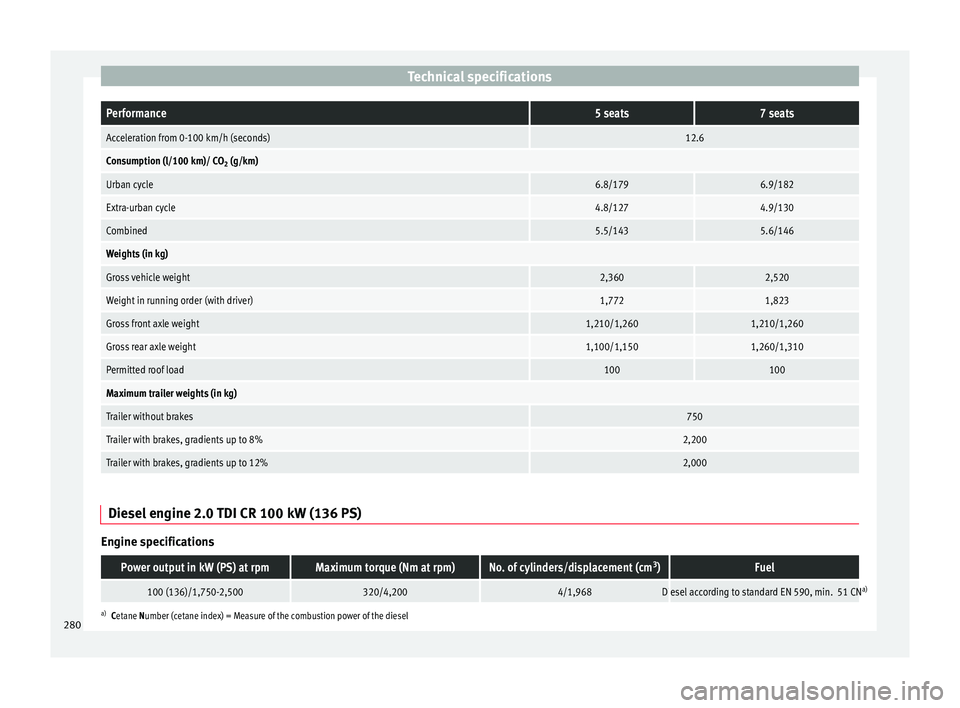
Technical specificationsPerformance5 seats7 seats
Acceleration from 0-100 km/h (seconds)12.6
Consumption (l/100 km)/ CO
2 (g/km)
Urban cycle6.8/1796.9/182
Extra-urban cycle4.8/1274.9/130
Combined5.5/1435.6/146
Weights (in kg)
Gross vehicle weight2,3602,520
Weight in running order (with driver)1,7721,823
Gross front axle weight1,210/1,2601,210/1,260
Gross rear axle weight1,100/1,1501,260/1,310
Permitted roof load100100
Maximum trailer weights (in kg)
Trailer without brakes750
Trailer with brakes, gradients up to 8%2,200
Trailer with brakes, gradients up to 12%2,000 Diesel engine 2.0 TDI CR 100 kW (136 PS)
Engine specifications
Power output in kW (PS) at rpmMaximum torque (Nm at rpm)No. of cylinders/displacement (cm
3
)Fuel
100 (136)/1,750-2,500320/4,2004/1,968Diesel according to standard EN 590, min. 51 CN a)
a)
Cetane Number (cetane index) = Measure of the combustion power of the diesel280
Page 283 of 305
Technical specificationsPerformanceManualAutomatic
5 seats7 seats5 seats7 seats
Top speed (km/h)192189
Acceleration from 0-80 km/h (seconds)7.87.8
Acceleration from 0-100 km/h (seconds)11.111.1
Consumption (l/100 km)/ CO
2 (g/km)
Urban cycle6.8/1796.9/182
Extra-urban cycle4.8/1275/132
Combined5.5/1435.7/149
Weights (in kg)
Gross vehicle weight2,3402,5002,3702,540
Weight in running order (with driver)1,1741,8221,8031,851
Gross front axle weight1,190/1,2401,190/1,2401,220/1,2701,230/1,280
Gross rear axle weight1,100/1,1501,260/1,3101,100/1,1501,260/1,310
Permitted roof load100100100100
Maximum trailer weights (in kg)
Trailer without brakes750750
Trailer with brakes, gradients up to 8%2,3002,4002,3002,400
Trailer with brakes, gradients up to 12%2,2002,200 281
Technical specifications
Advice
Operation
Safety
Page 285 of 305
Technical specificationsPerformanceManualAutomaticAll-wheel drive
5 seats7 seats5 seats7 seats5 seats7 seats
Trailer without brakes750750750
Trailer with brakes, gradients up to 8%2,3002,4002,3002,4002,400
Trailer with brakes, gradients up to 12%2,2002,2002,400
Diesel engine 2.0 TDI CR 130 kW (177 PS)
Engine specifications
Power output in kW (PS) at rpmMaximum torque (Nm at rpm)No. of cylinders/displacement (cm
3
)Fuel
130 (177)/4,200380/1,750-2,5004/1,968Diesel according to standard EN 590, min. 51 CN a)
a)
Cetane Number (cetane index) = Measure of the combustion power of the diesel
PerformanceManualAutomatic
5 seats7 seats5 seats7 seats
Top speed (km/h)208205
Acceleration from 0-80 km/h (seconds)6.76.6
Acceleration from 0-100 km/h (seconds)9.39.6
Consumption (l/100 km)/ CO 2 (g/km)
Urban cycle7.3/1926.7/177
Extra-urban cycle5.0/1325.4/143
Combined5.8/1525.9/154
Weights (in kg)» 283
Technical specifications
Advice
Operation
Safety
Page 286 of 305
Technical specificationsPerformanceManualAutomatic
5 seats7 seats5 seats7 seats
Gross vehicle weight2,3702,5302,3702,530
Weight in running order (with driver)1,8001,8511,8041,855
Gross front axle weight1,220/1,2701,220/1,2701,220/1,2701,220/1,270
Gross rear axle weight1,100/1,1501,260/1,3101,100/1,1501,260/1,310
Permitted roof load100100100100
Maximum trailer weights (in kg)
Trailer without brakes750750
Trailer with brakes, gradients up to 8%2,3002,4002,3002,400
Trailer with brakes, gradients up to 12%2,2002,200
284