Page 176 of 292
3.14
WINDOWS (1/2)
Avoid resting any objects against a
half-open window: there is a risk that
the electric window winder could be
damaged.
1
2
3
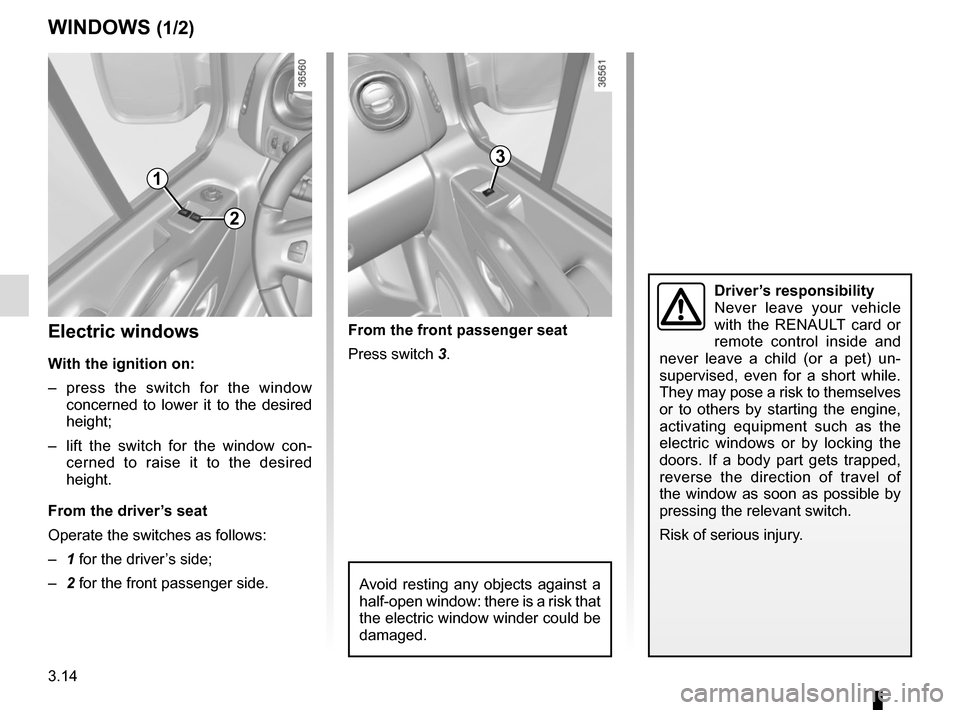
Electric windows
With the ignition on:
– press the switch for the window concerned to lower it to the desired
height;
– lift the switch for the window con- cerned to raise it to the desired
height.
From the driver’s seat
Operate the switches as follows:
– 1 for the driver’s side;
– 2 for the front passenger side. From the front passenger seat
Press switch 3.
Driver’s responsibility
Never leave your vehicle
with the RENAULT card or
remote control inside and
never leave a child (or a pet) un-
supervised, even for a short while.
They may pose a risk to themselves
or to others by starting the engine,
activating equipment such as the
electric windows or by locking the
doors. If a body part gets trapped,
reverse the direction of travel of
the window as soon as possible by
pressing the relevant switch.
Risk of serious injury.
Page 179 of 292
3.17
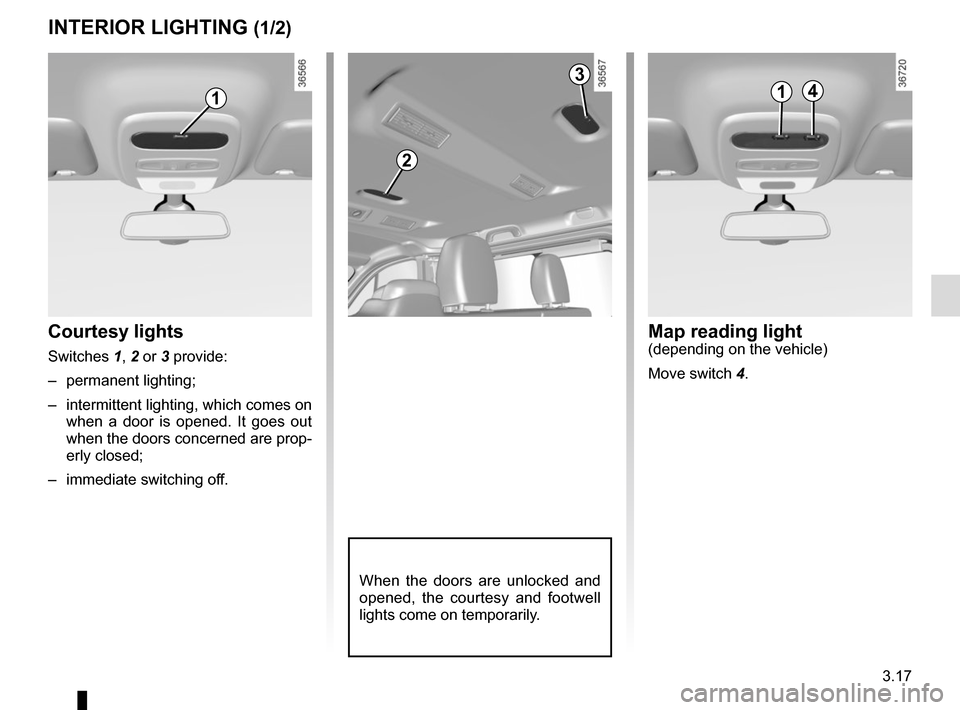
Courtesy lights
Switches 1, 2 or 3 provide:– permanent lighting;
– intermittent lighting, which comes on when a door is opened. It goes out
when the doors concerned are prop-
erly closed;
– immediate switching off.
When the doors are unlocked and
opened, the courtesy and footwell
lights come on temporarily.
INTERIOR LIGHTING (1/2)
1
2
3
Map reading light(depending on the vehicle)
Move switch 4.
14
Page 180 of 292
3.18
5
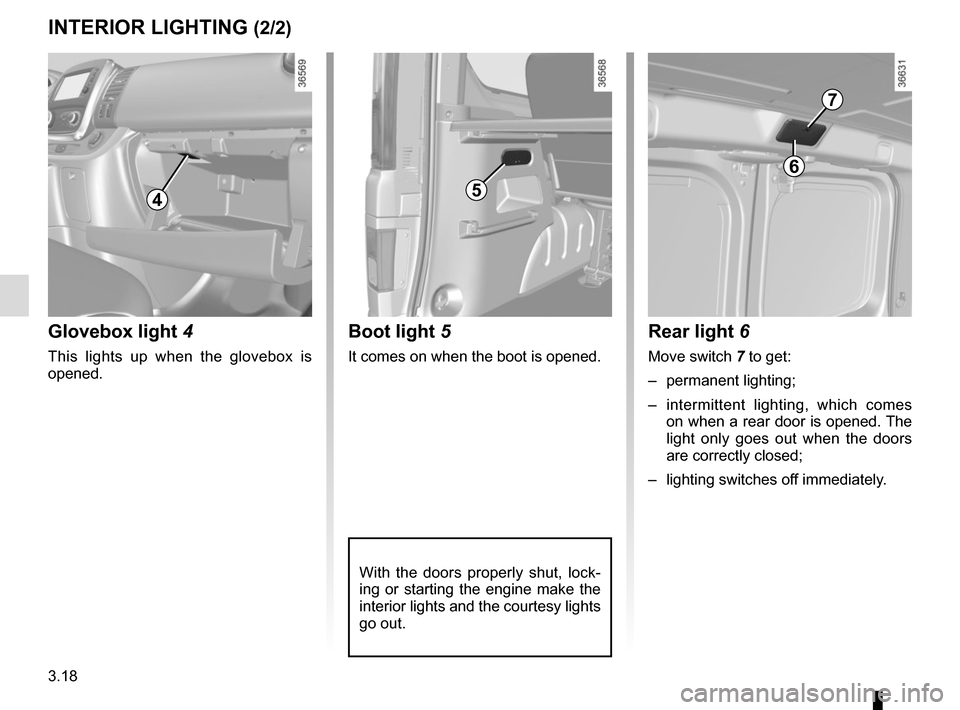
Boot light 5
It comes on when the boot is opened.
With the doors properly shut, lock-
ing or starting the engine make the
interior lights and the courtesy lights
go out.
INTERIOR LIGHTING (2/2)
Glovebox light 4
This lights up when the glovebox is
opened.
4
Rear light 6
Move switch 7 to get:
– permanent lighting;
– intermittent lighting, which comes
on when a rear door is opened. The
light only goes out when the doors
are correctly closed;
– lighting switches off immediately.
7
6
Page 187 of 292
3.25
Ensure that no hard, heavy
or pointed objects are
placed in the open storage
compartments in such a
way that they may fall on any pas-
sengers during sudden turning, bra-
king or in the event of an accident.
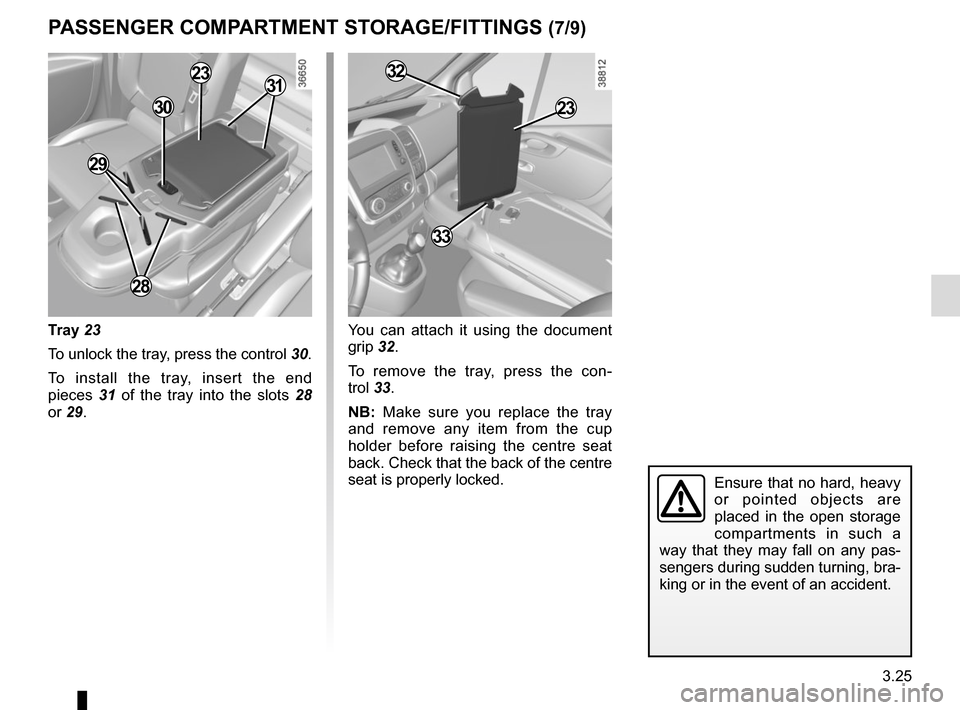
You can attach it using the document
grip 32.
To remove the tray, press the con-
trol 33.
NB: Make sure you replace the tray
and remove any item from the cup
holder before raising the centre seat
back. Check that the back of the centre
seat is properly locked.Tray 23
To unlock the tray, press the control 30.
To install the tray, insert the end
pieces 31 of the tray into the slots 28
or 29.
23
28
29
31
PASSENGER COMPARTMENT STORAGE/FITTINGS (7/9)
2330
33
32
Page 192 of 292
3.30
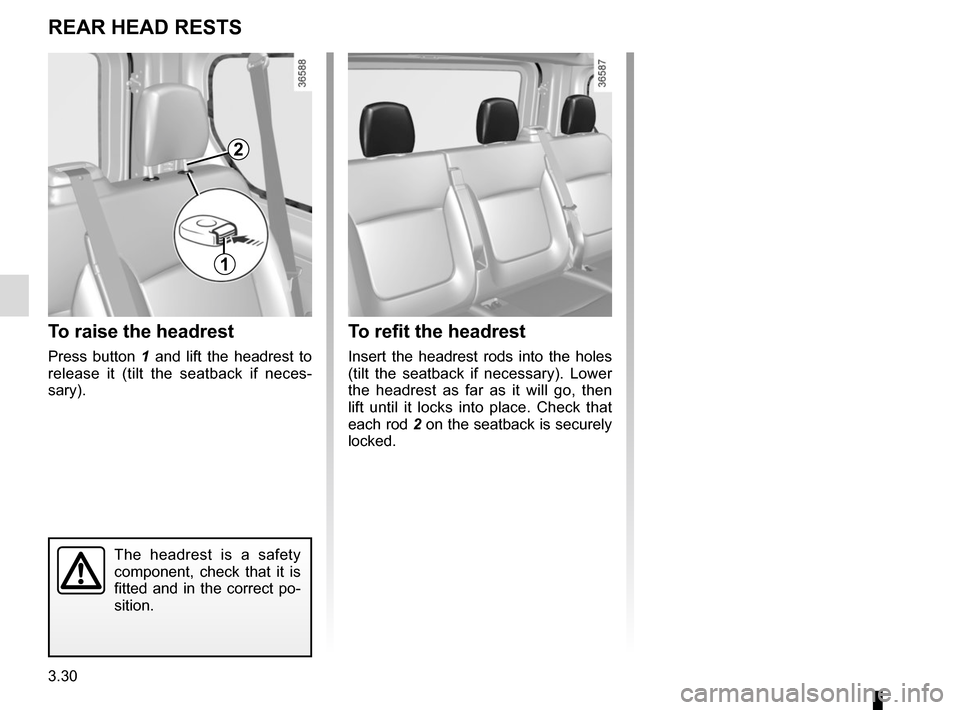
To refit the headrest
Insert the headrest rods into the holes
(tilt the seatback if necessary). Lower
the headrest as far as it will go, then
lift until it locks into place. Check that
each rod 2 on the seatback is securely
locked.
The headrest is a safety
component, check that it is
fitted and in the correct po-
sition.
To raise the headrest
Press button 1 and lift the headrest to
release it (tilt the seatback if neces-
sary).
REAR HEAD RESTS
1
2
Page 193 of 292
3.31
REAR BENCH SEATS: functions (1/4)
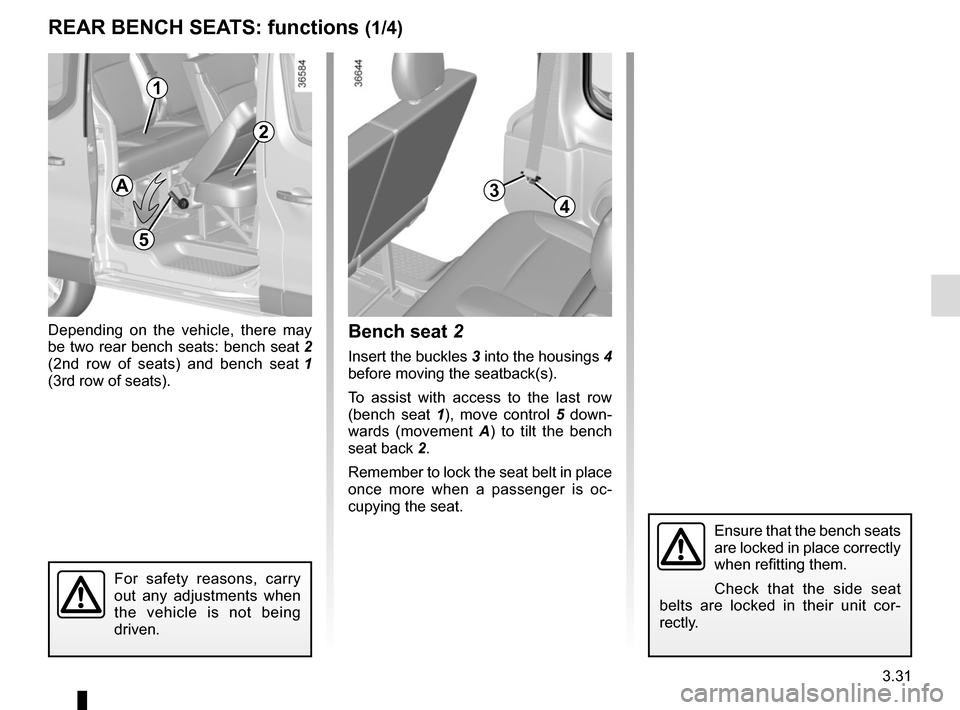
Depending on the vehicle, there may
be two rear bench seats: bench seat 2
(2nd row of seats) and bench seat 1
(3rd row of seats).Bench seat 2
Insert the buckles 3 into the housings 4
before moving the seatback(s).
To assist with access to the last row
(bench seat 1 ), move control 5 down-
wards (movement A) to tilt the bench
seat back 2.
Remember to lock the seat belt in place
once more when a passenger is oc-
cupying the seat.
Ensure that the bench seats
are locked in place correctly
when refitting them.
Check that the side seat
belts are locked in their unit cor-
rectly.
2
1
4
5
A
For safety reasons, carry
out any adjustments when
the vehicle is not being
driven.
3
Page 194 of 292
3.32
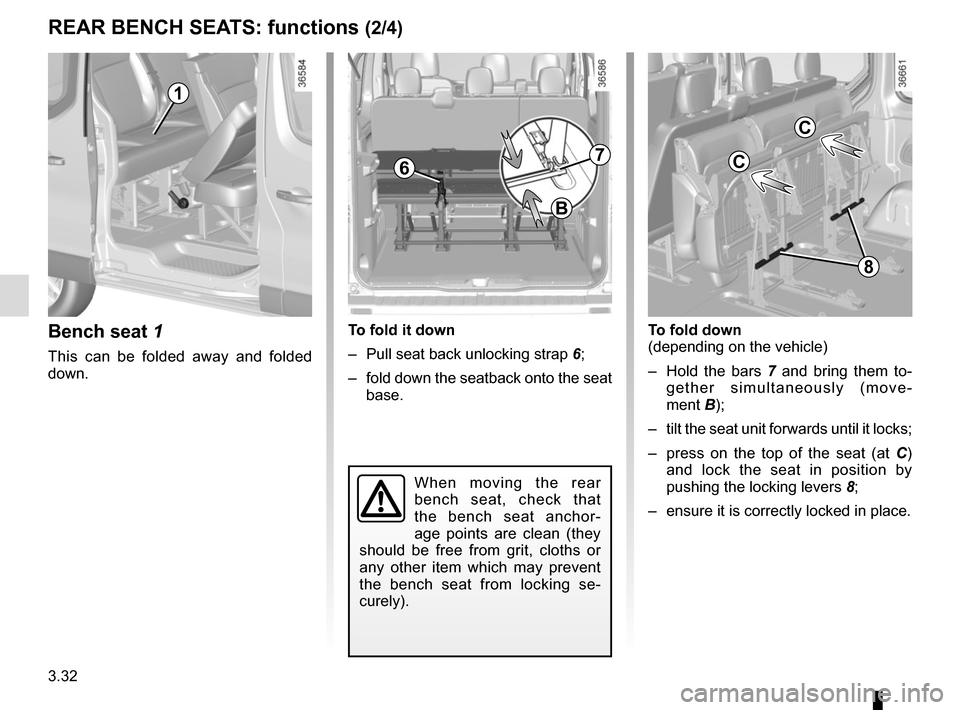
Bench seat 1
This can be folded away and folded
down.
To fold it down
– Pull seat back unlocking strap 6;
– fold down the seatback onto the seat base.
1
7
B
To fold down
(depending on the vehicle)
– Hold the bars 7 and bring them to-
gether simultaneously (move-
ment B);
– tilt the seat unit forwards until it locks;
– press on the top of the seat (at C)
and lock the seat in position by
pushing the locking levers 8;
– ensure it is correctly locked in place.
When moving the rear
bench seat, check that
the bench seat anchor-
age points are clean (they
should be free from grit, cloths or
any other item which may prevent
the bench seat from locking se-
curely).
REAR BENCH SEATS: functions (2/4)
6
8
C
C
Page 195 of 292
3.33
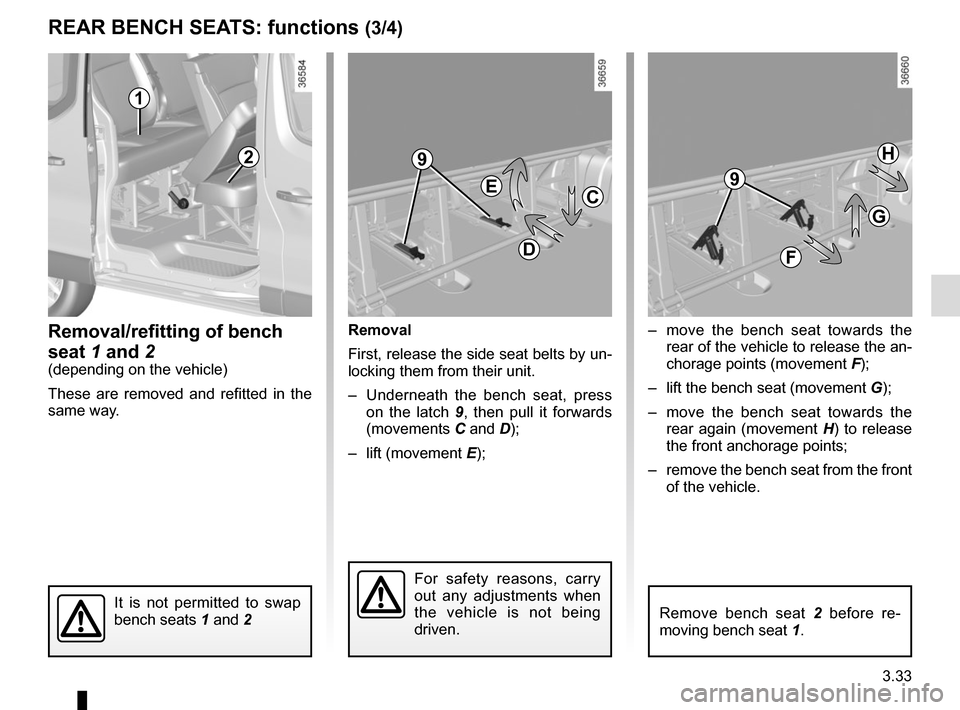
– move the bench seat towards the rear of the vehicle to release the an-
chorage points (movement F);
– lift the bench seat (movement G);
– move the bench seat towards the rear again (movement H) to release
the front anchorage points;
– remove the bench seat from the front of the vehicle.
REAR BENCH SEATS: functions (3/4)
Removal/refitting of bench
seat 1 and 2
(depending on the vehicle)
These are removed and refitted in the
same way. Removal
First, release the side seat belts by un-
locking them from their unit.
– Underneath the bench seat, press
on the latch 9, then pull it forwards
(movements C and D);
– lift (movement E);
It is not permitted to swap
bench seats 1 and 2
1
2
C
D
E
F
G
H
For safety reasons, carry
out any adjustments when
the vehicle is not being
driven.
Remove bench seat 2 before re-
moving bench seat 1.
9
9