Page 193 of 232
JauneNoir Noir texte
193
ENG_UD21012_4
Fusibles (X45 - H45 - Renault) ENG_NU_1057-1_H45_Ph3_Renault_5
FUSES (2/2)
Allocation of fuses (DEPENDING ON THE EQUIPMENT LEVEL)
Some accessories are protected by
fuses located in the engine compart-
ment in fuse box A.
However, because of their reduced ac-
cessibility, we advise you to have your
fuses replaced by an approved Dealer.
A
Symbol Allocation Symbol Allocation
SPARE Spare fuses ELEC IGN Electrical equipment
BLOWER
MOTORVentilation4WD
CONTAll-wheel drive trans-
mission
REAR
DEFOGHeated rear screen METER Counter
BOSE AMP Audio systemROOM
LAMPInterior light
FRONT
POWER
SOCKETFront lightsMIRROR
HEATERHeated door mirrors
CIGAR
LIGHTERCigar lighterBOSE
AMPAudio system
AUDIO
MIRRORAudio system and elec-
tric rear-view mirrorsSTOP
LAMPBrake lights
REAR
POWER
SOCKETRear lightsELEC
B (+)Electrical equipment
AIR BAG Air bag
METER Equipment and options
Page 194 of 232
JauneNoir Noir texte
194
ENG_UD31482_5
Batterie : d pannage (X45 - H45 - Renault) ENG_NU_1057-1_H45_Ph3_Renault_5
BATTERY: troubleshooting (1/2)
Handle the battery with care
as it contains sulphuric acid,
which must not come into
contact with eyes or skin. If
it does, wash the affected area with
plenty of cold water. If necessary,
consult a doctor.
Ensure that naked flames, red hot
objects and sparks do not come into
contact with the battery as there is a
risk of explosion.
The engine may be hot when car-
rying out operations in close prox-
imity. In addition, the engine cooling
fan can come on at any moment.
Risk of injury.
To avoid all risk of sparks
– Ensure that any electrical consumers
(courtesy lights, etc.) are switched
off before disconnecting or recon-
necting the battery.
– When charging, stop the charger
before connecting or disconnecting
the battery.
– Do not place metal objects on the
battery to avoid creating a short cir-
cuit between the terminals.
– Always wait at least one minute after
the engine has been switched off
before disconnecting a battery.
– Make sure that you reconnect the
battery terminals after refitting.
Page 195 of 232

JauneNoir Noir texte
195
ENG_UD31482_5
Batterie : d pannage (X45 - H45 - Renault) ENG_NU_1057-1_H45_Ph3_Renault_5
12
B
3
4
A
Starting the vehicle using the
battery from another vehicle
If you have to use the battery from an-
other vehicle to start, obtain suitable
jump leads (with a large cross section)
from an approved dealer or, if you al-
ready have jump leads, ensure that
they are in perfect condition.
The two batteries must have an iden-
tical nominal voltage of 12 volts. The
battery supplying the current should
have a capacity (amp-hours, Ah) which
is at least the same as that of the dis-
charged battery.
Ensure that there is no risk of contact
between the two vehicles (risk of short
circuiting when the positive terminals
are connected) and that the discharged
battery is properly connected. Switch
off your vehicle ignition.
Start the engine of the vehicle supply-
ing the current and run it at an interme-
diate engine speed.
BATTERY: troubleshooting (2/2)
Connecting a battery charger
The battery charger must be com-
patible with a battery with nominal
voltage of 12 volts.
Switch the engine off and then discon-
nect both battery leads starting with
the negative terminal.
Do not disconnect the battery when the
engine is running. Follow the instruc-
tions given by the manufacturer of
the battery charger you are using.
Special procedures may be
required to charge some
batteries. Contact your ap-
proved dealer.
Avoid all risk of sparks which may
cause an immediate explosion, and
charge the battery in a well-venti-
lated area. Risk of serious injury.
Attach the positive lead A to the (+) ter-
minal 1 then to the (+) terminal 4 of
the battery supplying the current.
Connect the negative cable B to the (–)
terminal 3 of the battery supplying the
current and then to the (–) terminal 2 of
the discharged battery.
Check that there is no contact between
leads A and B and that the positive
lead A is not touching any metal parts
on the vehicle supplying the current.
Start the engine as you would nor-
mally. As soon as it starts, disconnect
cables A and B in reverse order (2 - 3
- 4 - 1).
Page 198 of 232

JauneNoir Noir texte
198
ENG_UD20957_3
Balais d’essuie-vitre avant (X45 - H45 - Renault) ENG_NU_1057-1_H45_Ph3_Renault_5
WIPER BLADES
Check the condition of the wiper
blades. You are responsible for their
service life:
– clean the blades, windscreen and
rear screen regularly with soapy
water;
– do not use them when the wind-
screen or rear screen are dry;
– free them from the windscreen or
rear screen when they have not
been used for a long time.
In frosty weather, make
sure that the wiper blades
are not stuck by ice (to
avoid the risk of the motor
overheating).
Check the condition of the wiper
blades.
Replace the wiper blades as soon
as they begin to lose efficiency (ap-
proximately once a year).
Whilst changing the blade, take care
not to drop the arm onto the window
after it has been removed as this
may break the window.
Replacing windscreen wiper
blades 1
With the ignition on and engine
switched off, lower the windscreen
wiper stalk completely: they stop
slightly away from the bonnet. Lift the
wiper arm 3, pinch the tabs 2, gently
pull upwards (movement A) then push
the blade upwards (movement B).
Refitting
Slide the blade along the arm until
it clips on. Check that it is correctly
locked. Return the windscreen wiper
stalk to the park position.
1
2
3
A
Rear screen wiper blade 4
– Lift wiper arm 5;
– pivot the blade 4 beyond the point of
resistance. (movement C);
Replace the blade.
To refit
To refit the wiper blade, proceed in re-
verse order to removal. Make sure that
the blade is correctly locked in position.
4
C
5
B
Page 202 of 232
JauneNoir Noir texte
202
ENG_UD31483_4
Remorquage : d pannage (X45 - H45 - Renault) ENG_NU_1057-1_H45_Ph3_Renault_5
TOWING: breakdown (4/4)
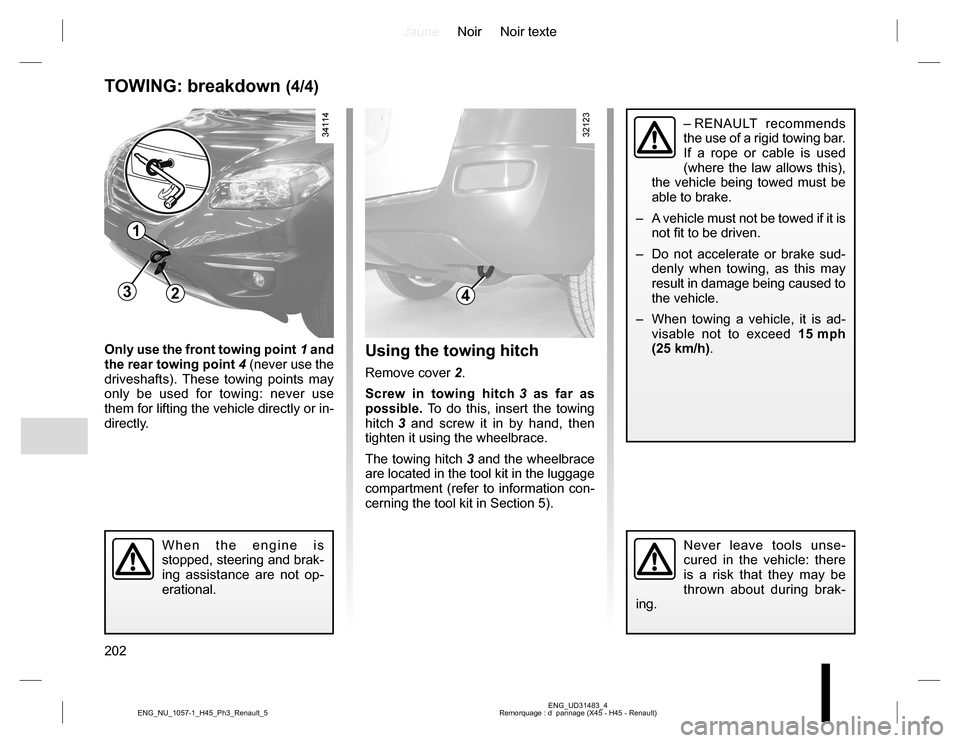
Only use the front towing point 1 and
the rear towing point 4 (never use the
driveshafts). These towing points may
only be used for towing: never use
them for lifting the vehicle directly or in-
directly.
When the engine is
stopped, steering and brak-
ing assistance are not op-
erational.
– RENAULT recommends
the use of a rigid towing bar.
If a rope or cable is used
(where the law allows this),
the vehicle being towed must be
able to brake.
– A vehicle must not be towed if it is
not fit to be driven.
– Do not accelerate or brake sud-
denly when towing, as this may
result in damage being caused to
the vehicle.
– When towing a vehicle, it is ad-
visable not to exceed 15 mph
(25 km/h).
1
324
Using the towing hitch
Remove cover 2.
Screw in towing hitch 3 as far as
possible. To do this, insert the towing
hitch 3 and screw it in by hand, then
tighten it using the wheelbrace.
The towing hitch 3 and the wheelbrace
are located in the tool kit in the luggage
compartment (refer to information con-
cerning the tool kit in Section 5).
Never leave tools unse-
cured in the vehicle: there
is a risk that they may be
thrown about during brak-
ing.
Page 203 of 232

JauneNoir Noir texte
203
ENG_UD21017_3
Anomalies de fonctionnement (X45 - H45 - X95 - J95 - R95 - Renault) ENG_NU_1057-1_H45_Ph3_Renault_5
OPERATING FAULTS (1/5)
The following advice will enable you to carry out quick, temporary repairs. For safety reasons you should always contact
an approved Dealer as soon as possible.
Using the RENAULT card POSSIBLE CAUSES WHAT TO DO
The RENAULT card does not lock or
unlock the doors.Card battery is flat.Replace the battery. You can still lock/
unlock and start your vehicle (refer to the
information on “Locking/unlocking the
doors” in Section 1 and “Starting/Stopping
the engine” in Section 2).
Use of appliances operating on the
same frequency as the card (mobile
phone, etc.).Stop using the equipment or use the
emergency key (refer to the informa-
tion on “Locking/unlocking the doors” in
Section 1).
Vehicle located in a high electromag-
netic radiation zone.
Vehicle battery flat.Use the emergency key integrated in the
card (refer to the information on “Locking/
unlocking the doors” in Section 1).
Page 204 of 232

JauneNoir Noir texte
204
ENG_UD21017_3
Anomalies de fonctionnement (X45 - H45 - X95 - J95 - R95 - Renault) ENG_NU_1057-1_H45_Ph3_Renault_5
OPERATING FAULTS (2/5)
The starter is activated POSSIBLE CAUSES WHAT TO DO
The instrument panel indicator lights
are weak or fail to light up and the
starter does not turn.Battery terminals not tight,
battery terminals discon-
nected or oxidised.Retighten or reconnect the terminals, or clean
them if they are oxidised.
Discharged battery or not
operational.Connect another battery to the faulty battery.
Refer to information on “Battery: troubleshooting”
in Section 5 or replace the battery if necessary.
Do not push the vehicle if the steering column is
locked.
The engine will not start.Starting conditions are not
fulfilled.Refer to the information on “Starting/stopping the
engine” in Section 2.
The RENAULT “hands-free”
card does not work.Insert the card in the card reader in order to start
the engine.
Refer to the information on “Starting/stopping the
engine” in Section 2.
The engine cannot be switched off. Card not detected. Insert the card in card reader.
Electronic fault. Press the starter button quickly five times.
The steering column remains locked. Steering wheel locked. Move the steering wheel while pressing the engine
start button (refer to the information on “Starting
the engine” in Section 2).
Page 205 of 232

JauneNoir Noir texte
205
ENG_UD21017_3
Anomalies de fonctionnement (X45 - H45 - X95 - J95 - R95 - Renault) ENG_NU_1057-1_H45_Ph3_Renault_5
OPERATING FAULTS (3/5)
On the road POSSIBLE CAUSES WHAT TO DO
Vibrations. Tyres not inflated to correct pres-
sures, incorrectly balanced or dam-
aged.Check the tyre pressures: if this is not the
problem, have them checked by an ap-
proved Dealer.
White smoke from the exhaust. This is not necessarily a fault. Smoke
may be caused by regeneration of the
particle filter.Refer to the information on “Special fea-
tures of diesel versions” in Section 2.
Smoke under the bonnet. Short-circuit or cooling system leak.Stop, switch off the ignition, stand away
from the vehicle and contact an approved
dealer.
The oil pressure warning light comes
on:
while cornering or braking The level is too low. Top up the engine oil (refer to the informa-
tion on “Engine oil level – Topping up/refill-
ing” in Section 4).
is slow to go out or remains lit
under accelerationLoss of oil pressure.Stop the vehicle: contact an authorised
dealer.
