Page 207 of 316

3.15
ELECTRIC WINDOWS (1/2)
1
2
34
5
6
These systems operate:
– with the engine running;
– with the ignition off until one of the front doors is opened (limited to ap-
proximately 12 minutes).
– before starting, with the front doors closed, after pressing the start
button.
Press the window switch down or pull it
up to lower or raise the window to the
desired height: the rear windows do not
open fully.
Safety of rear occupants
The driver can disable operation of the rear electric windows and doors \
by pressing switch 4. A confirmation message is displayed on the instru-
ment panel.
Driver’s responsibility
Never leave your vehicle with the RENAULT card inside and never leave a child
(or a pet) unsupervised, even for a short while. They may pose a risk to them-
selves or to others by starting the engine, activating equipment such as\
the elec-
tric windows or by locking the doors. If a body part gets trapped, rever\
se the direc-
tion of travel of the window as soon as possible by pressing the relevan\
t switch.
Risk of serious injury.
Avoid resting any objects against
a half-open window: there is a risk
that the electric window could be
damaged.
From the driver’s seat, use switch:
1 for the driver’s side;
2 for the front passenger side;
3 and 5 for the rear passenger win-
dows.
From the passenger seats, use
switch 6.
Note: if the window detects resistance
when closing (e.g.: fingers, branch of
a tree, etc.) it stops and then lowers
again by a few centimetres.
Page 214 of 316
3.22
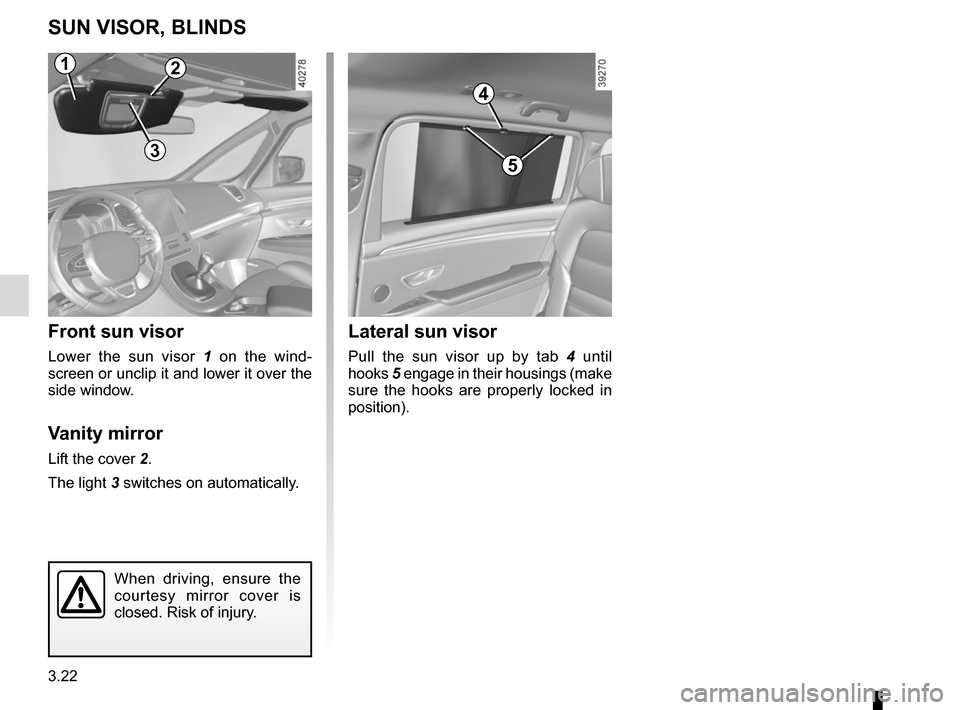
SUN VISOR, BLINDS
Front sun visor
Lower the sun visor 1 on the wind-
screen or unclip it and lower it over the
side window.
Vanity mirror
Lift the cover 2.
The light 3 switches on automatically.
Lateral sun visor
Pull the sun visor up by tab 4 until
hooks 5 engage in their housings (make
sure the hooks are properly locked in
position).
4
5
2
3
When driving, ensure the
courtesy mirror cover is
closed. Risk of injury.
1
Page 215 of 316
3.23
Dashboard storage
compartment 2Door pockets 1
It can hold a 1.5 litre bottle.
PASSENGER COMPARTMENT STORAGE/FITTINGS (1/5)
1
Nothing should be placed
on the floor area in front of
the driver as such objects
may slide under the pedal
during braking manoeuvres, thus
obstructing its use.
Ensure that no hard, heavy
or pointed objects are
placed in the “open” stor-
age compartments in such
a way that they may fall onto pas-
sengers during sudden turning or
braking.
2
Passenger storage drawer 3To open, move your fingers into area 4-
it will open by itself. If on a steep slope,
assist the drawer opening by pulling
handle 5. It can hold A4 documents. It
is ventilated and refrigerated.
Maximum load allowed in the pas-
senger storage compartment: 6 kg,
evenly distributed.
When driving, ensure
that the storage drawer is
closed. Risk of injury.
34
5
Page 218 of 316
3.26
PASSENGER COMPARTMENT STORAGE/FITTINGS (4/5
Ensure that no hard, heavy
or pointed objects are
placed in the “open” stor-
age compartments in such
a way that they may fall onto pas-
sengers during sudden turning or
braking.
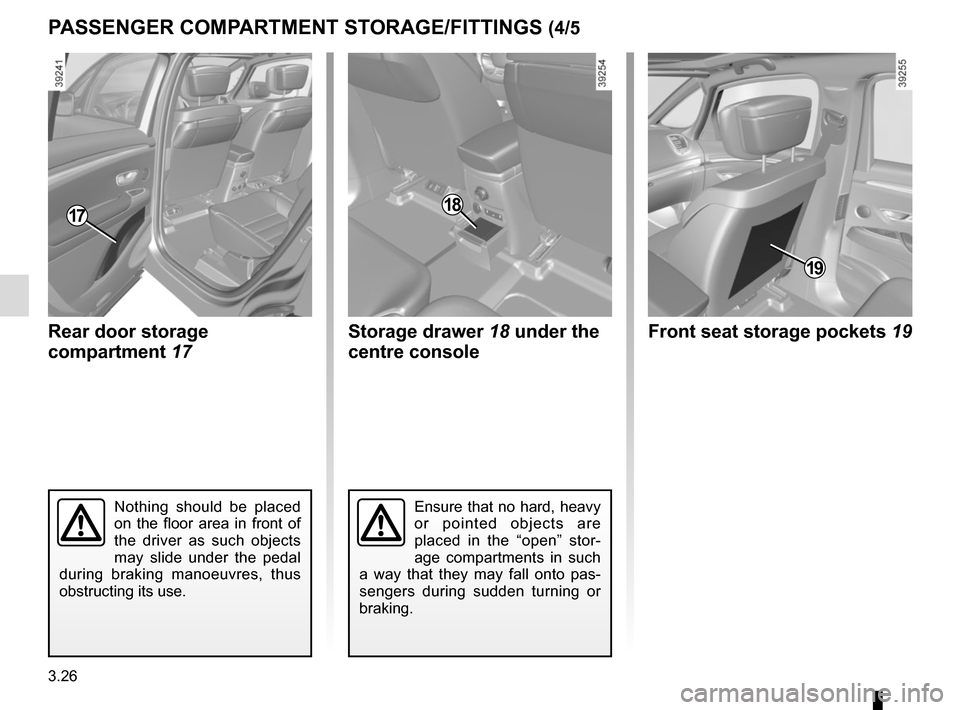
Storage drawer 18 under the
centre console
18
Rear door storage
compartment 17
17
Nothing should be placed
on the floor area in front of
the driver as such objects
may slide under the pedal
during braking manoeuvres, thus
obstructing its use.
Front seat storage pockets 19
19
Page 224 of 316
3.32
REAR SEATS (3/5)
To automatically fold down
the seats (flat position)
The rear seats are electrically unlocked
to fold down in order to create a flat
floor.
There are two ways to manoeuvre the
seats:
– from the boot using control 6;
– from the multifunction screen 7. Disabling the function
– With the engine running, a buckled
seat belt prevents the movement of
the relevant seat.
– Once the vehicle is moving the two controls are deactivated.
6
7
Conditions of use
With the vehicle at a standstill and the
rear seat belts unlocked:
– from control 6, with the boot lid open;
– from the multifunction screen, with the engine running.
Note:
All unlocking actions for folding down
the seats require that the trays on the
back of the front seats have already
been folded away.
Page 230 of 316

3.38
Always place the objects to be trans-
ported so that their largest side rests
against the back of the rear seat for
normal loads (e.g.: A), or against the
back of the front seats B when the rear
seatbacks are folded down.
If you have to place objects on the
folded seat back, it is vital that you
remove the headrests before folding
the seat back so that it can be folded as
flat as possible against the seat.
TRANSPORTING OBJECTS IN THE BOOT
A
Always position the heavi-
est items directly on the
floor. Use the lashing points
on the floor of the luggage
compartment, if these are fitted to
the vehicle. The luggage should be
loaded in such a way that no items
will be thrown forward and strike the
occupants if the driver has to brake
suddenly. Fasten the rear seat belts,
even if the seats are not occupied.
B
Anchorage points
Hooks 1 located on each corner of the
boot allow the load to be secured.
Always position objects being trans-
ported so that the heaviest items
are resting against the back of the
rear seat.
1
Page 232 of 316
3.40
3
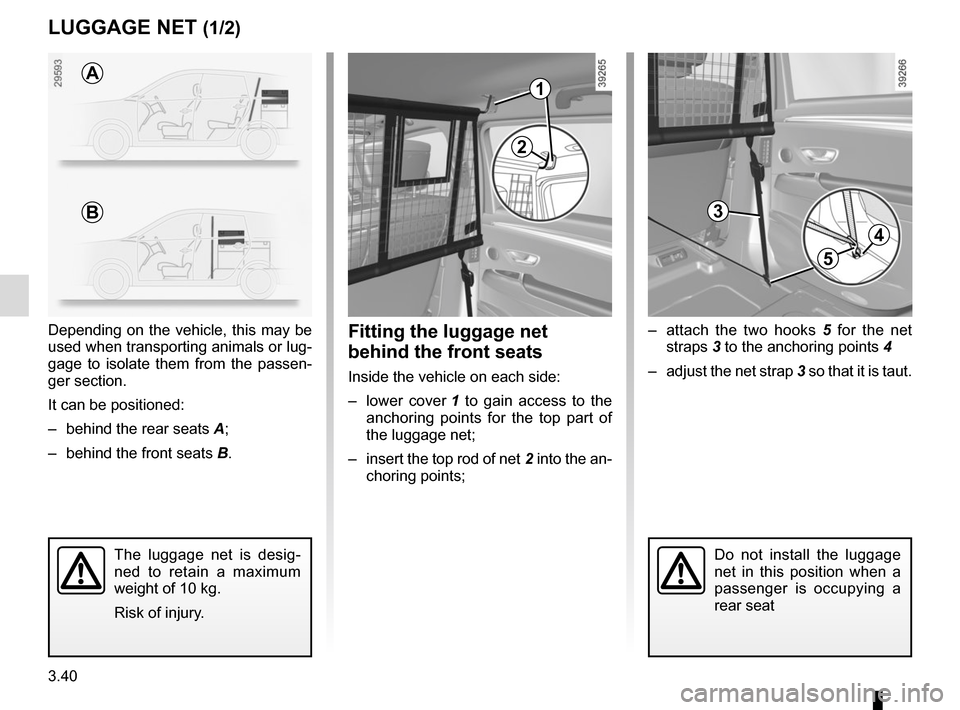
LUGGAGE NET (1/2)
– attach the two hooks 5 for the net
straps 3 to the anchoring points 4
– adjust the net strap 3 so that it is taut.Fitting the luggage net
behind the front seats
Inside the vehicle on each side:
– lower cover 1 to gain access to the
anchoring points for the top part of
the luggage net;
– insert the top rod of net 2 into the an-
choring points;
Depending on the vehicle, this may be
used when transporting animals or lug-
gage to isolate them from the passen-
ger section.
It can be positioned:
– behind the rear seats
A;
– behind the front seats B.
The luggage net is desig-
ned to retain a maximum
weight of 10 kg.
Risk of injury.Do not install the luggage
net in this position when a
passenger is occupying a
rear seat
A
B
1
2
5
4
Page 248 of 316
4.12
TYRE PRESSURE (1/2)
A
Label A
Open the door to read it.
Tyre pressures should be checked
when the tyres are cold.
If the tyre pressures cannot be checked
when the tyres are cold, increase the
pressures from 0.2 to 0.3 bar (or 3 PSI).
Never deflate a hot tyre. Vehicle fitted with a tyre pressure
monitoring system
In cases of under-inflation (puncture,
low pressure, etc.), warning light
�
lights up on the instrument panel.
Please refer to the information on the
“Tyre pressure monitoring system” in
Section 2.
Vehicle used fully laden (Maximum
Permissible All-up Weight) and
towing a trailer
the maximum speed must be limited to
60 mph (100 km/h) and the tyre pres-
sure increased by 0.2 bar.
Please refer to the information on
“Weights” in Section 6.
A
B
EF
C
C
D
D
B : dimension of the tyres fitted to the
vehicle.
C: front tyre pressure.
D: rear tyre pressure.
E: emergency spare wheel dimensions.
F : tyre pressure for the emergency
spare wheel.