Page 59 of 130
MESSAGEDESCRIPTION
Automatic Unavailable Automatic (DRIVE) mode is not available due to a fault or other condition. Use MANUAL (M) mode to operate the vehicle.
Contact your authorized dealer if the message continues to appear.
Transmission
Temperature High This message appears, together with a buzzer, when the clutch overheats.
In this situation, limit stop and go driving and gear shifts or if necessary stop the vehicle and turn the engine off to allow the clutch to cool.
If the message continues to appear, contact your Authorized Dealer.
To avoid clutch malfunction, do not use the accelerator to keep the vehicle at a
standstill (for example holding on a hill); the clutch could be damaged by over-
heating. Use the brake pedal instead and operate the accelerator only when you are ready to drive away.5
STARTING AND OPERATING 57
Page 60 of 130
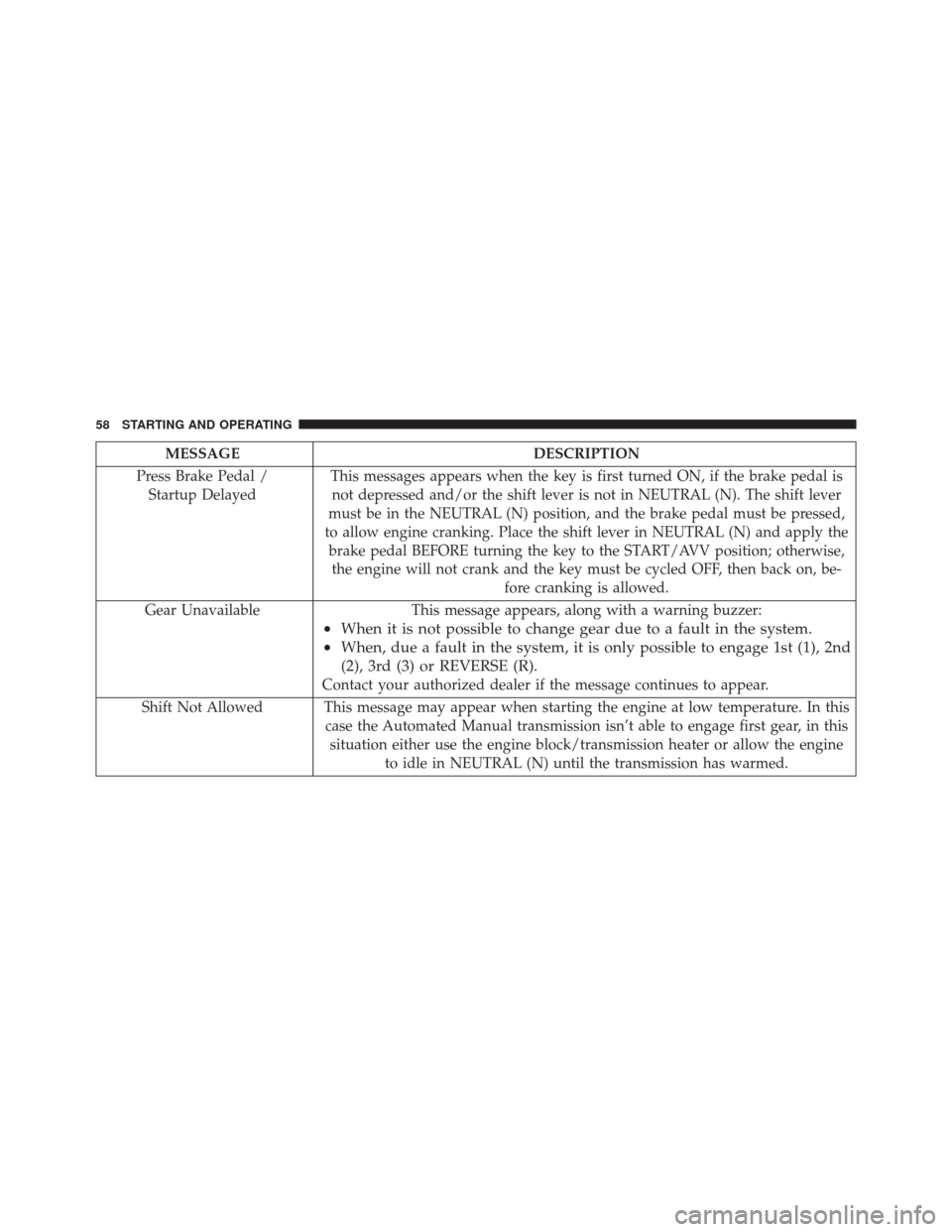
MESSAGEDESCRIPTION
Press Brake Pedal / Startup Delayed This messages appears when the key is first turned ON, if the brake pedal is
not depressed and/or the shift lever is not in NEUTRAL (N). The shift lever
must be in the NEUTRAL (N) position, and the brake pedal must be pressed,
to allow engine cranking. Place the shift lever in NEUTRAL (N) and apply the brake pedal BEFORE turning the key to the START/AVV position; otherwise,the engine will not crank and the key must be cycled OFF, then back on, be- fore cranking is allowed.
Gear Unavailable This message appears, along with a warning buzzer:
•When it is not possible to change gear due to a fault in the system.
• When, due a fault in the system, it is only possible to engage 1st (1), 2nd
(2), 3rd (3) or REVERSE (R).
Contact your authorized dealer if the message continues to appear.
Shift Not Allowed This message may appear when starting the engine at low temperature. In this case the Automated Manual transmission isn’t able to engage first gear, in thissituation either use the engine block/transmission heater or allow the engine to idle in NEUTRAL (N) until the transmission has warmed.
58 STARTING AND OPERATING
Page 62 of 130

Towing The Vehicle
•The manufacturer recommends towing your vehicle
with all four wheels OFFthe ground using a flatbed.
• Automated Manual transmission vehicles can also be
flat towed (all four wheels on the ground) with the
transmission in NEUTRAL. Ensure the transmission is
in NEUTRAL (N) (by checking that the vehicle moves
when pushed) and tow in the same way as a normal
vehicle with a manual transmission.
CAUTION!
• DO NOT flat tow any disabled vehicle if condition
is related to the clutch, transmission or driveline.
Additional damage to the drivetrain could result.
• Towing this vehicle in violation of the above re-
quirements can cause severe engine, transmission,
(Continued)
CAUTION! (Continued)
or drivetrain damage. Damage from improper tow-
ing is not covered under the New Vehicle Limited
Warranty.
If it is not possible to shift the transmission to NEUTRAL
(N), do not flat tow the vehicle and contact your autho-
rized dealer.
FUEL REQUIREMENTS
Use good quality diesel fuel from a reputable supplier in
your vehicle. Federal law requires that you must fuel this
vehicle with Ultra Low Sulfur Highway Diesel fuel
(15 ppm Sulfur maximum) and prohibits the use of Low
Sulfur Highway Diesel fuel (500 ppm Sulfur maximum)
to avoid damage to the emissions control system.
60 STARTING AND OPERATING
Page 86 of 130
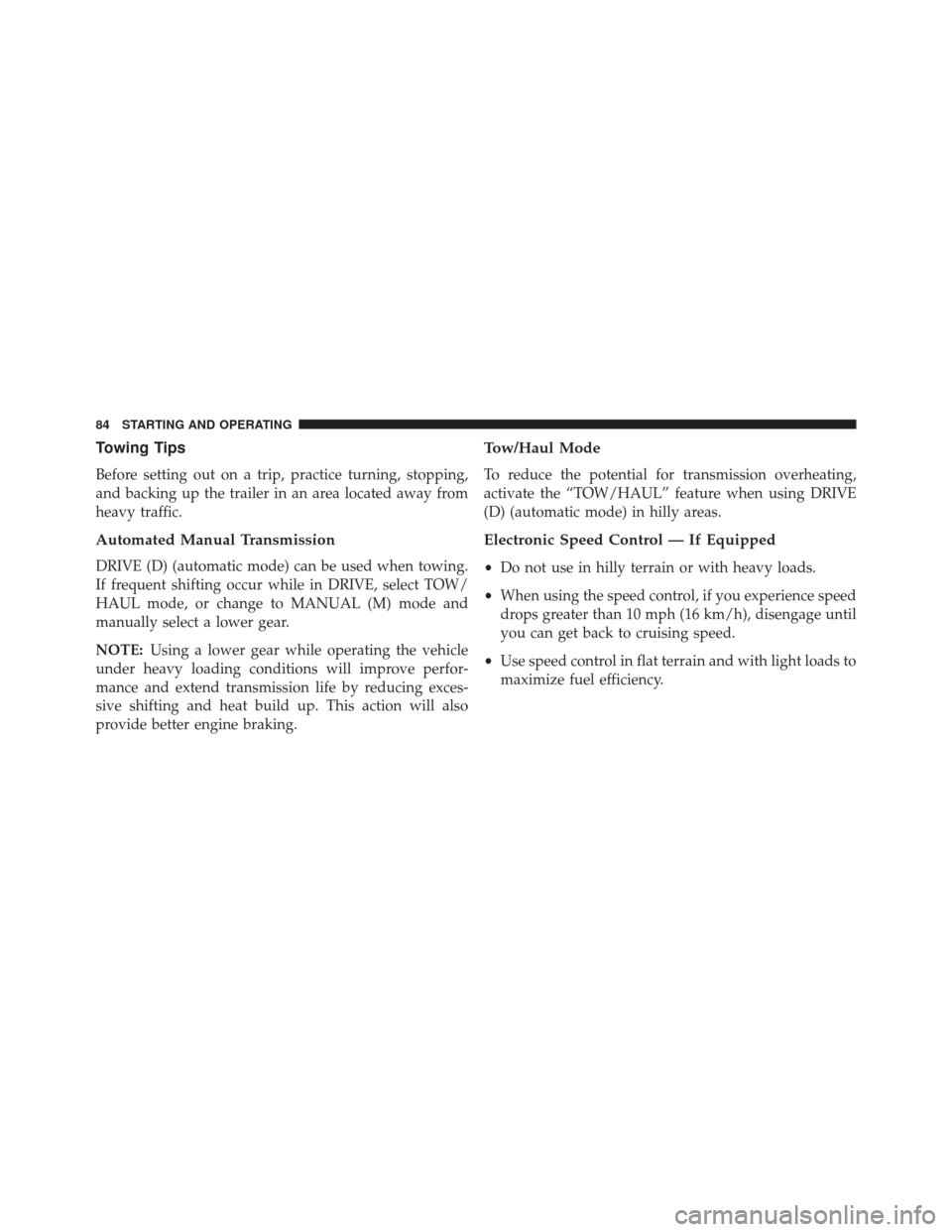
Towing Tips
Before setting out on a trip, practice turning, stopping,
and backing up the trailer in an area located away from
heavy traffic.
Automated Manual Transmission
DRIVE (D) (automatic mode) can be used when towing.
If frequent shifting occur while in DRIVE, select TOW/
HAUL mode, or change to MANUAL (M) mode and
manually select a lower gear.
NOTE:Using a lower gear while operating the vehicle
under heavy loading conditions will improve perfor-
mance and extend transmission life by reducing exces-
sive shifting and heat build up. This action will also
provide better engine braking.
Tow/Haul Mode
To reduce the potential for transmission overheating,
activate the “TOW/HAUL” feature when using DRIVE
(D) (automatic mode) in hilly areas.
Electronic Speed Control — If Equipped
• Do not use in hilly terrain or with heavy loads.
• When using the speed control, if you experience speed
drops greater than 10 mph (16 km/h), disengage until
you can get back to cruising speed.
• Use speed control in flat terrain and with light loads to
maximize fuel efficiency.
84 STARTING AND OPERATING
Page 89 of 130
MAINTAINING YOUR VEHICLE
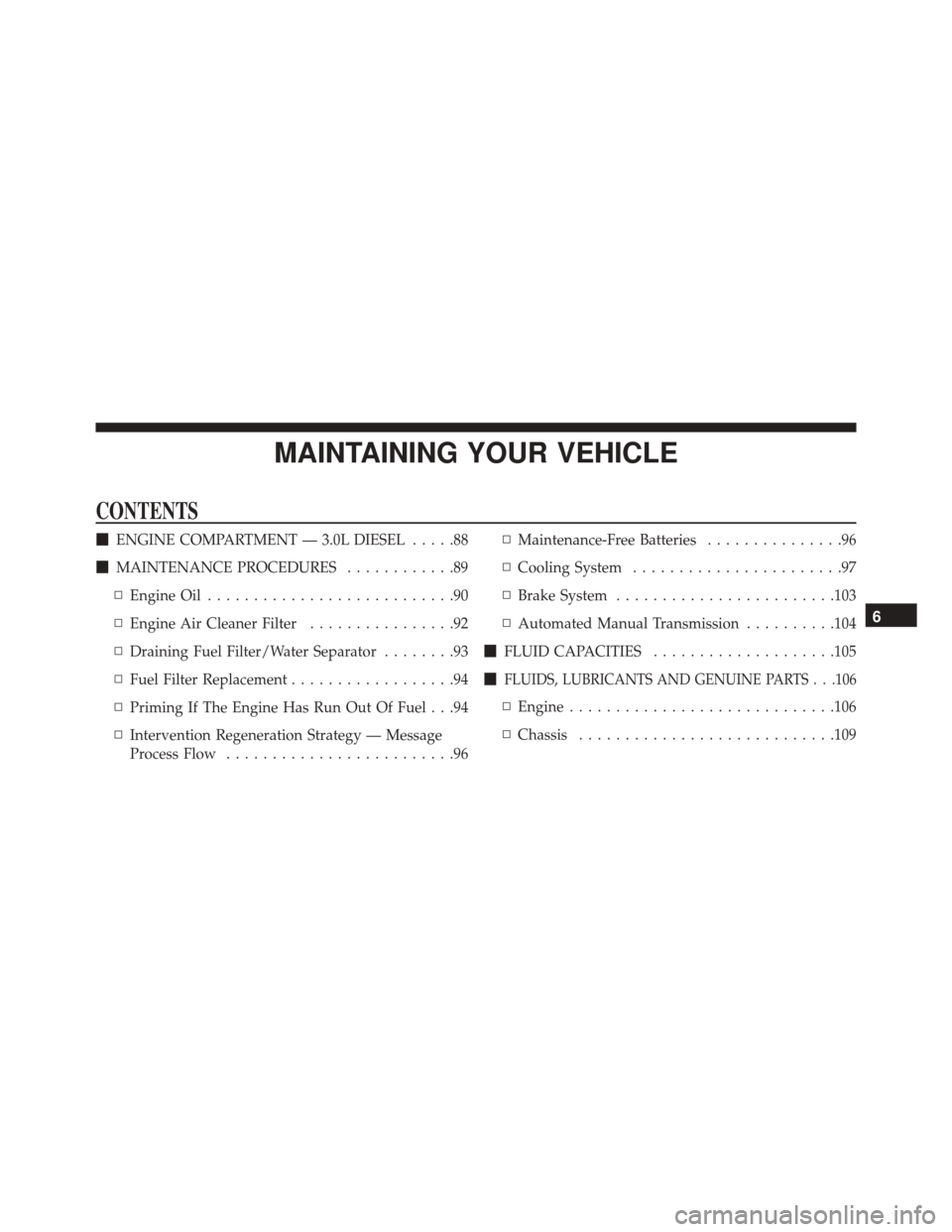
CONTENTS
�ENGINE COMPARTMENT — 3.0L DIESEL .....88
� MAINTENANCE PROCEDURES ............89
▫ Engine Oil ...........................90
▫ Engine Air Cleaner Filter ................92
▫ Draining Fuel Filter/Water Separator ........93
▫ Fuel Filter Replacement ..................94
▫ Priming If The Engine Has Run Out Of Fuel . . .94
▫ Intervention Regeneration Strategy — Message
Process Flow .........................96 ▫
Maintenance-Free Batteries ...............96
▫ Cooling System .......................97
▫ Brake System ....................... .103
▫ Automated Manual Transmission ..........104
� FLUID CAPACITIES ....................105
�
FLUIDS, LUBRICANTS AND GENUINE PARTS . . .106
▫ Engine ............................ .106
▫ Chassis ........................... .109
6
Page 106 of 130

WARNING!(Continued)
•To avoid contamination from foreign matter or
moisture, use only new brake fluid or fluid that has
been in a tightly closed container. Keep the master
cylinder reservoir cap secured at all times. Brake
fluid in a open container absorbs moisture from the
air resulting in a lower boiling point. This may
cause it to boil unexpectedly during hard or pro-
longed braking, resulting in sudden brake failure.
This could result in a accident.
•
Overfilling the brake fluid reservoir can result in
spilling brake fluid on hot engine parts, causing the
brake fluid to catch fire. Brake fluid can also damage
painted and vinyl surfaces, care should be taken to
avoid its contact with these surfaces.
•Do not allow petroleum based fluid to contaminate
the brake fluid. Brake seal components could be
damaged, causing partial or complete brake failure.
This could result in an accident.
Automated Manual Transmission
Checking Fluid Levels
To check the gear oil and check/replace the hydraulic
clutch operating system fluid, contact only your autho-
rized dealer.
NOTE: Do not add or use leak detection dye in the
hydraulic clutch operating system fluid.
WARNING!
Used gear oil contains substances that are hazardous
for the environment. It is advisable to have oil
changed by your authorized dealer where used oil
will be disposed of according to the law.
104 MAINTAINING YOUR VEHICLE
Page 111 of 130
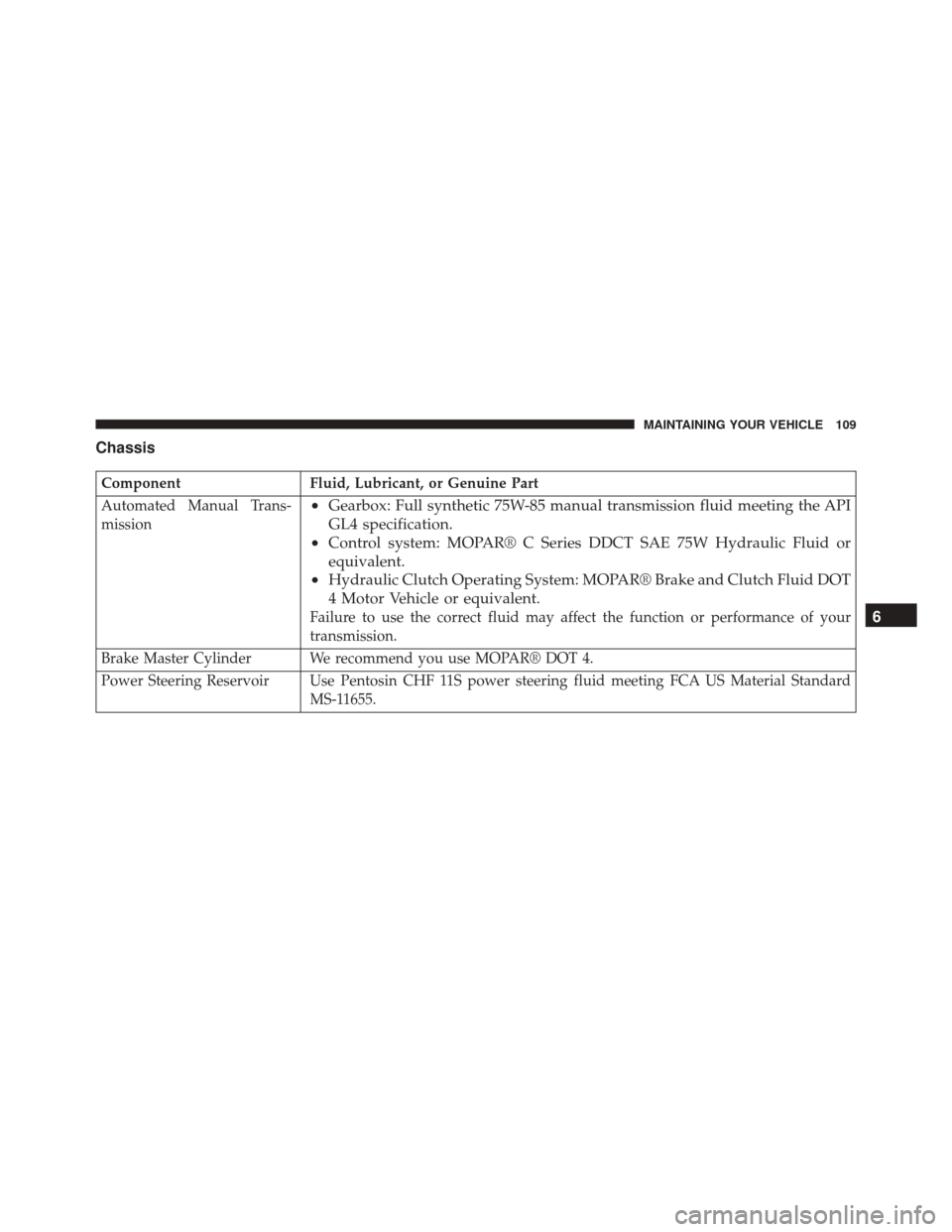
Chassis
ComponentFluid, Lubricant, or Genuine Part
Automated Manual Trans-
mission
• Gearbox: Full synthetic 75W-85 manual transmission fluid meeting the API
GL4 specification.
• Control system: MOPAR® C Series DDCT SAE 75W Hydraulic Fluid or
equivalent.
• Hydraulic Clutch Operating System: MOPAR® Brake and Clutch Fluid DOT
4 Motor Vehicle or equivalent.
Failure to use the correct fluid may affect the function or performance of your
transmission.
Brake Master Cylinder We recommend you use MOPAR® DOT 4.
Power Steering Reservoir Use Pentosin CHF 11S power steering fluid meeting FCA US Material Standard MS-11655.6
MAINTAINING YOUR VEHICLE 109
Page 124 of 130

Adding Engine Coolant (Antifreeze).............99
Adding Fuel ..............................66
Air bag Light .............................17
Air Cleaner, Engine (Engine Air Cleaner Filter) .....92
Antifreeze (Engine Coolant) ...............98, 105
Disposal ............................. .101
Anti-Lock Warning Light .....................17
Automated Manual Transmission Fluid Type ........................... .109
Battery .................................96
Brake Fluid ............................ .109
Brake System ........................... .103
Fluid Check .......................... .103
Master Cylinder ....................... .103
Warning Light ..........................17
Capacities, Fluid ......................... .105Caps, Filler
Oil (Engine) ............................91
Radiator (Coolant Pressure) ................101
Check Engine Light (Malfunction Indicator Light) . . .17
Coolant Pressure Cap (Radiator Cap) ...........101
Cooling System ...........................97
Adding Coolant (Antifreeze) ................99
Coolant Capacity ...................... .105
Coolant Level ...........................97
Disposal of Used Coolant .................101
Drain, Flush, and Refill ....................98
Points to Remember .....................102
Pressure Cap ......................... .101
Radiator Cap ......................... .101
Selection of Coolant (Antifreeze) .......98, 105, 106
Cruise Light ..............................17
Diesel Exhaust Fluid (DEF) ..................106
Diesel Fuel .......................... .60, 106
122 INDEX
Page:
< prev 1-8 9-16 17-24