Page 228 of 347
Do Not Operate The Engine With Low Oil
Pressure
When the engine is at normal operating temperature, the
minimum oil pressures required are:
Idle 700 to 800 RPM 10 psi (69 kPa)
Full speed and load 30 psi (207 kPa)
CAUTION!
If oil pressure falls to less than normal readings, shut
the engine off immediately. Failure to do so could
result in immediate and severe engine damage.
Do Not Operate The Engine With Failed Parts
All engine failures give some warning before the parts
fail. Be on the alert for changes in performance, sounds,
and visual evidence that the engine requires service.
Some important clues are:
•engine misfiring or vibrating severely
• sudden loss of power
• unusual engine noises
• fuel, oil or coolant leaks
• sudden change, outside the normal operating range, in
the engine operating temperature
• excessive smoke
• oil pressure drop
226 STARTING AND OPERATING
Page 253 of 347
•Brake pedal must not be applied.
• No vehicle, brake or clutch switch faults present.
• Vehicle engine must be running.
• PTO must be correctly installed using the vehicle
provided circuits.
The customer may choose to use the PTO while the
vehicle is moving. To do so, the PTO function must be
activated prior to taking the vehicle out of PARK. This is
accomplished by activating the upfitter-provided PTO
on/off switch. At this point, the customer may place the
vehicle in a forward or reverse gear and have PTO
operation once the vehicle begins to move. To disengage
PTO operation and return to “standard vehicle opera-
tion” simply toggle the on/off switch to the OFF position. NOTE:
For application specific information with respect
to PTO and pump requirements and additional vehicle
information (wiring schematics, preset idle values, en-
gine speed limits, and vehicle hardware and software
requirements) please refer to the Body Builders Guide by
accessing www.rambodybuilder.com and choosing the
appropriate links.
ENGINE RUNAWAY
Diesel engine runaway is a rare condition affecting diesel
engines, where the engine consumes its own lubrication
oil and runs at higher and higher RPM until it overspeeds
to a point where it destroys itself due to either mechani-
cal failure or engine seizure through lack of lubrication.
4
STARTING AND OPERATING 251
Page 254 of 347
WARNING!
In case of engine runaway due to flammable fumes
from fuel spills or turbocharger oil leaks being
sucked into the engine, do the following to help
avoid personal injury and/or vehicle damage:
1. Turn the ignition switch to the OFF position.
2. Using a CO2 or dry chemical type fire extinguisher,
direct the spray from the fire extinguisher into the
grille on the passenger side so that the spray enters
the engine air intake.
The inlet for the engine air intake is located behind
the passenger side headlamp and receives air
through the grille.
FUEL REQUIREMENTS
Use good quality diesel fuel from a reputable supplier in
your vehicle. Federal law requires that you must fuel this
vehicle with Ultra Low Sulfur Highway Diesel fuel (15
ppm Sulfur maximum) and prohibits the use of Low
Sulfur Highway Diesel fuel (500 ppm Sulfur maximum)
to avoid damage to the emissions control system.
For most year-round service, No. 2 diesel fuel meeting
ASTM (formerly known as the American Society for
Testing and Materials) specification D-975 Grade S15 will
provide good performance. If the vehicle is exposed to
extreme cold (below 20°F or -7°C), or is required to
operate at colder-than-normal conditions for prolonged
periods, use climatized No. 2 diesel fuel or dilute the No.
2 diesel fuel with 50% No. 1 diesel fuel. This will provide
better protection from fuel gelling or wax-plugging of the
fuel filters.
252 STARTING AND OPERATING
Page 257 of 347
Pickup Models And Chassis Cab Models Ordered
With B20 Option
Your vehicle has been validated and approved for the use
of Biodiesel in blends up to 20% (B20) provided that you
comply with the requirements outlined below. It is im-
portant that you understand and comply with these
requirements. Failure to comply with Oil Change require-
ments for vehicles operating on biodiesel blends up to
B20 will result in premature engine wear. Such wear is
not covered by the New Vehicle Limited Warranty.
Biodiesel is a fuel produced from renewable resources
typically derived from animal fat, rapeseed oil (Rapeseed
Methyl Ester (RME) base), or soybean oil (Soy Methyl
Ester (SME or SOME) base). Biodiesel fuel has inherent
limitations which require that you understand and ad-
here to the following requirements if you use blends of
Biodiesel greater then 5% but not greater than 20%
(B6-B20). There are no unique restrictions for the use ofB5. Use of blends greater than 20% is not approved. Use
of blends greater than 20% can result in engine damage.
Such damage is not covered by the New Vehicle Limited
Warranty.
Fuel Quality — Must Comply With ASTM
Standards
The quality of Biodiesel fuel may vary widely. Only fuel
produced by a BQ9000 supplier to the following specifi-
cations may be blended to meet Biodiesel blend (B6–B20)
fuel meeting ASTM specification D-7467:
•
Pretrodiesel fuel meeting ASTM specification D-975
and Biodiesel fuel (B100) meeting ASTM specification
D-6751.
Fuel Oxidation Stability — Must Use Fuel Within
Six Months Of Manufacture
Biodiesel fuel has poor oxidation stability which can
result in long term storage problems. Fuel produced to
4
STARTING AND OPERATING 255
Page 258 of 347
approved ASTM standards, if stored properly, provides
for protection against fuel oxidation for up to six months.
Fuel Water Separation — Must Use MOPAR®/
Cummins® Approved Fuel Filter Elements
You must use MOPAR®/Cummins® approved fuel filter
elements in both your engine mounted filter and frame
mounted filter.
Biodiesel fuel has a natural affinity to water and water
accelerates microbial growth. Your MOPAR®/
Cummins® filtration system is designed to provide ad-
equate fuel water separation capabilities.
Bio-Diesel Fuel Properties — Low Ambient
Temperatures
Biodiesel fuel may gel or solidify at low ambient tem-
peratures, which may pose problems for both storage and
operation. Precautions can be necessary at low ambienttemperatures, such as storing the fuel in a heated build-
ing or a heated storage tank, or using cold temperature
additives.
Fuel In Oil Dilution — Must Adhere To Required
Oil Change Interval
Fuel dilution of lubricating oil has been observed with
the use of Biodiesel fuel. Fuel in oil must not exceed 5%.
To ensure this limit is met your oil change interval must
be maintained to the following schedule:
•
Ram PickUp 2500/3500 Only — 15,000 Miles*
• Ram 3500/4500/5500 Chassis Cab — 12,500 Miles*
(*unless otherwise notified with a oil service message)
256 STARTING AND OPERATING
Page 259 of 347
CAUTION!
•Under no circumstances should oil change inter-
vals exceed 15,000 miles (24 000 km) pickup or
12,500 miles (20 000 km) chassis cab if operation
occurs with greater than 5% biodiesel blends. Oil
change intervals should not exceed 6 months in
either case. Failure to comply with these Oil
Change requirements for vehicles operating on
biodiesel blends up to B20 may result in premature
engine wear. Such wear is not covered by the New
Vehicle Limited Warranty.
• B20 Biodiesel capable: The engine may suffer se-
vere damage if operated with concentrations of
Biodiesel higher than 20%.
ADDING FUEL — 2500/3500 DIESEL MODELS
1. Open the fuel filler door.
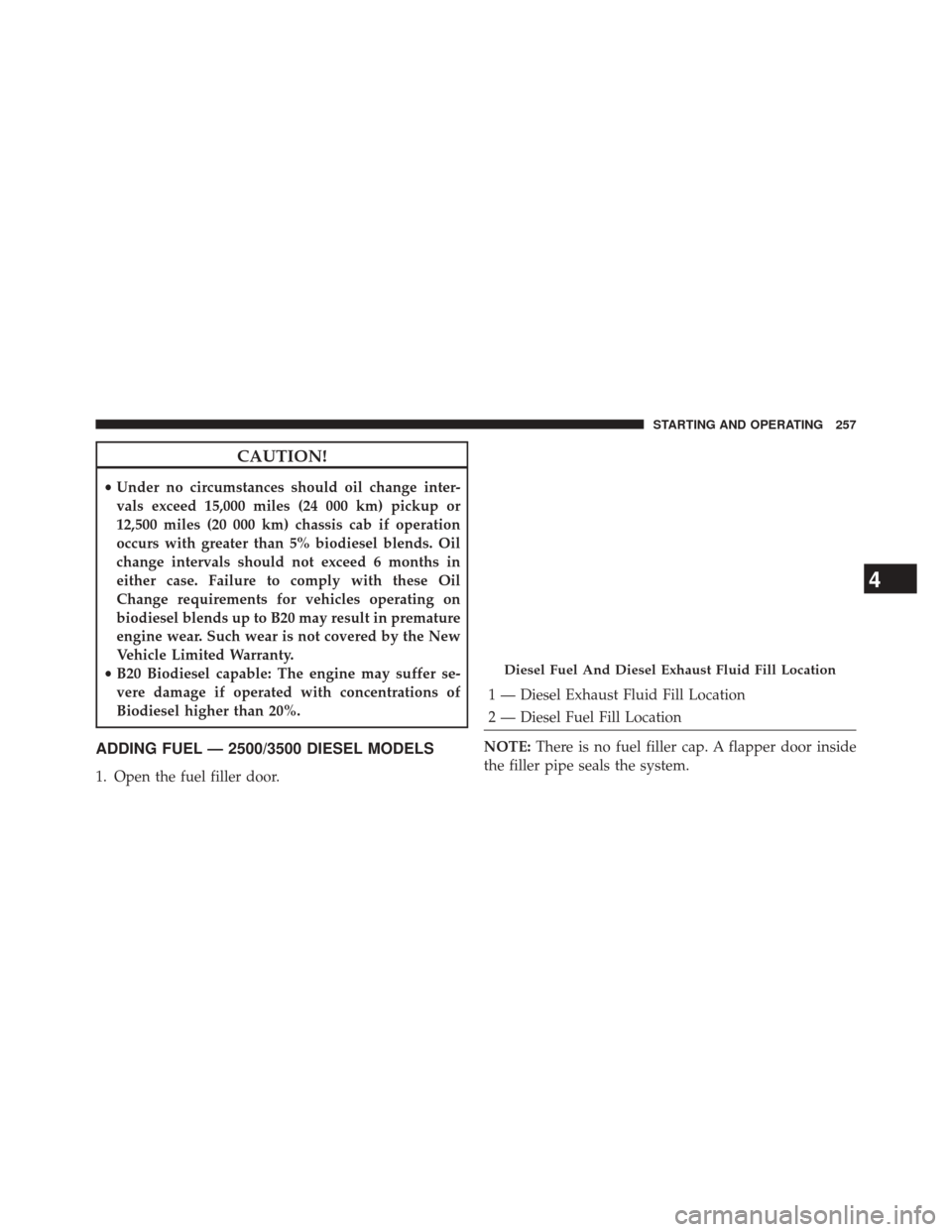
1 — Diesel Exhaust Fluid Fill Location
2 — Diesel Fuel Fill Location
NOTE: There is no fuel filler cap. A flapper door inside
the filler pipe seals the system.
Diesel Fuel And Diesel Exhaust Fluid Fill Location
4
STARTING AND OPERATING 257
Page 277 of 347
MAINTAINING YOUR VEHICLE
CONTENTS
�ENGINE COMPARTMENT — 6.7L DIESEL —
SIX-SPEED 68RFE (2500/3500 Models) .......277
� ENGINE COMPARTMENT — 6.7L DIESEL —
SIX-SPEED AS69RC HD (3500/CHASSIS CAB
MODELS) ........................... .278
� MAINTENANCE PROCEDURES ...........279
▫ Engine Oil ......................... .280
▫ Engine Air Cleaner Filter ................284
▫ Draining Fuel/Water Separator Filter .......288
▫ Engine Mounted Fuel Filter Replacement .....290
▫ Underbody Mounted Fuel Filter Replacement. .292 ▫
Priming If The Engine Has Run Out Of Fuel . .294
▫ Intervention Regeneration Strategy — Message
Process Flow ....................... .295
▫ Diesel Exhaust Fluid ...................296
▫ Maintenance-Free Batteries ..............297
▫ Cooling System ..................... .298
▫ Charge Air Cooler — Inter-Cooler .........303
▫ Brake System ....................... .304
▫ Clutch Hydraulic System ................305
▫ Transfer Case — If Equipped .............305
6
Page 279 of 347
ENGINE COMPARTMENT — 6.7L DIESEL — SIX-SPEED 68RFE (2500/3500 Models)
1 — Battery7 — Washer Fluid Reservoir
2 — Engine Coolant Reservoir 8 — Power Steering Fluid Reservoir
3 — Automatic Transmission Dipstick 9 — Power Distribution Center
4 — Brake Fluid Reservoir 10 — Engine Oil Dipstick
5 — Battery 11 — Engine Oil Fill
6 — Aux Power Distribution Center 12 — Air Cleaner Filter
6
MAINTAINING YOUR VEHICLE 277